Project 1: Reflect On and Evaluate Your SYP Process
Instructions: “In Parts One and Two you researched and wrote a Practice Plan which has in effect been a road map for your development and progress through the unit. As with most plans you may find that your aims and aspirations at the beginning of the unit changed as you gathered your research, experience and skills. Perhaps some things didn’t go as anticipated or planned, and other elements far exceeded your expectations. One aspect to keep in mind through your reflective and analytical process is what you think you learned from the process of research, making and testing out of your Practice Plan. Which specific learning experiences do you recognise as being most valuable for you to develop in future plans? How might you utilise these in sustaining your current and future practice?”
Exercise 1: Reflect On and Evaluate Your Practice Plan, Process and Your Progress
Critically reflect on your Practice Plan in terms of its fitness for purpose. Upon re-reading it, does it provide you with a sound road map to enable you to move forwards and build your practice and achieve your goals?
_________________________________________________________________________________
I have developed my practice Plan as it was required by the SYP course in Part One, and posted it on 25/03/25 here https://zhan-art.com/2025/03/25/level-3-sustaining-your-practice-project-6-practice-plan/
For my Tutor’s convenience, I copied and pasted it below and wrote my reflection on each point in red ink. In general, after I did my first exhibition, encountered my first real-life viewers, observed their reactions to my artworks outside my studio space, listened to their feedback and questions, and engaged in conversations, I can say that my Practice Plan needs to be more specific in each area and item in the column.
| Technical painting skills | Creative stimulation skills | Self Management skills | Production skills | Sales & Marketing skills |
| Ink-pulling painting, ink, acrylic, and soft pastel painting techniques. I plan to enrol on a calligraphy course, because I see that inks are my primary medium, which I want to master further. Calligraphy is largely about developing linear skills and synchronising your breath with a hand stroke. I saw that those paintings where I used this method were most successful at the showcase. I want to research this theme. I will start with YouTube tutorials and look for workshops. | Research on other artists’ work for the theme. My most successful piece was the dark blue one, “Sterlitzia. Night Bloom”. I saw how viewers deeply resonate with a block of intense colour. That makes me interested in Rothko’s practice. Since in my visual language, I have been always very fond of colours, I see that I should continue exploring the power of colour. I also plan to conduct research on Barnett Newman (1905-1970), Clyfford Still (1904-1980), Adolph Gottlieb (1903-1974), Helen Frankenthaler (1928-2011), Morris Louis (1912-1962), and Jules Olitski (1922-2007). | Time management and good planning. This area is probably my strongest one. My exhibition time management plan and practice were successful and efficient. However, I now realise that curation should incorporate a more creative element when choosing the venue, so I plan to dedicate more time to curating my next exhibition and searching for a venue that aligns more closely with my creative ideas. | Materials and resources consolidation in the studio. This area has undergone major changes since I exhibited and sold several of my prints from my original artworks. In May-June I started to explore the theme of metal and special paper prints, discovering that some types of metal are very complementary to my works, enhancing their visual features. This direction of my practice is essential for my PR and sales strategy, so I will keep working on that, exploring new printing options and materials. | Website maintenance on the WordPress platform. This area was challenging and underwent significant changes in terms of my decision about the strategy I needed to use, as we navigate our days in an AI reality that raises fundamental copyright issues. Please read a separate post further on that matter. |
| Canvas, painting surface preparation. While working toward my degree with OCA, I have learned that the quality of the canvas does make a big difference for the quality of your art. I showcased the artworks created on wood pieces, which looked more potent than the work ( even a decent one, “Sterlitzia. Day Bloom”, which was made on student-quality canvas. From now on, I will stop using student-level canvases and explore the themes of tailored surfaces, professional canvases, and wooden boards further. | Walks for new sensations and impressions. I realised that I need to keep a sketch book while travelling to areas, which have different vegetation and nature. I usually record my observations and inspirations with my camera, however, now I see that it would be better if I were more disciplined with the sketch book, since I feel the urge to process the sensation via sketching. I also discovered the underwater seaweed, which is inspiring me for a new project. | Self-discipline for studio work hours. The exhibition had a profound impact on me in terms of my self-motivation to dedicate as many hours as possible to studio work. Another interesting aspect is that people in your close surroundings – your family – also change their attitude towards your studio hours. | Digital proficiency with digital tools and software ( Adobe Photoshop, Illustrator, InDesign). This area, actually, didn’t appear as actual and urgent, as well as having lots of creative potential for me. The development of technical painting skills was really appealing to me after the exhibition, not the creation of digital artworks skills. I saw at the exhibition that people really resonate with human work and craftsmanship, when they see a result obtained by hand with a brush and medium. I am more into exploring mediums on the surface, rather than working on digital image. | Instagram, LinkedIn and FB profile maintenance and promotion. This area didn’t change much, since these social media platforms stay as effective self-promotion platforms. However, my research on copyright issues and challenges for visual artists led me to a different understanding of how I should handle the digital image posting of my artwork on the internet. Please read a separate post further on that matter. |
| Sketching, Linework, brushwork. I realise again that many more hours of studio work are required to sustain and upgrade the level of my practice. | Meditation. | Self-discipline in daily sketching to keep the level and enhance the technical skills. See the addition to “walks and sensations”. | Problem Solving in addressing technical challenges during the production process. This area is essential. One of my latest projects, “The Exalted Moon”, required me to solve the problem I had with inks. I now see that studio work will naturally lead to the development of this area. | Networking with people in the industry – art dealers, art critics, art curators, gallery owners, etc The exhibition opened a new chapter in my relationship with media and art professionals. I extensively wrote about that in my post-exhibition piece in Part Four. I also dedicate an additional post for Part Five. |
| Observational skills. See the addition to “walks and sensations”. | Limiting my exposure to unnecessary stress and daily hassle noise helps me stay in the creative zone. After the exhibition, this attitude of mine deepened. For some reason I stopped following the current world affairs at all, being completely immersed in my practice. | Self-discipline to stay physically well-rested and prepared for studio work hours. The exhibition helped me to reflect on why some works were successful in terms that people could connect with them. These worlds were created when I was in a very resourceful state. I understand now that physical and mental resourcefulness in the studio is part of my professionalism. | Sales and negotiation skills. | |
| Further professional development as a visual artist: Portraiture. My reflection on how I can grow as a visual artist led to the realisation that I want to work in portraiture, so I plan to focus on portraits, which may require developing my oil painting skills and collage-making techniques. | Organisation of Exhibition. This part of my Practice Plan was the most difficult, as it was an absolute terra incognita. I obtained invaluable experience, which I described in detail in my post for Part Four. | |||
| I decided to explore the printmaking techniques I could master. There are many options in terms of techniques and equipment, so I will engage with further learning. | Marketing materials printing arrangements: posters, cards, catalogues. These matters were easy for me due to my previous extensive business experience. I designed my paper business card, digital invitations, and announcements for posting on social media platforms and sending out via email. The catalogue requires more items, so it is not coming earlier than I do my second exhibition in 2026. |
Practice Plan (the steps below were planned as preparation for my exhibition and posted on 25/03/2025):
- Create five additional artworks for the exhibition theme, titled “The Garden Vibration,” scheduled for April, May, and June. This item was implemented only partially. I have created one more, but complex painting on three separate wooden boards 123 cm*81 cm in total size. However, I exhibited prints from my original artworks, so in total I exhibited 10 pieces: 5 original works and 5 prints. That was sufficient mass for exhibition.
- Establish my online presence as a visual artist. I have to open and run a new website in April. I have established my page on the Bēhance platform as a temporary solution for my website, as I didn’t have time to develop a fully functional permanent one. However, that decision was good, because the Bēhance platform page is sufficient for presentation. After researching copyright and AI scraping issues, I realised that no visual artist should rush to establish their website. A thorough research is needed to find a website building platform which provides full protection for the content from being scraped by AI visual generation models. I had a very different understanding of our current AI reality in the visual art field in March while developing this Practice Plan, compared to what I found out after my research in August.
- Establish Google optimisation search settings for my website. This item was not implemented due to the absence of the permanent website.
- Collaborate with local high-end furniture stores and real estate agencies to promote the planned exhibition. April/May/June. This item was not implemented, since I had doubts whether that marketing method would be beneficial for me. I am glad I didn’t approach any furniture stores, since I have to be very careful about how I position myself and my art. After completing my research in part four on curating practices, I realised that I need more time to figure out my curating strategy, which includes the thoughtful PR and self-positioning elements as well.
- Find and book a venue for the exhibition. I will probably showcase around 6-8 pieces (the three I have). Preliminary: I can schedule the exhibition for mid-June or the end of July, when I expect most people will be able to attend. April/May. This item was well-implemented to 100%.
- Design invitation cards: virtual and printed on paper. May. Both cards – a virtual invitation card and a business paper printed card were issued and used on time.
- Complete the list of guests/invitees, plan the virtual invitation campaign, and determine who will receive the printed invitations. May/June. I decided not to do a printed invitation and limited my costs by sending out a virtual version, which was sufficient.
- Craft the artist’s statement for the exhibition booklet and the website; latest – end of May. This item was implemented; however, I didn’t print the leaflet due to its costs. This approach was fine since the total number of my visitors was less than 50, so I had to engage in an artist Talk, rather than distributing the artist’s statement.
- Obtain two professional critical reviews to include in the booklet and place on the website. This is still in process. I didn’t manage to obtain any professional art critical reviews. I have to conduct extensive research on how to approach professional art critics to get their reviews.
- Create the virtual and printed exhibition booklet. Latest by the end of May. This item was not implemented due to the lack of photo materials of myself and my artworks. I hope I will be able to do it by my next showcase.
- Find the most suitable virtual art exhibition platforms and establish a good connection with them. Still in process and was postponed due to the results of my research on how to handle the high-quality digital images of my artworks to prevent scraping by AI models.
- Approach a local radio show to discuss my practice. April. This was not implemented yet.
- Check the legal aspects, such as terms of the consignment agreement, with any venue that will allow me to showcase and sell my artwork. This item was irrelevant for the first exhibition, since I didn’t showcase my artworks at the gallery. However, it is very relevant and I am conducting research on that.
Exercise 2: Road Map/Diagram
Instructions: “Create a visual road map or diagram to articulate your practice plan.Use visual representations and mapping to bring new insights into your aims for the future and assist you in evaluating your progress so far.
You may wish to follow some of the tips below, or you may feel confident in following your own line of questioning, or setting key points to consider. Use this understanding, and the creation of your road map, to feed into writing your final Practice Plan (in Project 5).
Write up and post your reflective evaluation to your learning log.“
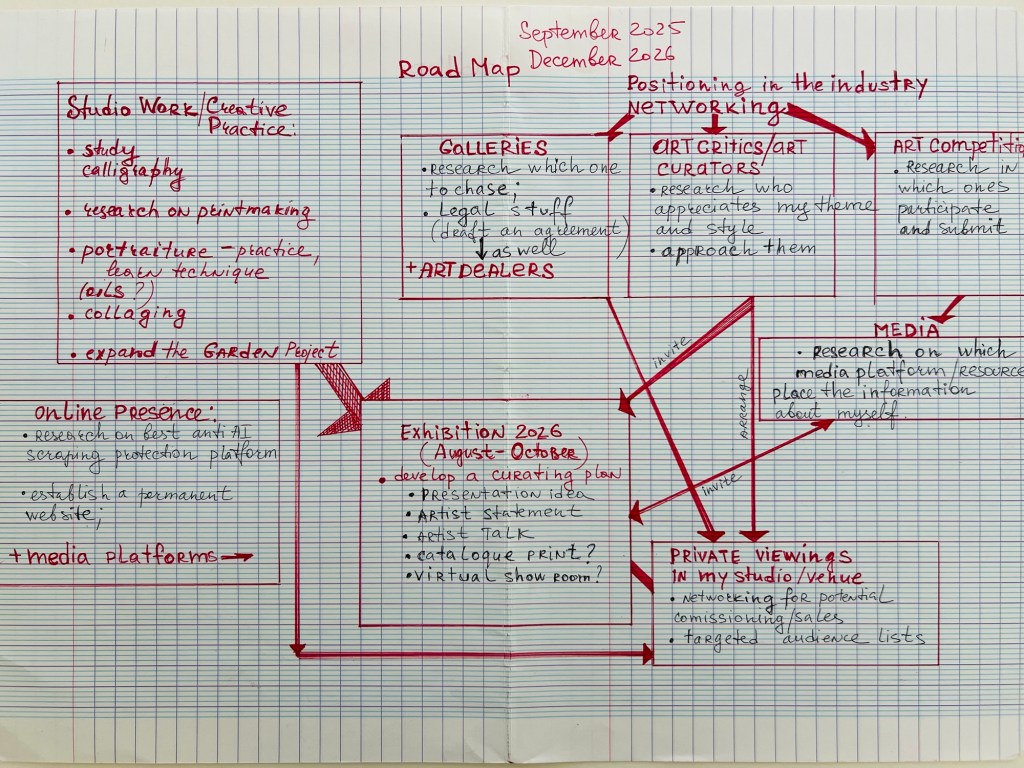
Before developing a Roadmap to outline my next Practice Plan, I prefer to work on the questions and tips below. I will post the Road Map below my answers/reflection on the suggested tips.
Tips
-How did the Practice Plan support and help you to experiment, research and develop your work? Planning is everything. I doubt that I would have had a positive experience with my first exhibition if I hadn’t planned and established the Practice Plan. The value of the initial Practice Plan is actually increasing when you evaluate it, identifying what worked, what didn’t and what was m strong and weak points, what woissing in it.
-Were there any ways that your plan could have been improved? Yes, definitely. The following items were missing or underdeveloped in my initial Practice Plan: 1) a creative element in curating. I was more focused on finding a good space for exhibiting my artworks, but I didn’t think about how I could present them to the audience in a more creative way; 2) networking in the professional art world. I should have focused more on finding and inviting art professionals. 3) Artist Talk training. I reflected on that extensively in my post-evaluation reflective piece as part of my SYP submission for Part Four.
How / what could have helped you more, and at what stage in the process? I think that if I could have more help navigating the AI reality in the visual art industry, specifically in protecting my work from scraping by AI models, as well as gaining copyright knowledge, and learning how to reach art professionals when I am a rising artist, that would be helpful. OCA is very focused on students obtaining peer review; however, I think some guidance on how to deal with art professionals is essential for the SYP course and Level 3 in general.
-What have you learned from the process of working on the Practice Plan? Which particular strengths evolved throughout the process, and how might you apply these in future projects?My previous business experience, including time management, self-discipline, attention to detail, and effective business communication, has been invaluable.
-Which particular weaknesses might you need to address, or seek external support for /commission skills from others or mitigate for? Can you see ways and means of doing this, and how? My particular weakness is that I struggle to navigate interactions with art professionals, such as gallery owners, art critics, and art dealers, and I lack the necessary commission skills. I realise that I need to gain this experience, like every other rising artist, through extensive strategic networking and research.
-When making; what could you do more of, and less of, might you work more slowly and/or quickly? I just realised that I have to work more. I see that people resonate with my artworks and they can connect with them. The theme of Nature is universally attractive, so I continue to stay in my favourite area, expanding it. I also plan to engage in portraiture as part of my practice.
-What role and part did recording and documentation play, and could you make this process more relevant, purposeful or dynamic? Recording and documenting is essential for establishing myself as a professional visual artist, as well as supporting your entire journey in the industry. I plan to make more recordings of my creative process. I have created good reels from my first exhibition, showcasing how I placed my artworks in the venue, as well as the final setting. My social media audience was curious and enjoyed them. I understand now that in this sense, the more is the better.
-Who could you connect with and/or collaborate with, and for what purpose/ function / outcome? Which relationships were fruitful and why and how could you have improved or changed the way you connected with others? At this stage, I have no idea with whom I should connect and collaborate in a creative sense. Professionally, I really have to develop my connections with art professionals.
-Which organisations, sites or locations were most resourceful / useful for you? Which might you explore in the future, and why? I have been conducting extensive research on establishing my online presence since the beginning of this year. So far, I think the Bēhance platform, which unites all types of visual professionals (visual artists, interior designers, digital artists and graphic designers), is beneficial to me. I have to develop my online presence, so this research is underway.
-In what way was the process successful (on your terms) and how do you define ‘success’? Before my first showcase, I have defined the “success” for myself in the following way: 1) Will anyone come at all? 2) Will the invites like my work? 3) Will they buy anything? I achieved all three points; however, I fully understand that if people buy nothing and don’t like your work, it doesn’t mean that you are a bad or untalented artist. Many first exhibitions, not only those of prominent artists, were not successful.
-What did you learn from the process of working that you might take forward into future practice and projects? What have you yet to learn, and how? I have made a separate post on what I have learned as part of my SYP submission, Part Four.
THE ROADMAP
Below is the photo of my Roadmap that I have developed for my practice.