Project 1. Reflecting on your practice.
We are asked to write down and make notes on each of these specific elements below:
- Media, materials, processes and techniques you utilise.
As a Level 3 student, I have reached a point where I feel technical and artistic confidence and courage handling larger size artworks, when I clearly understand my preferred medium- inks, mastered the technique, and developed a personal style.
I like to work with mixed media, primarily with inks, using some oil, soft pastels, and acrylics. Mixed media approach allows me to unfold engaging visual effects using the advantage of special features of each medium.
I experiment with different painting surfaces, including canvases and often use wooden boards to test different kinds of them, because inks behave differently on each type of surface. I am a big fan of the ink-pulling technique, which was the foundation of the ink technique I have mastered and developed certain technical approaches for my works.
- Research concerns that drive inform and facilitate your practice-led research.
My painting practice artists research is implemented within two domains: I do technical research, and I study the visual style and visual language as well.
Technical research is essential since I want to master the quality of my work, which greatly depends on my technical skills, from the basic line and brushwork to how I handle mediums and supporting materials such as painting surface preparation and quality of all materials, so I test many of them: wooden boards, canvases from different manufacturers, sanding paper, inks, paints and brushes from various manufacturers.
The visual style and language research concentrates on studying my favourite art movements and artist research to analyse their compositional, design and colour palette decisions.
The most convenient way for me to research is to find a high quality well-published books about them, which I keep in my studio so I can study them and refer to them while working on a particular project. Since my main artistic interest is gardens, flowers, and various plants, so far, I have built up a good collection of traditional Japanese Visual arts, including books about the Japanese folding screens byōbu, the legendary Kano school( 15th-19th centuries), the book about Hokusai’s ( 1760-1849) Hawase Kasui’s, (1883-1957), Hiroshige‘s (1797-1858) works, as well as traditional Indian visual art pichwai.
I often look into Gustav Klimt‘s (1862-1918), Frida Kalo‘s (1907-1954), Vincent van Gogh‘s (1853-1890), David Hockney ( 1937-) artworks books I have. I notice and pay attention to traditional Japanese textile and kitchenware patterns. Another research I do is a daily direct observation of plants and flowers, trees and leaves; I look at how they change under different light during the day, taking photographs of the same plant many times during one day and within a week.
- Means and methods of reflection and evaluation
Sketching, photographs, and collages are my primary tools for reflecting on and evaluating gathered material inspiration sources to generate creative ideas for my artworks. Sketching materialises my thinking and creative search. I can not be productive without a preliminary study of the subject, because preliminary study helps me understand how my hands and mind will deal with the subject on the painting surface.
I never know how the subject will unfold in my interpretation unless I start sketching it and testing the colours and mediums.
I do the sketch and take multiple photographs of my work at different stages of its development. The photo reveals the weak and strong areas and helps me to find the direction to move further with my work. I also started to gaze at my work for a prolonged time, which helped me sense the rising vibe from the painting and connect with my work.
I also practice pausing when I don’t approach my painting for several days and then come back to it. This approach also helps me find new solutions.
- Processes and means of recording and documentation.
My learning log is my primary source of recording the working process for most of my artworks. Over the years of studying, I have accumulated a substantial archive of photographs of my works and inspirational materials, which I use extensively.
- Content & context around the work
Most of my artworks feature plants and flowers, the garden in its broadest sense. My artistic practice is based on my strong spiritual needs, and spirituality is the primary context of my creative works. Whenever I look at a tree’s stem, leaf, or flower of their creation, I am astonished by its perfection. I feel dissolved in this powerful sensation of inner joy and overwhelming admiration for the Creator’s aesthetic thought and skill. This state of my mind results in my painting practice.
I answered the three last questions in one block since they are interrelated to me.
- Types of practice(s) you use in your work
- Identification of others you work with/for / by.
- Professional Practice.
So far, I have only been engaged in painting, but I am also interested in collaborating with movie production teams. I am a big fan of teamwork and very interested in the work of movie directors. I find this genre most complex and creative since any director must have a unique and expanding aesthetic taste manifested through his visual and musical ideas, choreography, and writing pieces such as screenplays, poetry and literature. In my opinion, I have the potential for costume design or overall visual language development for a particular project.
The work is in progress.
- Research Task: Zines, photo stories, photo-montage
- Exercise 2: Making-It Fast – Zine, Photo-montage, Photo Story, or Pamphlet
Here, we must: “Take your intentions, refined through your creative conversation, as your starting point, and make a ‘fast’ visual and textual piece that somehow conveys your themes and ideas.”
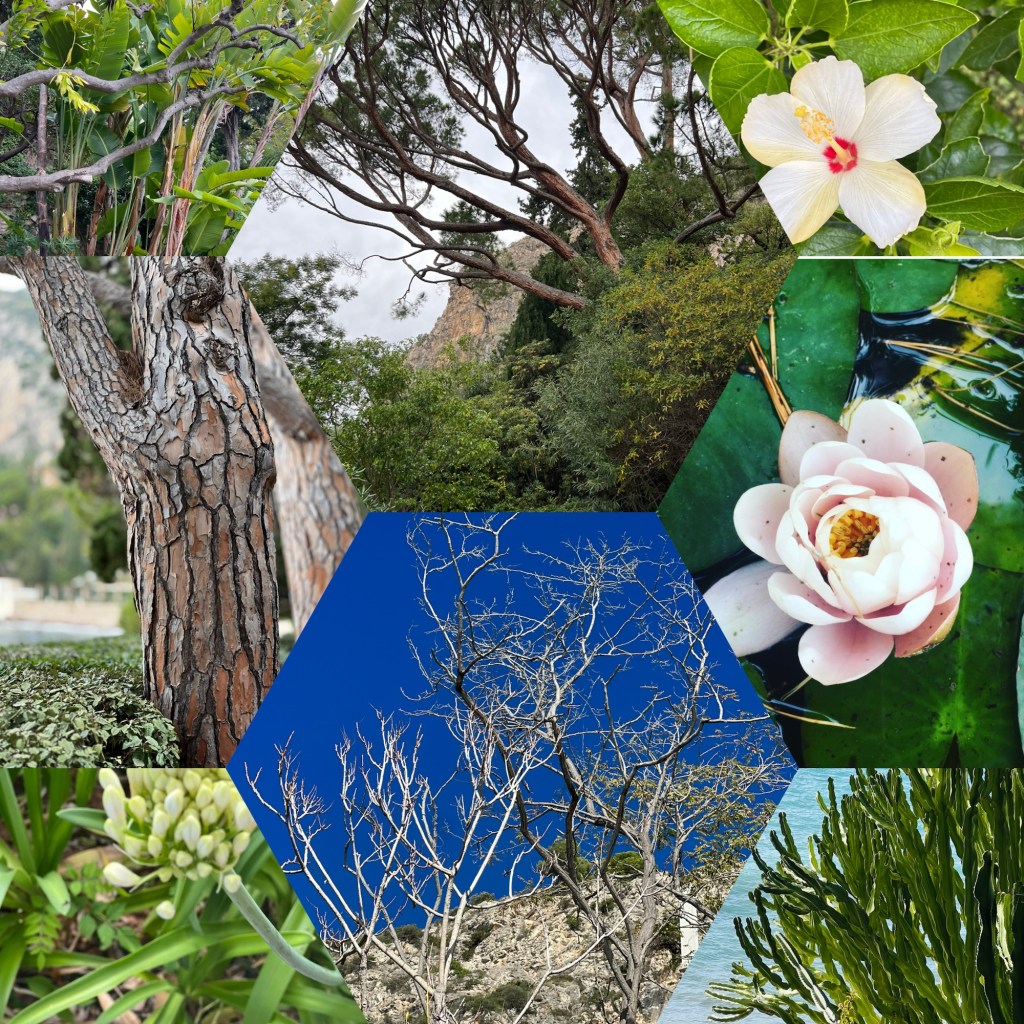
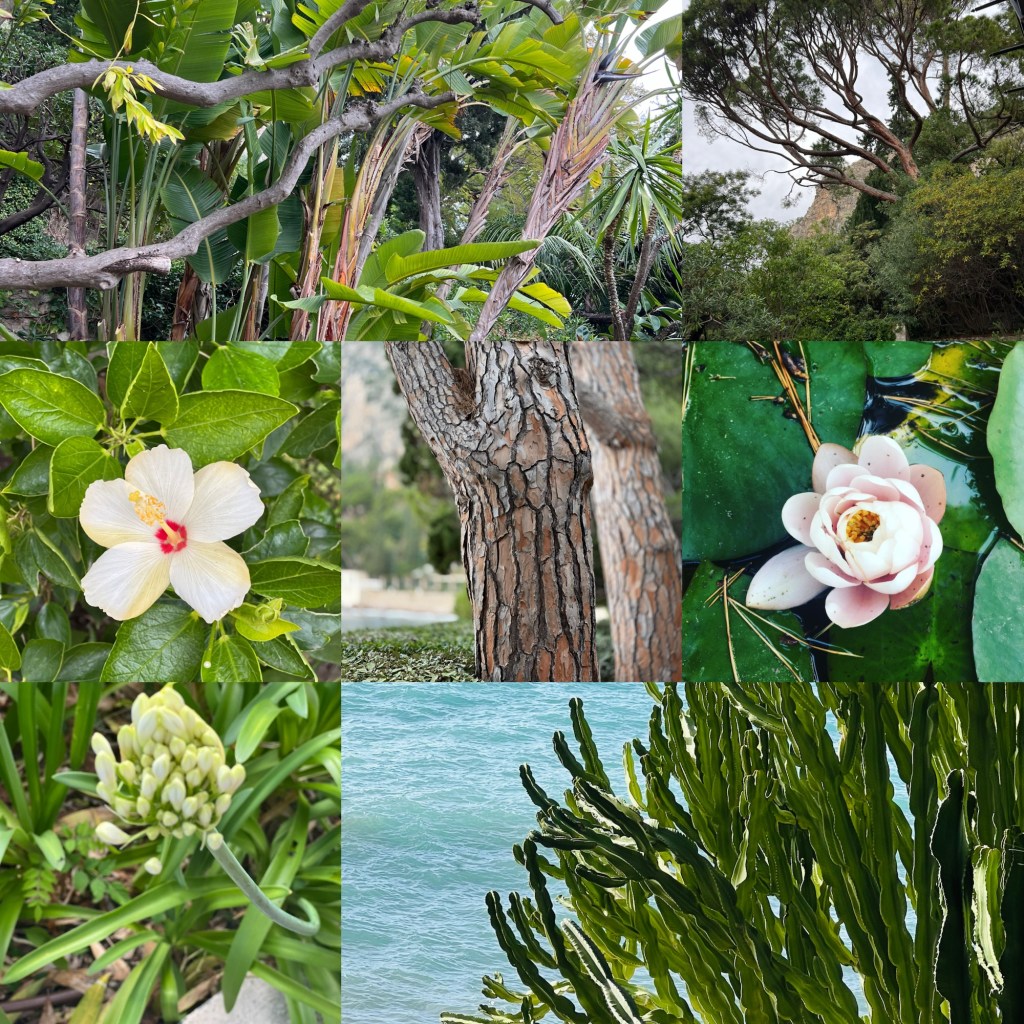
The photo collages above and below are made using photos from my archive.
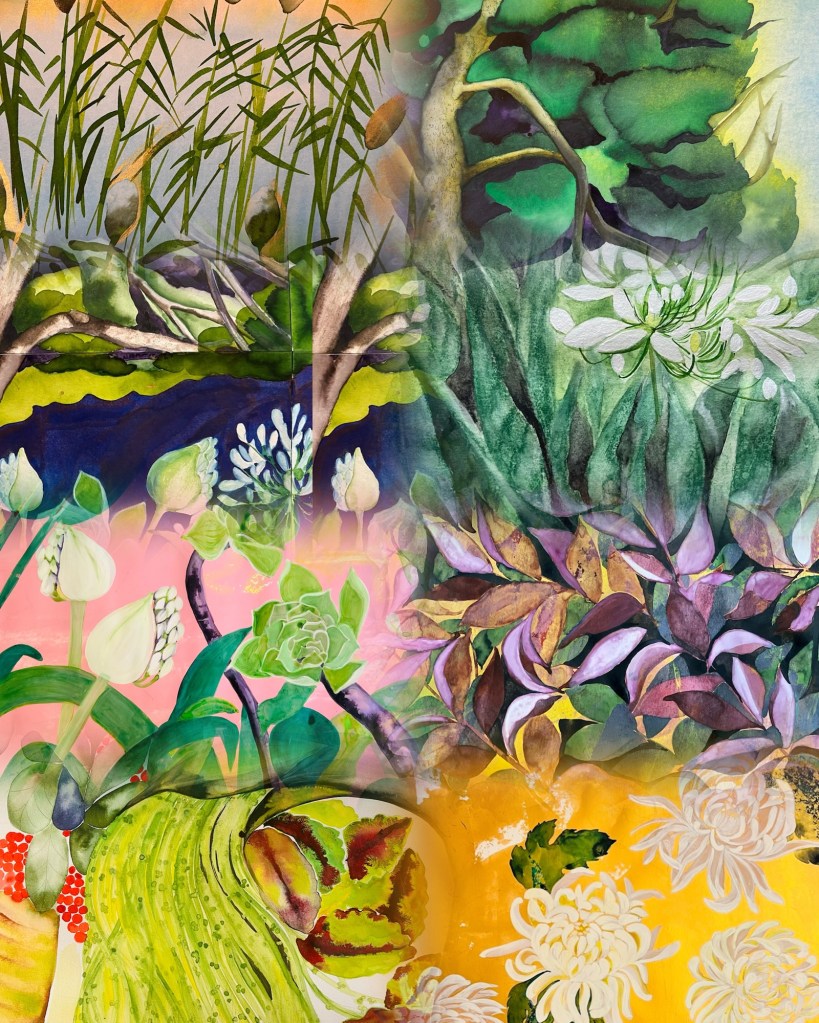
This photo collage contains interesting perspective and visual effect as blended borders between different plants themes, layered details. I keep it in my learning log as note for an idea for a composition.
In this exercise, we analyse, gather, and understand which skills, approaches, and strategies we have within our resources and which are the most helpful to us in specific ways. We also reflect on at least four recent artworks we have created.
Below, I place my recent artworks I analysed for this exercise.
Trees’ stems are subjects which will be a notable part of my Garden project, so I started sketching them in colour on different surfaces.
The two works below, in colour and monochrome, are fresh examples of my practice of painting snow. I have painted it on paper and on a wooden board. I had two ideas for painting snow: one in a classic winter version and another as an unconventional approach when the snow shares the space with spring greens. Both works below are studies, not finished artworks.
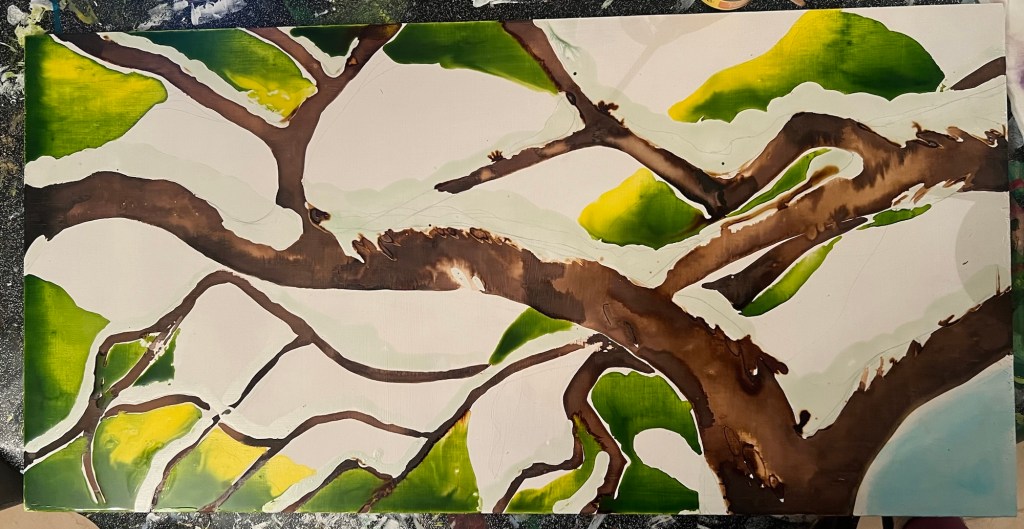
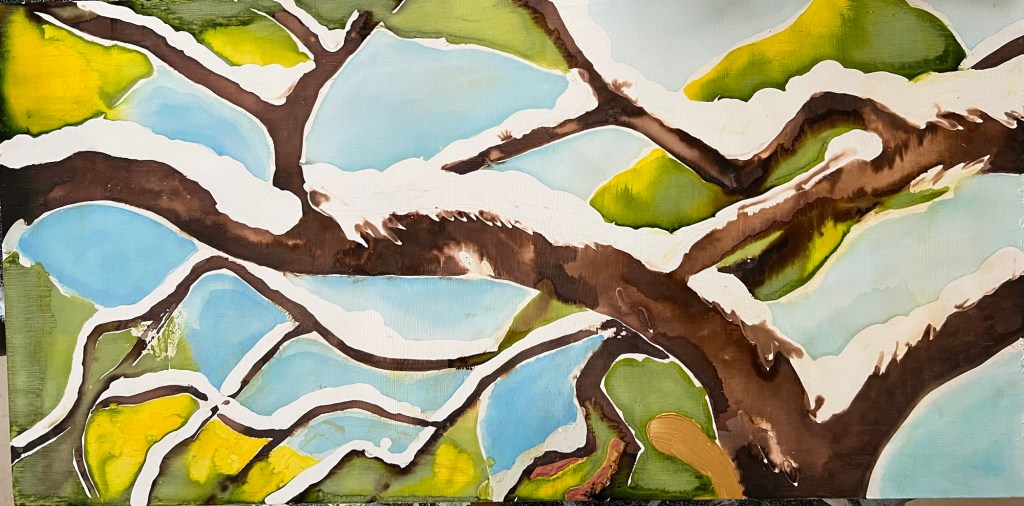
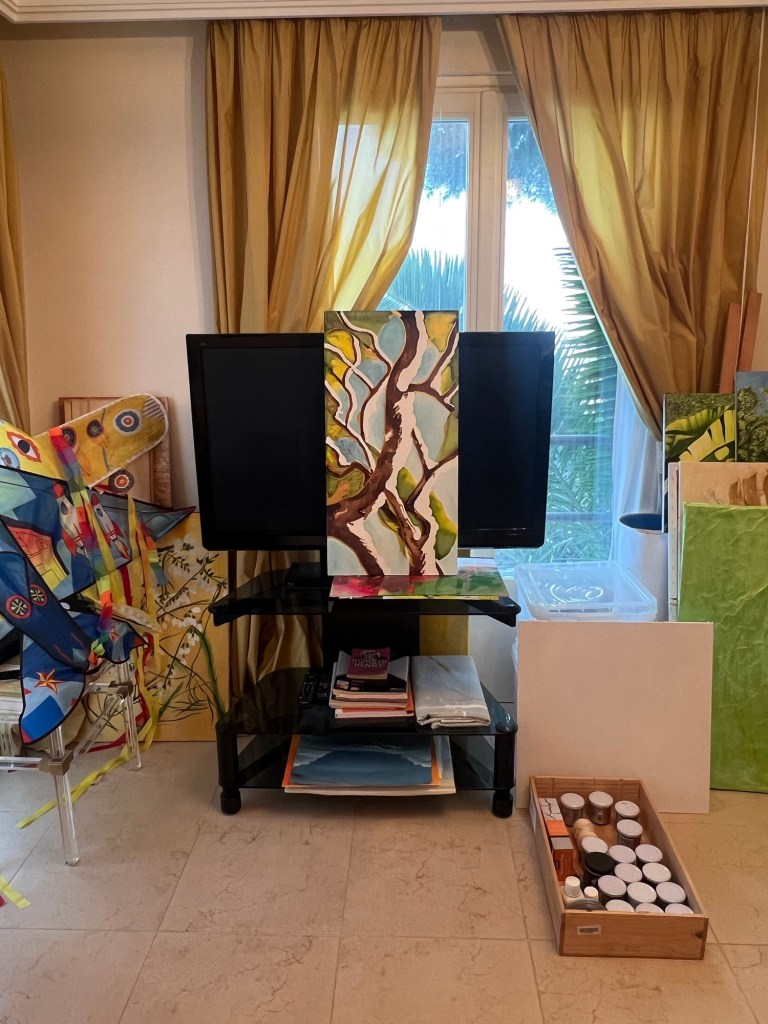
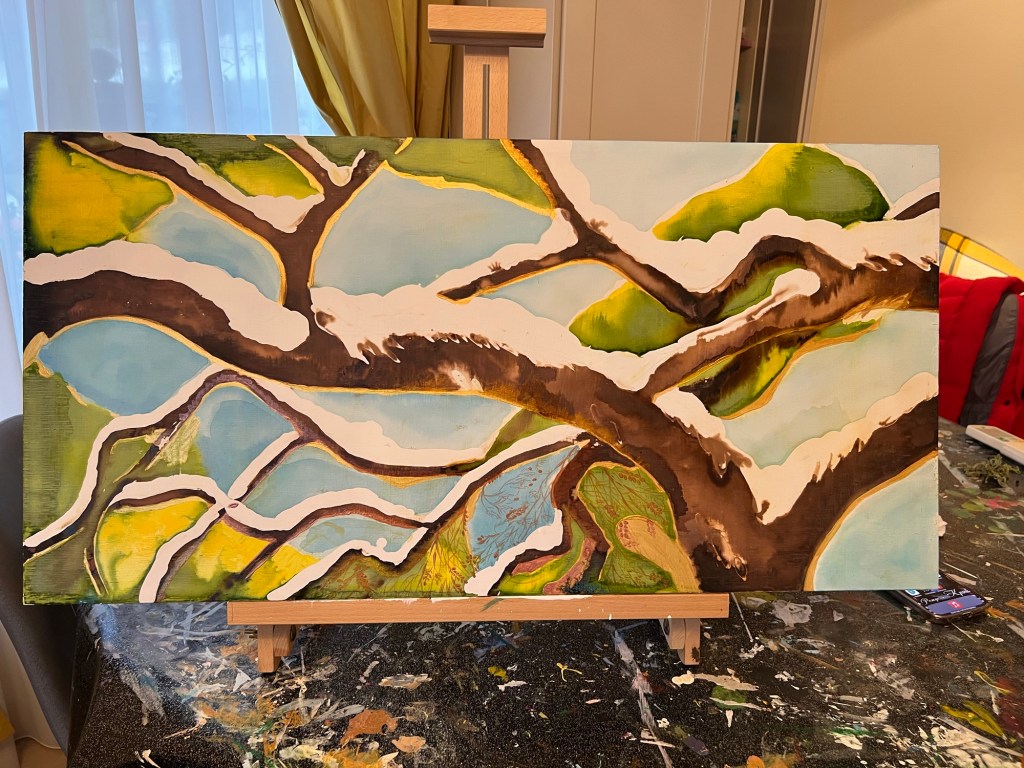
In the work above, I practised my technical skills and tested resources. I wanted to see how the work would look on the wooden board. I needed to check all aspects of how the gesso and inks would behave with wood. I also tested the new masking fluid to create the snow effect on the branches. Another point of interest was working on the piece, which can be viewed in horizontal and vertical positions. That determined my compositional solution. This work is unfinished and is still in progress.
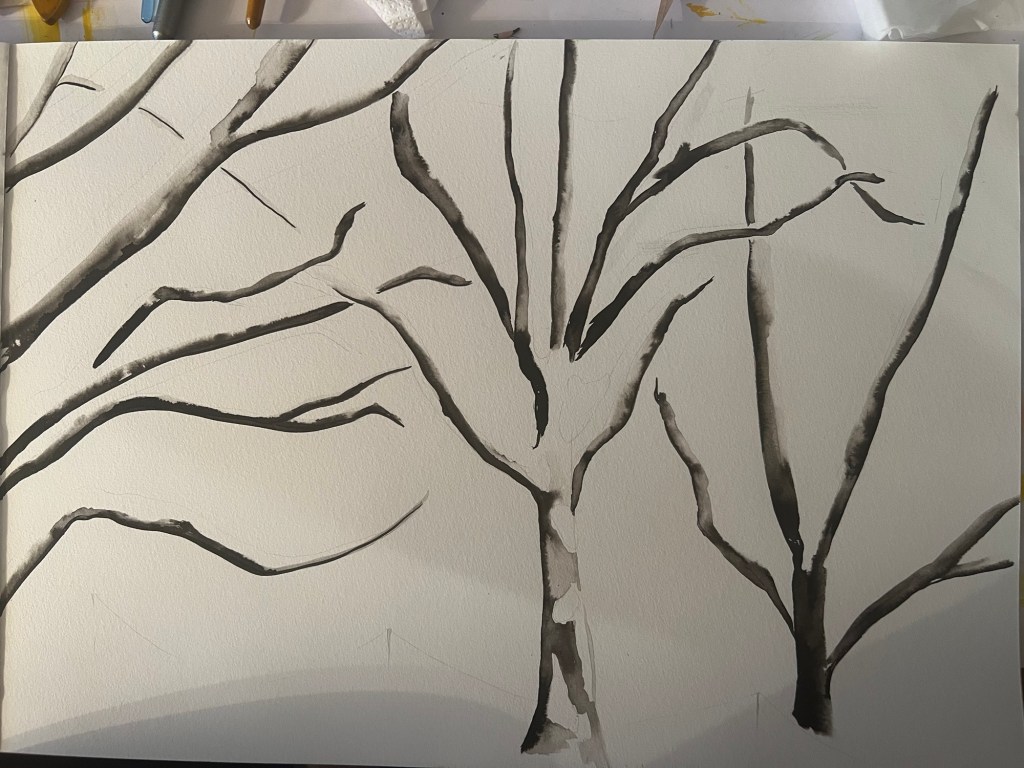
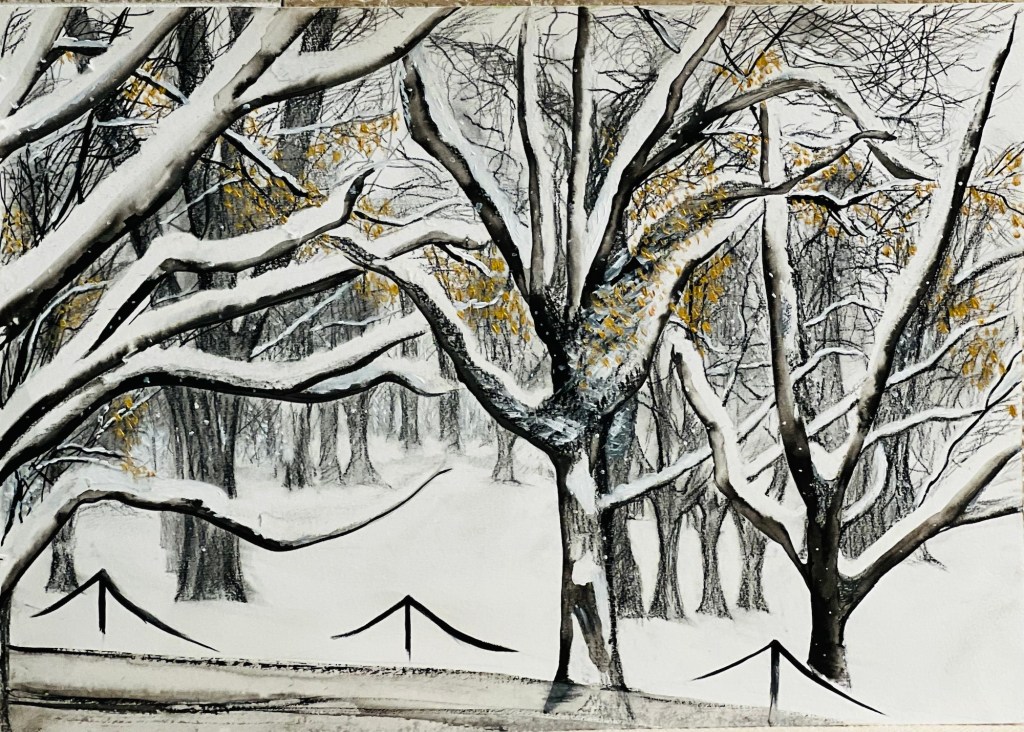
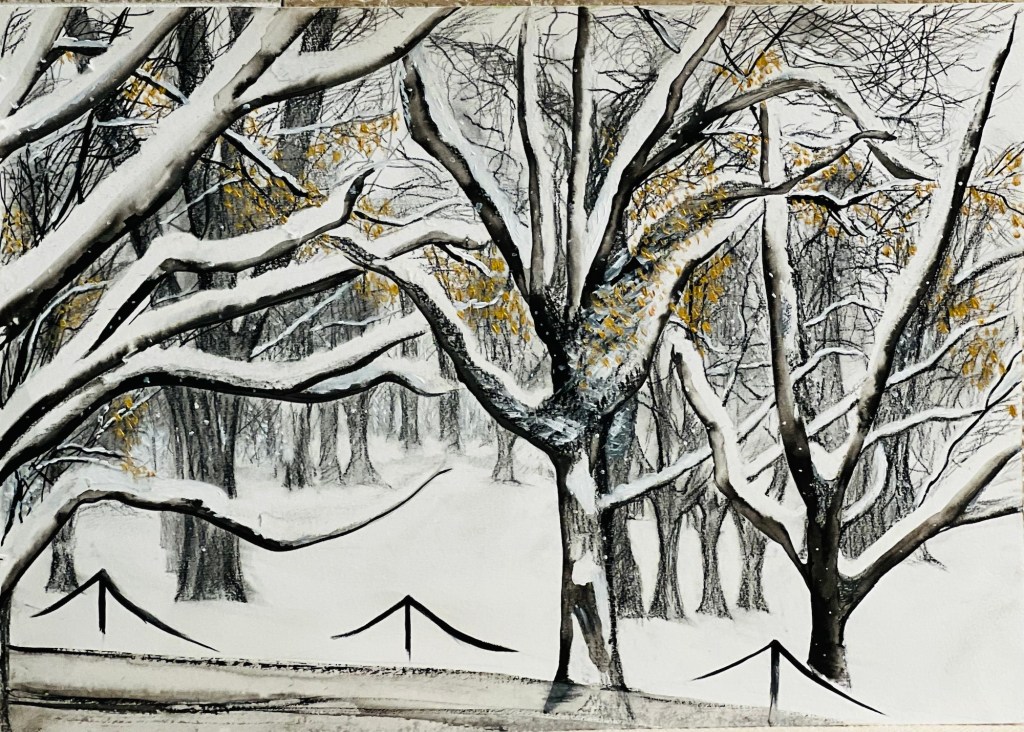
In the work above, I practised monochrome painting, creating an atmospheric image of snow in the park, studying the stems of the trees. I had never painted snow landscapes before, so I was eager to check how I would manage them. Monochrome painting with black ink was also an exciting part of this study. I wanted to create a complex image with limited colours and medium resources. The image’s complexity, as my goal, required building a linear perspective. Reflection on how I can make the depth of the park brought me to the understanding that I should use pencils and charcoal pencils instead of black ink, leaving the black-inked stems only for the front trees.
There is another recent work which I reflect on in separate blog post for this part of the course.
I divide my skills into five categories and place them in the table below. Then, I placed the specific skill related to this domain inside each column. I have highlighted in red ink the skills I am lacking and which I consider as my weaknesses :
| Technical painting skills | Creative stimulation skills | Self Management skills | Production skills | Sales & Marketing skills |
| Ink-pulling painting, ink, acrylic, and soft pastel painting techniques | Research on other artists work for the theme | Time management and good planning | Materials and resources consolidation in the studio | Website maintenance on the WordPress platform |
| Canvas, painting surface preparation | Walks for new sensations and impressions | Self-discipline for studio work hours | Digital proficiency with digital tools and software ( Adobe photoshop, Illustrator, InDesign) | Instagram, LinkedIn and FB profile maintenance and promotion |
| Sketching, Linework, brushwork | Meditation | Self-discipline in daily sketching to keep the level and enhance the technical skills and keep | Problem Solving in addressing technical challenegs during profuction process | Networking with professionals in the art industry. |
| Observational skills | Limitation of my exposure to unnecessary stress and daily hassle noise to keep myself in the creative zone | Self-discipline to stay physically well rested for studio work hours | Quality Control (reviewing artowrls for errors, weal points, making necessary adjustments) | Sales negotiations skills |
| Organisation of Exhibition | ||||
| Marketing materials printing arrangements: posters, cards, catalogues |

