Project 1. The Body of Work. ( continuation) and Project 2. Critical Evaluation.
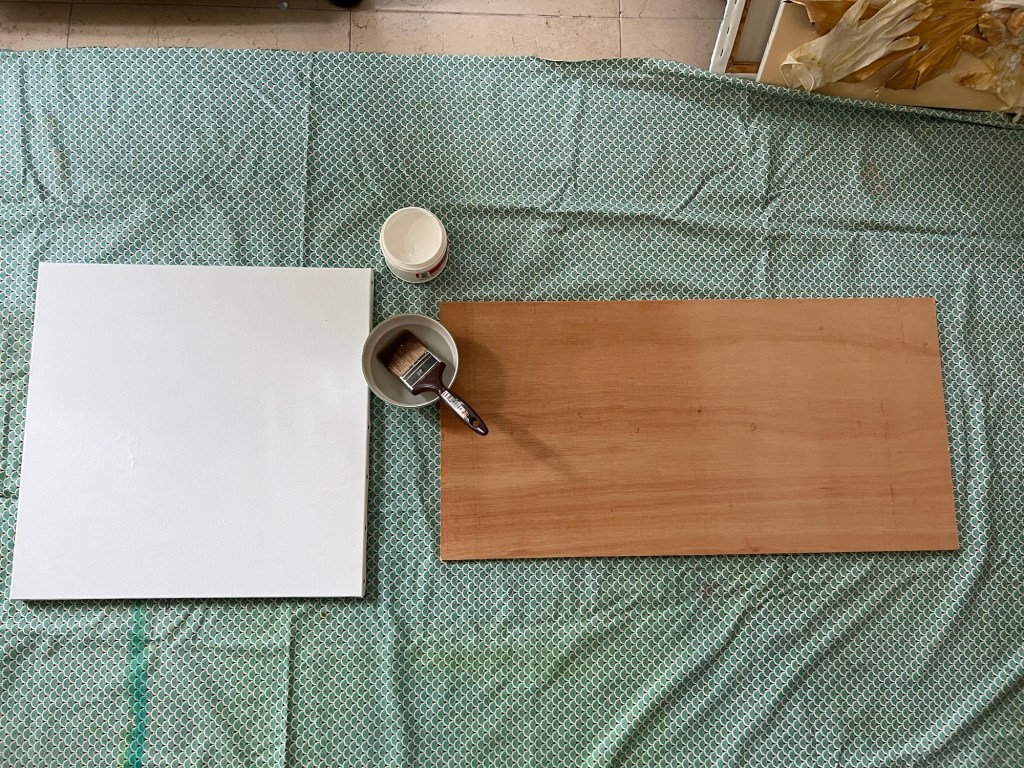
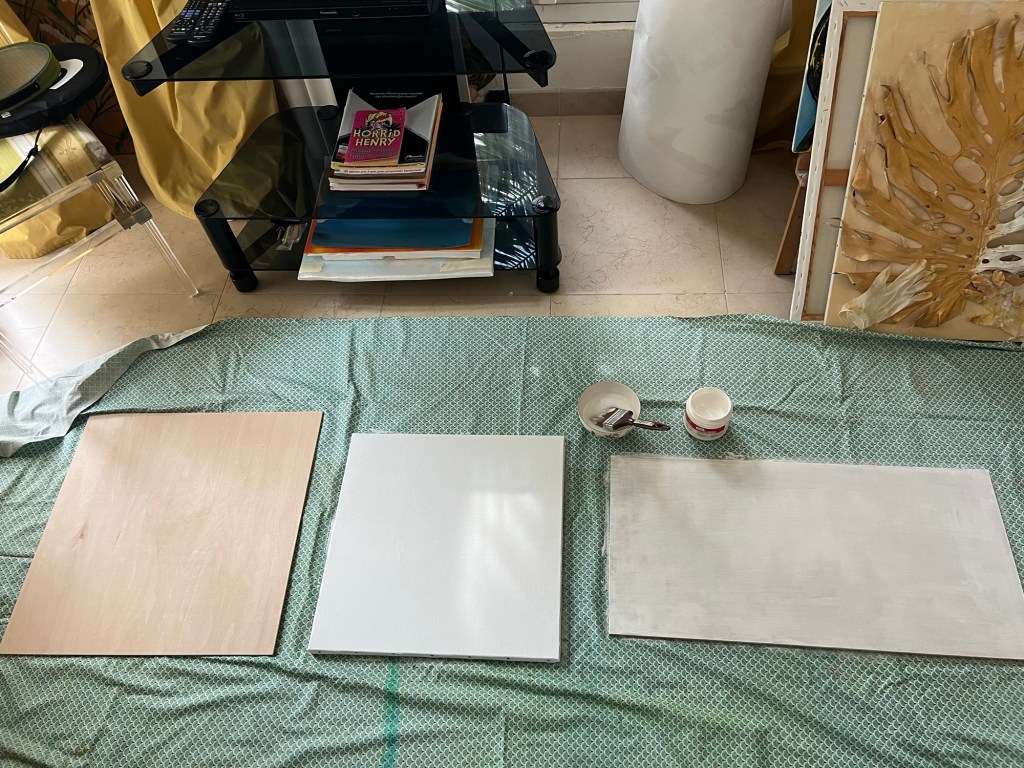
Below is the development of my final work for this AP course on another canvas, which I (this time!) carefully prepared with gesso and sanded with sandpaper. I also prepared in the same way the two wooden boards, which I will use for my project “Riviera Flowers”. I also reallocated from my office space to my studio.
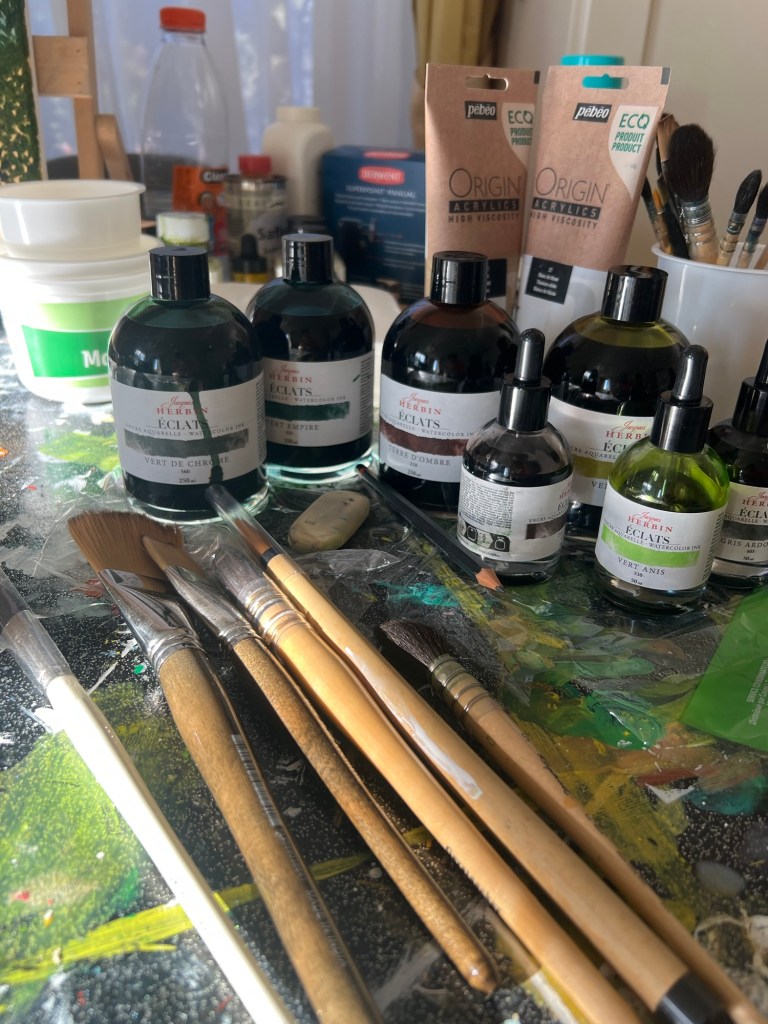
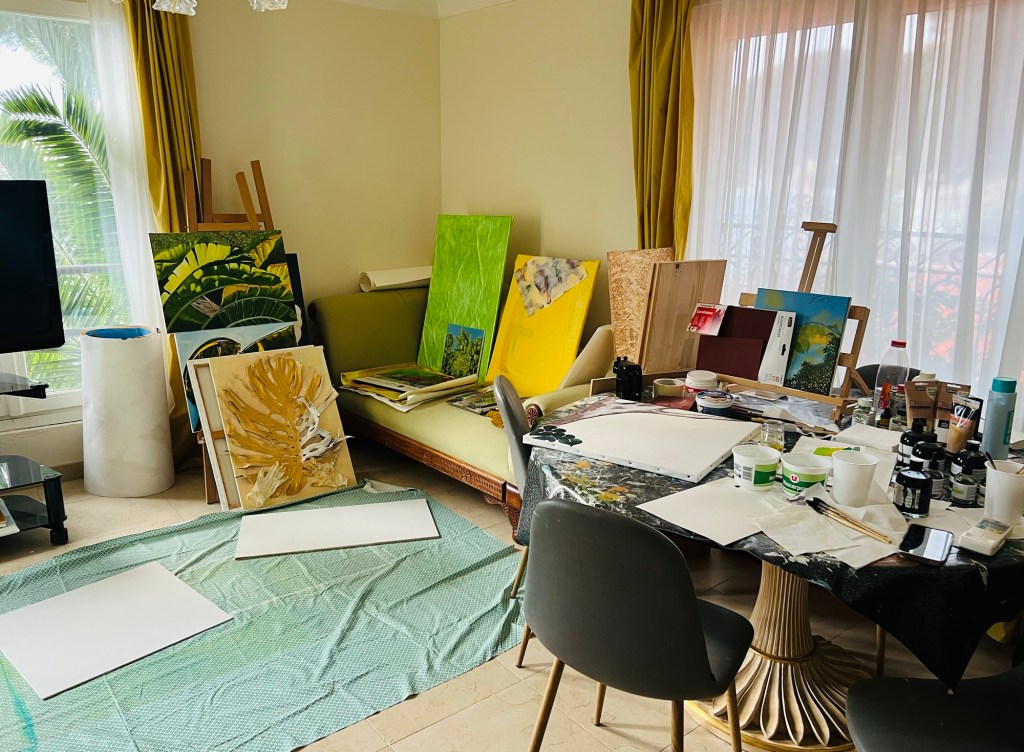
At this stage, I felt myself fully prepared for serious work. I knew what mistakes to avoid, what flowers I would paint, and what colours to use, and I clearly understood the tree’s stem. I plan to develop this project on 6 or 9 canvases 50*50 cm, allowing me to create 1m*1,5m or 1.5m* 1.5 m, respectively. One of the significant compositional decisions I made over the course is that I can work on blocks that can be assembled differently and grow as much as possible.
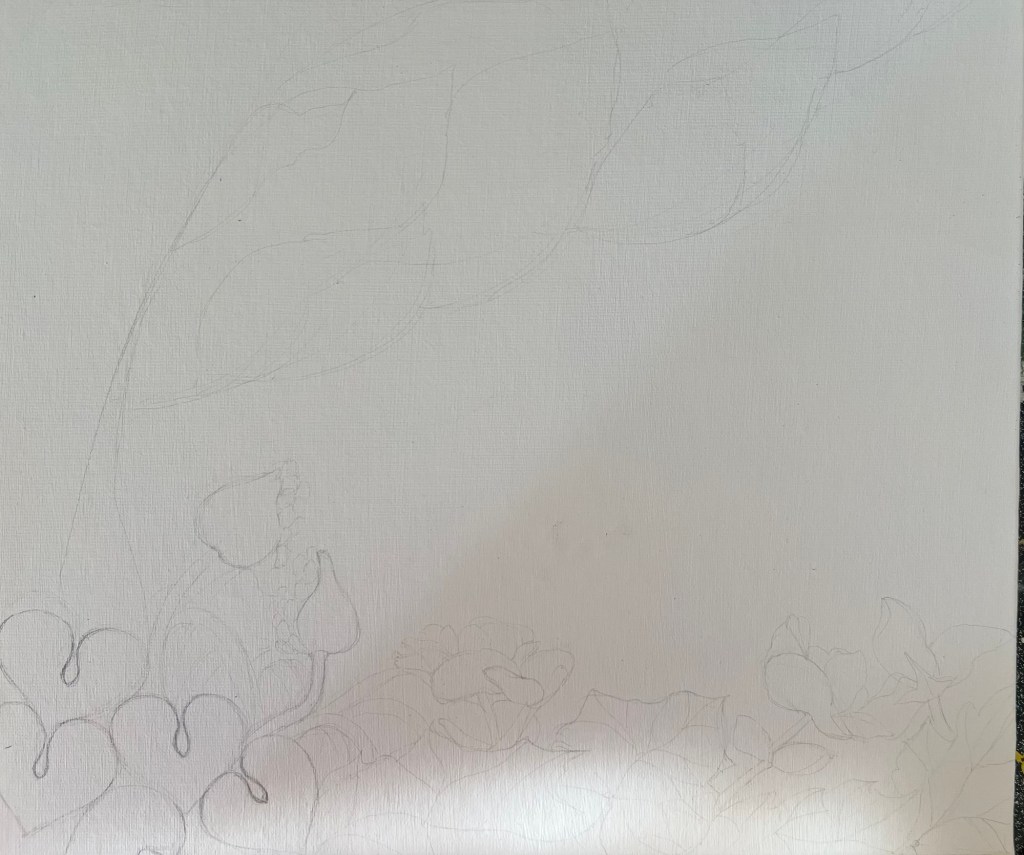
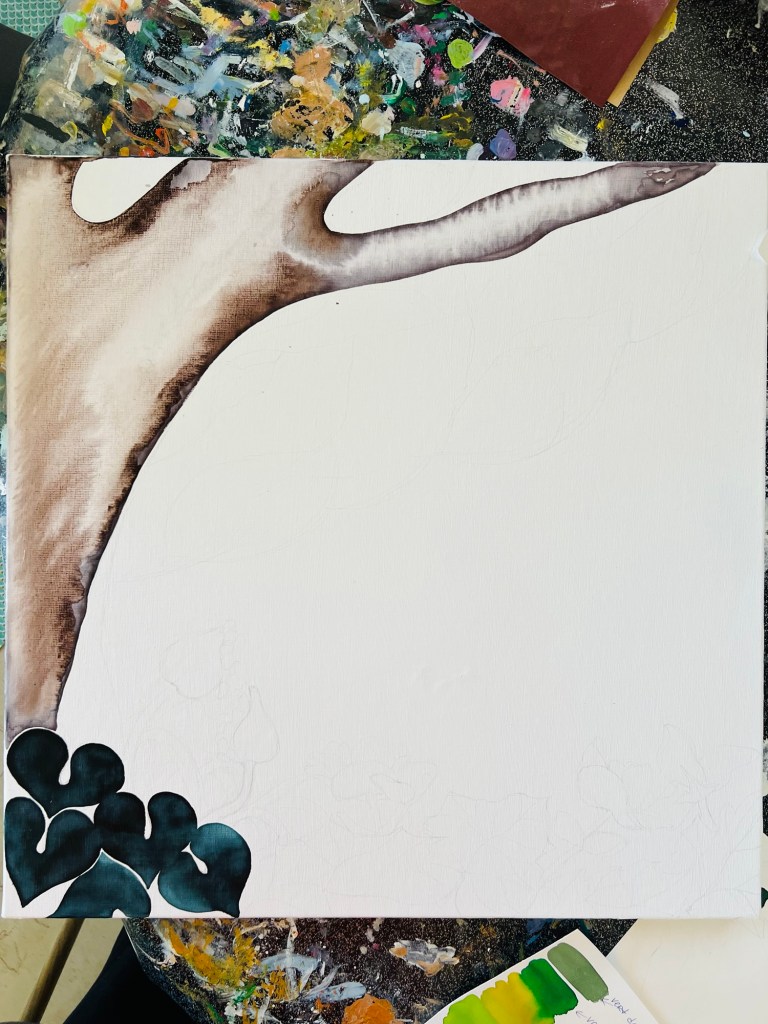
Work in progress below: I worked very carefully this time, applying all the technical rules. Such as having enough space around for my moves, keeping the canvas far from bottles and wet brushes to avoid occasional spilling, not touching the surface of the canvas with my hands to prevent any greasy marks, using a paper napkin under my hand and elbow while working on elements, protecting the finished ones, using the dry soft brush to get rid off residues after the rubber work.
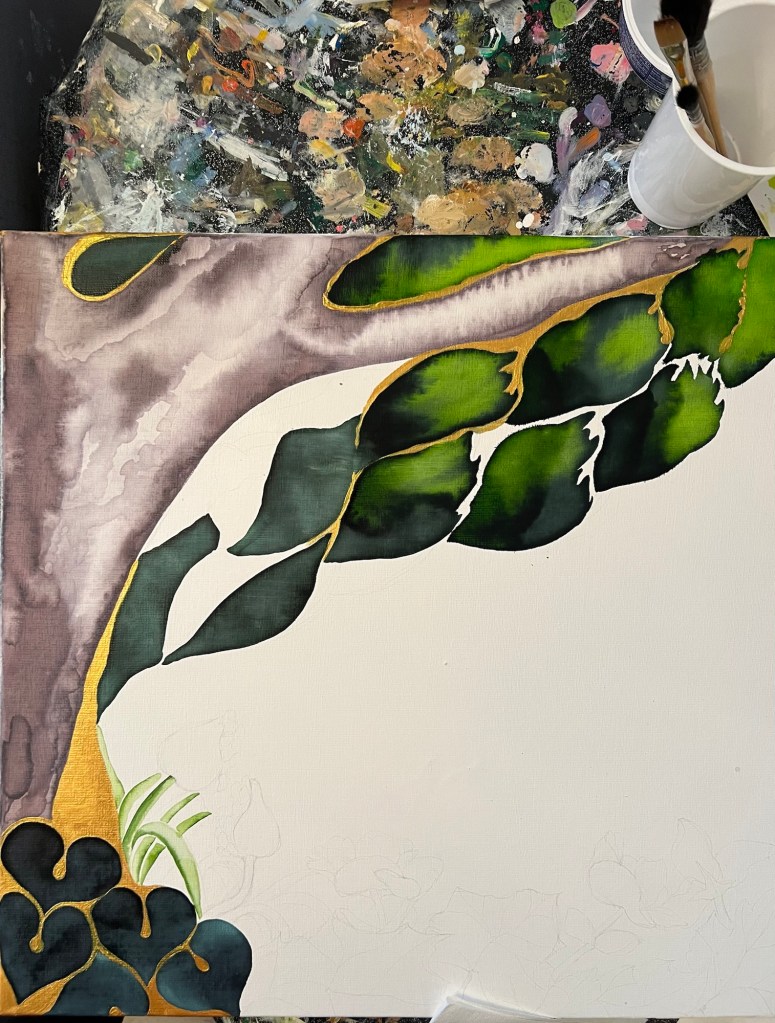
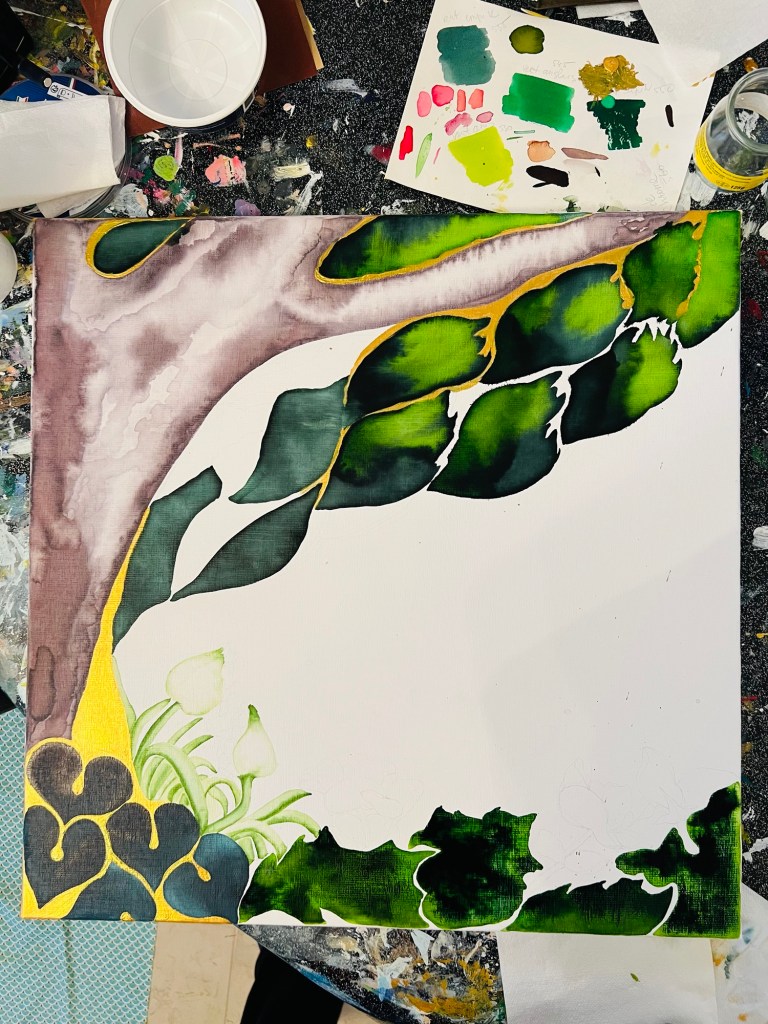
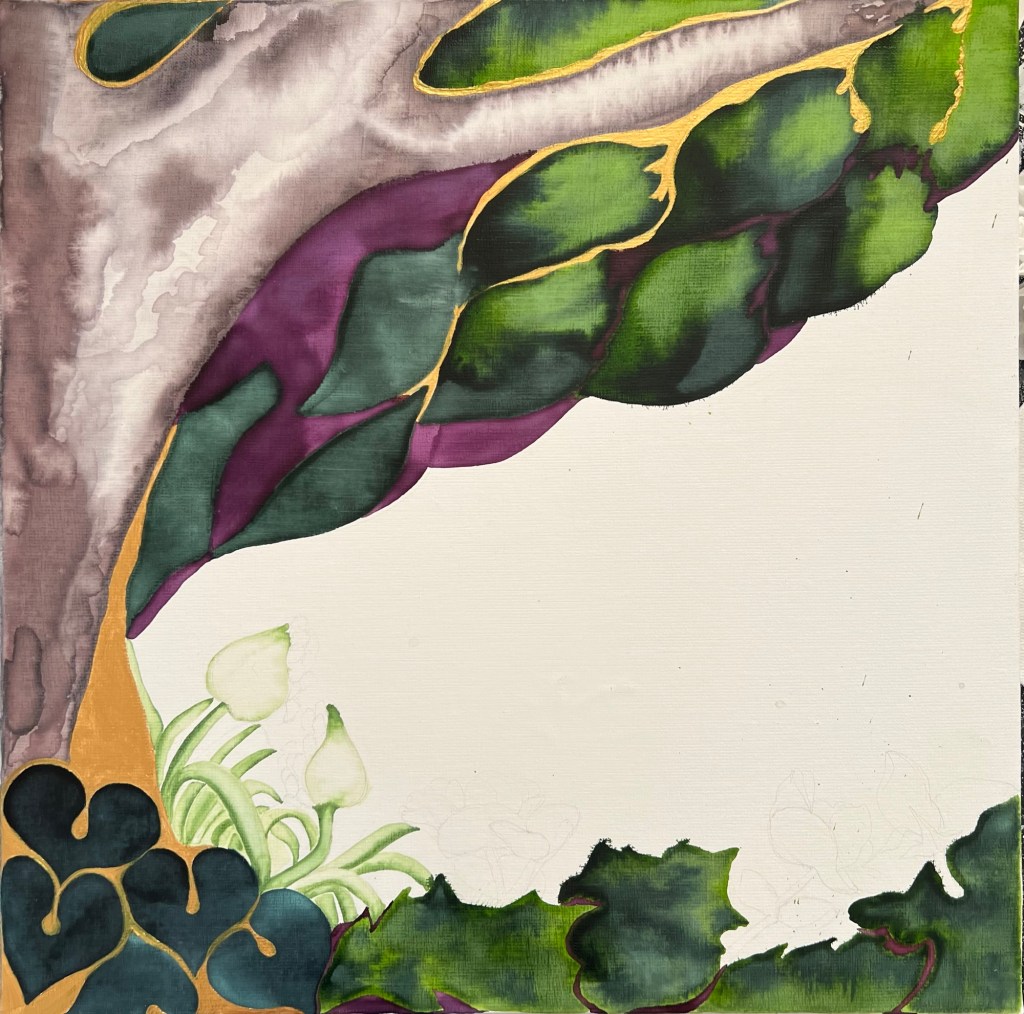

Below is my submission for this course, Part 5, as a final piece of my studio work. It looks unfinished since the negative space has not been engaged yet. I leave it open since this is the first block in the composition, and I can’t complete it until I do another. I consider the work below to manifest a significant breakthrough in my technical skills and a development of my personal style, including my ambition to create a large item. When I say that I feel a breakthrough in my technical skills, I mean that my works begin to appear a good quality professional look, which doesn’t look amateur and timid.
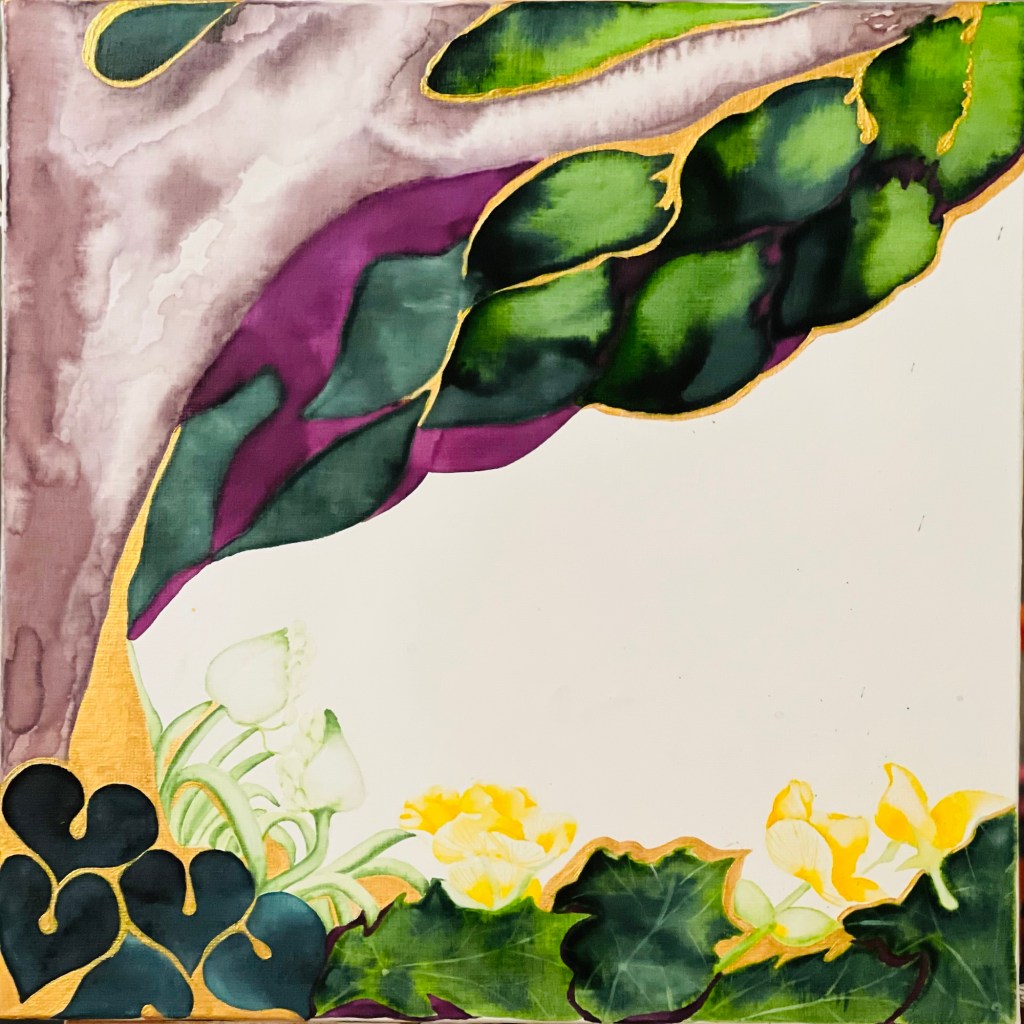
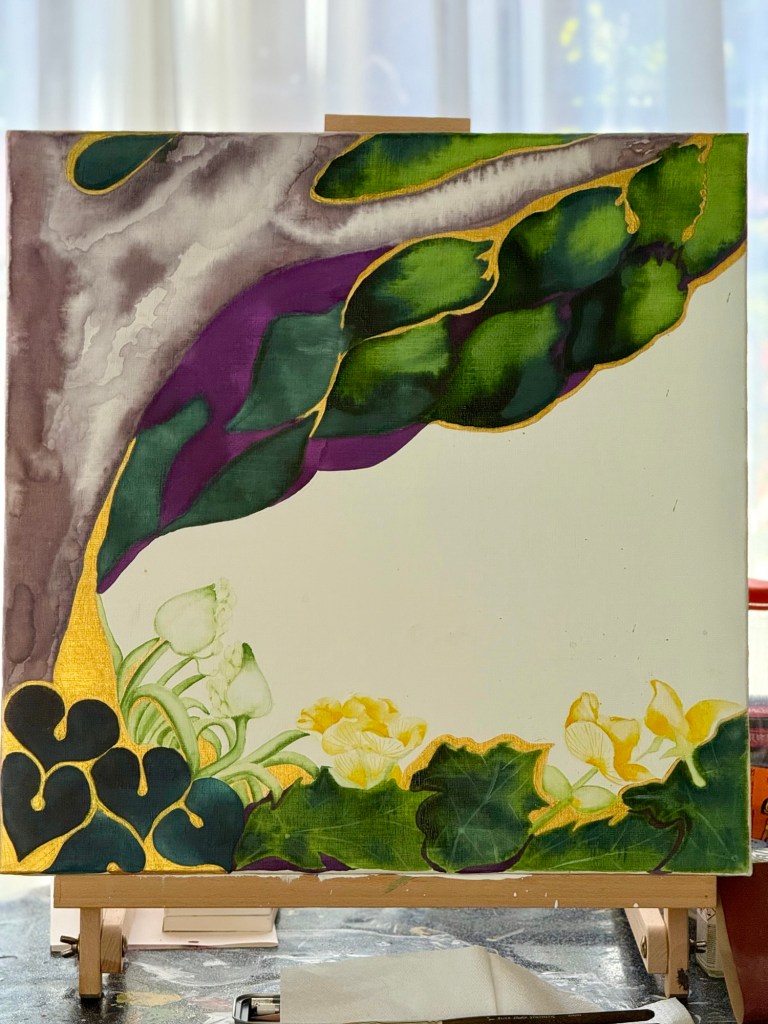
For the self-evaluation, I go over the questions we are asked to reflect on in our course book at https://learn.oca.ac.uk/mod/book/view.php?id=29437&chapterid=10345
Self-evaluation.
Looking back, I appreciate the structure of Level 3, which implies the student taking two courses simultaneously: Advanced Practice and Research. It is important to note that my tutors for both courses were consistent with the logic of working on two courses, aiming for an enhanced learning effect due to the synergy of studying visual fine arts from two perspectives: intensive studio practice and strengthening academic research writing skills. In my Advanced Practice course, I worked on my large-size project, the working title is “Riviera Flowers.” My research tutor recommended that I work on the “garden” as a notion in visual arts, giving me complete freedom to decide about the context, from garden design to particular visual art traditions within any historical time frame. This approach let me concentrate on my personal artistic voice and the platform, which has a significant element of spirituality. A good reflection on that naturally inspired my research paper’s theme: “Cultural and Symbolic Significance of Gardens in Traditional Japanese byōbu and Indian pichwai Visual Arts.” Since the research course aimed to bring us to a profound level of academic writing, I had to elevate my paper’s research level by working on high-quality, exemplary academic sources which contain writings about outstanding artworks. For my research, I used rare editions of art books about Indian and Japanese art, carefully reading essays written by world-class art experts. My intense exposure to flawless academic writing from world-class art experts and beautiful artworks significantly improved my understanding of the standards for high-quality art writing, further training my eye and harnessing my artistic taste. The latter was a new large wave of influence on my drawing and painting skills. I experimented rigorously with details, brushwork, line work and compositional decisions. My Advanced Practice tutor witnessed my path and encouraged my experiments.
My progress in the Advanced Practice course was undoubtedly enhanced by the work I did for the Research course. My research is “Cultural and Symbolic Significance of Gardens in Traditional Japanese byōbu and Indian pichwai Visual Arts.” In my research paper, I explore the connection between cultural, philosophical, and religious concepts and elements of the visual language engaged in Japanese byōbu and Indian pichwai artworks. That required intensely studying the visual language and reflecting on its elements and spatial representations. This study significantly broadened my apprehension of various artistic approaches and solutions.
The Advanced Practice course has turned out to be my most productive study in terms of my learning curve towards my career as a professional visual artist. I started the course with the idea of creating a large-size painting dedicated to the local flora I am surrounded by daily. Though I had a pretty clear idea of what kind of flowers I wanted to paint, that was basically the end of my understanding of how to implement the project. Looking back, I see that I went through a year-long path working on a single project in detail, which allowed me to make significant discoveries about myself as a visual artist. I feel satisfied at this point because I have achieved clarity on how I will develop the particular “Riviera Flowers” project, as an artist in general, in terms of my voice and style. In this sense, I find myself at the point of perfect harmony, which happens when you set up a goal, work towards it and arrive at the awareness that you can do it since the fruits of your work tangibly improve. Even though I never have problems observing someone’s beautiful artwork and never engage in negative self-talk that I am bad and someone is better than me, I now love my failures because they bring the clarity I seek so much while working on a particular painting.
The course also helped me to break through my technical skills in ink painting, which I described in detail above in my post on this page. It solidified my intention to continue working with inks, and they will remain my primary medium so far. Another notable point in developing my technical skills was my decision to work on large-scale projects. That was a good decision I made since size matters. Eventually, I realised how much effort it takes to create a large-size painting on the level of physical work and cognitive ability. You need to develop and refine many more elements; the composition is much more complex to comprehend and execute. I still go through the moments when I feel intimidated by my ambition, and sometimes my work looks silly to me.
One of the main results I have achieved over the course is that I finally started researching other artists’ artworks profoundly differently. My research has become meaningful for me since I began to look at the paintings from a practitioner’s point of view, studying their artistic and technical decisions and searching for solutions I was looking for in my projects. A most important discovery about myself as an artist and what direction I want to go while working on this project was that I want to create dimension paintings, and I should work on blocks. I was influenced by David Hockney‘s ( 1937-) approach he followed in his artworks below:
A Closer Winter Tunnel, February-March 2006, David Hockney, oil on six canvases, 91.4* 121.9 each, 182.9* 356.7 cm overall.
Late Spring Tunnel, David Hockney, May 2006, oil on two canvases ( overall size is 121.9*182.9 cm)

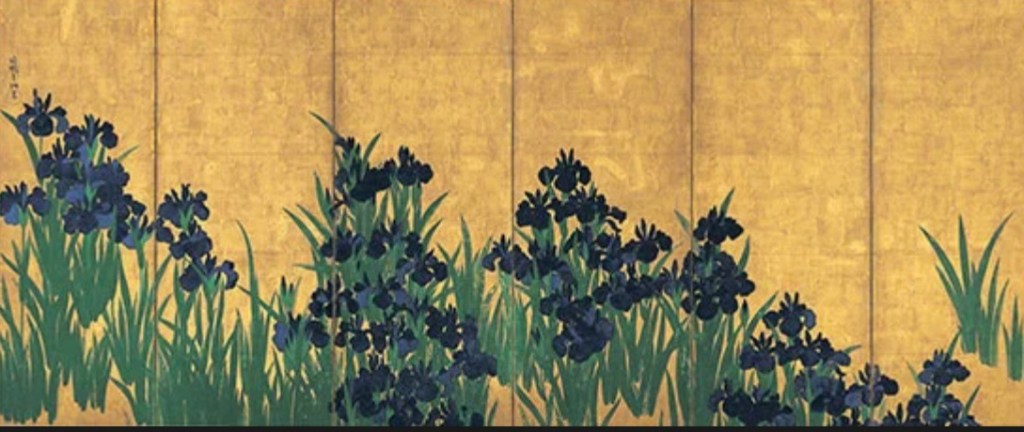
Regarding my visual language and design style, I am still enchanted with traditional Japanese paintings, including folding screens byōbu, of the Kano ( 15th to 19th century, Japan)school as well as Ogata Kōrin‘s ( 1658-1716) and Gustav Klimt‘s (1862-1918) works. The artists I mentioned depict nature themes, such as greenery, flowers, and landscapes, focusing on vivid colours, gold leaves and intricate designs.
Irises, Ogata Kōrin, early 18th century, in Nezu Institute of Fine Arts, Tokyo, Japan; image via online http://www.britannica.com [access on January 27th 2025];
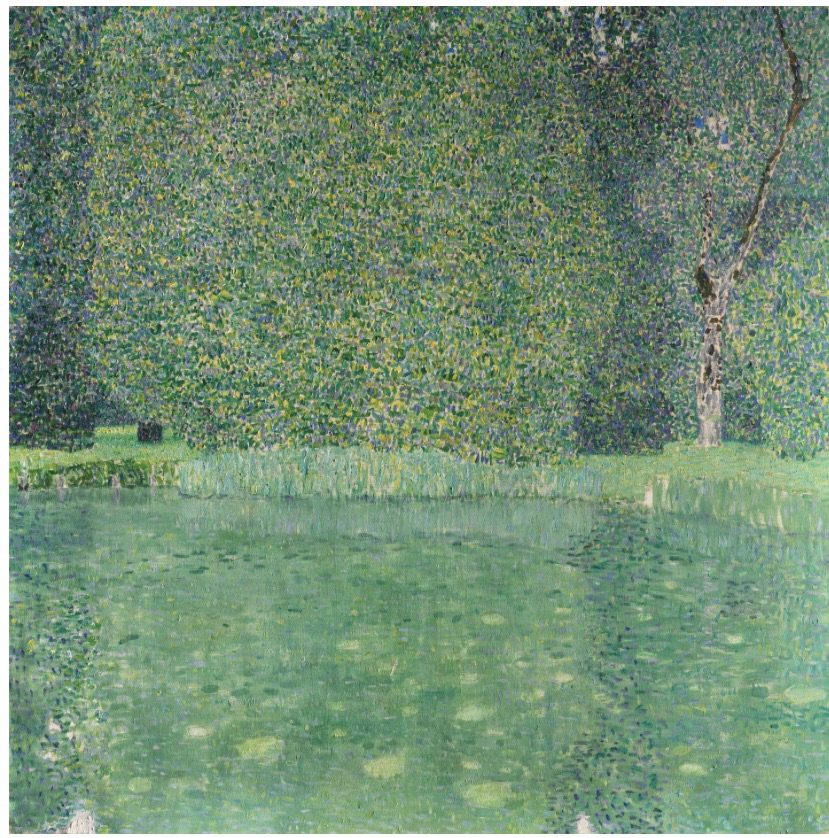
Park at Kammer Castle, 1909, Gustav Klimt, oil on canvas, Neue Gallery New York, Estée Lauder collection, image via http://www.neuegallery.org; [accessed on January 27th, 2025].