
In the final stage of Part Two, we have to draft our research questions and make a submission to our tutor.
Below, I have placed the artworks I am interested in for my research. However, it is important to note that this is not the final and complete list of artworks I will research.
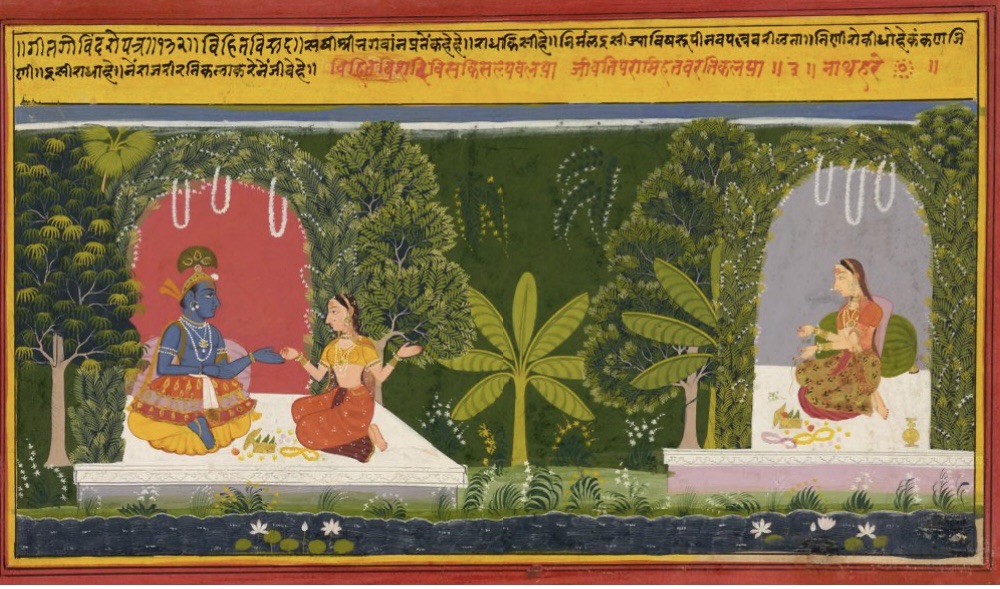
Illustration from a Gita Govinda series, Artist Unknown, ink, opaque watercolour, and gold on paper, 21.4*38.5 cm, period: Mughal dynasty (1526-1857); image via Asian Art Collection, Yale University Art Gallery, online on https://artgallery.yale.edu/collections/objects/83909 [accessed on July 30th, 2024];
The Union and Separation of the Hindu God Krishna and Radha, from a Song of Govind (Gita Govinda) manuscript, Artist Unknown, opaque watercolour, and gold on paper, 21.4*38.5 cm, period: Mughal dynasty (1526-1857), image via Asian Art Collection, Yale University Art Gallery, online on https://lux.collections.yale.edu/view/object/1882fa52-5035-4939-beac-bc751cb89d58 [accessed on July 30th 2024];


Pichwai of Rasleela for Sharad Purnima, Unknown Artist, c.1900, from the collection of Museum of Art & Photography, image online on https://umaid.art/2022/08/06/pichwai-paintings-of-rajasthan/ [accessed on July 30th 2024];

Pichwai of Daan Leela, Unknown Artist, c.1900, from the collection of Museum of Art & Photography online on https://umaid.art/2022/08/06/pichwai-paintings-of-rajasthan/ [accessed on July 30th 2024];

Folding Screen with Design of Chinese Phoenixes, Kano School, Edo Period, colour on gold-leaf paper, pair of six-fold screens, 187.0*358.0 cm each, image via Tokyo Fuji Art Museum, online on https://www.fujibi.or.jp/en/collection/artwork/03823/ [accessed on July 29th 2024];

Folding Screen with Design of Grape Arbor, Kano School, Momoyama Period (16th c.), colour on gold-leaf paper, 152.5*350.9 cv (each), image via Tokyo Fuji Art Museum online on https://www.fujibi.or.jp/en/collection/artwork/03823/ [accessed on 29th July 2024];


Scenes of Yoshino and the Tatsuta River, Artist Unknown, XVII c. Pair of six-panel screens; ink, colour and gold on paper; each 177.3 *418.5 cm. Collection of NEZU Museum Tokyo, image via Japanese folding screens Byōbu. “Beyond Golden Clouds”, Japanese Screens from the Art Institute of Chicago and the Saint Louis Art Museum; edited by Janice Katz, essays by Philip K. Hu, Janice Katz, Tamamushi Satoko, Alicia Volk; @2009. p.40.
Exercise 12: Critical questioning.
At this point, I can place below the directions of my contextual study:
- Cultural and Symbolic Significance of Gardens in ancient Japanese and Indian visual art;
- Iconography and Symbolism in Garden representation in visual art of ancient Japan and India;
- Plant and Flower Symbolism in ancient Japanese and Indian visual art traditions;
- Spatial representation of Garden in ancient Japanese and Indian visual art;
Since this is not my first research paper during my OCA studies toward my degree, I rely on my previous experience in choosing the research theme. The main rule is that I must be interested in the subject. I must like it and resonate with it to a great extent to push myself forward in my research. I must also connect my research theme with my current artwork project, perhaps with my artistic voice and personal approach/style. Since I am exploring the themes of God, spirituality, faith and nature as plants’ beauty, I naturally ended up with the following significant subjects/themes: the primary materials I have identified and worked with. It is important to note that this is not the complete and final list of the research materials.
PICHWAI paintings in ancient India ( introduced via “ShrinathJi Pichwai paintings: Why we love them”, Indian Folk Art online on https://indianfolkart.org/shrinathji-pichwai-painting/ [accessed on August 5th, 2024]; “5 Pichwai Artists of India Whose Artworks Reign Supreme”, Rooftop, online on https://rooftopapp.com/5-pichwai-artists-of-india-whose-artworks-reign-supreme/;
also on https://www.architecturaldigest.in/content/pichwai-good-earth-mumbai/
Jyoti. (2024). TRANSFORMING TRADITIONS: THE JOURNEY OF PICHWAI ART OF NATHDWARA FROM RELIGIOUS ROOTS TO MODERN SPACES. ShodhKosh: Journal of Visual and Performing Arts, 5(2), 98–110. https://doi.org/10.29121/shodhkosh.v5.i2.2024.1062
https://www.granthaalayahpublication.org/Arts-Journal/ShodhKosh/article/view/1062
https://indianartspalace.in/the-colorful-tradition-of-indian-pichwai-paintings/
More research on academic sources:
https://thedigitaleducation.org/blog/pichwai-paintings-a-complete-guide/
Latika Sanchiner, Dr Dolly Mogra, Documentation and Revival of Pichwai painting, Journal of Emerging Technologies and Innovative Research (JETIR), JETIR, volume 10, issue 4, April 2023, An international scholarly open access, peer-reviewed journal, online on https://www.jetir.org/papers/JETIR2304A44.pdf [accessed September 1st 2024];
Khan, Dr. (2022). Article Pichwai painting of Rajasthan, online on Research Gate, https://www.researchgate.net/publication/363298398_Article_Pichwai_painting_of_Rajasthan [accessed on September 19th 2024];
Emilia., Ghose, Madhuvanti. Ambalal, Amit, 1943- Krishna, Kalyan. Lyons, Tryna. Shah, Anita. Bachrach (2015). Gates of the Lord : The Tradition of Krishna Paintings .Art Institute of Chicago
Twinkle Kataria, From Havelis to Galleries: Examining the Shift in Context and Relevance of Pichwai Art through Contemporary Devotional Artistic Expressions, 2023, online on Academia Eduhttps://www.academia.edu/108267221/From_Havelis_to_Galleries_Examining_the_Shift_in_Context_and_Relevance_of_Pichwai_Art_through_Contemporary_Devotional_Artistic_Expressions [accessed on September 10th 2024];
Pryanka Yadav, Ramratan Guru, Ushma Saini, Pichwai: the Tapestry Art of Nathdwara, Shodh Drishti, An international peer reviewed preferred journal, Vol.14, #5.2., May 2023 online on https://www.scribd.com/document/680045442/PichwaiArtofNathdwara [accessed on September 12th 2024];
Japanese folding screens Byōbu. “Beyond Golden Clouds”, Japanese Screens from the Art Institute of Chicago and the Saint Louis Art Museum; edited by Janice Katz, essays by Philip K. Hu, Janice Katz, Tamamushi Satoko, Alicia Volk; @2009.
Kano School in traditional Japanese visual art, books: “Ink and Gold, Art of Kano”, Felice Fischer and Kyoko Kinoshita, Philadelphia Museum of Art, in association with Yale University Press, New Heaven and London, 2015;
Below, I place the required 500-word first draft of my research details.
My contextual study of the notion of “Garden” will be dedicated to its place, role and significance in traditional Japanese and Indian visual arts, such as Japanese folding screens byōbu and Indian Pichwai paintings. Even though these types of artworks are different in the visual details and painting style, they have common features, such as their functional purpose, way of production and visual elements, such as a garden in a broad sense: greenery and flowers. I will research each of these common features in detail. Further, I will briefly outline the main details at this point.
The functional purpose of byōbu was to decorate a living space or specific location, display it on special occasions, and include a luxury gift. The Pichwai paintings also served for decorative purposes, especially in shrines. Both types of artwork are important representations of the spiritual cultures of both countries and carry great devotional significance.
The Byōbu were made of “layers of paper, attached to a wooden framework on top of which a painting on paper or silk was affixed” (” Beyond Golden Clouds,” “Hidden Behind History,” Janice Katz, p.13). The Pichwai paintings were traditionally created on handmade paper or cloth. Special artisan communities/schools created both types of artworks, requiring great knowledge and craftsmanship.
Traditionally, ancient byōbu screens contained images of nature, trees, blossoming flowers, birds, rivers, and mountains, often depicted in the dynamic of four seasons. The Pichwai paintings were devoted to particular Gods or Diety—Shiva, Vishnu, Durga, Surya, and Ganesha, as well as to Lord Krishna ( this type of Panchai is called “ShrinathJi”), depicting their existence on transcendental, not Earthy plane, visually represented by lavish nature.
The questions I want to ask and explore in my contextual study ( the list is not final):
- Cultural and Symbolic Significance of Gardens in Ancient Japanese and Indian Visual Arts of byōbu and pichwai; My main appeal/idea is that both types of artworks are quintessential examples of how particular spiritual ideas have been represented in visualised forms. They are heavily loaded with cultural significance, with a garden as their main feature, a platform, and a stage where all scenes of existential phenomena unfold. In both cases, these artworks can be considered attempts to communicate with an upper realm, bringing its fragments to a particular space on Earth. The difference in cultural and symbolic significance is determined by the difference in faith and spiritual beliefs. It will be interesting to explore these differences and how they are channelled in the details of the artworks in terms of their subjects.
- What are the differences and similarities in the visual representation of the garden in both types of artworks in terms of the: a) Spatial representation of the garden in ancient Japanese and Indian visual art; b) Plant and Flower Symbolism in ancient Japanese and Indian visual art traditions. The byōbu and pichwai are visually very different. I would say the gardens are depicted from dramatically different perspectives, especially regarding their elements and spatial decisions.
- Garden representation in Visual Art of Ancient Japan and India. I would like to research more general concepts of iconography and symbolism in garden representation within Japanese and Indian cultures.
- Why is the garden a central element for both types of visual arts? Here, I want to find answers to this question, exploring the garden from a scientific point of view, such as the garden as a restorative environment for human cognitive ability. There are several scientific theories to study which might be helpful in the research: a) A theory that should be covered is the “Biophilia Hypothesis,” which is about humans’ innate affinity for nature and living systems; B) research by physicist Roger S.Ulrich, who conducted significant and influential research on the therapeutic benefits of garden settings; C) research by Stephen Kaplan who developed an Attention Restoration theory ( ART) ;
- ?
 JeanArt