My notes on the Tutor’s feedback for the Research, Part One.
My Tutor gave me a good insight into the theme of my research project. She analysed my work and individual artistic approach and suggested that I research the notion of a garden in different cultures. Her recommendations were as follows: “My recommendation is that research in relation to The Garden might offer some vital inspiration, perspectives, themes and diverse cultural insights into how the garden has been approached, perceived, and employed as a vehicle for ideas, in didactic, and more nuanced ways.” It was suggested I explore the notion of “Garden” within the categories of landscape design, agriculture, and cultivation of flora. However, I think I am more interested in exploring this theme within its representation in paintings of particular cultures.
Action points:
- “Consider expanding upon your ideas to encompass a diverse range of cultural, spiritual, and aesthetic sources- potential in the overarching idea of ‘The Garden’.
- We discussed strategies to facilitate and establish different approaches to embedding discipline in research and AP, which you raised as a weakness (see notes in the report). Do more of what you see as your strengths, and factor in / try strategies to flex your weaknesses.
- Evaluate and analyse some artists’ works as case studies. (see the body of the report)”
The first action point regarding expanding my ideas is “to encompass a diverse range of cultural, spiritual, and aesthetic sources.” This action point is directly related to all the work in Part 2, so all my future posts will be designated to this action point.
Following my Tutor’s guidance, I have reviewed my options for the type of research and the potential theme of my research. The exercises below were very helpful in expanding my views on the research and its methodological implementation. My answers to the questions raised in the Tutor’s feedback will be clarified in my later posts when I will narrow down the theme of my research. The analysis of other artists’ works overlaps with the Advanced Practice course requirements and can be found in these posts: https://zhanartcom.wordpress.com/wp-admin/post.php?post=15042&action and https://zhanartcom.wordpress.com/wp-admin/post.php?post=15080&action. I must say more research on individual artists’ works will be coming further.
Project 1: Establishing format, research and theoretical framework.
Exercise 1.1. Planning.
We are suggested to choose between different formats of our research final outcome. I reviewed the suggested formats and explored contextual study, essay, and presentation formats. I write well, but I want to challenge myself and produce a presentation since I want to engage in speaking skills and a voice, trying myself in a new genre, such as a podcast. If I produce a contextual study or essay accompanied by a video presentation, my work and skills will be at a new level. Also, it will provide the necessary link between my creative work and a written work. At this point, it is not clear to me yet whether I should do a contextual study or an essay, so I decided to look at the differences between these two formats.
| Differences in: | Contextual Study | Essay |
| Purpose | aims to analyse a specific topic/subject within a broader context, examining the background, circumstances, and environment that influences the subject; | presents an argument or a perspective on a particular topic, it is more focused on presenting the writer’s ideas, interpretations or analyses; |
| Structure | includes an introduction, a detailed examination of the context surrounding the subject, an analysis of how the context surrounds the subject, and a conclusion; | has an introduction and body paragraphs that focus on a single point that supports an overall argument thesis and a conclusion. |
| Focus | emphasises understanding the subject within its larger context, describing the influence of cultural, political, and social context; | concentrates on developing a central argument or thesis. While it may include contextual factors, the primary goal is to persuade or inform the reader about the writer’s viewpoint on the topic; |
After looking at the differences between these research formats, such as a contextual study and an essay, I see that the main difference between them lies in the area of the goal of the research work. Suppose I am interested in establishing reasons and connections between the subject and the environment of its creation in a broad context, and I want to explain things. In that case, I should do the contextual study. However, if I have my own strong idea – I should pursue writing an essay and bring the arguments to support my point of view.
The phenomena of “Garden” depiction in visual arts is vast to research. The Garden theme has been a notable and diverse subject throughout human and art history.
Exercise 1.2. Making Connections
We have a good comment in our course book reminding us: “..in your learning log, reflect on your process so far, considering the ways you feel this study might support your work in Fine Art 3: Advanced Practice. Remember, this body of research should have a direct relationship with your studio practice, enabling you to research, develop and think critically about areas of interest and/or concern across both areas.”( Level Three, Research).
My research work has to be connected with my current bodu of artworks. Since the beginning of my Advanced Practice course this year I have been working on “Riviera Plants” project. My research course Tutor recommended that I connect with research for a “garden” theme. I found her advice appropriate and engaging.
Exercise 1.3. Introducing Research methods;
I will place one more good reminder from our “Research” Coursebook: ” You’ll need to consider a range of theoretical perspectives and research methodologies to pick the best fit for your research approach.”
I agree that understanding the methodology of the research I conduct will improve the clarity of the final outcome. Below, I place a mind map I made to overview the research methods.
There is a wide array of research methods. I think for my theme in the artwork and related to it research, I will have to use the following research methods for my study:
- Ethnographic research is “The study of the culture and social organization of a particular group or community… Ethnography refers to both the data gathering of anthropology and the development of analysis of specific peoples, settings, or ways of life.” See Calhoun, C. J. (2002). Dictionary of the Social Sciences. New York: Oxford University Press
- Historical research is a “Historical method that refers to the use of primary historical data to answer a question. Because the nature of the data depends on the question being asked, data may include demographic records, such as birth and death certificates, newspaper articles, letters and diaries, government records, or even architectural drawings. See Tuchman: The Historical Method (2004)
- The Narrative Inquiry Research method is “. By focusing on narrative, we are able to investigate not just how stories are structured and the ways in which they work but also who produces them and by what means, the mechanisms by which they are consumed, and how they are silenced, contested, or accepted.”
- See Andrews et al. (2008) in Doing Narrative Research. Los Angeles Calif.: SAGE. http://site.ebrary.com/id/10546227
- A Case Study is “A research method that engages in the close, detailed examination of a single example or phenomenon. …Case studies are often published by ethnographers, participant observers and historical researchers. The study of ‘classic’ cases plays a central role in training in some fields, especially anthropology, law and psychoanalysis.”
See Calhoun, C. J. (2002). Dictionary of the Social Sciences. New York: Oxford University Press
Exercise 1.4. Theoretical Perspectives;
Here, I post my map to help myself navigate the Conceptual and Theoretical frameworks for my study. I had to systemise my approach and clarify my understanding so I won’t confuse these two platforms I need to develop to make my research well thought out and written. Below are the screenshots of my navigation maps, which I will use to plan and conduct my research.
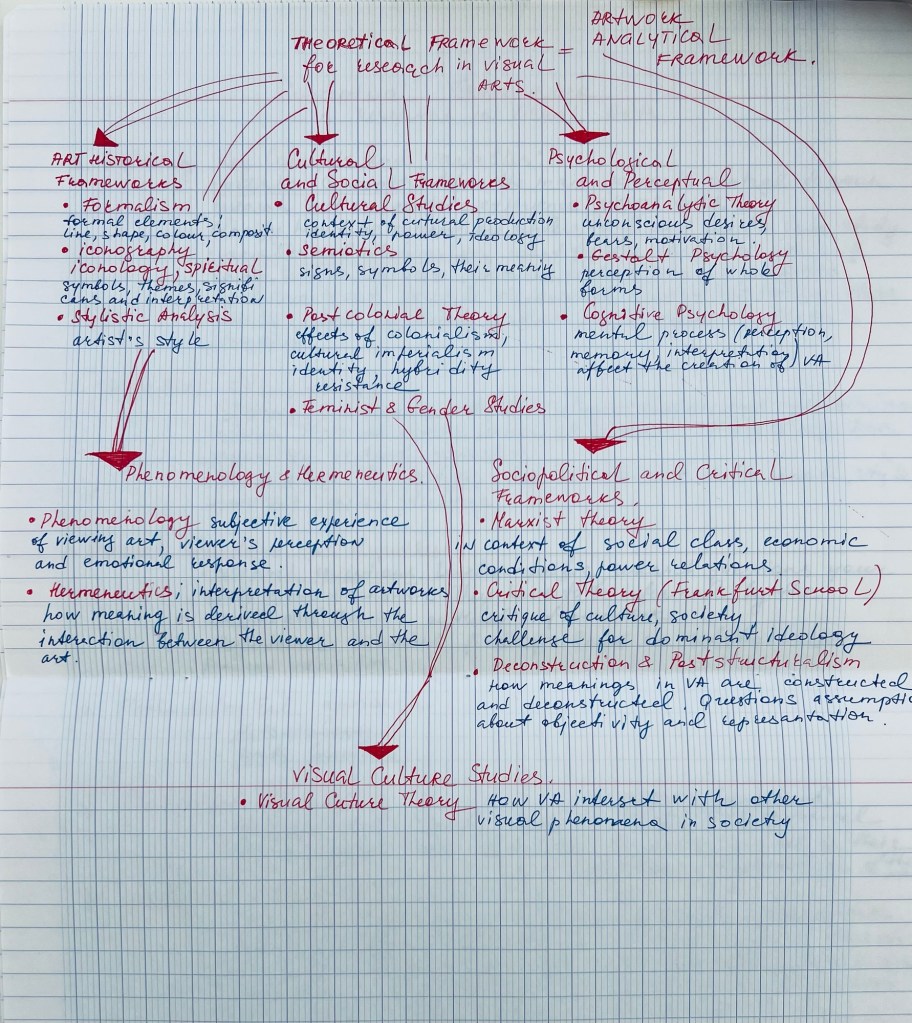
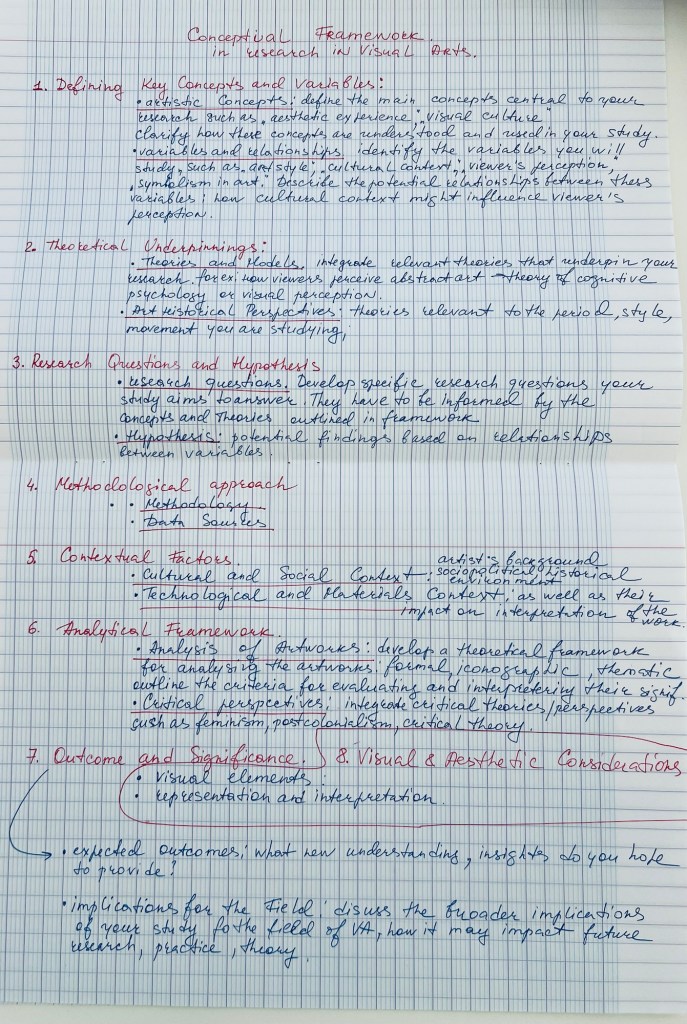
At this point, it was important for me to learn the difference between the Conceptual and Theoretical frameworks. Another helpful note I found in a paper written by Roxana Leonor Vileda Trigueros: “…A conceptual framework also works as a conceptual map where you order the main ideas or concepts, and you set topics and subtopics and draw lines to indicate their relationship.” ( p.2 Conceptual Framework, Theoretical Framework, State of Art and Referenced Framework, 2018); In her paper, the author gives great insights about the theory of research and suggest concrete action plan for conducting a research. Using the language of this paper, my “research phenomenon” will be a phenomenon of garden in Visual Arts in different cultures, which I will narrow down. I will have to define the variables within this phenomenon and theoretical concepts and establish relationships between them, leading to and supporting my conclusion. Roxana L.V. Trigueros also refers to the work of Richard M.O., quoting him: “A conceptual framework differs from the theoretical framework in that it provides the direction that is missing in a theoretical framework. Also called a research paradigm, a conceptual framework makes things easier by delineating the input as well as output of the research project. One gets to know the variables that need to be tested in a conceptual framework” (Richard, ed.).
Bibliography: Roxana Leonor Vileda Trigueros, MSC. Social Science Research, Methods and Techniques, University of El Salvador, English Language Department, February 7, 2018 online on https://www.researchgate.net/publication/323127266_CONCEPTUAL_FRAMEWORK_THEORETICAL_FRAMEWORK_STATE_OF_ART_AND_REFERENCED_FRAMEWORK; [accessed on July 6th, 2024]; Chat GPT about the differences between a contextual study and an essay [accessed on July 7th, 2024]; Chat GPT, What are the Theoretical and Conceptual frameworks for research in Visual Arts, [accessed on JUly 8th 2024]; Research Methodologies for the Creative Arts and Humanities, Edith Cowan University, ECU, library, online on https://ecu.au.libguides.com/research-methodologies-creative-arts-humanities/other-related-creative-arts-research-methodologies [accessed on Jule 7th 2024]; Appropriate Research Methodologies for Artists, Designers & Craftspersons: Research as a Learning Process, Julian Malins and Carole Gray in collaboration with Katie Bunnell & Eleanor Wheeler, 1995, The Centre for Research in Art & Design, Gray’s School of Art, Faculty of Design, The Robert Gordon University, Aberdeen, Scotland, UK, online http://www.carolegray.net/Papers%20PDFs/cc.pdf [accessed on July 7th 2024];


[…] in two types of visual art I research. I have placed below the table from my earlier post https://zhan-art.com/2024/06/21/level-3-research-part-two-research-methodologies-and-theoretical-fra… as a reminder for […]
LikeLike