
Research point 5. We have to do the research about artists such as Robert Smithson, Robert Morris, Dan Graham, Anish Kapoor and reflect on how they used mirrors and mirror surfaces.
Robert Smithson (1938-1973).
Robert Smithson is an American visual artist interested in travel, cartography, geology, architectural ruins, prehistory, science fiction. He developed his interests through his artworks, “fascinated by concepts of duality, entropy and questions of how we might find our place in the world.” (www.mariangoodman.com) His artworks can be classified as Minimalism and Conceptualism, influenced by Abstract Expressionism. Smithson was interested in the “viewer’s experience of the space around the object ( as much as the object itself)” (www.theartstory.org). He lived a short life of 35 years and had his first solo exhibition in 1959. He started from drawings, paintings and collages, using multimedia such as gouache, pencil, crayon. Around 1964 he began his experiments by creating sculptures. He was attracted by industrial materials, deserts, tracts of land. Smithson used mirrors and mirrored surfaces, which he placed in different settings, making photographs of the altered physical reality. One of his most notable works is a Spital Jetty (1970), which is a grandiose installation he created on the northern shore of the Great Salt Lake, Utah, USA. Smithson “inserted into the violet-red water a massive spiral constructed of some 6650 tons of earth (www.theartstory.org). Because of this Project, he is recognized as a founder of the Land Art genre.
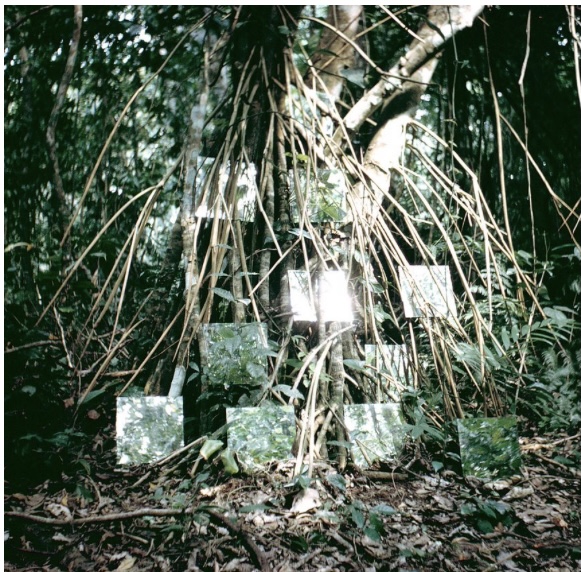
Besides his visual conceptual art, he was an outstanding and accomplished writer, critic, essayist and art theoretician. He explored the concept of time and our humankind’s attempts to control it. In his “Yucatan Mirror Displacements” (1-9), he brings the idea of temporality, where mirrors reflect and record the passage of time. Below there are some of his notable artworks( from left to right):
Spiral Jetty, 1970, Robert Smithson, image via http://www.mariangoodman.com;
Broken Circle, 1971, Robert Smithson, image via http://www.mariangodman.com;
Yucatan Mirror Displacements (1-9), 1969, Robert Smithson, image via http://www.guggenheim.org;


Dan Graham (1942-2022)
Dan Graham is an American visual artist and curator who explored how the “built environment influences our perception” (www. artstory.net). He is also one of the founders of Conceptual Art during the 1960s. Graham reflected on man built artificial aesthetics and their influence on people’s daily lives. Graham is very famous for his pavillions made of reflective surfaces, such as mirrors and plexiglass. The surfaces usually were both reflective and transparent so that the viewers could see reflections of themselves and the surrounding area and views through the glass. “the use of mirrors makes the audience part of the sculpture.”(Dan Graham: Two Two-Way Mirrored Parallelograms Joined with One Side balanced Spiral Welded Mesh”, editors of National Galleries, online on www. nationalgalleries.org;)
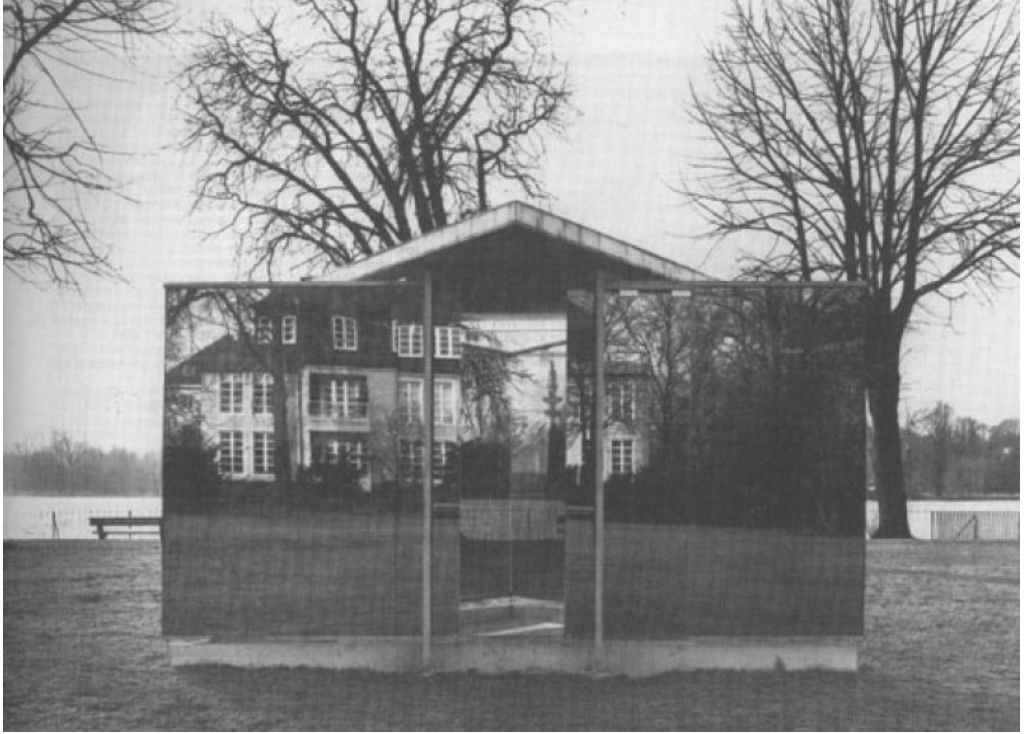
Below are some works of Dan Graham where we can see his experiments with mirrored surfaces. From left to right:
Palais des Beaux Arts, Exhibition Voici, 2001, Dan Graham, image via ww.artnet.com; Anamorphic stainless steel column, NYC office bldg, 2010, Dan Graham, image via http://www.artnet.com;
Double Triangular Pavilion for Hamburg, 1989, Dan Graham, image via http://www.mariagoodman.com;


Anish Kapoor (1954-)
Anish Kapoor is a British-Indian visual artist famous for his elegant large scale, engineered artworks. “Convex and concave surfaces and mirrors, which offer optical illusions, are a common motif throughout his work” (Anish Kapoor, http://www.artsy.net). As he says in his interview, he is interested in “esoteric and difficult stuff” (interview for Al Jazeera English, Youtube). Kapoor’s artworks are known for their biomorphic forms made with different materials such as stone, aluminium, resin and stainless steel. His most notable, monumental size artworks are: installation “Marsyas (2002)”- three massive steel rings joined by a 155 meters span of fleshy red plastic membrane. Another one is a “Could Gate (2004) – the 110-ton elliptical archway of highly polished stainless steel (nicknamed “he Bean”).
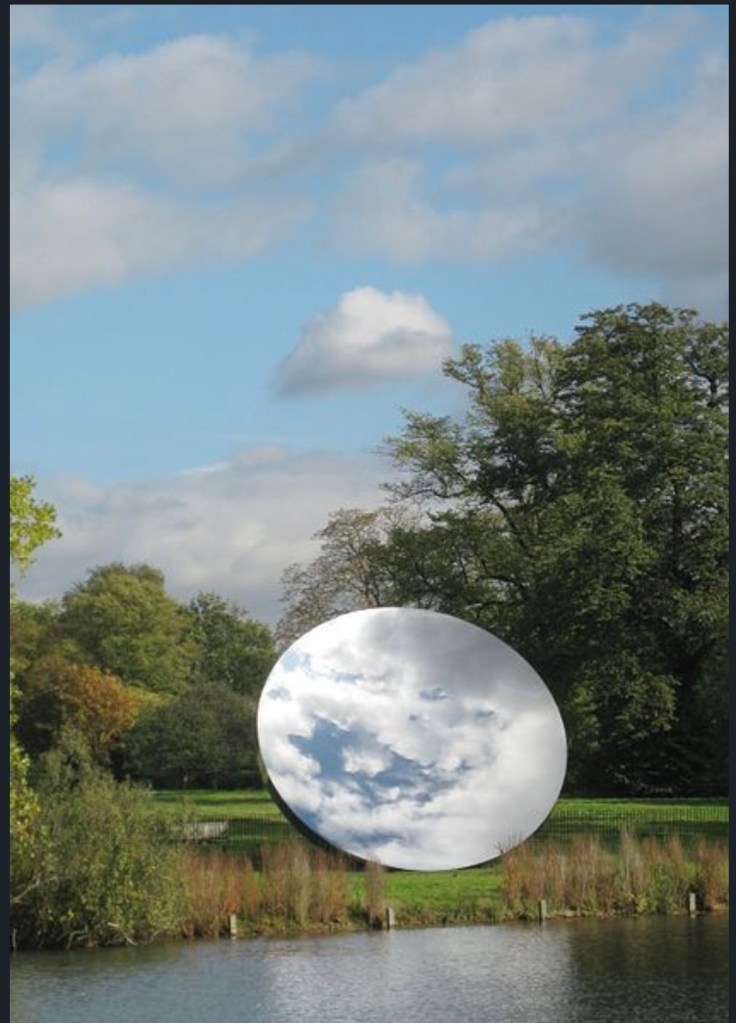
Below are some of his artworks, from left to right:
Sky Mirror, Amish Kapoor, 2001, acier, image via http://www.amishkapoor.com
Cloud Gate, Amish Kapoor, 2006, starless steel, image via http://www.amishkapoor.com;

My reflection on the ways in which the above mentioned artworks cut out and costume space within the environment, viewer’s relationship to these works. We also have to reflect on viewer’s position in relation to Manet’s “A Bar at the Folies-Bergere” (19881-1982).
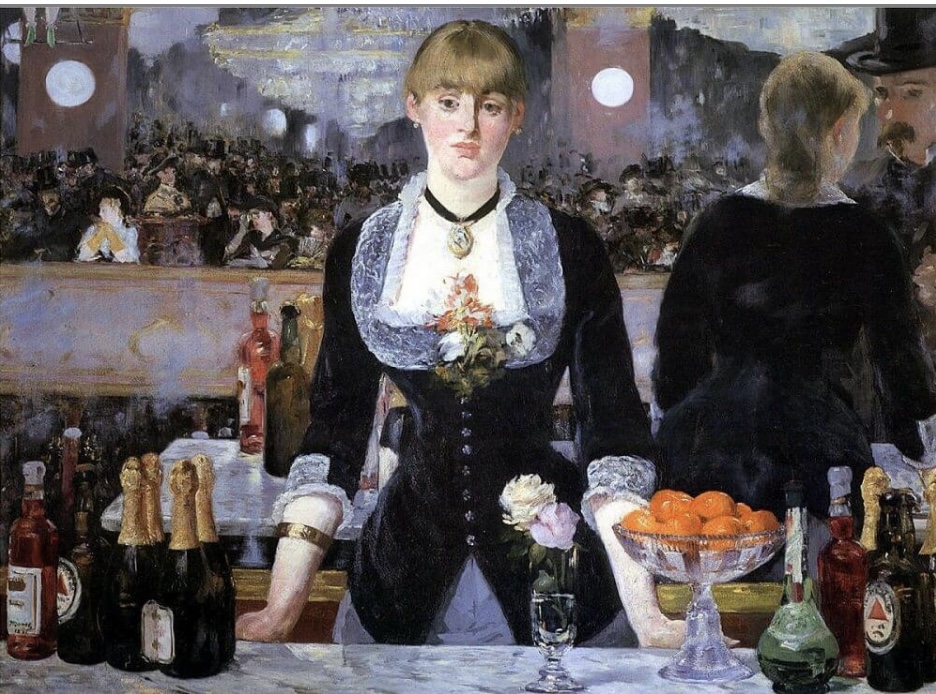
I understand now that working with reflective surfaces empowers any artist with an ability to create a complex, multidimensional context of the painting or installation. A mirror or any other reflective surface is a powerful tool to bring a lot of intrigue into the artwork, suggesting a viewer a vibrant, complex and multifactor relationship with the artwork. A great example of this is Manet’s painting “A Bar at the Folies-Bergere” (1881-1882), where he placed a large mirror behind the barmaid’s back. This mirror enabled Manet to show the crowd attending a popular entertainment place, the round lights, and most important, an enigmatic interaction of the barmaid with a guest at the bar. It is interesting to observe the barmaid’s face and her back simultaneously, noticing that the face/front and the back “speak” differently. Her face has a distant expression, but her back, showing her whole body leaning towards the visitor and her head- close to the visitor’s face says the opposite. Manet used the mirror to conduct this dialogue.
Often, artists, using all kinds of reflective surfaces in their installations invite a viewer to become apart of the installation since viewer’s reflection in the reflective surface appears within the installation, as a natural part of it.
Bibliography: “Anish Kapoor. British Sculptor” Raz-Russo, Michael, Encyclopedia Britannica, March 8 2022, online on http://www.britannica.com, [accessed on March 11 2022]; “Ai Weiwei and Anish Kapoor (Part 1) Studio B: Unscripted”, Al Jazeera English, Youtube,[accessed on March 10, 2022]; “Anish Kapoor British-Indian, b.1954” editors of artsy.net, online on http://www.artsy.net, [accessed on March 10, 2022]; “Robert Smithson”, Marian Goodman Gallery, online on http://www.mariangoodman.com, [accessed on March 10, 2022]; “Robert Smithson. American Sculptor and Writer”, editors of The Art Story, online on www. theartstory.org, [accessed on March 10, 2022]; “Dan Graham, American, 1942-2022”, editors of artsy.net, online on www. artsy.net,[accessed on March 10, 2022]; “Dan Graham”, editors of Artnet, online on www. artnet.com; “Dan Graham by Mike Metz”, interview for Bomb magazine, January 1, 1994, online on http://www.bombmagazine.org; [accessed on March 10, 2022]; “Dan Graham: Two Two-Way Mirrored Parallelograms Joined with One Side balanced Spiral Welded Mesh”, editors of National Galleries, online on www. nationalgalleries.org; [accessed on March 10, 2022];
Contextual focus.
Exercise 1.3. The mirror as a stage. In this exercise we have to explore the cut or incision made in space by reflective surfaces, considering these as a stage. We can use mirrors or reflections we can find. We must use a paint that allow us to work with transparent layers of colours. Before starting the exercise I have watched the LINK 32, which is an interview of a German artist Katharina Gross. She works in large scale format using paint spray gun. This allows her to engage the muscular power of her body, what we can see in her large paint strokes. She paints in architectural spaces transforming them in painted structures; paints change our perception of this architectural space, when people move through them.
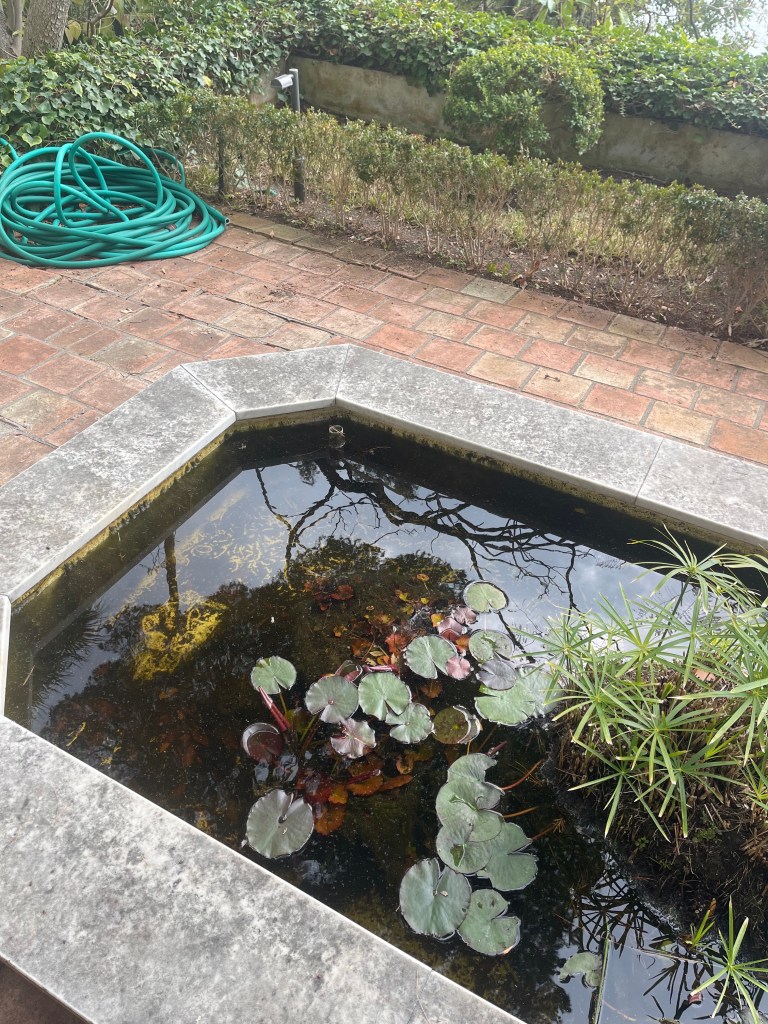
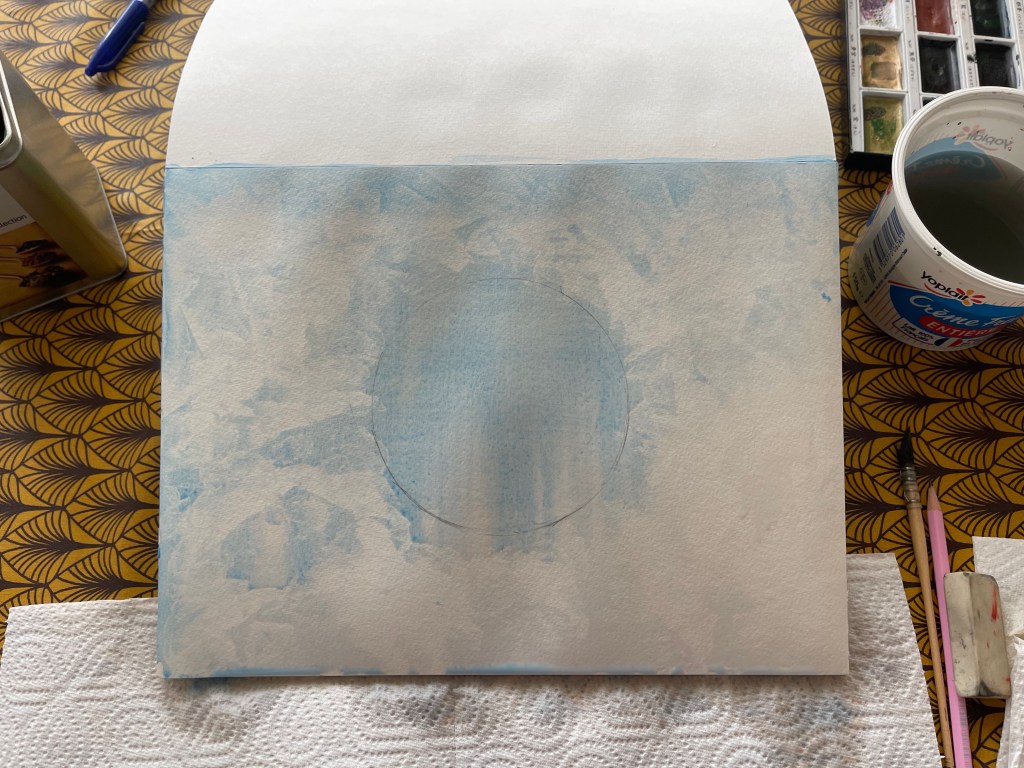
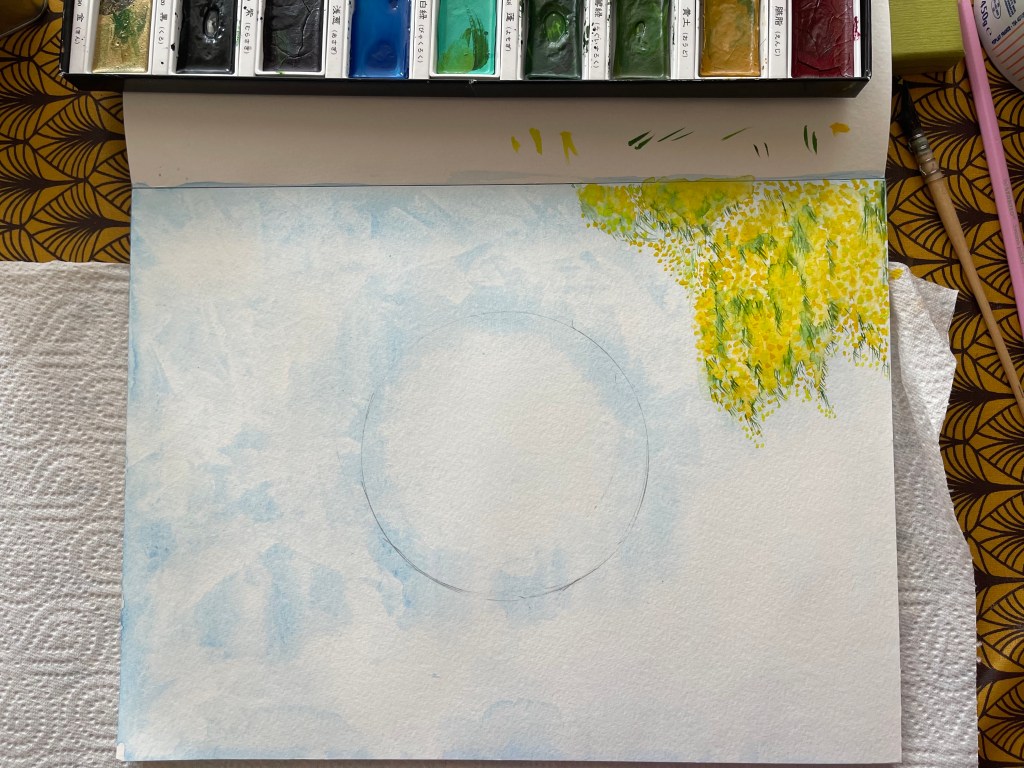
I used this exercise as an opportunity to work with reflections. I love to stare in the rectangular pond in my garden, where I can see the sky, the clouds, branches of trees and water lilies. It is a natural stage, and there is a new play every day. I have used my Japanese Tambi set of aquarelle colours and Motvall paper for aquarelle works from Canson. If I look carefully in the reflection, I can see many layers:
- The sky is layered by water.
- Another layer are shades from trees and plants.
- Another layer is the bottom of the pond, with residues of old leaves and soil.
This reflection in the pond is a very complex stage. Aquarelle is the best medium for this exercise. I did my study in a rectangular shape as it is with the pond and made another one, making the reflection in a round shape. Below is my work in progress. My perception of “incision in the space” was like seeing another reality through a window. Like there is another whole world and dimension, a door to enter to get into another world you can see from this Earthy plane, provoking a feeling of estrangement. Working with reflections made me work in the landscape genre, developing a constructed reality, abstracted topographies and complicated vistas. As Barry Schwabsky says in his book “Landscape Painting Now”, 2019, p. 311: ” A vista … is a view, but not just any view: it is a view out to a far prospect …. succession of planes or objects.”




Contextual Focus. Reading link 33 in the course book of the Painting 2, part three.
I have followed the link from OCA learning platform resources and the code “404” has appeared. I googled the name of the link and I guess we are supposed to read the text by
Lyle Rexer, “The Multiplication of being, or a reflective abyss”, online on http://www.tate.org.uk
I have understood the following author’s ideas about the mirror as a tool and as an element in painting/artwork:
A mirror can bring reality scenes in a compelling and detailed way. “These are the mirror’s two poles: the multiplication of being through a plenitude of representations: or negation of that power through creating an impossible void in the space of representation, a reflective abyss” (Lyle Rexer, tate.org).
A mirror has been a complex object to reflect on in Western philosophy and psychology. It brings to the surface of our conciseness the problems of identity, illusion, narcissism, and vanity. Edouard Manet’s painting “A Bar at the Folies-Berger” (1882) has become an iconic painting because of its complex “visual puzzle” when we can gaze at the reflection of the mirror behind the barmaid’s back and, at the same time, we can’t escape from her gaze at us. I think the following explanation of this visual dilemma is best described on http://www.manet.org: “Manet seems not to have offered a single, determinate position from which to confidently make sense of the whole”.
An inevitable shift happened around the end of the 70s of the XXth century, when the mirror, with its reflective ability, started to be actively used by photographers. There is a particular type of relationship between photography and the mirror due to their common ability to represent reality. Both mediums are very reflective. Incorporating/using the mirror in artworks allows reflecting on philosophical concepts of Art and Theory of Art, such as: “Art can not deliver us from this true tyranny of its own appearances, the tyranny that points us towards a Platonic search for the origins of some singular truth outside ourselves.” (Lyle Rexer, “The Multiplication of being, or a reflective abyss”, online on http://www.tate.org.uk)
In my further readings and research, I have the following important observations about the mirror and its usage in art.
Besides the fact that the mirror’s reflective surface has been actively used in artworks to suggest to the viewer complex, multidimensional, or several viewpoints as well as philosophical problems, the mirror has been a crucial/essential tool for artists for centuries. They have been using it for self-portraits and as a learning tool at their starting point for a precise and accurate depiction of body features and figures.
In their paintings, artists used the mirror to symbolise such categories as “truth” and “sight.” The reflection of a particular object (usually a human’s skull) in the mirror meant the transience of earthly life and pleasures. However, the reflection in the mirror could also signify a “deeper truth”. The reflection in the mirror is often an allegory in the artwork.
Another use of the mirror or reflective surface incorporated in the artwork was the artistic desire to add some compositional complexity and an engaging, fresh viewing point. Many artists used mirrors in their paintings to show the drama in the “story” they have depicted on the canvas. The most famous example of this is the painting “Las Méninas” (1656-1657) by Diego Velázquez. Below, image via http://www.metmuseum.org

Bibliography: “A Bar at the Folies-Berger. Edouard Manet”, online on http://www.manet.org, [accessed on March 27th 2022]; “The Multiplication of being, or a reflective abyss”, by Lyle Rexer, Tate Etc, -1 May 2010, online on http://www.tate.org.uk); “Symbols in art: Mirrors & Reflections”, Christopher P. Jones, Aug 13, 2019, online on http://www.medium.com, [accessed on March 27th 2022]; “Reflections on the mirror in art”, by Anne Walentine, 14 Kan, 2022, on http://www.artuk.org, [accessed on March 27th 2022];
 JeanArt