Exercise 1.2. Before and after. In this exercise we have to us an image from Exercise 1 or 1.1. and imagine it as a still film or animation. Using the format of a film, construct a series of painted images that imagine narrative inspired by, and including, your original painted image. We should think about different options of presenting the work, taking into the account linear or non-linear narrative, sequence of events – chronological or sequence of events moving backwards and forwards in time. We must consider use of filmic techniques, such as close- ups, panning shots, change of view pint, dialogue to camera, etc.
Research point: “Draft of a Voice-Over for Split-Screen Video loop, 2012”, Vimeo, Link 29 from Painting 2, Part III, work book, [accessed on March 3d, 2022];
I enjoyed the animated video of the poem by Lisa Robertson, and it was beneficial to me to understand and implement the exercise. In addition, Amy Sillman’s drawings are bold and expressive. The whole idea of animating the illustration of the poem is very creative. I find the graphics enhance the poem’s effect, and their style directly influences our perception of it. Amy Sillman uses both sides- the right and the left one to illustrate the poem. She offers and places her drawings in some dialogue, which outlines the whole idea of the poem: woman’s interaction with the surrounding reality, with the world. Engaging both sides, making them changing and dynamic, is best to show the existential problem of a woman raised by the poem. If I imagine just one image, the effect would be different even if it is animated. Working on both sides, engaging viewers’ attention with both sides, brings the complexity of the woman’s problem to the surface, raised by the narrative.
I also liked the animation as the tool to unfold and develop this particular narrative. It gives the intense feeling of the fact that things here are mortal and time flies. Images on both sides change quickly; what signifies the problem of existence: everything changes, disappears, fades and vanishes, while your questions remain open and unanswered. When I was watching this video, I also saw that the images on both sides, even though they have been in some dialogue between each other, were immersed in and living in their own reality. Some separation between them was apparent, which is precisely the source of conflict described by the poem.
Research Point: Juetha Koether, “Seasons and Sacraments”, Link 30 in Painting 2, Part III. work book. [accessed on March 3d, 2021];
Jutta Koether’s layers appeared very inspiring to me. If we think about developing a narrative via visual arts/effects, layering also brings a lot of philosophy. Nothing around us is left untouched or happens without a mark and trace. Some memories left and stay alive, at least for a while. These are layers of our reality, of our conscience. Reality always is multi-layered, so I find this approach in painting profoundly philosophical. The artist explains her layers as “there is never a one thing, this idea that an image, and an image, and an image on top of each other and that is a performance….” Exactly, there is never one straightforward, simple thing in our reality. It is so multi-layered, and it goes further even more complex because each of us picks up and creates new layers by the nature of our consciousness. Koether’s paintings imitate the same process: gazing at her multi-layered paintings, we see different layers and different objects differently.
Reading point. Link 31. Bibliography: “Time and Narrative”, James Elkins, online on http://www.academia.edu, [accessed March 3d, 2022];
“A single work can symbolise time without moving” (p.4, J. Elkins “Time and Narrative”)
“In painting more than once seen can take place within a single frame, so that a single picture can represent a several different times in “continuous narrative“(p. 4, J. Elkins “Time and Narrative”)
Below I put some thesis from the reading LINK 31 in the coursebook. I usually do so while reading because it helps me focus on reading’s main ideas and do the exercise and answer questions. I keep quotes and write my understanding of the author’s ideas. We were required to read the second part, which starts from page 38, “The Place of narrative in Contemporary Art”. I have read the whole reading because it was well written and engaging.
Part One.
- All artworks are subject to time, and they change over time. It takes time to make it, and it takes time to see/view it, to remember it. Many artworks reflect on time and show things in time. For these reasons, as James Elkins say (p.2): “..all visual art has to do with time.”
- There are specific ways of representing time in visual arts. “Time can become part of artworks in many ways” (p.3, J.Elkins)
a) artworks can represent any objects in motion: moving figures in figurative drawing, moving vehicles and objects of nature; Any gesture, any dynamic brush stroke, including in abstract painting, represent motion.
b) artworks depict objects which symbolise time- clocks, hourglasses, Sphinx, gravestones; Many objects can represent time and its passage, such as mountains, castles, ruins in vanitas paintings. “Symbol of time do not have to show any sign of motion” (p.4, J.Elkins)
c) visual art is often about narrative represented in a sequence of images, of individual pictures;
3.”Narrative is fundamental in the sense that we always look for it as a preliminary way of understanding what we see” (p.25. J.Elkins).
4. “The disruption and erasure of narrative, whatever its reasons and its meaning, leaves artists with a major unsolved problem” (p.25, J.Elkins).
5. “The problem is how to make a large-scale work without a story and still keep the viewer’s interest” (p. 25, J.Elkins)
6. Deductive and Associative reading. Any artwork is usually viewed and perceived by a viewer as “seeing as puzzles’ and as “opportunities to meditate”, as James Elkins calls the phenomena of viewing art (p.33). A viewer is always searching for hidden messages in an artwork, decoding it, trying to understand the narrative, moral, and idea behind the artwork.
7. “Frozen narratives, the moment and the instant”. There are different approaches to depicting time and narrative in art history. Some authors preferred to show an instant moment – “punctum temporis” of what just happened, “pivotal points”. Others thought it was more important to show a “turning point”. However, such art historian as E.H.Gombrich argued that there was no single instant moment because every moment exists in the context of time and events, which are anticipated and “looking ahead” (p.35, J. Elkins).
8. Chronological and non -chronological narratives. Non-chronological narratives are the epitome, the anatomy, the index, the encyclopedia.
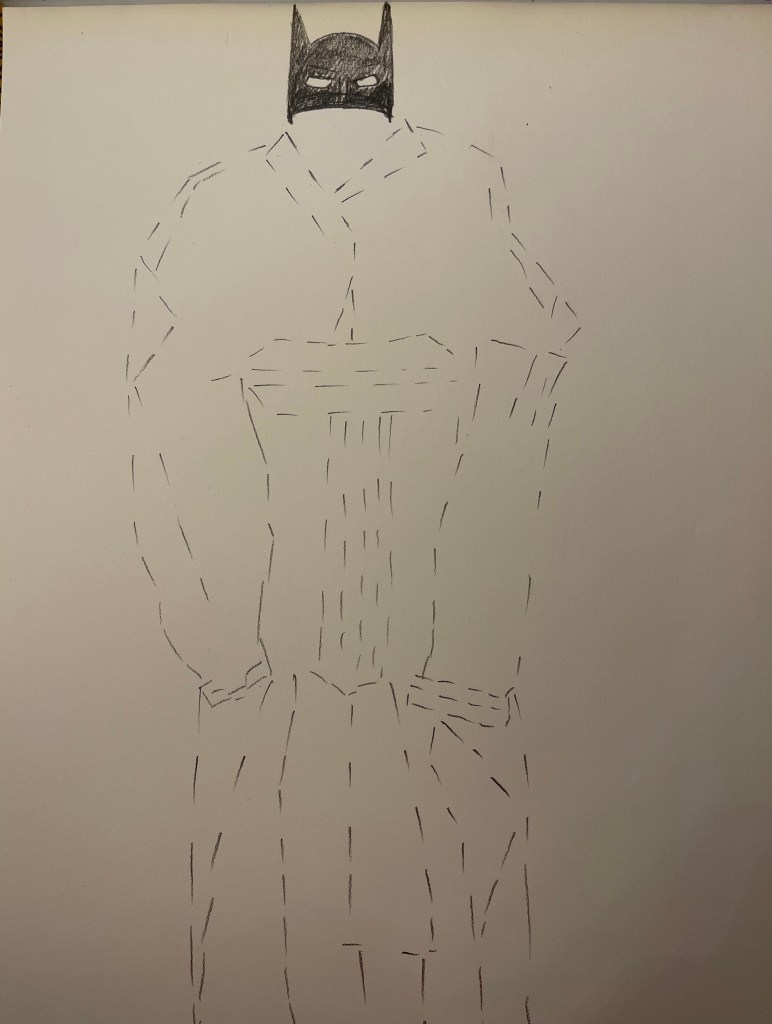
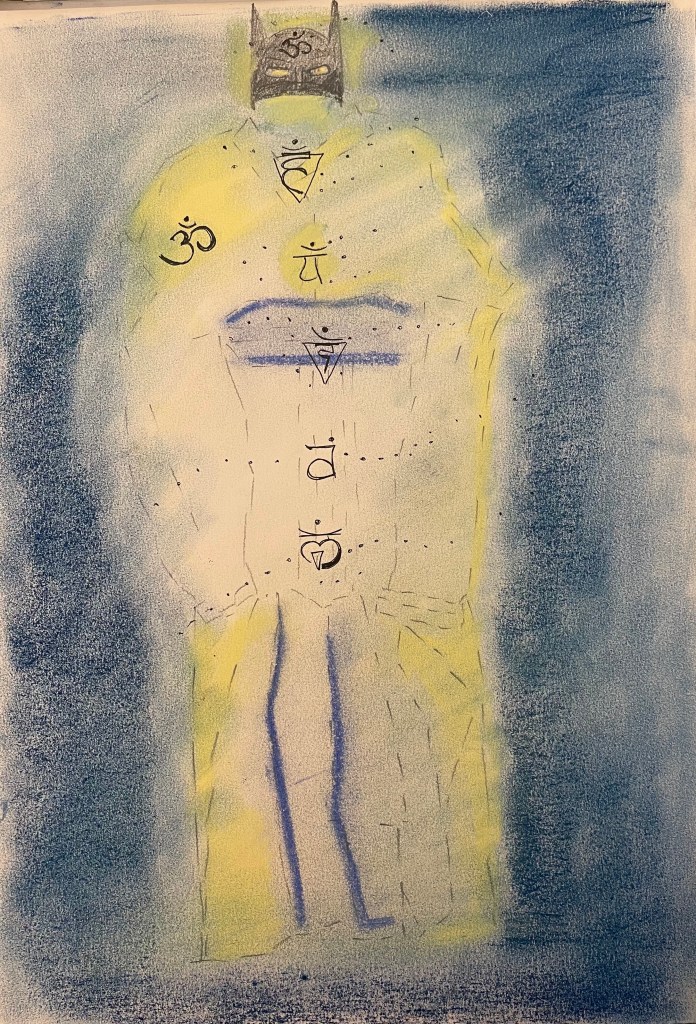
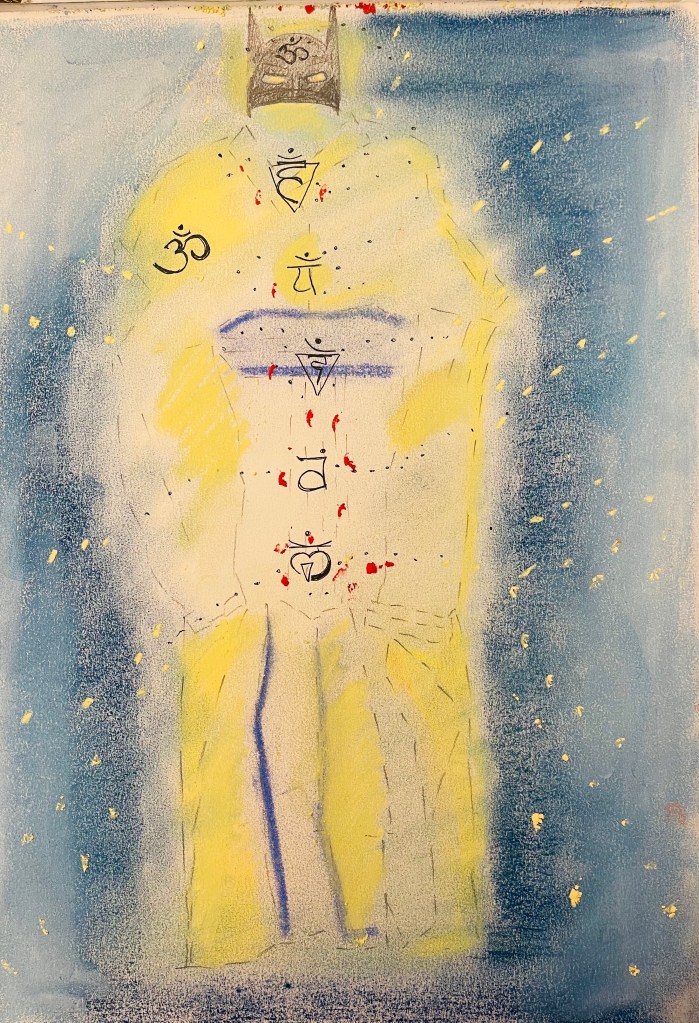
We have to reflect on the ideas and approaches described in the reading how they influence us in our work for the exercise about the narrative sequence. I agree that this reading was essential to a better understanding the “narrative” as a concept in visual arts. In my artworks, I have not been yet focused on time and depicting an accent of time and the motion of objects. However, it is interesting to observe the author’s point about how time is related to any artwork in my works, even though I was not thinking about depicting it. A good example would be my nature morte work about pears I did for Painting One course. That work depicted aged pears, inspiring because of those little spots and dark brown scars on their skin. Now I understand that the time factor inspired me. I liked their unperfect and aged look. Before this exercise, I had never thought about sequencing and narrative in my artworks. At the same time, the author is so reasonable that the narrative is always present in the artist’s mind. I can’t come up with inspiration and produce actual work without reflecting on what I want to do. This reflection is always a story, even though I often depict a single moment from the life of my object of inspiration. When I think about that in the context of an inevitable connection between the Time factor and artwork, I realise that when I depict my mimosa branch with flowers and leaves, I am touched with the moment of its life. In other words, I want it to exist in my memory and on my wall to prolong the short time of the delicate and fantastic beauty in its blooming moment. Thus, the moment in time is inspiring me. J.Elkins’ ideas are very engaging because I am quite the opposite of Greenberg’s views on art and the whole division of Formalism in art. I never create just for a shape or colour’s sake. I see stories around, and I want to tell them in my way. For this part of the course and the exercise, I came up with a narrative depicting my artistic view on reincarnation. My sequence was made in chronological order:
- The preparation of the soul for reincarnation.
- Time on earth.
- Leaving the body after the mission has been accomplished.
Part Two.
- “….narrative is one of the crucial issues in visual studies, but one with the smallest literature (p.38, J. Elkins).
- “It is acceptable to make truncated narratives… But it is not normally advisable to use photography or painting or printmaking to tell stories…..The narrative isn’t dead, but it’s a dead issue… The avoidance of narrative is one of the grates dogmas or working assumptions of art production, criticism, and instruction (p.39, J.Elkins).
- The narrative process in visual arts is more complex than filmmaking or writing. It is characterised by the following (below by J. Elkins, p.44):
a) “The order of occurrence may not exist”;
b)”The order of telling is not clear”;
c) “The order of readings is always impossible to parse’;
Bibliography: “Formalism”, editors of Tate, online on http://www.tate.org.uk. [accessed on February 28, 2022]; “The Narrative and Time’, James Elkins, online on http://www.academia.eu, [accessed on Feb 25th, 2022];
I have found J. Elkin’s quotes mentioned above fascinating. However, I wish I could read his particular work while doing the Understanding Visual Culture course, in part covering Clement Greenberg’s theories and views on art. I agree with J. Elkins that “too much narrative” is not welcome in the artwork. For example, the illustration genre is considered a “low class’, unintelligent type of art, almost “kitch”, which is appropriate to children’s books only. However, I think the art culture and professional art society are still greatly influenced by Greenberg’s views on art. For example, he argued art should be free from any ideas behind it, and an artist should create only for the sake of medium, the flatness of the canvas, shape and colour. The viewer should analyse the form of the artwork- the way its made, how and what it looks like, trying to appreciate its purely visual features and aspects without establishing any connections or relationship between the art object and the visible world. We can say Greenberg was anti-narrative in art. I can see that the visual art culture and professional circle is in some sense intimidated by Greenberg’s claims on superior intellectuality of abstract art. This is the reason why there is no much literature about the concept of narrative in visual at, and it is so much underrated.
After reading and research we have to reflect on the following: 1) How did working on related images impact on your process? 2) Did you work on one after another or work with all the images simultaneously? 3) Did working this way helped you to about alternative ways of viewing the paintings?
Both videos and the reading were beneficial to me to understand how I could do my NarrativeNarrative and sequence of images. They also greatly influenced my artistic development because the reflection on Narrative and creating a sequence gave me more confidence in approaching my creativity. Suddenly, instead of rigidly fixing my creative idea on some fixed visual image, a fragment, I realised that I could develop a larger/longer story. My story reflected in my sequence makes my artworks more complex. Therefore, I feel as Narrative and sequence/series are very enriching for my artistic pursuits. I worked on a series of images, presenting my artistic perception of the idea of RE Incarnation. The development of images- stages of reincarnation came to me quickly. The whole process was smooth and felt very natural. This part of the course and the exercise literally opened a new dimension in me as an artist. Also, it does upgrade your skill of viewing any other artworks of other artists.
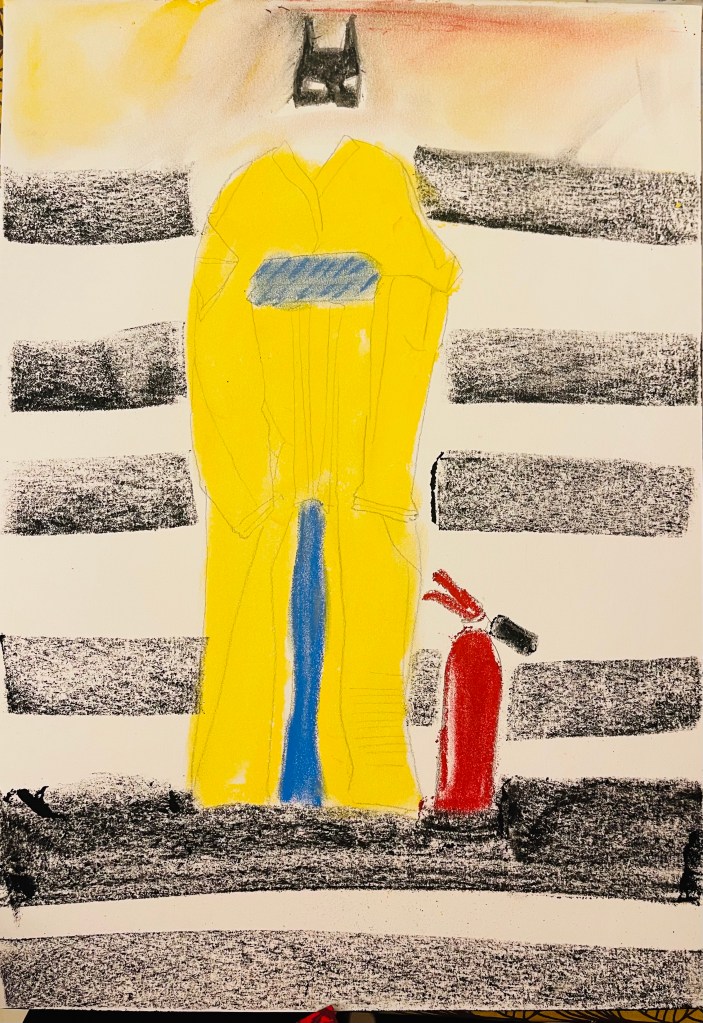
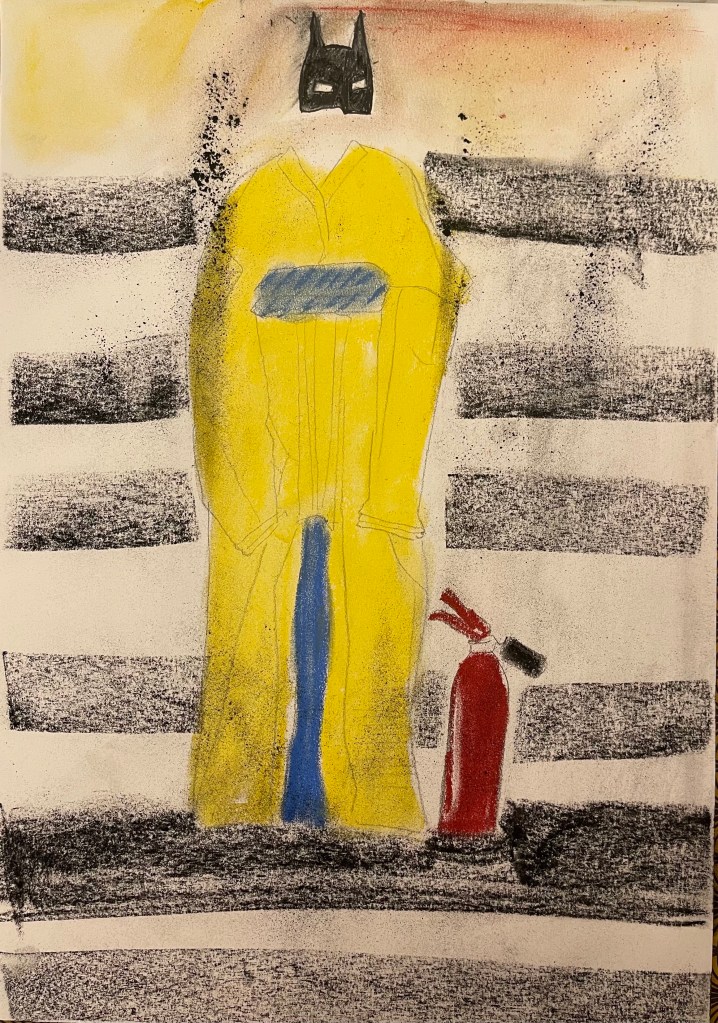
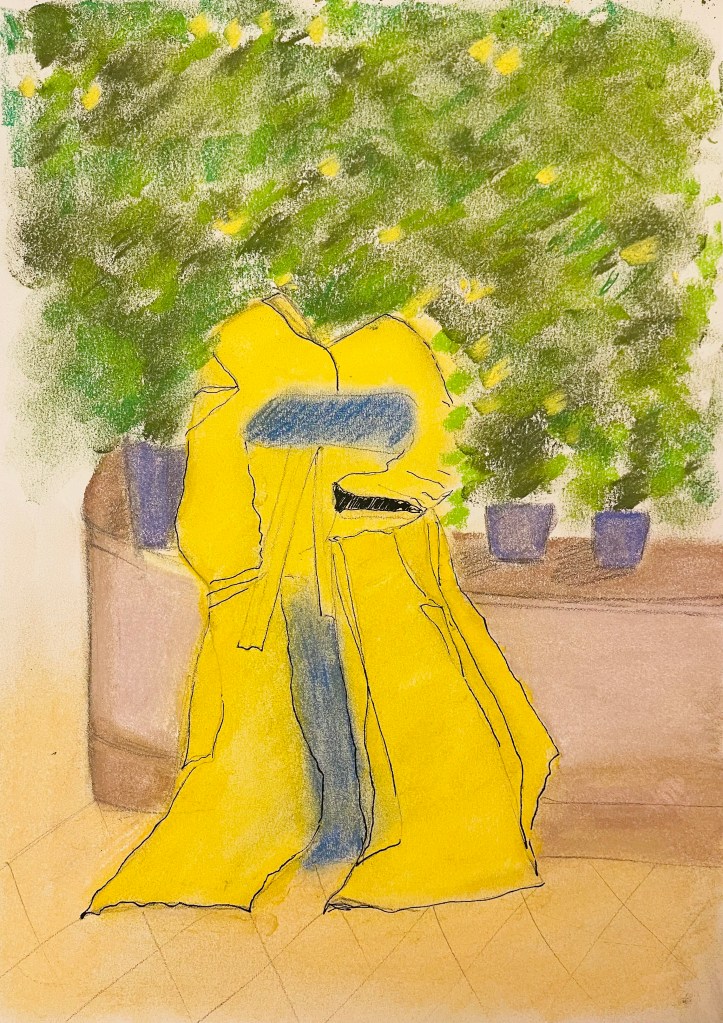
Below is my sequence of constructed narrative for this exercise.
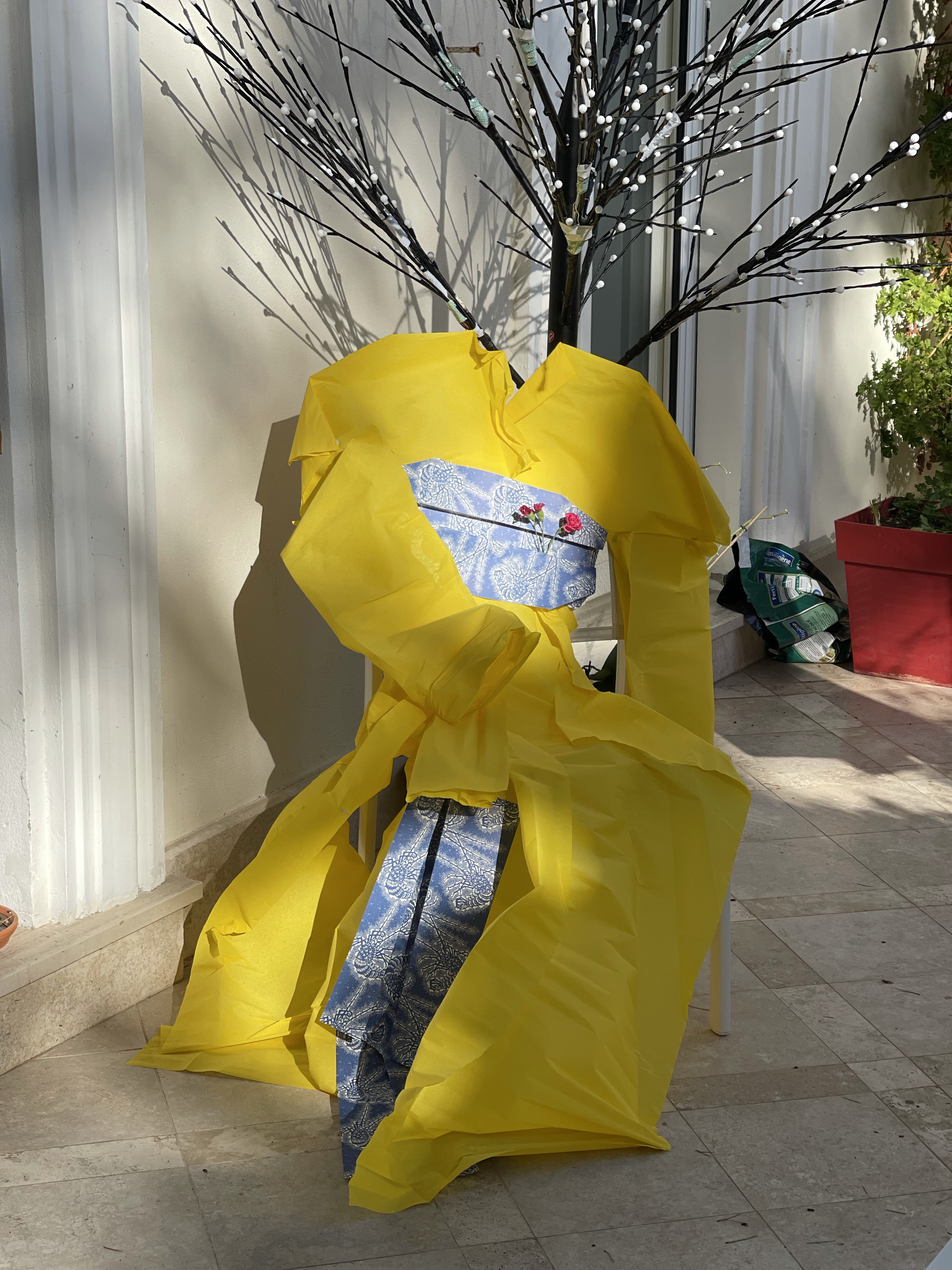
I used the image of my Samurai paper cloth piece and my installation with it and a fire extinguisher. I developed my narrative as a story of soul’s reincarnation on this material plane on Earth and it is presented in chronological order. I used A3 size sketch paper from canon, soft pastels from Sennelier, black ink pen from Uni Pin, 2H pencil from Daler Rowney. I have developed 4 sketches (below) and then used an application “InStories” to make a sequence of images. Click the video below.