
History of Colour Theory.
Before Michel-Eugene Chevreul there were at least 3 people who tried to think about the phenomena and concept of colour: the Greek philosopher Aristotle with his work “De Colouribus”, Renaissance Art theorist Leon Battista Alberti (1404-1472) with his handbook “Della Pittura” and Sir Isaac Newton with his discovery of colour spectrum.
Project 1: Understanding colour
Colour Theory basics
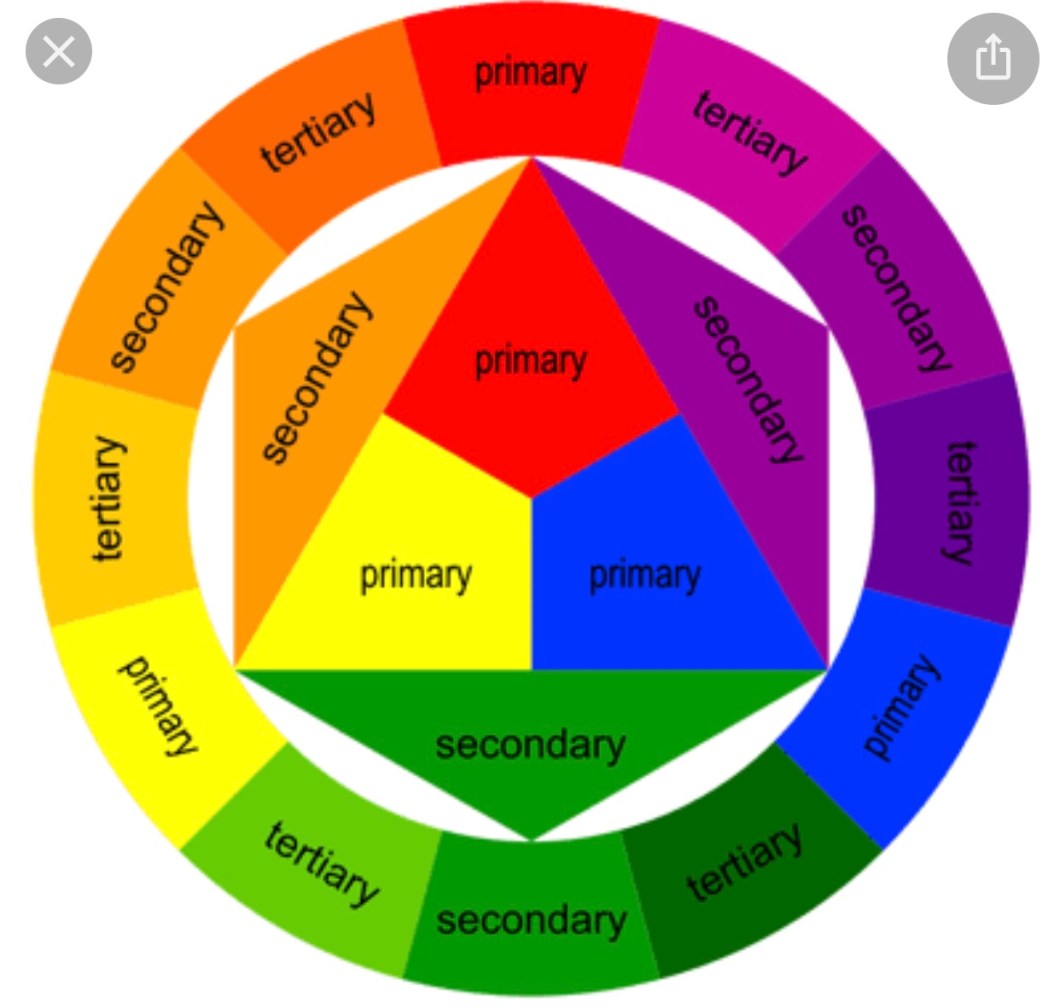
Primary colours – red, yellow and blue – can be used yo create any other colours;
Secondary colours – purple, green, orange – are created by mixing primary colours;
Tertiary colours: red-orange, red-purple, blue-purple, blue-green, yellow-green, yellow-orange – are created by mixing primaries and secondaries;
Characteristics of Colours:
Saturation – intensity or purity of the colour, it is measured from “high saturation” what means as vert bright hue to “desaturation”, what means when the colour is washed out.
Value – brightness or darkness of the colour, the degree of brightness or darkness of a hue from light through mid tones till dark.
Entire image can be produced using one colour with different saturation
Too much saturated colours ruin the image – saturated and unsaturated colours must be present in painting
Tone -tints and shades of colour yo make it lighter or darker. Any colour can be different in: “shade”- a hue produced by adding black; a “tint”- a hue produced by adding white; a “tone” is a hue produced by adding grey;
Colors are divided by the temperature, there are warm and cold colours;
I really liked how “Colour Harmony” notion is defined by an Marco Bucci on his YouTube lesson about colour theory: “Colour Harmony is the combination of simultaneously displayed colours that produce a pleasing effect” which he derives from the notion of musical harmony in the Dictionary. I find his Colour Theory tutorial as one of the best one because he brings in a very comprehensive way the idea of “communicating” colours which can “shout” or “have a beautiful conversation” in any painting.
Image from “Analogous Colours and Colour Wheel” by Harshani Chathurika; uxplanet.org;
It was very interesting to discover a scientific opinion in the article on visual-arts-cork.com about the Colour Theory. I should like to quote the whole piece:
”…please, note that most colour theory is still in its infancy. The science of colour-optics remains somewhat confused, while colour-psychology is still highly underdeveloped. To illustrate how far we have to go properly to understand the colour, and its effects on human eye, consider this: computers are capable of identifying up to 16 mln colours, while humans can detect up to 10 million: yet there are only 11basic colour terms to be found in any of 98 languages studied by anthropologists Berlin and Kay during the 1960s.Until we find a way of familiarising ourselves with a greater number of identifiable tonal variations, our knowledge of colour theory and its underlying concepts is bound to be seriously incomplete”.
Colour harmony: colour schemes could be as follows:
1) Monochromatic – one colour;
2) Analogous – adjacent colours like red, orange and their mix;
3)Triadic – equally distant from each other on the colour scheme
4) Complementary – opposing each other on the colour wheel like yellow and purple, red and blue;
5) Split complimentary – very much like complimentary colours but allowing to use a third colour;
6) Tetratic or Double complementary -two pairs of opposite colours;
Research point: Find out more about the colour theories of Chevreul and make notes on how particular artists have used Chevreul`s theories to expand the possibilities of painting.
Chevreul colour theory.
Michel-Eugene Chevreul (31.08.1786-09.04.1889) was a French chemist who studied the chemical composition of animal fats and developed a Theory of Colour which influenced the techniques of French painting and is still considered as an absolute necessary concept in fine arts education from painting to photography and interior design. He is one of the most prominent figures in a science of organic chemistry who through his extraordinary long life (102 years) has elucidated the chemical composition of animal fats. His works and research improved the complex methods of extraction, isolation and purification of fats what led to much better underrating of of their composition and chemical compounds. His work “Recherches chimiques sur les corps gras d`origine animale” (“Chemical research of animal fat”) is considered as a classic study. After 1824 his carrer path brought him to solve the problem of tapestry colours in Gobelin which seemed to lack of vigour in their colours. He found that the problem was not chemical though but purely optical. His study “De la loi du contraste simultané des couleurs” published in 1839 – “the Laws of Contrast of Colour” has become a most influential work. He brought the colours of the visible spectrum into a circular system. Some very prominent artists have been inspired by his work and implemented his theory in their paintings such as Eugene Delacroix, George Seurat and Paul Signac. In the article of Qlbert B. Costa it is stated “… The Impressionists, in their research for ways to make light and colour appear more brilliant, found valuable Chevreul` s advice that they should apply separate brushstrokes of pure colour to a canvas and allow the viewer `s eye to combine them optically.”
Reference list:
1). Youtube; understanding colour by Blender Guru
2). Youtube; Colour Theory basics; Simple Art Tips channel
3). YouTube; Colour Harmony, 10 minutes to Better Painting by Marco Bucci
4). Britannica.com; Michel-Eugene Chevreul, French chemist; an article by Albert B. Costa;
5). “Analogous Colours and Colour Wheel” by Harshani Chathurika; uxplanet.org;
6).Colour Theory in Painting: Colour Wheel, History of Colourism,Characteristics/Effects of Colours, Psychology” on visual-arts-cork.com;

