
A while ago, I noticed some posts on my Instagram account that gained popularity and became more frequent, discussing the traditional approach, where visual artists typically depend on collaboration with art galleries. This approach has been disintegrating, if not vanishing, due to the independence artists have today, thanks to social media platforms and the internet. Indeed, these days, any visual artist can gain broad public exposure via Instagram, TikTok, or Facebook if their work goes viral. Today, visual artists no longer need galleries as much to expose their work, as galleries can offer them high-quality curatorial assistance and unique exposure to their customer base, including high-profile or dedicated art collectors. I couldn’t resist including some screenshots with discussion on this topic on the @hypeart page (682K followers) below. As a virtual gallery, the account owners are interested in supporting the idea of “slow death of the contemporary art gallery”, attracting many professional visual artists and inviting them for discussion, which was engaging and actual for me.

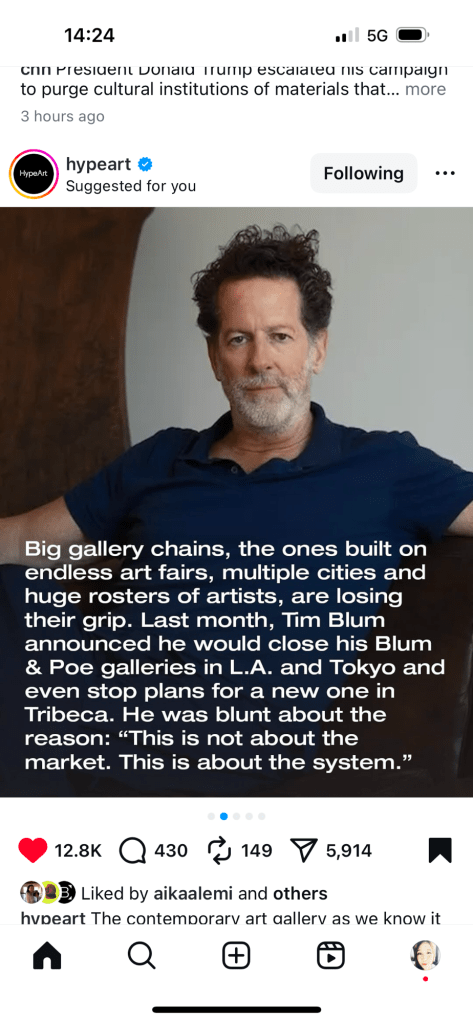

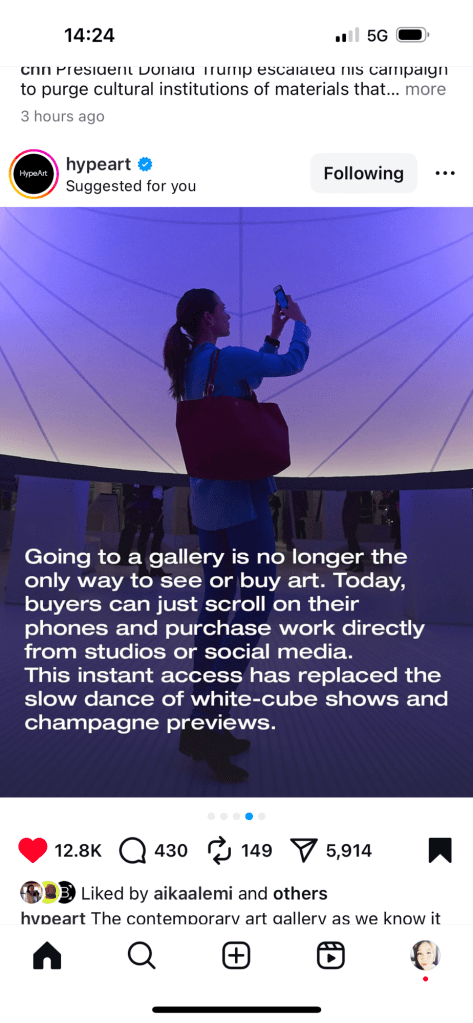

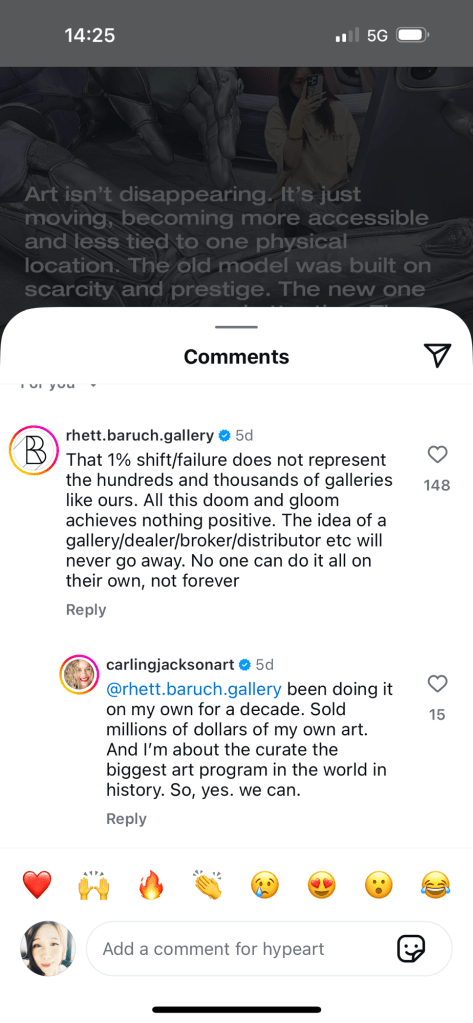
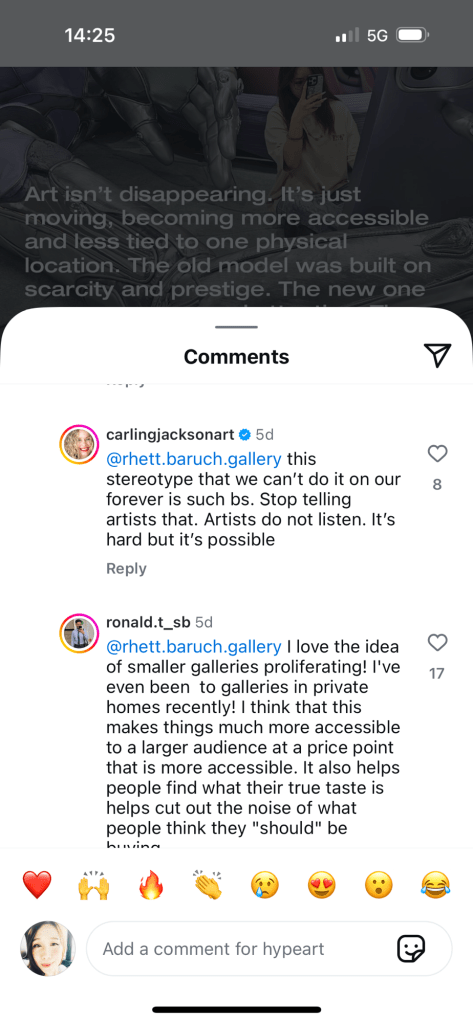
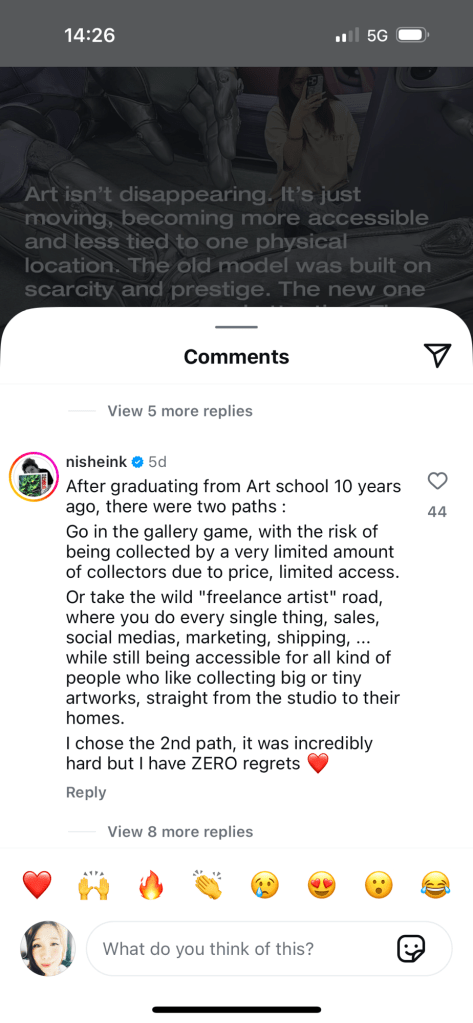

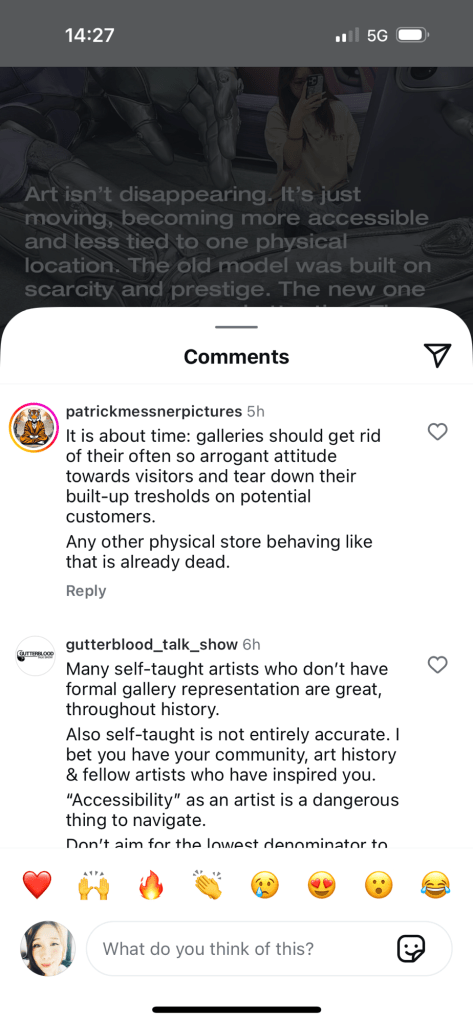
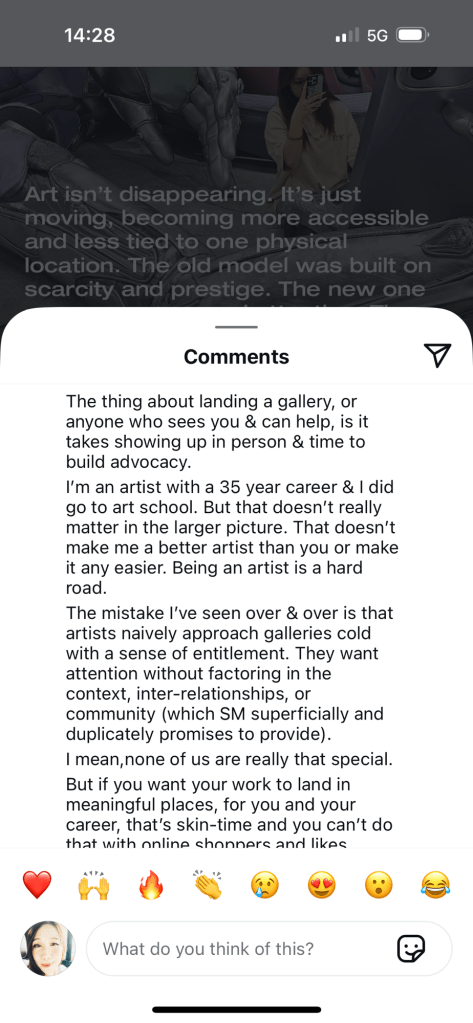

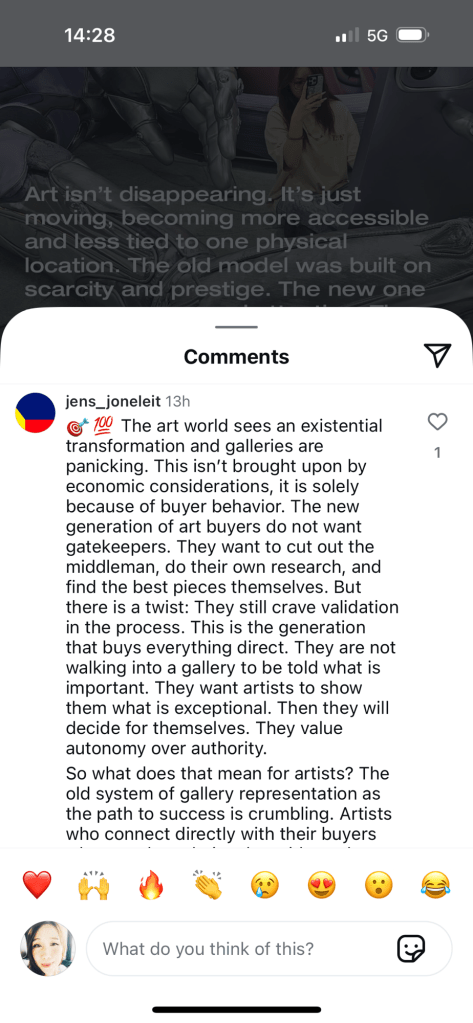
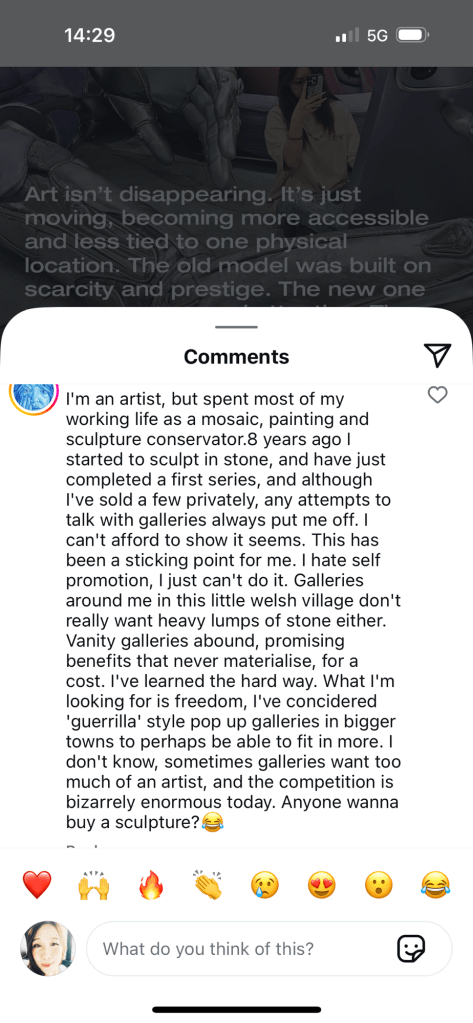
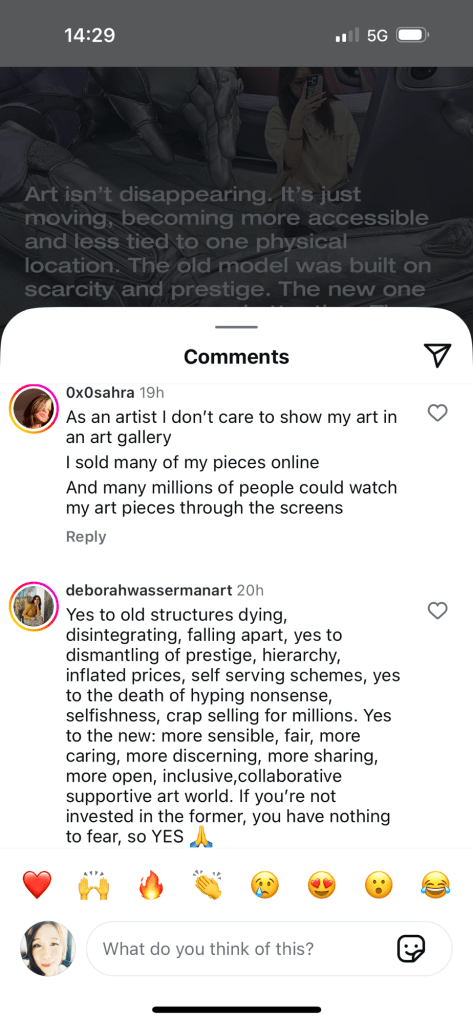

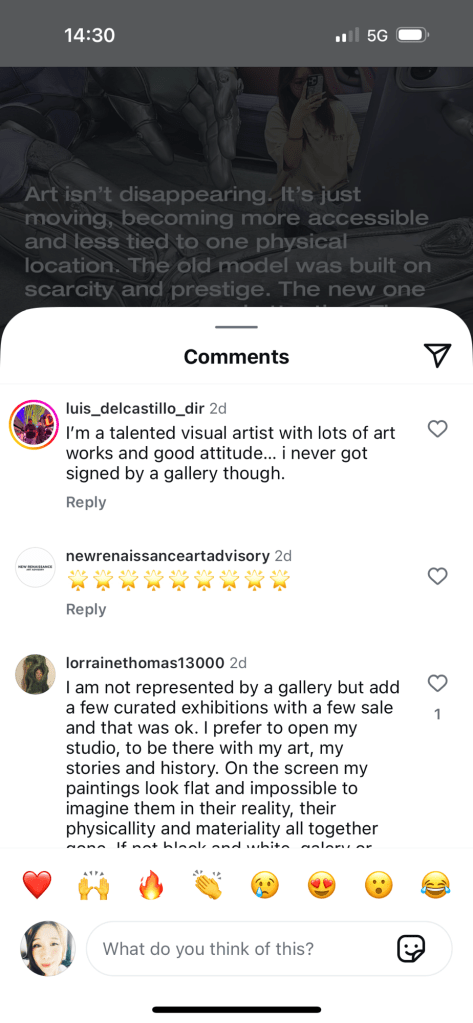
Most comments I read were made by visual artists, who follow an independent professional approach, arranging their own exhibitions, private viewings, and fully controlling their sales. I have reviewed all 450 comments, a discussion among gallery owners, art critics, and practising visual artists. What I understand now is the following:
- Most artists are underrepresented by art galleries and have experienced the “arrogant” and “cold” approach from them. This is true and I experienced it as well, actively visiting many art galleries in Soho and Upper East Side in NYC, as well as in Paris and places where I love. I can add that all galleries I have visited (even those that are well-established in the industry) follow a very professional approach when dealing with prospective visual artists and potential clients. I have posted a screenshot of my comment below in the discussion thread.
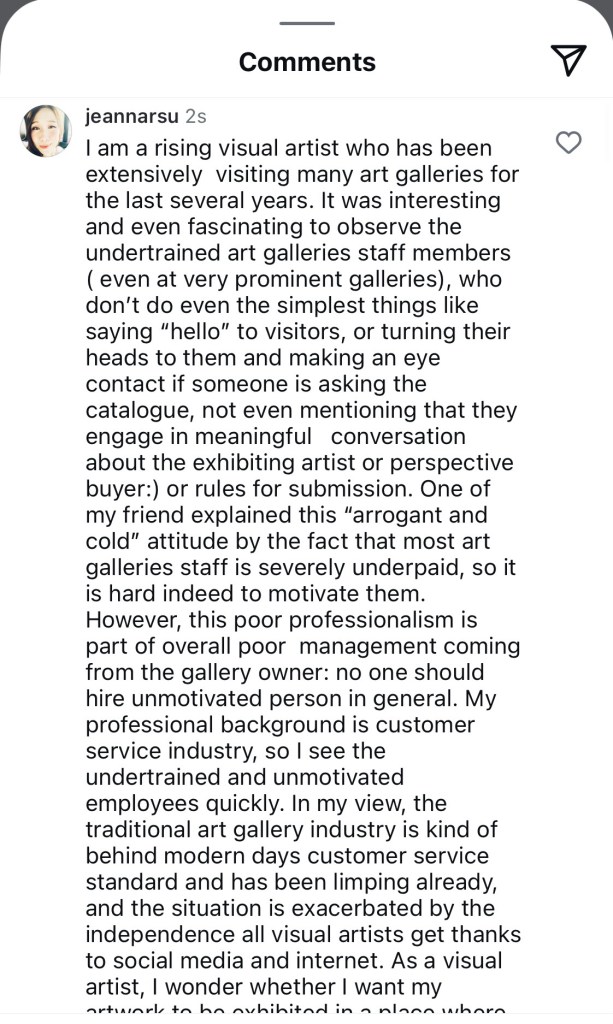
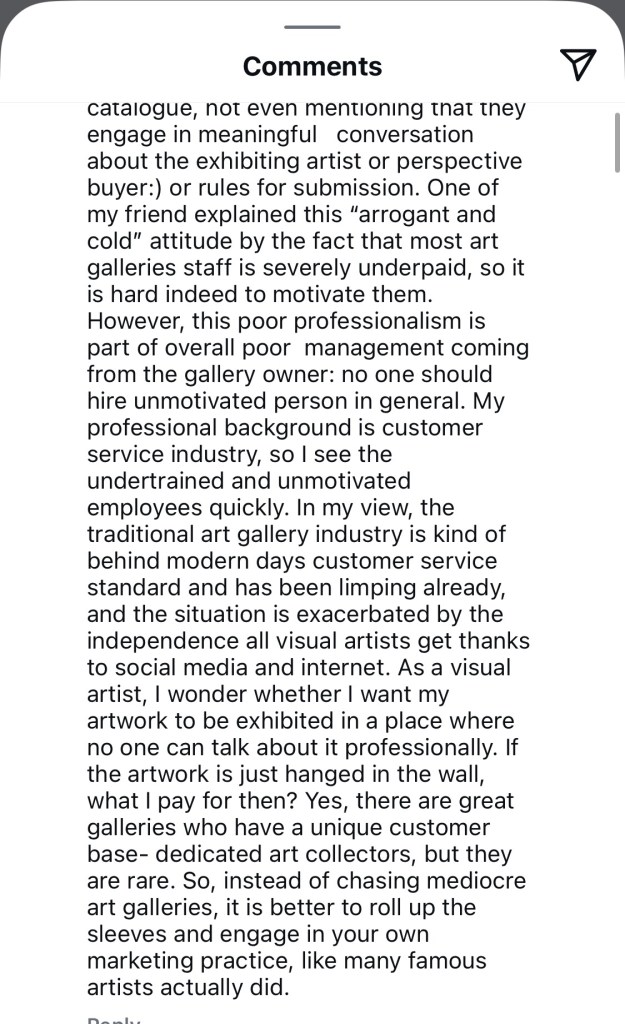
2. Traditional art galleries still have their place, because, and I agree with that: they are the place where viewers can gaze at the original artwork. I firmly believe, based on my intuition, that the original artwork holds an extraordinary power over the flat digital image on the internet. However, visual artists these days should not be desperate if they don’t get represented by any art gallery, since they are indeed empowered by the internet for self-promotion, and no one limits their power to do an exhibition.
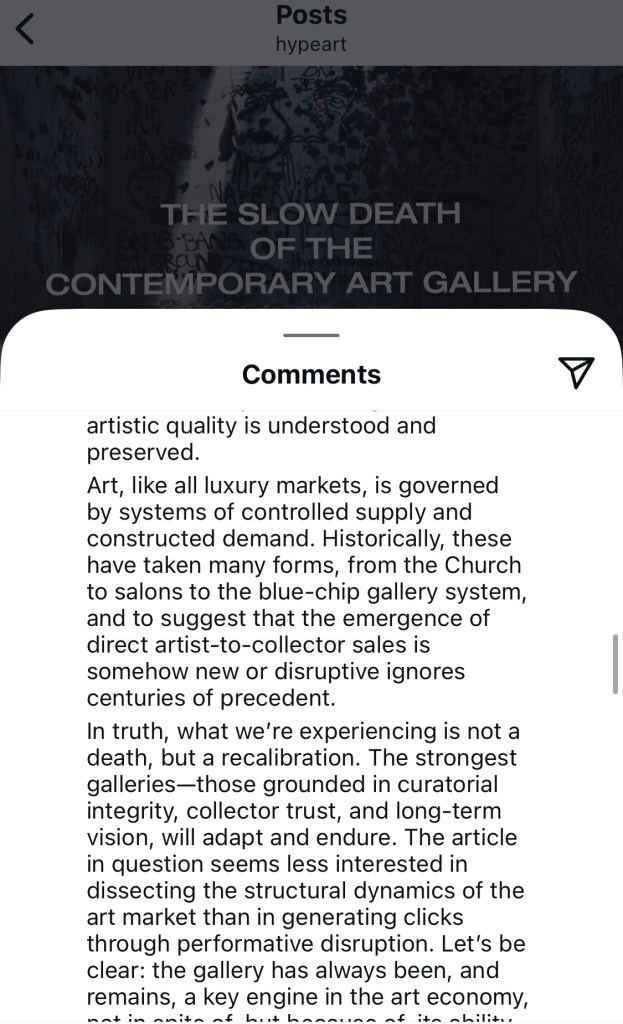
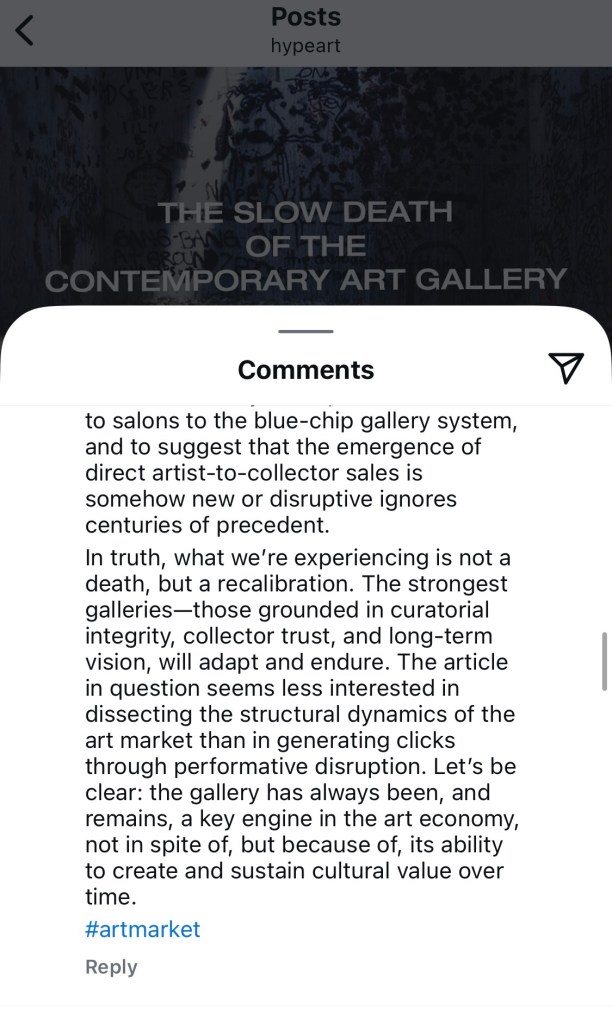
3. I also partially agree with the comment below, made by a professional art gallerist, Louis Buysse, that “digital tools cannot replace the complex, community-driven ecosystem that galleries sustain…. Galleries create context, critical farming, and a shared value system through which artistic quality is understood and preserved.” I agree that galleries possess the qualities described; however, it is essential to understand that with digital tools artists have now, they (galleries) have lost their exclusive rights (after museums) to create the context and the value of the artwork. If someone is a seasoned art collector who discovers a virtual, unconventional gallery, bypassing the traditional gallery or via the artist’s website, with potential,ct strip away the artwork’s purchase rising artist in the context and the value of the how can this fa? We are all aware of the most commonly adopted theory of art, which is an institutional theory. The problem of any art gallery ( especially of the mediocre one) is the simple fact that it doesn’t possess any exclusivity on professional art opinion. There is an entire row of art professionals before any art gallery – independent art critics, art curators, museum curators, and art collectors who form their institutional opinions about the art object, creating the context and value, and the art gallery has quite limited influence on it. It is evident that, with the advent of the digital era, art galleries have taken a new, more humble place in the industry. Apparently, there are art critics and art curators who heavily rely on preliminary art critique selection work done by galleries, so they will stay as a permanent element of the mentioned “complex ecosystem”. Still, I firmly believe that any art critic has a quite independent mindset and that no gallery can have the last word in an artist’s appraisal process.

_________________________________________________________________________________
In July, before my exhibition, I also had a helpful conversation with a professional art dealer, who strongly recommended that I not approach all art galleries indiscriminately, as they are very different. She was very straightforward about how a collaboration with the “wrong” gallery can bring me a lot of damage, being particularly harmful at the very vulnerable stage of my career when my reputation is still under construction, warning me that I might “get stuck with a bad gallery”. As part of my research on this topic, I had also read the following articles on the “gallery-artist” relationship.
https://www.artbusiness.com/bad_art_dealers_galleries.html?utm_source=chatgpt.com
This article was helpful to understand the “red flags” such as: secrecy in pricing and selling process, overpromising like grandiose sales, and pomposity of the gallery. This article mentioned the risk for the artist of not being paid if the gallery gets into overall financial distress:
“Dealers commonly stop paying artists because their galleries run into financial problems. Reputable ones will approach their artists, tell them what’s happening and try to work through difficult situations; less reputable ones have no qualms about taking whatever profits they can get before the ship sinks. So an excellent idea is to regularly speak with other artists they represent and keep tabs on how things are going in terms of getting paid. If you don’t, you might not realize what’s happening until it’s too late.”
I find this risk to be a significant reason which might prevent the artist from working with a mediocre gallery. No one, except the gallery’s owner, knows its financial situation.
The article above helped evaluate my current state and determine whether I am ready to approach the galleries. I think I am almost ready. I have acquired a substantial amount of business knowledge and possess strong business skills, including proficiency in working with legal paperwork. However, I still need to establish my permanent website and build more work for my Mediterranean theme to be able to approach the galleries with a strong cohesive body of work.
The article above was helpful to review different options artists have for exhibiting their works, including galleries and alternative spaces such as public libraries, community centres, and restaurants. I don’t exclude the collaboration with interior design firms and working directly with art collectors. The article reviews the pros and cons of these options as well and sounds encouraging.
This article helped me understand how to appear reliable and reputable to any art collector, as it outlines the standards art collectors should consider when evaluating a work for acquisition.
https://serenademagazine.art/navigating-the-gallery-system-a-practical-guide-for-emerging-artists/
This article is helpful to understand the technical details of submission and approaching the gallery.
Below are some outcomes of my readings:
Brand Damage by Association with a wrong gallery:
- If a gallery has poor reputation, weak curation, or sells art without discernment, being represented there can lower your perceived value.
- Future collectors or better galleries might assume your work isn’t serious simply because of where it’s been shown.
Market Undervaluation
- Some lower-tier galleries price too low, discount aggressively, or don’t understand how to build an artist’s value over time.
- This can undermine your long-term pricing strategy, making it harder to raise prices or transition to blue-chip representation.
Contractual Constraints
- Even modest galleries may lock you into exclusivity, take high commissions (often 50%), or retain control over sales/marketing in ways that limit your freedom.
- Worse, they may be disorganized, unprofessional, or disappear with your work or money.
Signs of a Gallery to Be Cautious About
| Red Flag | Why It Matters |
|---|---|
| No real curatorial vision | Aims to sell anything, not develop serious artists |
| Unclear or shady contracts | Protects the gallery, not you |
| No promotional effort | They hang your art, but don’t actively promote or position it |
| Doesn’t attract real collectors | Shows mostly to friends, hobbyists, or tourists |
| Pushes for large inventory upfront | May hang onto unsold works for too long |
What an artist should Want Instead
- A gallery that champions your long-term vision, not just short-term sales
- One that’s known for building artist careers, not just rotating sales
- A team that has relationships with critics, institutions, collectors
- Willing to collaborate, not just control
- Do pop-up shows, independent exhibitions, or artist-run spaces
- Sell editions directly to collectors — you’re building your market already
- Network quietly with curators, other artists, and collectors at openings or fairs
Questions to ask any gallery before entering into collaborataion:
- “How do you support your artists beyond sales?”
- “What collectors typically buy from you?”
- “What’s your commission structure?”
- “Do you expect exclusivity, and for how long?”
Main question: Is this gallery aligned with my goals and worth the collaboration?
To look in detail:
1. Reputation & Vision
- Do they have a strong, recognizable curatorial voice?
- Do they show artists whose work or career trajectory I respect?
- Are they known for supporting artists over time, not just selling work?
- Do they avoid overcrowding exhibitions or low-effort hanging?
- Have they placed works in collections, museums, or publications?
2. Audience & Reach
- Do their exhibitions attract serious collectors, curators, or critics?
- Is their collector base appropriate for my price level and aesthetic?
- Do they participate in art fairs or collaborate with institutions?
- Are their online platforms (website, Instagram, Artsy, etc.) professional and active?
3. Sales Strategy & Pricing
- Do they understand pricing strategy for limited editions vs. originals?
- Do they respect and support long-term value-building?
- Are they willing to align with my pricing structure without heavy discounting?
- Will they give transparent reports on sales, inventory, and client interactions?
4. Contract & Business Practices
- Is their commission rate fair? (Standard is ~50%, but can vary)
- Are contract terms clear — especially on exclusivity, duration, and payment timing?
- Do I retain copyright and reproduction rights of my work?
- Do they insure my work while in their possession?
- Are they responsive, organized, and respectful in communication?
5. Relationship & Respect
- Do they see me as a creative partner, not just inventory?
- Are they open to my ideas about curation, editions, and strategy?
- Do I feel respected when I speak to them — as an equal?
- Do they support their artists publicly (press, interviews, content creation)?
- Do I feel excited—not just tolerated—at the idea of working with them?
Red Flags to Watch For
- They ask for money upfront to show your work (pay-to-play galleries)
- They demand exclusivity without a proven collector base
- They don’t put anything in writing
As a result of my research on this theme, I have come to realise that I no longer need to prioritise collaboration with a gallery as a top task in my Practice Plan, primarily because I have managed to sell my artworks directly to private collections. There are two major risks for me, which outweigh all the potential benefits for me at this stage ( I mean the small, mediocre galleries):
- The risk of being not paid;
- The risk of a bad association for my reputation.
I now realise that I should not chase small galleries and not prioritise this direction over other options I have for exhibiting my work. I have a clear understanding that I should be highly selective and work only with galleries that can offer me an outstanding curatorial experience and exposure to a unique customer base. In my case, after conducting research on juried exhibitions, it makes sense to focus on Paris galleries, which exhibit at Art Paris, as through them I can participate in two art competitions: Her Art Prize (Marie Claire France, Art Paris, and Boucheron) and BNP Paribas Focus on the French Scene. Actually, it is pretty apparent to me now that paying a gallery 50% of the price tag is worth only if the gallery brings the association with a solid and reputable brand name in the art world, which elevates my reputation.
I also conducted research on famous artists who deliberately avoided collaboration with galleries. Among those are Andy Warhol (1928-1987), who did it partially, Jean Michel Basquiat (1960-1988) in his early years as a profesional visual artist, Banksy (1974-5-), Hilma Af Klint (1862-1944), Henry Darger (1892-1973), Joseph Beuys (1921-1986).
Andy Warhol:
- Though he did show with galleries, Warhol deliberately turned his studio into “The Factory” and cultivated direct relationships with collectors and celebrities.
- He blurred art with commerce by selling commissioned portraits and producing prints/books directly, sidestepping total dependence on galleries.
- Andy Warhol sold commissioned portraits directly to wealthy collectors and celebrities.
- He built a personal “brand” that attracted clients, bypassing galleries as middlemen.👉 Inspiration for you: Cultivate a collector base through direct relationships, studio visits, and limited edition works.
Jean-Michel Basquiat
- Basquiat sold his SAMO graffiti drawings and early works directly on the street in New York before dealers took notice.
- Even later, he often complained about galleries controlling his work and pricing.
Banksy
- Perhaps the most famous living example.
- Has consistently refused formal gallery representation and often criticizes the art market directly.
- Instead uses public walls, guerrilla installations, and self-organized stunts (e.g. shredding Girl with Balloon at Sotheby’s in 2018).
- When his work does enter galleries, it is usually secondary market and without his authorization.
- Banksy used the street as his gallery, reaching millions without ever needing a white cube.
- Surprise events (shredded artwork at Sotheby’s) generated global attention without gallery mediation.
Henry Darger
- Outsider artist who never sought galleries at all.
- Created thousands of drawings and manuscripts in isolation; only discovered after his death.
- Now represented by galleries, but during his life he entirely bypassed the art system.
- Henry Darger never sought the art world; his obsessive work was discovered posthumously.
- While unintentional, it demonstrates the power of creating a monumental body of work without compromise.
- Similarly, Warhol published his own books and magazines, making his own publishing platform. Use artist books, catalogues, or online archives to self-publish and frame your practice on your own terms.
Hilma af Klint
- Avoided galleries deliberately, feeling her abstract spiritual paintings wouldn’t be understood in her lifetime.
- She wrote in her will that her work should not be exhibited until at least 20 years after her death.
- Posthumously recognized and celebrated by institutions, not galleries.
Joseph Beuys (partially)
- Engaged more with actions, performances, and political projects than with selling via galleries.
- He was active in co-founding institutions (Free International University), using education and social practice rather than gallery sales as his main vehicle.
- Joseph Beuys treated museums, universities, and political forums as his stage.
- He employed social practice and teaching as art, keeping galleries on the periphery. Collaboration with cultural institutions, schools, or NGOs; create projects that live in public or educational spaces rather than gallery walls.
Artists who avoided galleries often:
- Created alternative distribution systems (Warhol’s Factory, Banksy’s stunts).
- Worked outside market conventional logic (af Klint, Darger).
- Used institutional, political, or public frameworks (Beuys).
Bibliography:
Renee White, “Branding Andy: Art and Business lessons from Andy Warhol”, March 22,2022, White River Studio, online on https://www.whiteriverdesignstudio.com/post/branding-andy-art-and-business-lessons-from-the-andy-warhol-diaries [accessed on August 21, 2025]
“Banksy vs. the Art World.” Wired, August 2005.
https://www.wired.com/2005/08/bansky [accessed on August 21, 2025]
“Hilma af Klint’s Visionary Paintings.” The New Yorker, October 22, 2018.
https://www.newyorker.com/magazine/2018/10/22/hilma-af-klints-visionary-paintings[accessed on August 21, 2025]
“Hilma af Klint: The Woman Who Revolutionised Abstract Art.” The Guardian, October 6, 2020.
https://www.theguardian.com/artanddesign/2020/oct/06/hilma-af-klint-abstract-art-beyond-the-visible-film-documentary [accessed on August 21, 2025]
Voon, Claire. “How Joseph Beuys Built a Legacy from Anti-Capitalist Work Worth $20 Million.” Artsy, May 2016.[accessed on August 21, 2025]
https://www.artsy.net/article/artsy-editorial-joseph-beuys-built-legacy-anti-capitalist-work-worth-20-million
 JeanArt