In this post, I also answer the questions related to Social Media for Artists.
I have been using Facebook, Instagram, and LinkedIn so far. I have been posting my artworks on Facebook and Instagram for the past three years, intentionally transforming and using them as a platform for my artist blog. I don’t post any other content on my Instagram page; however, I can write about topics different from art on my Facebook page. LinkedIn has always been free from art themes and is devoted to my other professional pursuits, such as business consulting and board work. I don’t use TikTok and Threads, maybe yet. I think things will stay like that. With my experience in social media and observation of what others in the visual art field do, I have come to the conclusion that I don’t want to sell via social media platforms at this point. Every time I see a rising artist’s advertising on Instagram or Facebook about the holiday time 30% discount – it looks desperate and kind of puts them in the “struggling artist” category. Instagram is ideal for showcasing, sending invitations, and promoting overall publicity for professional visual artists, but I would not recommend using it as a primary sales tool for artworks. You can be very successful on Instagram selling pots and pans, bijoux and clothes, but not the artwork, and I am even more convinced of that after I had my first artwork sales experience via my exhibition.
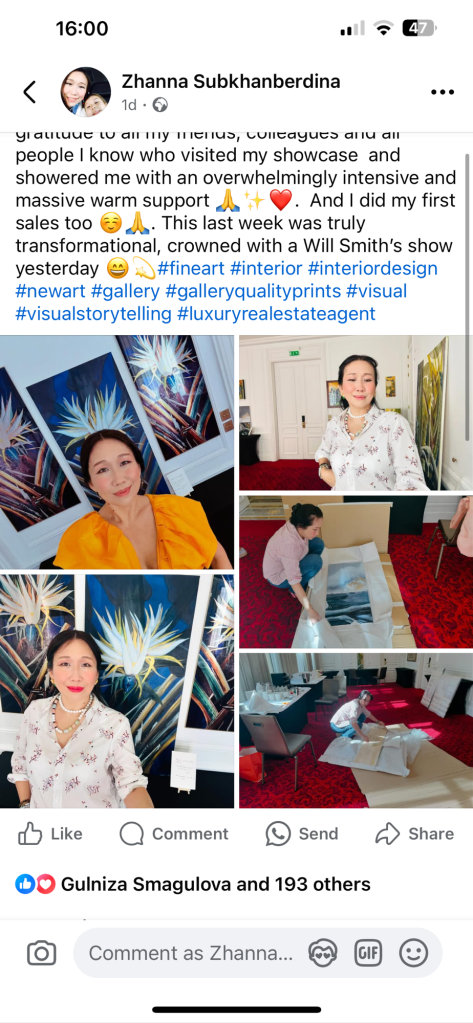

WHAT I HAVE LEARNED FROM MY FIRST EXHIBITION.
Curation and Curation Strategy:
Below, I have outlined my current thoughts and conclusions about the curating strategy I will follow in preparing my next show.
- I now understand what the curation process is about. I have observed and felt how the artworks change once they leave the studio and begin to live their own lives, how their initial value, instilled by me, can be vulnerable to being diminished, stripped away, and how their new value and identity emerge as the viewers start to interact with them. It is crucial to pay close attention to curating your show, helping each piece to shine and establish itself in a new space, in the outer world beyond the birthplace in the studio. I now realise that the creative process is not complete when you finish your artwork; it continues through curation and never truly ends if the artwork is exhibited at various venues.
- Whatever venue is chosen, the quality of light is essential. It is worth checking the windows’ position with a compass to ensure your works are exposed to daylight for as long as possible. My venue had a very favourable window position, so there was good daylight from 10 am till 6 pm in the summer.
- Avoid a “jungle sale”- just don’t do it. While I was preparing for my exhibition and checking available venues, I intuitively came to the understanding that I should not place my artworks among those of many other artists, as it was an option at the gallery “Space XX”. I mentioned this in my Part Three submission, and it was about my rejection of the idea to participate in the “jungle sale”, which is an exhibition where the curator is not involved at all. Thus, when you don’t curate the show or the show is not well curated, you see this wild and un-supportive effect on your artworks. My first practical experience convinced me that it is essential for your artwork (especially for rising artists) to have an exclusive space, with no other artists’ works, so that your viewers’ attention is wholly focused on you and your work. Nothing and nobody interrupts this emerging dialogue; there is no “noise”, allowing you to maintain 100% focus on your viewer.
- It is important to consider yourself and your physical needs when choosing the venue, not only focusing on your creative idea and supporting the artworks. I was glad that I was inside the hotel because the exhibition work is very demanding physically and emotionally, so you need to eat, stay well hydrated, and be able to go to the bathroom. This is essential to your guests as well. The overall comfort and being smart about these things influence the post-show impressions of your visitors. Everyone should feel comfortable to be able to perceive and appreciate the art. In this sense, I can draw a parallel with a pop star concert I attended with my children in Dubai when they were young. The organisation was so bad: we had to walk 2 km from the bus parking spot to the stadium gates, and there were unstructured queues, so no one managed the concert entry process, making it chaotic and tiring. The worst thing happened after the show ended, people could not find any taxi around, we were just lucky that we exited the stadium ( somehow) from the gates ( which were many) where our bus was parked, because the driver somehow managed to move the bus closer to the stadium. Those who came to the show by taxi reached the hotel on foot by 4 am, covered in dust from the sand and carrying their sleeping children, after a 3-hour walk in the desert. So, I am sure, no one remembers the show, but everyone remembers the stress and fatigue. Thus, creating a physically comfortable environment (with room temperature, good ventilation, basic drinks, comfy chairs, and a relaxed and pleasant ambience) is vital for the successful show.
- Now I can say that I prefer to have full control over the curation of my show. After reading various materials on Frieze and other platforms, as well as exploring other artists’ curating practices within my research on curation strategy, and after organising my first real-life exhibition, I can say that I will be quite a controlling person in curating my show. That also stems from a longstanding business and entrepreneurial background, so I am not afraid to make decisions and work hard on every detail. I see this confidence in the careers of Pablo Picasso and David Hockney, both of whom demonstrated strong business acumen, being confident with their curation, PR, and sales decisions. This is a good example of the advantages when the artist is capable of that level of control and involvement in promoting/curating their art. At the same time, I am open to creative ideas which might come from talented professional art curators, and I am sure I can work in collaboration.
- The curated exhibition theme is, actually, storytelling; it is not just a title. I have created a title for my exhibition, which was featured on the invitation and the exhibition signs in the hotel. I noticed a particular informational gap between the featured title and the artworks I gathered for my exhibition, and people just step into this gap. For some reason, the title lacks self-explanatory power; people want more information, and if you’re going to engage their minds, build a strong connection with your show, and help them resonate with your creativity, you have to tell them a compelling story. For my next show, I will write my Artist Statement differently.
- Solo shows and Private Viewings. My first show was a solo exhibition with a private viewing practice element, since even though it was clearly indicated on the signs in the hotel that “walk-ins are welcome,” I had only 8 walk-ins over three days. The rest of the visitors were from my social circle, so it was a very controlled visiting policy. I had hoped to exhibit my work at the local gallery, but then I had to postpone the entire process until late November, which was too late for me. So naturally, I started my career with a solo show, which allowed me to make independent decisions and gain maximum real-life, intensive exposure when you are on your own with the public, when you don’t have other people’s resources, such as a supportive art curator and the crowd brought to the show by the gallery. I find this a better practice for rising artists, as it allows them to avoid public embarrassment if it happens, and gain some personal control over the entire curating process and their career, resulting in a natural professional confidence boost. I also had a good conversation with an experienced art dealer who helps her clients build art collections. She said that I should be careful when selecting the gallery because they are very different, and their agendas might be harmful to an artist, as they often prioritise their own commercial interests over the artist’s needs, without proper professional art curation. That was a very new theme for me, because I was thinking that all galleries and “biennales” are great, just different in size and entrance fee. I began my research on this topic, and I see that the art dealer was right; things are indeed more difficult and complex when it comes to art galleries and art exhibition platforms. I will deliver my research for the Part Five submission.
- Artworks have their physical vibes indeed, don’t neglect this fact. Intuitively, on the second day, I began to encourage my visitors ( who were not in a rush) to sit down and relax, allowing their senses to open up and connect with the vibes emanating from my artworks. I am glad that many of them didn’t want to leave, spending a good time watching my works and saying they feel calm and elevated. Many of them said that the room “was so nice”, “oh, this room is great”, “you picked up a pleasant room”, and they all agreed that it was the artworks they were viewing which made the room better. Artworks have the power to transform spaces, a quality that has consistently been recognised in Japanese visual art, splendidly manifesting in the artworks of the traditional, legendary Kano (15th century, Meiji period) and Rimpa (17th century) schools.
Public Relations:
- PR is another essential part of any artist’s career that should be given full and focused attention. This is how you manage the value of your work, so it is super important. Even if you were perfect with curating, you are still halfway through if your PR strategy and PR elements are weak. Yes, the artworks speak for themselves, and their voice can be clear and beautiful if you curated the show well; however, the audience considers you as an integral part of your artwork, and if you are mute, that doesn’t help at all.
- Work on your Artist Talk, not just the Artist Statement. It was interesting to discover, through real-life experience, that 100% of my visitors (very different people with diverse international, cultural, and professional backgrounds) were not interested in reading but were very keen to listen to me explain my creative practice and the details of each artwork. Nobody took a minute to read my artist statement, and nobody approached me to ask where it was so they could read it. The OCA curriculum places a great emphasis on artists’ statements, but it doesn’t adequately prepare you for the Artist Talk. As an entrepreneur and having held leadership positions in my company and within my industry, with extensive experience in mentorship and education, I possess a strong background in business PR. I am an engaging speaker, I love to talk and discuss things in public, so I managed. However, I acknowledge that, being overwhelmed with preparation, I was not ready for that amount of ART talk I had to do. However, the necessity of good-quality, meaningful artist talks hits you hard with every visitor. I didn’t have any scripts for each of my artworks that I could rehearse. I think the OCA faculty needs to reconsider the syllabus and incorporate writing scripts for each art piece the student plans to exhibit, and have them discuss and talk through these scripts on an audio recording device. This is what I plan to do for all my future exhibitions: record myself giving an artist’s talk and listen to it, aiming to improve my performance. Of course, when you have hundreds and thousands of people visiting your show, you do a press release, the artist statement and put them on a wall, but when you are a rising artist and your exhibitions are much smaller in number of visitors, the TALK part is prevailing over your writing, so you must train yourself for that. I am not the only one who notices that all well-established and successful visual artists are strong and talented speakers. So no visual artist should underestimate this skill.
- Your PR strategy should be built around the idea that you are a good professional. My future PR materials, including the press release, artist statements, and the Artist Talk, must contain some art theory and art history facts and information; I have always been convinced that you cannot focus solely on sharing with your art viewers your feelings, regardless of whether they are happy or sad, when presenting your artworks. This attitude of mine is consistent with the reading in Part Four about how the value of the artwork is built after it leaves the studio and is exposed to the public eye. People sense your art, and they cannot connect with your joy or pain through the artwork at first glance; it is very rare, I assume. When they encounter your artwork for the first time, they are immersed in their own senses and emotions from it. You cannot interfere with this process, abruptly interrupting it, pushing your feelings forward. I realised I need to be patient and refrain from dominating conversations with “me-me-me” talk. I noticed that all my visitors were particularly interested in art history and the details behind the creative process. This kind of information smoothly aligns with the inner emotional moment people experience when viewing your art. Every time I shared my knowledge about how I was influenced by traditional Japanese visual art, Gustav Klimt, Van Gogh and Cézanne, explained why Irises are a symbolically complex and sacred subject for Asian art, that I practice the calligraphy technique, aligning my breath and the brushstroke, why the trees’ trunks are painted in this particular way and that was a continuation of a specific cultural tradition, what is the all symbolism behind them and other elements, multiple viewpoints strategy in compostional decision, where I order prints, the technical characteritics of different surfaces I use for my prints, details of my OCA degree journey – all of this was facsinating and compelling for all my visitors. I noticed that without professional information, people would have a less thorough understanding and appreciation of what I do. It is very clear to me.
- In Art – Don’t rush into collaboration with media professionals. I have extensive business experience with press conferences and dealing with media professionals, which made me aware early on of the fact that journalists (and I assume the art ctitics) can simply stick a bad label on you publicly, which will be scaled by their platform’s public exposure, being under their subjective, often uneducated, and biased perspective, and sometimes just hostile. It is essential to understand that there are so many unprofessional journalists out there. So every artist has to be really careful navigating the professional media space. It is crucial to be highly selective about who you invite to your event and who the media sends to you. I won’t invite any media professional unless I am absolutely sure that they are true professionals and have experience in art event reporting. It is also worth making a separate private viewing first, so they can get to know you and your practice, and you can feel their style and personal vibe as well. So I intentionally didn’t call any press and didn’t deal with the press release for my first exhibition. Actually, the media industry doesn’t appreciate press releases about visual artists that don’t mention any prior events or private collection purchases. Thus, I find the OCA task in this part four to be writing a press release and sending it to local press somewhat confusing and premature action for a first solo show.
Additionally, when it is your first solo show, you cannot produce a meaningful press release that aligns with industry standards. As a general standard approach, you must include names, dates, events, and square footage, as well as monetary valuations, among other details, in the media industry. A lot of facts are necessary. You just don’t have much factual information about you as an artist and your art at the moment of your first show. During my show days, I became acquainted with the editor of a local Hello magazine, which has 200,000 followers on Instagram and, as she said, 20,000 printed copies of the magazine they produce twice a year. However, I am not in a rush. I prefer to grow at a slower pace, carefully building my reputation with a very targeted effort. - Be aware of the cultural background of your viewers and adapt your PR materials and curating strategy to the cultural views of your visitors.. This was one of the most interesting discoveries I made during my show. Since my show’s theme was about local nature, gardens, and plants, I exhibited my artwork, “The Irises,” which I created in two versions. One of the visitors, a well-educated man with extensive experience in school management, a British national, pointed to one of the Irises and said, “You can make lots of money on postcards!”. This phrase is not a good compliment for the artist, which puts my work in the kitch, low value mass production “art category. He didn’t have an insulting intent; this is just what he thought about the flowers, which looked like flowers. I was reflecting on why he had such a perception of my artwork and realised that he has his own underlying understanding of what is good art. In the UK, people tend to appreciate abstract art that explores unconventional, complex, and emotionally charged experiences/ themes, as well as unusual, grotesque, and dramatic interpretations and visual language. In the UK, people especially praise the early works of David Hockney (1937-), Lucian Freud (1922-2011), and Peter Doig (1959-), the list, of course, is much longer.
In contrast, my artworks are strongly influenced by the Japanese visual art tradition, which has a strong spiritual component. I work in a tradition that appreciates elegant brushstrokes; however, this does not resonate with his taste, which is shaped by the British visual art tradition and its accompanying visual art education and criticism. That comment made me think that I should be cautious in curating the show and tailor it for the special audience. That is why solo shows and private viewings are a better strategy for me, as my reputation is at its earliest and most vulnerable phase. I was horrified. What if an influential British art critic visited my first show, when my reputation was just like a tabula rasa, looked at my irises, and then made a comment in his article in The Guardian that I am a postcard maker? I was correct in this insight about cultural background differences influencing viewers’ perceptions of my artwork. All other people, from different parts of Asia, the USA (who are familiar with Georgia O’Keeffe ( 1887-1986) and Frida Kahlo (1907-1954), visitors with Greek and Spanish roots, didn’t have any associations with a postcard. People who were culturally exposed to Chinese and Japanese art, who often travel to that part of the world, were the buyers of the yellow/white chrysanthemum prints. A French citizen of Russian origin was pleased to acquire the smaller Irises print. My board colleague from Greece, who also paints in the abstract genre, found the “postcard” irises to be a strong work, which appealed to him more than any others. Because I had the opportunity to speak with each of my visitors, it provided me with an invaluable chance to observe their reactions and deeply reflect on them. Now I understand that if I want to make an exhibition in the UK, I have to bring something different from irises or paint them in a very different manner. Any rising artist with a reputation which is under formation must be aware of this cultural background complexity factor.
 JeanArt