As I mentioned in my earlier post about curating strategies, it is challenging to find a wealth of firsthand material about the details of curating strategies from artists. I see that many artists follow a hands-on approach to curating their shows, including close collaboration with art curators, who can have different views on how much they can/should be submissive to the artist’s vision. I decided to look at articles coming from art curators, hoping that they could give me more details about the curating strategies and their collaboration with artists, revealing what kind of curation decisions and ideas came from who and how they proceeded.
I was very keen to explore the curating practice details and early career start-up moments of David Hockney (1937-) and Pablo Picasso (1881-1973), because they both had a long and artistically fruitful, abundant life; I deeply resonate with Hockney’s later life project – the Yorkshire landscapes, spring and Big Canon paintings, and I borrowed his style to create large paintings on multiple individual canvasas; I wanted to look closer on Picasso’s practices because of his different artistic direction and genre, which I dont practice.
I found an interesting short article by The Daily Mail: “Dear Mr Hackney: What an art curator called the unknown young painter who was pushing for his first break before David Hockney became one of the 20th century’s greatest artists.” online on https://www.dailymail.co.uk/news/article-7569069/What-art-curator-called-David-Hockney-pushing-break.html [accessed on July 3d, 2025]; I placed it below in full.
“As one of the most influential British artists of the 20th century, David Hockney has the art world at his feet. But 82-year-old’s rise to the top appears to have had something of a shaky start – thanks to the indifference of a snooty curator. In 1960, when Hockney was an unknown 23-year-old Royal College of Art student, he invited Helen Kapp, the then director of the Wakefield Art Gallery, to view a show he was putting on in Skipton, North Yorkshire. However, after addressing him as ‘Mr Hackney’, she continued the slight by fobbing him off with the excuse that she had no car and did not fancy taking the bus, according to their recently unearthed correspondence. The letters were found in the archives of the gallery, which is now a school, during research for an exhibition of Hockney’s work at the contemporary Hepworth Wakefield gallery.“
David Hockney’s first exhibition took place in February 1960 at the John Kasmin Gallery in London, just as he was about to graduate from the Royal College of Art. I was very curious about the paintings showcased in that very first exhibition, so I found most of them and listed them below. In 1963, he presented, probably, six of his artworks created between 1960 and 1961.

We Two Boys Together Clinging, David Hockney, 1961, Oil on board, 48 × 60″Arts Council, Southbank Centre, London; image via https://www.thedavidhockneyfoundation.org/artwork/3573

Cleaning Teeth, Early Evening (10pm), W11 (1962); David Hockney, 1962; image via https://www.afmuseet.no/en/artwork/cleaning-teeth-early-evening-10-pm-w11/

The Cha Cha that was Danced in the Early Hours of 24th March 1961, David Hockney, 1961, Oil on canvas, 68 x 60 1/2 inches; 172.7 x 153.7 cm; image via https://hh-h.com/artworks/4371-david-hockney-the-cha-cha-that-was-danced-in-the-1961/

Tea Painting in a Illusionist style, 1961, David Hockney; oil on canvas, Dimensions: support: 2325 x 830 x 38 mmoil on canvas, image via online https://www.thedavidhockneyfoundation.org/chronology/1961;

Myself and My Heros, 1961, David Hockney, Etching and aquatint on wove paper ‘Whatman’, laid down on cardboard, 26,4 x 50 cm. (10.4 x 19.7 in.) image via online https://www.tate.org.uk/art/artworks/hockney-myself-and-my-heroes-p07352
“While at the Royal College of Art in London, Hockney turned to etching for pragmatic reasons. Students were responsible for purchasing their own supplies and Hockney had quickly run out of money thanks to his enthusiasm for painting, so he took advantage of the college’s free printmaking materials. His first etching, Myself and My Heroes,embraces several of his passions at the time: the homoerotic poetry of Walt Whitman and the pacifism and vegetarianism of Mahatma Gandhi.”, (from the article online on The Morgan Library Museum, https://www.themorgan.org/exhibitions/online/david-hockney/myself-and-my-heroes)

Doll Boy, 1960-1961, David Hockney, Oil on canvas; Dimensions:121.92 x 99.06cm image via online https://www.myartbroker.com/artist-david-hockney/articles/david-hockney-doll-boy
The documentary “I am a space freak” about David Hockney, available on YouTube through the Louisiana channel, online at https://www.youtube.com/watch?v=rnDAidgLZiE [accessed July 1, 2025], is just fantastic. He reveals a great deal about how he perceives, observes, and thinks about things before and while painting. He is very generous in sharing his artistic thoughts and ideas, which influence his decisions in his creative process. For example, he describes in detail the advantage of painting with multiple viewpoints in the composition, which I also practice and find very comfortable for myself as a compositional decision. he doesn’t like the classic academic single “vanishing point” and perspective. He also shares why he came up with the idea of painting on multiple canvases. He loves the sense of space in life and aims to bring it to his canvases, creating significant-sized artworks. However, the transportation of a single large canvas is problematic, so at some point, he realised that multiple canvases are a great compromise. Watching this video, I understood that Hockney is very keen on how viewers engage with space and time, so he takes a leading role in deciding how (which one goes to which wall and in what order) to display the artworks. He explains his ideas and mistakes in this regard in this video, bringing the example of his paintings of the Grand Canyon.
He showed his paintings for the first time alongside other Royal College of Art students, who were a part of the group “Young Contemporaries”. There was no specific theme for his collection of artworks; however, the event had a title, “Young Contemporaries 1961”.
From his earliest shows, Hockney took an active role in shaping how his works were displayed, including:
- Grouping works by theme or technique (e.g. his early “Demonstrations of Versatility” series shown at the Young Contemporaries in 1961).
- Designing exhibition sequences that guide viewers through shifts in style—from early graffiti-inspired work to more personal, diaristic paintings. At his 1963 solo show at John Kasmin’s gallery, he carefully selected works that showed his emerging identity—erotic, ironic, and proudly unorthodox.
In later decades, Hockney has collaborated closely with curators for major retrospectives but insisted on key framing strategies, such as:
- Advocating for the inclusion of his photocollages, iPad drawings, and theater designs, which some curators might otherwise overlook in favor of his paintings.
- Organising works non-chronologically, to emphasise visual or thematic links (e.g. in the Tate Britain retrospective in 2017). He reportedly said during the 2017 Tate show:
“I don’t think chronology is everything. Sometimes it’s misleading… You should be able to see how things connect through ideas, not just dates.”
- Space, time, and movement are arranged within a frame.
- Multiple perspectives are layered—echoing the choices a curator might make in a group show or themed exhibition.
In his “joiners” (like Pearblossom Hwy. 11–18 April 1986), Hockney plays the role of both artist and curator, assembling fragments to form a cohesive visual logic.
- Insisting on large-scale formats and specific lighting conditions for digital works.
- Advocating for multi-screen or immersive displays, especially in his later video installations (The Four Seasons, 2010–2011), which required spatial design akin to curating.
Pablo Picasso had his first exhibition at age 19 in February 1900; he organised it at Els Quatre Gats, “a modest but symbolic place” in Barcelona. Below, I have included the pages from the book I have been reading about the artist, along with an essential detail about his curating strategy, on page 37. It’s striking to know about the quantity of artworks he showcased: he displayed between 150 and 200 drawings and paintings, mostly portraits, caricatures, and sketches (of famous people, intellectuals, and Bohemians), and studies of female figures.
“Control was what counted. Without permission or institutional sanction, he had put on a show according to his own rules”. (Aiden D. Griffin, “Pablo Picasso”, p.37, (2025), Amazon Fulfilment,
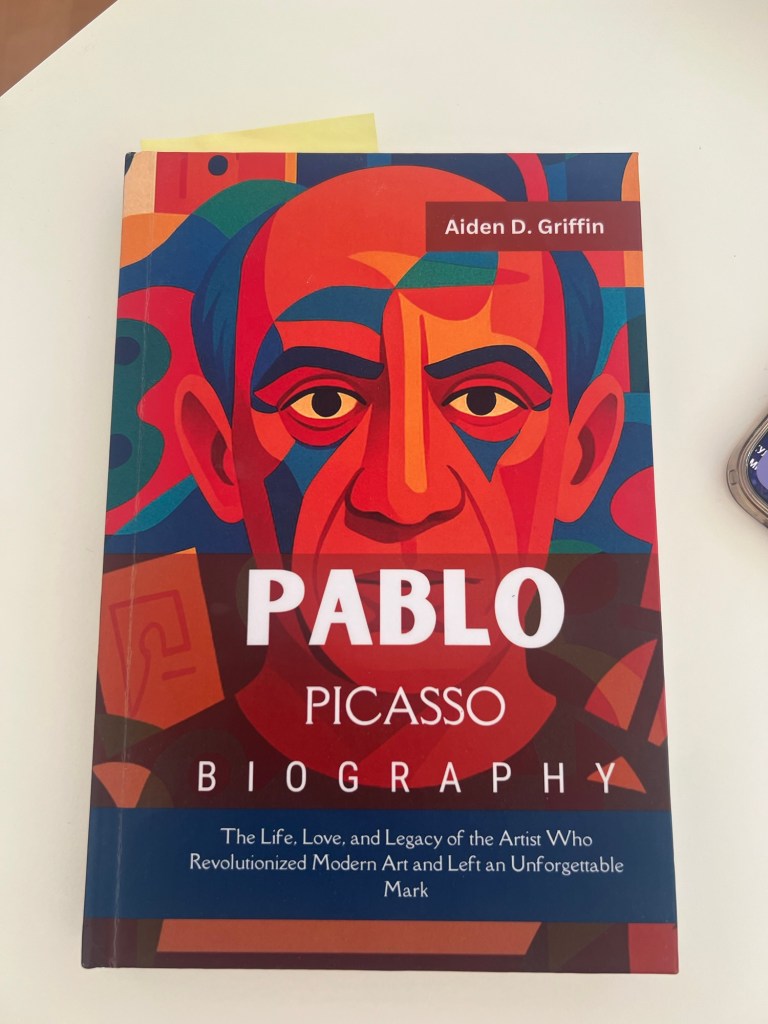


From the outset, Picasso was actively involved in the curatorial process, shaping the presentation of his artworks. He tended to have a strong, authoritarian grip on how his artwork should be presented to the public. Interestingly, like Hockney (actually, Hockney like Picasso), he didn’t favour the standard curatorial approach of presenting the works in chronological order. He used home studios as curated environments. Below are some more details on his curation strategy.
- Picasso was highly selective about which works he released or exhibited. He often withheld important works from dealers and public view, keeping many in his personal collection.
- He deliberately held back key experimental pieces (e.g., early Cubist works), anticipating their future value and controlling the narrative of his evolution.
- He arranged works in his studios (especially in Paris and later at Notre-Dame-de-Vie in Mougins) to reflect formal, thematic, or psychological relationships—almost like private exhibitions.
- These arrangements were visible to friends, dealers, and later biographers, and often shaped how retrospectives were eventually mounted.
- At Kunsthaus Zürich, Picasso was deeply involved in selecting the works for his first major retrospective.
- He refused to divide the show chronologically, preferring groupings by theme or style—e.g., portraits, mythologies, Cubist experiments.
- This show set a precedent for how his art would be organized in future exhibitions.
- For postwar retrospectives (e.g., 1955 at Musée des Arts Décoratifs, Paris), he again intervened heavily in layout and selection, ensuring certain works were omitted or emphasized based on personal and political reasons.
- Picasso never donated works formally during his lifetime, but he indirectly curated the museum’s contents by:
- Stockpiling key phases of his work (especially Blue Period, Cubism, and ceramics).
- Creating a vast private collection that included not only his own works but also African art, Cézannes, and Renoirs—contextualizing himself within art history.
- Picasso also designed ballet sets and costumes for Diaghilev’s Ballets Russes (Parade, 1917), which required curating the visual language of space and movement in a collaborative context.
- In these roles, he selected color palettes, costume shapes, and backdrops that expressed his Cubist vision—translating his curatorial instincts across media.
Bibliography:
- Hockney, D. (1976). David Hockney by David Hockney. Thames & Hudson.
- Hockney, D. (2001). Secret knowledge: Rediscovering the lost techniques of the old masters. Viking Studio.
- Gayford, M. (2012). David Hockney: A bigger picture. Royal Academy of Arts.
- Tate. (2017). David Hockney at Tate Britain. https://www.tate.org.uk/whats-on/tate-britain/david-hockney [accessed July 20, 2025]
- The David Hockney Foundation. (n.d.). Chronology: 1961. https://www.thedavidhockneyfoundation.org/chronology/1961 [accessed July 20, 2025]
- Jones, J. (2012, January 15). David Hockney: ‘I’m teaching the French how to paint again’. The Guardian. https://www.theguardian.com/artanddesign/2012/jan/15/david-hockney-interview [accessed July 20, 2025]
- Kennedy, R. (2010, October 14). David Hockney’s iPad art: Drawing with your finger. The New York Times. https://www.nytimes.com/2010/10/17/arts/design/17hockney.html [accessed July 20, 2025]
- Hockney, D. (2016). 82 portraits and 1 still-life. Royal Academy of Arts.
9. Henry Geldzahler and Chrispher Scott (1969)”A Watershed Moment for David Hockney”,, online on http://www.christies.com; https://www.christies.com/en/stories/henry-geldzahler-curator-influencer-cultural-svengali-549b3d6ca4064985a0d3ef0c180d241c [accessed on July 19, 2025];
10. Richardson, John. A Life of Picasso: Volume II, 1907–1917. Knopf, 1996.
11. McCully, Marilyn. Picasso: The Early Years, 1892–1906. National Gallery of Art, 1997.
12. Baldassari, Anne. Picasso and His Collection. Queensland Art Gallery, 2006.
13. O’Brian, Patrick. Pablo Picasso: A Biography. Norton, 1994.
14. Museu Picasso Barcelona. https://www.museupicasso.bcn.cat [accessed July 20, 2025]
 JeanArt