
Project 3: Making, Testing and Prototyping
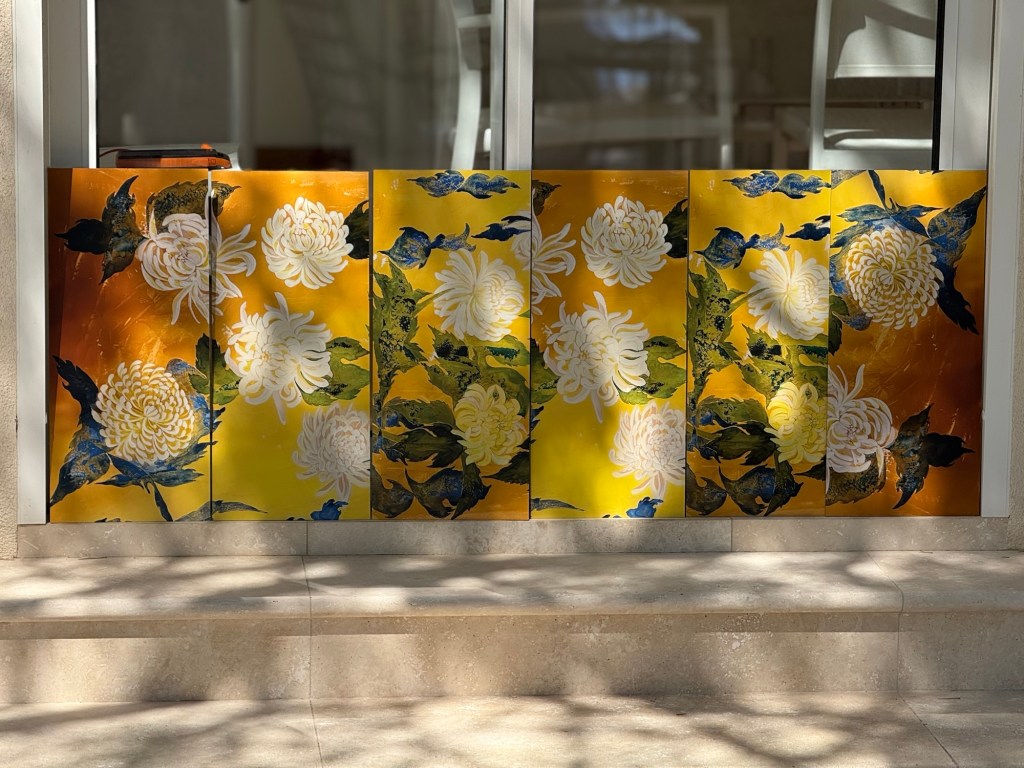
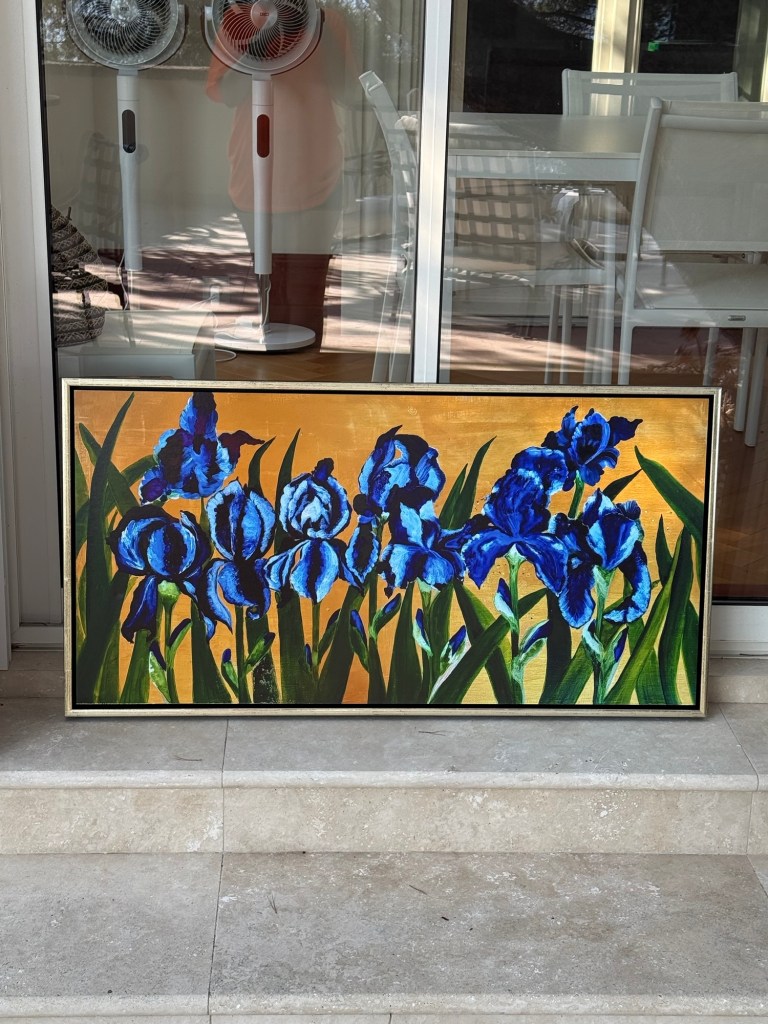
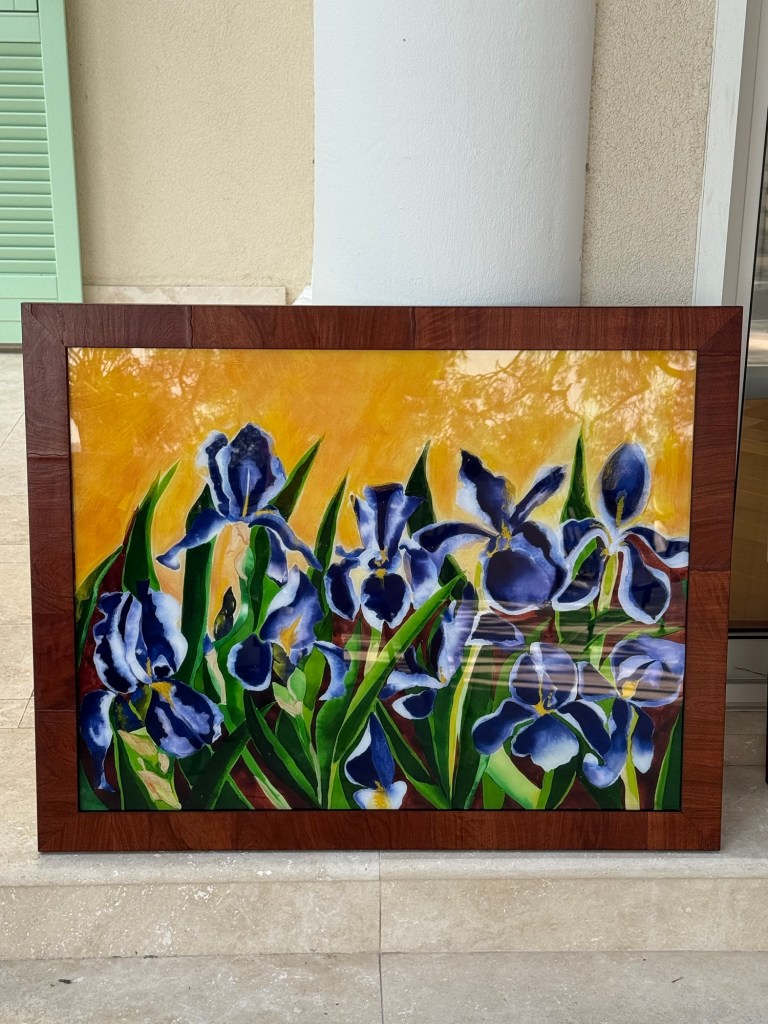
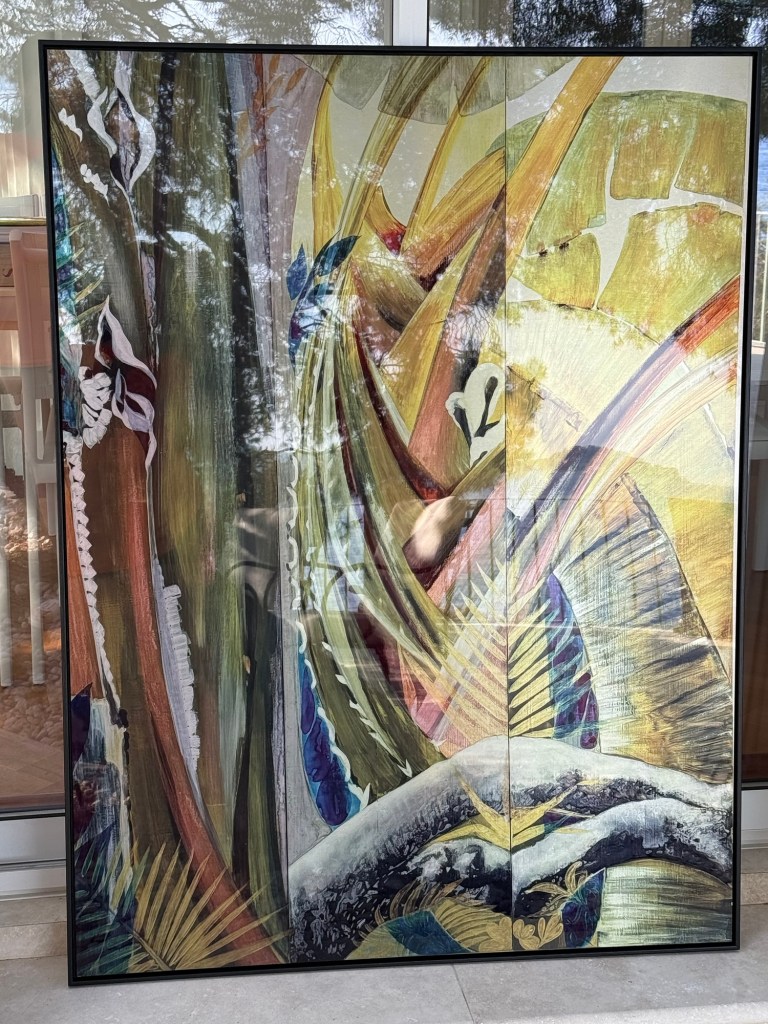
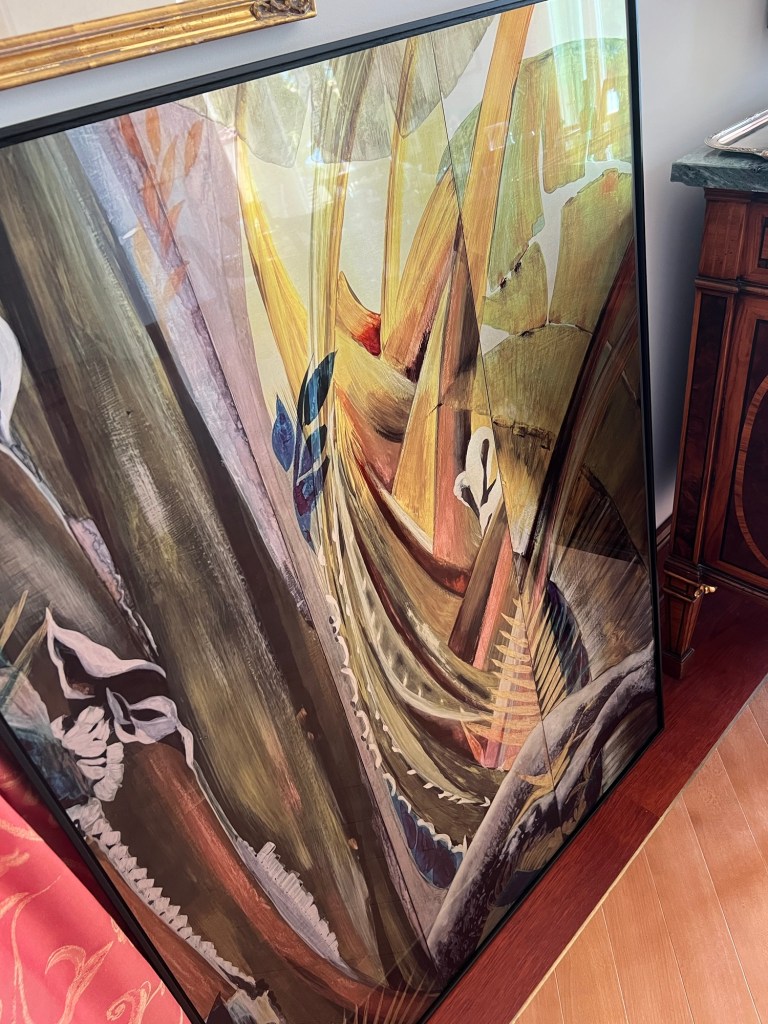
My exhibition will be substantially enriched with the metal Dibond prints of my original works. In June, I ordered and tested different prints of my selected artworks to evaluate the material and new effects I can achieve by making metal prints of my original works. I collaborated with White Wall Printing House, which is used by many renowned world-class photographers. I ordered a sample box from them and then selected several surfaces for the paintings I had created earlier. I decided to test different kinds of Dibond prints because the final product looks very chic and original. I was afraid that the original work would fade compared to prints, but actually, it didn’t, and I would say it even gained more character as a handmade piece. Although the prints have their own independent life, I find them highly original as well.
I tested the following different Dibond prints: aluminium Dibond with Hahnemühle Fine Art Pearl paper, Dibond Chroma Lux, and Dibond brushed aluminium in gold. The Chroma Lux and Brushed Aluminium in Gold products came out as super interesting due to the unusual qualities of aluminium merging with the features of my work – details and colours creating a new aesthetic value. Below, I have placed the photos so that you can see the first tested outcomes.

Project 4: Exploring Curation Strategies and Creating Content;
“Starting from the perspective of your potential audience; their viewing, meeting and engaging with your work, ask yourself how could you create and test-out a range of interventions, and curious conversations between your work, other spaces or others’ work?“; “Review and reflect on this process, your documentations and how this might explore, facilitate and convey specific content and connection.”
This was a very beneficial and essential exercise to help me deal with my anxiety about what I will tell my viewers when they come to see my works. I am afraid of having an awkward silence, so I must write something interesting and engaging about my artwork in the invitation and be prepared to discuss it with the visitors. Reflecting on my anxiety, I understood that I must build a content surrounding by paintings so they don’t exist in some sort of vacuum. I must indeed guide future viewers on how to connect with my art. This process, the process of building the living environment for my artworks, is equally creative as the painting them.
The key points for expanding in discussion and presentation materials:
My “Riviera Garden” project is tightly connected to the themes of floral symbolism and spirituality, when nature is a bridge which connects us with the Divine. I also think that emphasising local French culture would be appropriate, as the local flora and microclimate variations are the sources of my inspiration. I would like to expand on this theme in connection with French poetry as a way to connect with the visitors viewing my artworks. Another point of connection with the audience and making my event intellectually curious and culturally interesting would be about the influence of traditional Japanese visual arts on my artistic visual style. So Haiku theme would be appropriate as well.
- I did some research on the topic of flowers in French literature. There is an excellent, famous poetry collection by Charles Baudelaire (1821-1867), “La Fleur du Mal” (1857), specifically from the poem “La Solitude”, “Harmonie du Soir”: ” Mainte fleur épanche á regret son perfume doux comme un secret dans les solitudes profondes“;
- Francis Jammes ( 1868-1938) in “Clairières dans le ciel” (1906): “Je voudrais être simple comme les fleurs des champs”; “Je ne veux pas d’autre joie, quand le printemps reviendra...”.
Les lilas qui avaient fleuri
Les lilas qui avaient fleuri l'année dernière
vont fleurir de nouveau dans les tristes parterres.
Déjà le pêcher grêle a jonché le ciel bleu
de ses roses, comme un enfant la Fête-Dieu.
Mon cœur devrait mourir au milieu de ces choses,
car c'était au milieu des vergers blancs et roses
que j'avais espéré je ne sais quoi de vous.
Mon âme rêve sourdement sur vos genoux.
Ne la repoussez point. Ne la relevez pas
de peur qu'en s'éloignant de vous elle ne voie
combien vous êtes faible et troublée dans ses bras.

Translation by ENG English (Faith J. Cormier), "The lilacs which bloomed", copyright © 2003, can be looked at here https://www.lieder.net/lieder/get_text.html?TextId=20991
- Anna de Noailles (1876-1933) from ‘Le Cœur Innombrable” “Les fleurs savent le secret du printemps“;
I think Anna de Noailles’s following poetry deeply resonates well with my theme.
“Le Cœur”
« Mon cœur tendu de lierre odorant et de treilles,
Vous êtes un jardin où les quatre saisons
Tenant du buis nouveau, des grappes de groseilles
Et des pommes de pin, dansent sur le gazon. »
Translation (ChatGPT): “The Heart”
“My heart, stretched with fragrant ivy and vine,
You are a garden where the four seasons,
Holding fresh boxwood, clusters of currants,
And pinecones, dance upon the grass.”
“Le Cœur innombrable ( 1901)”, “L’Offrande à la Nature“
Nature au coeur profond sur qui les cieux reposent,
Nul n’aura comme moi si chaudement aimé
La lumière des jours et la douceur des choses,
L’eau luisante et la terre où la vie a germé.
La forêt, les étangs et les plaines fécondes
Ont plus touché mes yeux que les regards humains.
Je me suis appuyée à la beauté du monde
Et j’ai tenu l’odeur des saisons dans mes mains.
J’ai porté vos soleils ainsi qu’une couronne
Sur mon front plein d’orgueil et de simplicité,
Mes jeux ont égalé les travaux de l’automne
Et j’ai pleuré d’amour aux bras de vos étés.
Translation ( by Catherine Perry, Anna de Noailees, La Cœur innombrable (1901), excerpts, online on http://www.annadenoailles.org)
Offering to Nature
Deep-hearted Nature, supporting the heavens,
None more than I will have so ardently loved
The light of days and the sweetness of things,
The shimmering water and the nurturing earth.
The woods, ponds, and fertile plains
Have touched my eyes more than human gazes.
I have leaned upon the beauty of the world
And my hands have held the seasons’ fragrances.
I have worn your suns like a crown
On my noble and simple brow,
My games have matched the labors of fall,
And I have wept with love in your summers’ arms.
Key points to expand in the text for the marketing materials, artist statement and conversations with the viewers:
- Celebrate the beauty of our everyday life and natural surroundings.
- Overwhelming aesthetic wonder and spiritual nourishment ;
- Emotional surrender to the natural world and the beauty of nature as a resort and refuge for humans’ most profound emotions.
After conducting research on floral and garden themes in French and Japanese literature, I found that establishing this connection was a key strategy in presenting the story of my artworks and a way to connect with my viewers. I think I will allocate Anna de Noailles’ piece “Offering to nature” to the back of my event card. I also have an idea of placing some quotes from French poetry and Japanese Haiku near each artwork.
Japanese poetry – Haiku.
I conducted research on Japanese Haiku and discovered that this poetry format resonates well with my paintings. I resonate strongly with Yosa Buson’s (1716-1784) poetry.
中々にひとりあればぞ月を友
nakanaka ni hitori areba zo tsuki o tomo
3 translations below:
Since it turns out
I’m all by myself
I make friends with the harvest moon
(Yosa Buson, translation W.S. Merwin and Takako Lento, Collected Haiku of Yosa Buson (2013) #526, p. 142)
With nothing to do and all alone by myself, I’ll make friends with the moon.
(Yosa Buson, translation by Leon M. Zolbrod, Reluctant Genius: The Life and Work of Buson, a Japanese Master of Haiku and Painting—Tenth Instalment, Modern Haiku 26:3 (fall 1995), 52)
D’autant plus que je suis seul la lune est une amie.
(Yosa Buson, translation by Gilles Fabre, “75 Haikus de Buson,” Haiku Spirit Web site)
Haiku by Kobayashi Issa (小林一茶)(1763-1827)
垣津旗よりあの虹は起りけん
Kakitsubata yori ano niji wa okoriken
Irises –from which that rainbow rises
Translation by David G. Lanoue ( Basho’s irises, online https://akitahaiku.com/2009/07/04/bashos-irises/ [accessed on June 30, 2025];
Bibliography: Anna de Noailles, La Cœur innombrable (1901), excerpts, online on http://www.annadenoailles.org [accessed on June 30, 2025];
by Charles Baudelaire, Les fleurs du mal, Poésie française, online https://www.poesie-francaise.fr/charles-baudelaire-les-fleurs-du-mal/ [accessed on June 30, 2025];
by Francis Jammes (1868 – 1938), no title, appears in Clairières dans le ciel, in Tristesses, no. 19, first published 1906, Lieder Net, online on https://www.lieder.net/lieder/assemble_texts.html?SongCycleId=85
Thirteen Haiku by Yosa Buson (1716 to 1784), online on https://www.upaya.org/uploads/pdfs/ThirteenHaikubyYosaBuson.pdf [accessed on June 30, 2025];
Akita International Haiku Network, Hiruta, Basho’s irises, online https://akitahaiku.com/2009/07/04/bashos-irises/ [accessed on June 30, 2025];
 JeanArt