Read ‘Creating the Environment’ – The cultural eco-system of Creative People and Places’. Make reflective notes in your learning log about your own ‘cultural ecosystem’ and how you might want to nurture it.
I have read the “Cultural Ecosystems of Creative People and Places” by Jonathan Gross and Nick Wilson (Gross, J. D., & Wilson, N. C., 2019). Creating the Environment: The Cultural Eco-Systems of Creative People and Places. Creative People and Places. http://www.creativepeopleplaces.org.uk/our-learning/creating- environment) [accessed on May 15th, 2025]. It is a great read, valid for all art and education professionals. This research should be mandatory for reading by teachers and students at schools. I strongly recommend incorporating into cu the abuse of OCA, Fine Art Level 1 curriculum, because it helps to understand the importance of early nurturing your own cultural ecosystem. The research helps to see a larger picture and identify areas to focus on to stimulate artistic growth, and there is no reason to postpone it till Level 3. The paper made me reflect on what things have been nurturing my artistic pursuits and what I should do nurture nore my ecosystem; so I came up with the following:
- I research other artists’ lives, creativity, and artworks, and I enjoy watching other artists’ interviews on YouTube. These videos are highly stimulating and motivational for me.
- I opened my profile and expanded my activity on special platforms for professional visual artists and art professionals, such as Bēhance, MutualArt, and Artsy. These platforms play the same role as, for example, Bloomberg, MarketWatch, and Stock Analysis, servicing the needs of professional investors who work on financial markets. You need to log in daily and immerse yourself in all the information available to make the right decisions and learn.
- I must start building a circle of professional contacts, such as art dealers, galleries, and other artists.
- I also recently came to the firm conclusion that to keep myself creatively elevated, I need to follow a relentless approach to staying above the daily household routine, which is not ecological to keeping my mind and hands engaged in creative work. It is distracting, disruptive, and does not induce creativity. If I want to be serious, I really have to cut my mind and lifetime from household tasks as much as I can.
Research task: Understanding Global Context
Read the introduction, Entering the Maze, pages 1-7, of Harris, J. (2017) The global contemporary art world. Hoboken, New Jersey: Wiley Blackwell.
Make reflective notes in your learning log about Harris’s introductory arguments and identify at least one other section of this book for further individual reading.
Unfortunately, I could not obtain the full text following the link. I will finish this exercise later because I need to order and read the book. However, its content overlaps with that of another book I read recently: “A Year in the Art World”, 2020, Thames & Hudson, written by Matthew Israel, who is an art curator, PhD art historian, and writer.
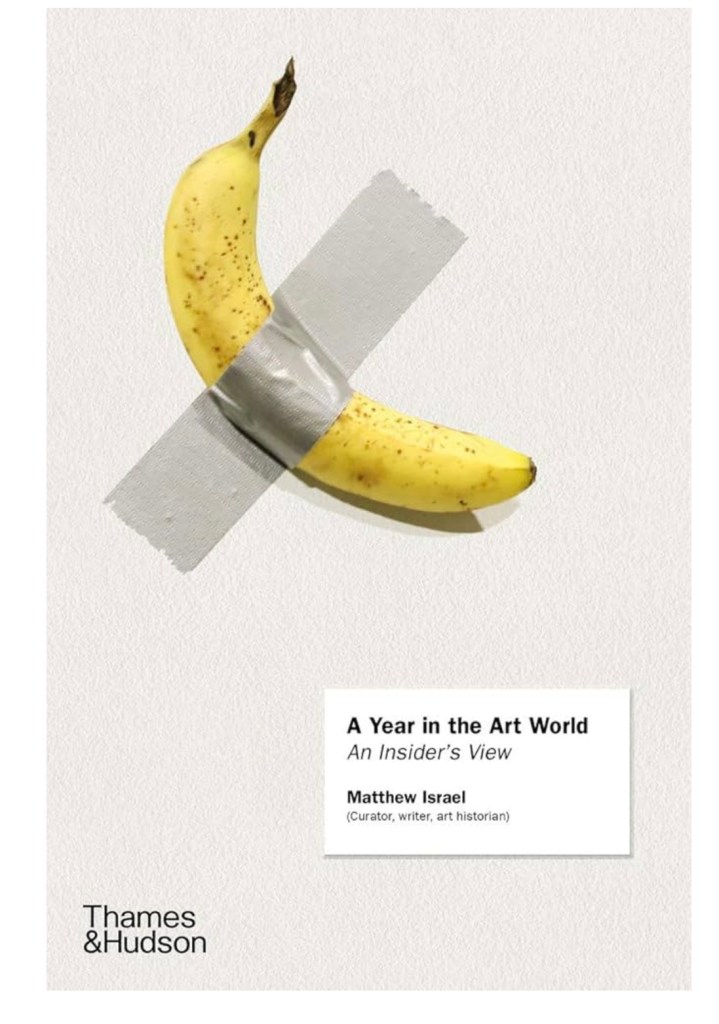
The author examines the role of each professional player of the art industry: from different types of artists who engage with photography, painting or sculpture, he does his research on those who help the professional visual artists to create their complex monumental scultures ot installations, he approached big and small galleries, owners, art dealers, art critics, organisers of significant notable art events like Venice Bienalle or Art Bazel Switserland, Hong Kong and Miami, museum curators, even the art items transportation company, bringing light to details of their work. This book is also essential to read by any emerging visual artist,becasue it explains the logic, the rationality and rules of each player of the industry and provide useful names:)).
The next book I want to read is “Understanding International Art Markets” by Iain Robertson, published by Routledge, 2005. As it is said in the brief summary on https://www.perlego.com/book/1625746/understanding-international-art-markets-and-management-pdf [accessed on May 15, 2025];
“This groundbreaking text brings together experts in the field of visual art markets to answer some fundamental questions:
- Is art a good investment?
- Why is the art market dominated by America and Western Europe?
- Where are the key emerging markets and what are the next good buys in art?
Providing readers with an understanding of the challenges facing art market ‘makers’ (dealers, auctioneers, collectors and artists) and the decision-making process experienced by market ‘players’ and investors, this exciting text merges the key theories with examples of practice in a highly accessible style.
Written by an international array of experts from the US, the UK and China, this book is essential reading for all those studying or interested in art markets and management.
Research task: Your place in it all. Research Task: Understanding Your Place In It All. Reaching out and Community.
“Instead of the national centres of London, Paris or New York, artistic communities today operate across a more dispersed, reciprocal set of coordinates…”
I connect this assignment with the task of updating my Practice Plan.
This month, I started researching how to integrate myself into the local and international art community in preparation for my exhibition. Disclaimer: I am very much restricted in my proactive approach due to the simple fact that I don’t have enough artworks to showcase. So far I have five – two large size and three A3 format. I need to produce two to three large-sized paintings for a good showcase. Thus, at this moment, when I am in short supply of serious work ( in my opinion), I postpone my visits to local galleries.
However, I made a list of local galleries and started contacting them. The best way is to visit a gallery to understand and evaluate the space, the size, the lighting conditions, the general policy of the gallery, whether they work with emerging artists, or at least they are ready to rent the space. I visited the RETELET gallery, which is a small gallery, it has two floors, good lighting and a great location. There is a big chance of generating many walk-ins during the exhibition days because it is in a busy pedestrian area. The space has display windows close to the viewers’ eyes. I get acquinted with a co-owner and I am waiting for theor reply.
I am not nervous about the space for the exhibition since I can always make it at home. However, I am working on alternative spaces and approaching the following:
- Gallery 22, https://www.espace22.mc. This gallery is open for young and rising artists to rent space. I have sent them a contact inquiry and will visit them next week as we have agreed.
- I sent an inquiry to Head of Office of local rep of one well known auction houses which has a good and not large exhibituion space. This people don’t rent out their space. I would be surprised if they would. Just was practicing my audacity:).
- Kamil Art Gallery. They answered my email and asked me to send them digital images of my work.
- Hauser & Wirth – to contact
- I also want to approach next week local high-end hotels to see whether they can collaborate with me for my work display.
I plan to conduct my exhibition somewhere between July 15 and August 10. Thus my nearest future plan, the list of things to complete before June 30th:
- Launch my profesional website;
- Book the venue;
- Design and print the showcse small-size inviation to distribute;
- Make a list of invitees and do the firts round of sent outs;
- Produce 2 more works;
- Probably frame smaller works which I did on paper;
- Priny with White Wall a selection of my works, which will show case as well;
 JeanArt