I have asked my friend to peer review my work. My friend is an MFA student in creative writing at New York University. She holds a B.A. in English Literature and Film Studies from Barnard College, Columbia University.
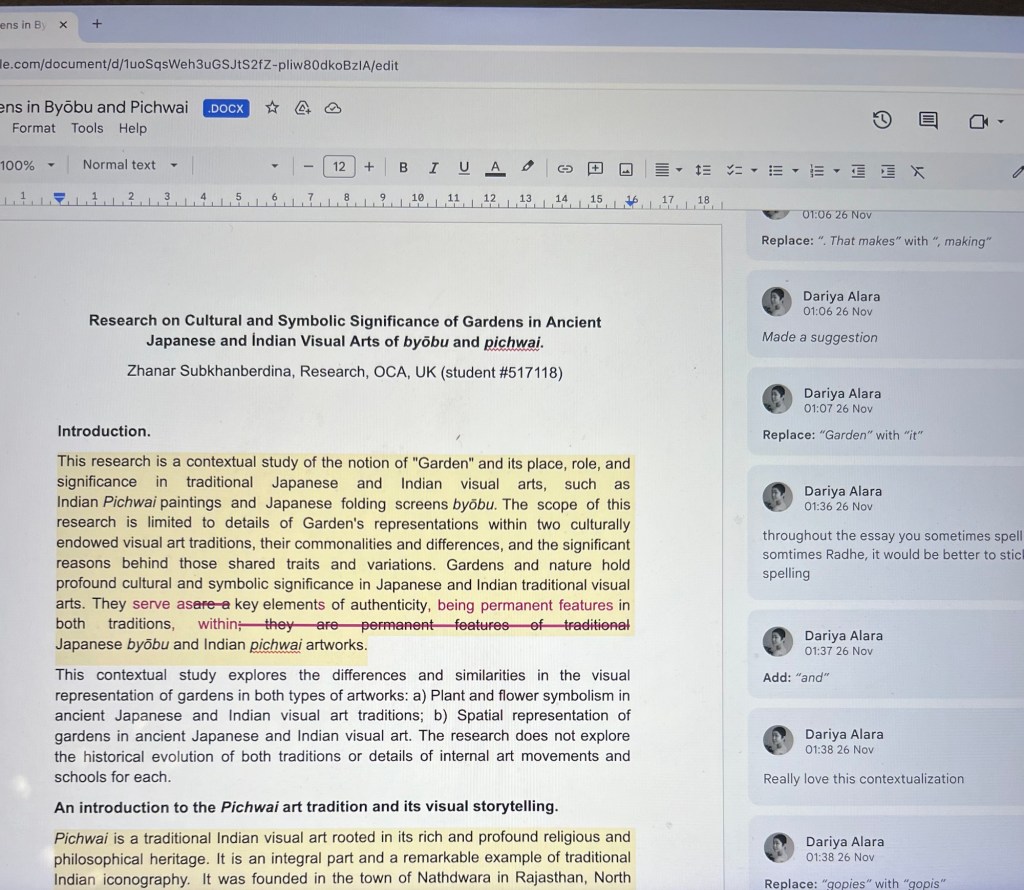
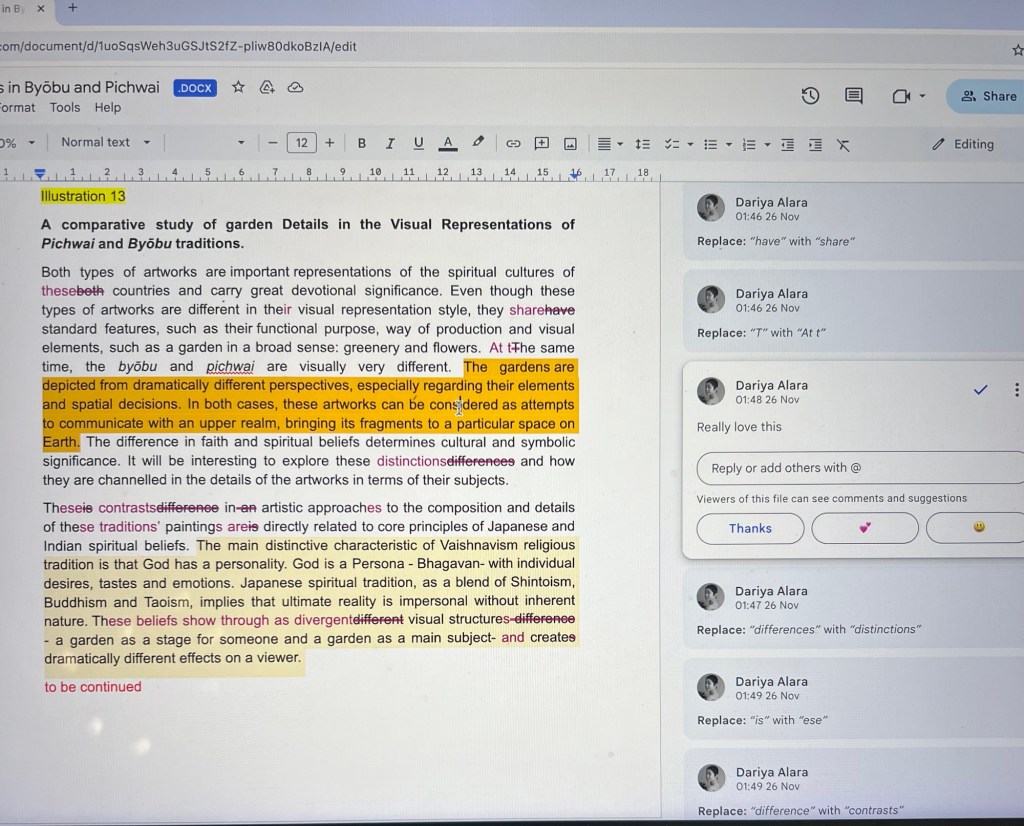
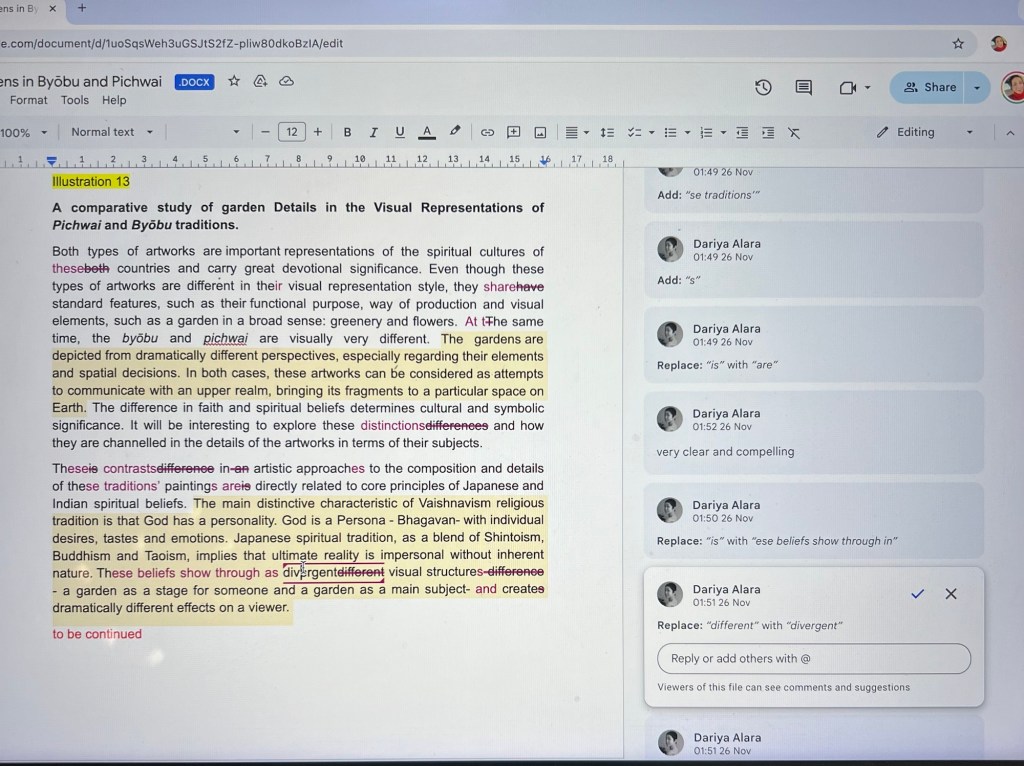
Her edit was super helpful for me. I will place some screenshots of her comments. Besides clearing up some grammar mistakes, she clarified what parts of my written work were good and what ideas should be more supported by explanations and references to academic sources.


Action Points from My Tutor’s ( Mrs Cheryl L Huntbach) Feedback received on October 9, 2024:
Action points ( quotes from my Tutor’s report):
● ” Employ the poetic phrasing around the garden as a transcendental realm. This creates a rich focus for the research question”.
● Gather specific quotes and/or paraphrase text/poetry about specific spiritual narratives.”
● Gather and organise a selection of illustrations to posit an evaluation, analysis and develop Acyour arguments.”
● Keep bringing yourself back to the main focus of the research. Ask how and in what ways the paintings, quotes, and material inform help to develop and respond to the research question.”
I tried to address each action point in the draft of my research. The most challenging point is to “employ the poetic phrasing” since I didn’t state that the transcendental significance of the garden is directly or straightforwardly channelled via poetry. The sense of transcendence in Pichwai is achieved via the devotee-artist’s mental focus on the upper realm and Divine, which he imagines as a garden and depicts on the surface. In traditional Japanese, visual art is intertwined with poetry – poetry focuses on human emotions and the human experience of life on earth in connection with Divine nature. Human’s sensitivity to the beauty of Nature signifies the delicate sense of the Upper realm.
Additional thoughts added in December 2024: When I wrote my initial thoughts about the difficulty of finding poetic phrasing related to the garden, I panicked and was overwhelmed by the task. However, later, working further on my research and focusing on particular details of garden representation in two visual art traditions, I found plenty of poetry, such as verses from Bhagāvad Gītā and traditional Japanese poetry. That was a critical and substantial addition to my research paper.
Action Points from My Tutor’s Feedback received on December 5th, 2024:
On December 5th, I had a meaningful conversation with Dr Lydya Halcrow, who reviewed the draft of my research. She was very supportive and encouraging. Dr Halcrow advised me to focus on the following to improve the final outcome of my research paper:
- To think about the final title for my research paper,
- To finalise the byōbu, the Japanese part. This part was not much covered in the draft;
- To include my clear definition of the “Garden” in my work to avoid misinterpretation;
- Reread the text and make more references to academic sources. ( This part was challenging because I thought I followed the citing. However, I was advised to make a clear distinction between my own thoughts, putting direct references such as “I think…” and “In my opinion..” and those thoughts of other authors I agree with and include in my writing).
Action Points from My Tutor’s Feedback received on January 8th, 2025:
That was my last tutor’s feedback for this course assignment – a written element – my research paper “Cultural and Symbolic Significance of Gardens in Traditional Japanese byōbu and Indian pichwai Visual Arts“. Dr Halcrow was happy with my progress and didn’t suggest any changes in terms of the textual structure of my study, nor did she find my conclusions weak and unsupported by my arguments or not interesting and irrelevant. Below is a summary of her advice to improve the final quality of my written work, I put in quotes:
- “Your introduction to Pichwai paragraph is informative, but it is also a very dense passage and would benefit from being split into two paragraphs to make this more readable.” Agree, done.
- “You bring in images of Pichwai work later in the writing on page 5. I would suggest including an example earlier on in the essay so the reader has sight of an example and you are less reliant on description. You might also include an image of a Pichwai painting to further illustrate the central points to the reader – for example before or after your sentence: ‘The pichwai paintings were traditionally created on handmade paper or cloth using natural pigments.’ This will break up the text making it more readable and also offer a visual reference point for the materiality.” Agree, done. I completely reshuffled the illustrations so that the final work’s numbers differ. I fully grasped my tutor’s idea to make the reading more comprehensive for the reader and make direct connections between my statements and illustrations. I did it.
- “Similarly the subject matter and structure of the Pichwai paintings and their focus on Lord Krishna would also benefit from an example image that you refer to in the body of the essay (with words to the effect of: ‘as seen in ‘Figure 1’ for example).” Agree, done
- “In this way I would suggest weaving in your selected illustrations within your text rather than listing the 5 between pages 5 and 9 so that you refer to an image each time you make a specific point.” Agree, done.
- “The section ‘Details of Spatial representation of the Garden in Pichwai.’ Would be strengthened by the inclusion of sources to pin point the research here, for example where you write: ‘To me, when I view the pichwai paintings, this upper realm looks and is perceived as solid, if not even more realistic than the viewer’s Earthly reality.’ You could expand upon this by saying ‘academic writer xyz states that Pichwai paintings use of colour and density….. (source as per Harvard)’ or similar.” The particular sentence my tutor examines here is, actually, my own perception of the pichwai painting and thought, so I can not cite it. I clearly stated that it was my subjective thinking. Academic art scholars have not studied the spatial representation of pichwai artworks. I think my study is a pioneering one. I have searched Google, Academia.edu, and Scribd.com but haven’t found any academic papers on spatial representation in pichwai. In my previous drawing and painting courses, Levels 1 and 2, including Advanced Practice Level 3, we were encouraged to observe artworks in detail and come up with our own understanding of compositional decisions, trying to put them in words. So, my observation, which my tutor wants me to support by citing academic sources, stems from my practice research skills.
- “Footnote 8 looks like it is missing some information – please can you check this. Done.
- “You refer well to illustrations 7 and 8 in the writing to develop a position – so aim to do this throughout when you bring in a visual of a work.” Agree, done
- “Similarly for Byobu I suggest weaving in images of the work earlier so that they illustrate aspects you are currently describing in words (for example the support materials used).OCA Formative Feedback: Page: 2” Done.
- “You bring in Dr Janice Katz and Dijana Nikodinovsk’s words well here to position the nature of the paintings. Aim to expand upon quotations within the body of the essay – this could be as simple here as words stating – ‘this can we seen in illustration 9’ for example.” Done.
- “There seem to be more sources in the exploration of the Japanese paintings, so where possible I’d suggest more balance and the inclusion of more sources in your Pichwai section.” It is difficult to find more academic sources for Pichwai artworks because there are more academic writings on traditional Japanese visual art than on pichwai. Pichwai is a tiny niche that didn’t attract that much academic interest compared to traditional Japanese art. I checked platforms such as Academia.edu and ResearchGate.net
- “Your chrysanthemum quotes on page 19 are very long and listed in places, I’d suggest taking a shorter quote or perhaps a shorter paraphrase with the inclusion of the course in brackets as per Harvard as this will help the essay flow better here.” Agree, done.
- “Include at the end of the essay a connection back to your own studio practice so that the significance of the research in developing your own work is included.” Done.
 JeanArt