
Reflective Self-Evaluation
At this stage, at the end of the Research course, Level 3, we must present a written reflective self-evaluation, as we did for the Advanced Practice course. To guide me through my self-reflection, I used the recommendations from our online course book ( Research, Part 5);
“To assist you in this process, consider the following:
- Look back and think about your work and the material you have encountered. Alongside and in relation to the work for this course, consider the body of work produced as part of Advanced Practice.
- Think about the journey you have taken; how has it felt?
- Where were your strengths, and which areas were less strong?
- Were there any milestones or moments of realisation?
- Have you solved any problems?
- What has been learnt?”
Looking back, I appreciate the structure of Level 3, which implies the student taking two courses simultaneously: Advanced Practice and Research. It is important to note that my tutors for both courses were consistent with the logic of working on two courses, aiming for an enhanced learning effect due to the synergy of studying visual fine arts from two perspectives: intensive studio practice and strengthening academic research writing skills. In my Advanced Practice course, I worked on my large-size project, the working title is “Riviera Flowers.” My research tutor recommended that I work on the “garden” as a notion in visual arts, giving me complete freedom to decide about the context, from garden design to particular visual art traditions within any historical time frame. This approach let me concentrate on my personal artistic voice and the platform, which has a significant element of spirituality. A good reflection on that naturally brought me the theme of my research paper: “Cultural and Symbolic Significance of Gardens in Traditional Japanese byōbu and Indian pichwai Visual Arts.” Since the research course aimed to bring us to a profound level of academic writing, I had to elevate my paper’s research level by working on high-quality, exemplary academic sources which contain writings about outstanding artworks. For my research, I used rare editions of art books about Indian and Japanese art, carefully reading essays written by world-class art experts. My intense exposure to flawless academic writing from world-class art experts and beautiful artworks significantly improved my understanding of the standards for high-quality art writing, further training my eye and harnessing my artistic taste. The latter was a new large wave of influence on my painting skills. I experimented rigorously with details, brushwork, line work and compositional decisions. My Advanced Practice tutor witnessed my path and encouraged my experiments.
The Research course syllabus helped me tremendously improve my academic research skills. I followed the instructions and exercises meticulously, and I am satisfied with the final result- my contextual study of Garden representation in the traditional Indian pichwai and traditional Japanese byōbu artworks. I find the research paper writing guidance we benefited from in the Level 3 Research course materials, from following and working on each part of this course tasks and assignments, is made comprehensively and systematically. I would recommend the same approach to guide students toward better academic writing for the writing task for the Understanding Visual Culture course, Level 2, which was incredibly challenging to me due to the absence of such clear guidance and reading dense and complex philosophical writings. My progress in the Research course is evident and tangible because I have never produced 27 art research pages. The breakthrough was that I learned how to take an idea and unfold it in academic writing language, bringing it to a fresh point of view. This kind of reading is already an excellent learning method; it helps to understand the quality of writing standards and how to comprehensively deliver your ideas and thoughts. My overall advantage was that I have always been a good writer, but not in academic writing. Another strong position is that I didn’t struggle with the structure of the contextual study and didn’t stick with how to bring an interesting point of view. The areas I had to concentrate on and improve while working on my research paper were the following: I had to boost and refine the academic precision, working on small but important details that distinguish a high-quality academic paper, such as finding a good title, arranging good footnotes, strategically placing illustrations and quotes. Another area I have to work on is that I tend to bring an idea or statement without clearly explaining where my view ( statement) comes from. In this sense, my two tutors’ feedback and peer review were critical and efficient.
Bibliography check. My primary academic resources.
“Ink and Gold, Art of Kano”, Felice Fischer and Kyoko Kinoshita, Philadelphia Museum of Art, in association with Yale University Press, New Heaven and London, 2015;
“On the Laws of Japanese Art”, Henry P.Bowie, 1911, Copyright © 2013 Read Books Ltd., online on Google Play Books;
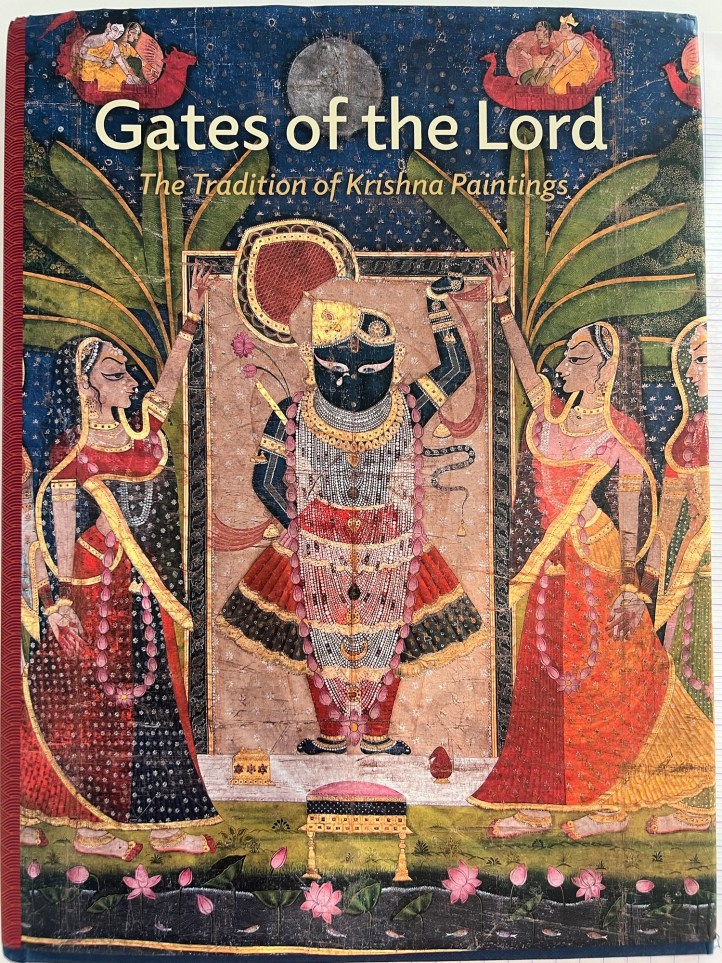
“Gates of the Lord. The Tradition of Krishna Paintings, a collection of essays, edited by Madhuvanti Ghose, published by @The Art Institute of Chicago, Mapin Publications, 2015.
“Beyond Golden Clouds”, Japanese Screens from the Art Institute of Chicago and the Saint Louis Art Museum; edited by Janice Katz, essays by Philip K. Hu, Janice Katz, Tamamushi Satoko, Alicia Volk; @2009.

Senzui Byōbu ( Screen with landscape painting for Buddhist rituals) Item List, Tokyo National Museum, online on https://www.tnm.jp/modules/r_exhibition/index.php?controller=item&id=5365&lang=en [accessed on November 10th 2024];
Summaries. The meaning of the calligraphic line of the East, Noriko Kaya, Osaka University Knowledge Archive, online on https://ir.library.osaka-u.ac.jp/repo/ouka/all/48170/mra_023_021A.pdf
The Painted Screens Surrounding Throne used in Tendai Sect Ceremonies, Toshie Kihara, University of Osaka Knowledge Archive, online https://ir.library.osaka-u.ac.jp/repo/ouka/all/48170/mra_023_021A.pdf [accessed on 10th November 2024];
Jyoti. (2024). TRANSFORMING TRADITIONS: THE JOURNEY OF PICHWAI ART OF NATHDWARA FROM RELIGIOUS ROOTS TO MODERN SPACES. ShodhKosh: Journal of Visual and Performing Arts, 5(2), 98–110. https://doi.org/10.29121/shodhkosh.v5.i2.2024.1062
https://www.granthaalayahpublication.org/Arts-Journal/ShodhKosh/article/view/1062
https://indianartspalace.in/the-colorful-tradition-of-indian-pichwai-paintings/
More research on academic sources ( the full bibliography list is in the Research paper):
https://thedigitaleducation.org/blog/pichwai-paintings-a-complete-guide/
Latika Sanchiner, Dr Dolly Mogra, Documentation and Revival of Pichwai painting, Journal of Emerging Technologies and Innovative Research (JETIR), JETIR, volume 10, issue 4, April 2023, An international scholarly open access, peer-reviewed journal, online on https://www.jetir.org/papers/JETIR2304A44.pdf [accessed September 1st 2024];
Khan, Dr. (2022). Article Pichwai painting of Rajasthan, online on Research Gate, https://www.researchgate.net/publication/363298398_Article_Pichwai_painting_of_Rajasthan [accessed on September 19th 2024];
Twinkle Kataria, From Havelis to Galleries: Examining the Shift in Context and Relevance of Pichwai Art through Contemporary Devotional Artistic Expressions, 2023, online on Academia Eduhttps://www.academia.edu/108267221/From_Havelis_to_Galleries_Examining_the_Shift_in_Context_and_Relevance_of_Pichwai_Art_through_Contemporary_Devotional_Artistic_Expressions [accessed on September 10th 2024];
Priyanka Yadav, Ramratan Guru, Ushma Saini, Pichwai: the Tapestry Art of Nathdwara, Shodh Drishti, An international peer-reviewed preferred journal, Vol.14, #5.2., May 2023 online on https://www.scribd.com/document/680045442/PichwaiArtofNathdwara [accessed on September 12th 2024];
 JeanArt