We are asked to research any artist “whose work has changed radically in style, medium or subject matter at some point in their career. Find interviews and artists’ writings in journals, online, and/or books that present the artists’ accounts of these developments. In your learning log, reflect on their motivation for change, the challenges presented, and how the artist tackled them.” ( Advanced Practice course-book);
I think Vasily Kandinsky ( 1866-1944) would be a good fit. I will not write his biography but will focus on the development of his spirituality, which is reflected in his understanding of what visual art was for him and in a massive change in his personal artistic style. He is known as a pioneer of nonrepresentational art, creating the first abstract modern artwork, “Composition I” or “Abstraction”. Kandinsky made notable contributions to art theory in his book “On the Spiritual in Art” ( 1912).
Kandinsky’s early paintings dramatically differ from those he created later in life in terms of how he migrated from representational and naturalist art towards abstraction. He explored abstractions, substituting representational drawing with geometric forms and curvy lines; he gave colour a lot of value and importance.
Below, I place his very early and very late artworks.

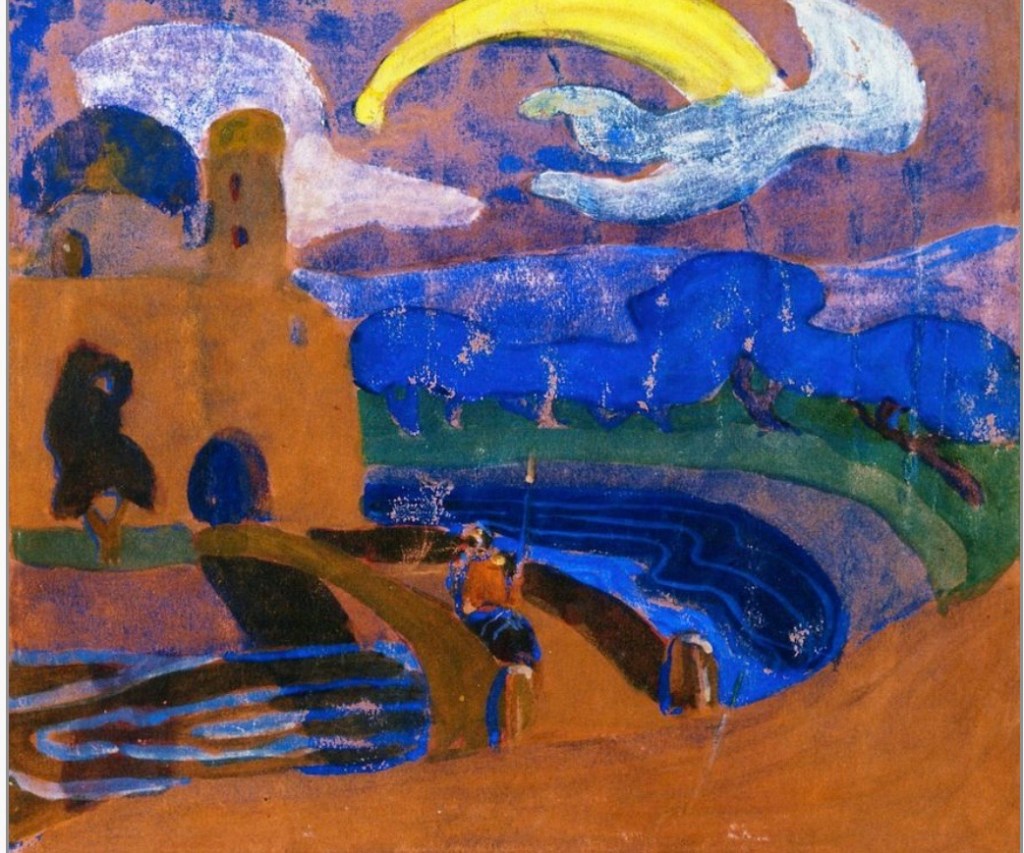

A Motley Life (Das Bunte Leben), Wassily Kandinsky, 1907. Tempera on canvas. 51 1/8 x 63 15/16 in. (130 x 162.5 cm). Bayerische Landesbank, on permanent loan to the Städtische Galerie im Lenbachhaus, Munich. Artist Rights Society (ARS)/Wikimedia Commons; image via https://www.thoughtco.com/kandinsky-profile-4
Below is the painting he created in 1939, five years before his death. I placed these two paintings together to show the contrast and change Kandinsky underwent as an artist.
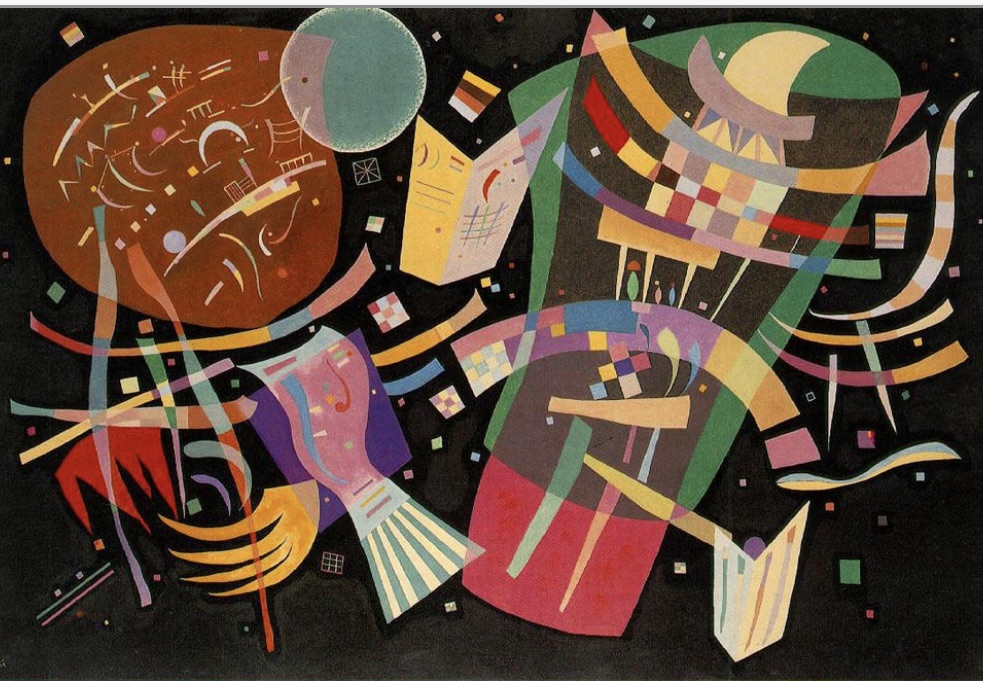
Kandinsky’s last watercolour was created in 1944, the year he died.

I wanted to reflect on why Kandinsky was passionate about going from representational to abstract art. One of the main reasons I see is that Kandinsky was an artist born and evolved when photography was invented. The first photograph was taken in 1826, and by Kandinsky’s age of twenty in 1886, photography was already quite well spread, provoking thoughts on the validity of someone’s skill to represent reality while the new technology, photography, can do it much more accurately. It is a well-known fact that with the invention of photography, visual artists had to rethink themselves. Thus, Vasily Kandinsky took one of the most active roles in this collective generational self-reflection. Another critical factor in his development as a philosopher is the influence of spiritual literature available at that time, which stimulated the evolvement of his spiritual views and beliefs. In his own book “On the Spiritual in Art” ( January 1912), the artist explores such ideas as what art should be as a reflection of the inner spiritual life of an artistic person; he believed colours have unique characteristics and evoke particular emotions in humans, so each colour has got its own spiritual and metaphysical significance. It is worth mentioning that Kandinsky perceived any artist’s path as a mediation between the spiritual world and the viewer. Kandinsky shifted from representational art to abstract art to emphasise artistic ability, insisting that representation of outer material reality distracts the viewer and the artists from spirituality and narrows their focus on the external material world. Many art critics believe that Kandinsky was influenced by Sigmund Freud’s ideas, who lived simultaneously from 1856 to 1939. For example, Freud’s “Interpretation of Dreams” was published in 1900.
I started to read his book “On the Spiritual in Art“, and from the first pages, I saw that Kandinsky strongly believed in eternal Soul, Spirit’s existence. He puts a great emphasis on the “awakening” of the soul. He strikes a reader right from the introduction on page 10 with his words:
“This glimmer of spiritual closeness is, in spite of its great importance, no more than a spark. Our soul, after the long period of materialism, at last begins to awaken from despair born of unbelief, lack of purpose and ideals. This nightmare of materialism, which has turned the life of the universe into an evil, useless game, has not yet past. The awakening soul, while trying to free itself, is still under its domination. Only a feeble light flickers, like a tiny star, in the vast encircling darkness. As a presentiment, the soul does not as yet courageously admit its fear, that the light might be a dream and the encircling darkness, reality.” (On the Spiritual in Art, Vasily Kandinsky, 1946, p.10)
This passage strongly reminds me of the message of the nature of the Soul as it is put in the Bhagavad Gita, 5:15 “…However the living entities are bewildered because their knowledge is covered by ignorance”. The BhagavdGita was published in Europe when it was translated to German by August Wilhelm von Schlegel ( 1767-1845), a renowned Indologist and scholar, in 1823. Firther, for example, Kandinsky writes in the book in his passage “This opinion is an unconscious protest against materialism, which demands that everything be practical and have a purpose. It proves the strength and permanence of art and of the human soul, eternal and eternally alive, which can be bent but not broken, stunned but never destroyed.” ( p.93). This is very much similar with what is said in Bhagavad Gita, chapter 2, verse 20 ( 2:20) and verse 23 ( 2:23) in translation from Sanscrit by A.C. Bhaktivedanta Swami Pabhupada ( 1896-1977): “The Soul is neither born, nor does it ever die; nor having once existed, does it ever cease to be. the soul is unborn, ternal, ever existing, undying, and primeval. It is not destroyed when the body is destroyed”, ” weapons can not cut it, fire cannot burn it, water cannot wet it, and the wind cannot dry it“.
I wanted to understand why Kandinsky established a direct relationship between abstract painting and spirituality. Why can spirituality be represented only through abstract painting? For me, any good work of art is spiritual. For example, I am enchanted by traditional Japanese visual arts, the Kano school paintings, and Ogata Kōrin‘s works—I find them deeply spiritual, though they are not abstract. It is important to note that I fully share Kandinsly’s view on the nature of the Soul and art’s effects on it: art should touch the soul on the level of “subtle” vibrations. He explains this:
“The elementary, baser emotions such as fear, pleasure, sorrow, serving the contents of art during this period of temptation, will hardly attract the artist. He will endeavor to awaken more subtle, undefined emotions, as he himself lives a comparatively complicated, subtle life. His creative work will surely arouse in observers, who are capable of deeper response, emotions which cannot be defined in words.” ( On the Spiritual in Art, Vasily Kandinsky, 1946, p.11)
Thus, in this aspect of “awakening more subtle emotions” I understand spirituality in art in the same way as Kandinskly did. If we speak about artwor’s ability to provoke these “subtle” vibrations in the viewer, then his early artworks are equally spiritual to me as his later ones. Notably, Kandinsky recognised some representational art as spiritual. It was interesting to read how complimentary Kandinsky was about Cezanne:
“A similar task to find a new law of form was realized by Cezanne. He made a living thing out of a teacup. To be more precise, he realized the existence of a being in this cup. He raised the “nature morte” to a height where the exteriorly “dead” object becomes Inwardly alive. He treated these things as he would the human being because he was endowed with the gift of divining inner life in everything; he gives them a colourful expression. (On the Spiritual in Art, Vasily Kandinsky, 1946, p.31).
I read his book and I understand now his idea about why abstract art is a pure form of art. This idea is related to his concept of “inner necessity“, which is described by Kandinsky as follows:
“This inner necessity which consists of three mystical elements is brought about through three mystical ways:
- Every artist, as a creator, has to express his own personality (element of personality).
- Every artist, as a child of his age, is impelled to express the spirit of his age (element of style composed from the message of the epoch and the language of the nation, as long as the nation continues to exist).
- Every artist,a servant of art, is impelled to present art as such (element of pure, eternal art, which is constant among all people, nations and ages, and Is evident In the works of every artist, every nation and every epoch, as the main element of art, irrespective of time and space).” ( On the Spiritual in Art, Vasily Kandinsky, 1946, p.55)
Together with his explanation further it becomes clear that the artists should not focus on external world and there fore can not engage in representing the external reality : “The artist should be blind to the importance of “recognition” or “non-recognition” and deaf to the teachings and demands of the time. His eye should be directed to his inner life and his ear should harken to the words of the inner necessity. Then, he will resort with equal ease to every means and achieve his end.” ( p.58). Thus what is left is abstraction, nothing else, which can be depicted only by geometric forms and/or colours, that is why his book naturally contains chpater about colours and forms. In some sense his book is very technical and can be used by any artist who can master the abstract genre:
Finally, the more abstractions the artist employs the more at home will he feel in the realm of the non-objective. Likewise the observer, led by artistic attainment to better knowledge of the language of the abstracted, finally, becomes fully conversant. ( On the Spiritual in Art, Vasily Kandinsky, 1946, p. 52).
Bibliography: “Vasily Kandinsky, His Life, Philosophy and Art”, Shelley Esaak, November 2019, ThoughtCo, online on https://www.thoughtco.com/kandinsky-profile-4122945 [accessed on October 12 2024]; “Kandinsky: the Path to Abstraction”, Tate Modern Exhibition, 22 June-1 October 2006, online on http://www.tate.org.uk [accessed on October 12 2024]; “Composition X”, Kandinsky, online https://www.wassilykandinsky.net/work-62.php [accessed on October 12 2024]; “On the Spiritual in Art, Vasilly Kandinsky, PUBLISHED BY THE SOLOMON R. GUGGENHEIM FOUNDATION. FOR THE MUSEUM OF NON-OBJECTIVE PAINTING. NEW YORK CITY. 1946. HILLA REBAY. EDITOR online on https://www.csus.edu/indiv/o/obriene/art206/onspiritualinart00kand.pdf [accessed on October 10 2024]; Search in ChatGPT about what kind of spiritual literature was available in Kandinsky’s lifetime”, [accessed on October 15 2024]; “Bhagavad-Gita AS IT IS”, His Divine Grace A.C. Bhaktivedanta Swami Prabhubada, second edition, The Bhaktivedanta Book Trust, 1968, online on http://www.asitis.com [accessed on October 17 2024]; “August Wilhelm Von Schlegel”, online on http://www.plato.stanford.edu [accessed on October 15 2024];
 JeanArt