Where have you been, and how did you get here?
Exercise 3. Opening your letter. Questions to reflect on:
- How has your actual route deviated from the planned path?
- To what extent and to what effect have intuition/planning, chance/risk, instinct/research and labour/series played a part in developing the work and your thinking around it?
- What have you valued most within your experience of the course?
I had no “planned path” to write about the letter in Part One of this course. In Part One, I audited my previous works and reflected on what was of good quality, complete and engaging and what was “raw”, showing me a new path and area for refinement and growth. It is worth mentioning in the framework of this exercise that in 2017, I started from scratch in terms of my knowledge and overall exposure to the visual arts. I knew nothing about art history, creative process, mediums, visual art theory, or practice. I have been very open to whatever came into my hands during my OCA learning path and did my best to be disciplined and follow each exercise’s requirements. I give full credit to OCA’s methodology and overall experienced attitude toward its students and the challenges of their learning process. I would not have reached my current point without OCA’s structured teaching approach. Thus, I had no ambitions except to become a professional visual artist and maybe an art critic. I planned to create a large painting of the French Riviera flowers and greenery at the beginning of this Advanced practice course.
It is interesting to observe myself in my creative process on this project. There is a direct correlation between my intuition and the amount of research I do on other artists’ works. When I was a Level 1 student doing research for my Drawing 1 course, the results of my research didn’t influence my creative practice at all since I didn’t have particular truly artistic projects and, consequently, questions since my creative ideas at that time were very basic following the requirements of the Level 1 tasks. I didn’t notice and chronically overlooked other artists’ decisions about every detail, composition and colour, so I didn’t learn. My major growth is reflected in this change – I look at other artists’ works differently, observing small nuances and trying to understand whether their ideas are relevant to my personal style and its development. I am glad I managed to develop an educated view. At my current point, there are all elements such as intuition/planning, chance/risk, and instinct/research in my creative practice. I plan the project and gather initial visual and literature ( reading) material using mind maps; I take risks – this time in the sense of the size of the painting. My instinct and research go hand in hand; I also leave space for chance when I analyse the outcomes and exploit whatever appeared good by chance – like spilt inks or new, unexpected effects from the medium.
In this Advanced Practice course, I value the freedom OCA gave me as a student at Level 3, my Tutor’s support, and his knowledge of my personal style. Another great thing is that we are doing this course simultaneously with the Resercah course, which enriches my creative practice and elevates my understanding of what I want to achieve from my current project.
Research on Paul Cezanne’s artworks.
Below is my selection of Cezanne’s works. He used many green colours and painted the greenery near my place.

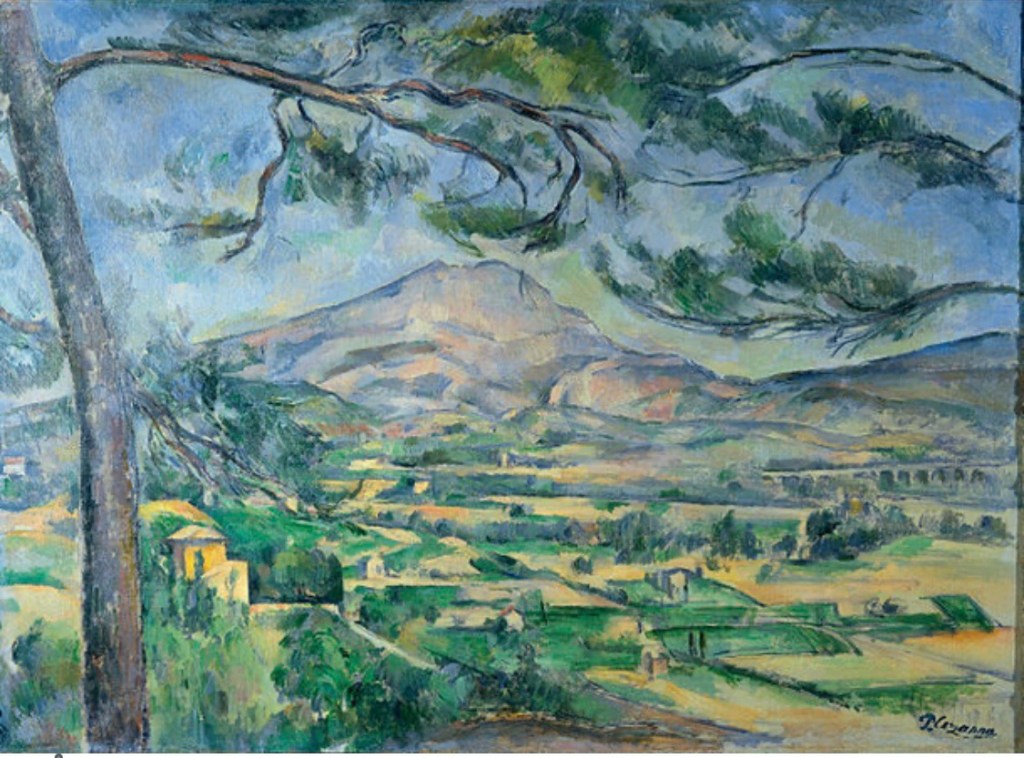
Mont Sainte-Victoire and the Viaduct of the Arc River Valley, Paul Cézanne, oil on canvas completed between 1882 and 1885; image via https://www.metmuseum.org/art/collection/search/435877
Mont Sainte-Victoire and the Viaduct of the Arc River Valley is an oil painting on canvas completed by Paul Cézanne between 1882 and 1885. It depicts Montagne Sainte-Victoire and the valley of the Arc River, with Cézanne’s hometown of Aix-en-Provence in the background.
First, I observe that he created the perspective diagonally, outlined with a thin path in the meadows running diagonally through the painting. It is a captivating perspective that creates depth and a sense of space on the flat canvas. It looks like he painted it on the hill since he placed the trees of different heights—some can be seen at full height, and there are just crowns at the lower right corner. He was standing at the edge of the hill, and I can also see the upper part and the roof of the yellow building at the bottom of the painting. Another notable and intriguing common feature of his artworks is the tilted horizon line. In his painting above, the bridge line is not perfectly straight, especially when it goes closer to the right side of the canvas, becoming soft and curved as hills’ lines around. Besides this tilted and softly shaped bridge, many lines are not straight and consecutive in the painting: the upper hill diagonal line, tilted apart trees’ trunks, the dark line of the hill on the right side is moving away from the diagonal path line. These geometric lines’ irregularity and absence of rigid straight lines create a sense of space, breathing and fluidity.
Another fascinating feature of this painting is how he handled the light/colour value on the canvas. There is a lot of light on the right side of the painting; the light comes from the upper right corner and occupies a lot of space. If we draw an imaginary diagonal line from the lower left corner to the upper right corner of the surface, we can see that the vast light on the right side is balanced by darker tones on the top left side.
Paul Cézanne, Mont Sainte-Victoire with Large Pine, c. 1887, oil on canvas, 66.8 c 92.3 (The Courtauld Gallery, London) image via https://www.khanacademy.org/humanities/ap-art-history/later-europe-and-americas/modernity-ap/a/czanne-mont-sainte-victoire
Again, in this painting, I see a perspective created with a diagonal line from the lower right corner to the upper left side of the canvas. Cezanne painted the same scenery from different viewing points. Here, we can see the “|viaduct of the Arc River Valley,” which is smaller than in the first painting above. The hills are painted in transitioning colours between the greenery and the blue skies in both paintings. Also, I see that he didn’t use any red and pink colours, which actually supported my hesitations regarding the red flower in my work, which seemed inappropriate. Both of Cezanne’s landscapes above are very consistent in terms of the colour palette: I can see shades of green, blue, yellow, and brown colours.

Oil on Canvas, image via https://www.artchive.com/artwork/mont-sainte-victoire-paul-cezanne-1902-1904/
Cezanne tirelessly painted the mountain Sainte-Victoire in Aux-de-Provence. The painting above was completed after the first two. It is more abstract and uses a different brushstroke technique, emphasizing geometric square forms. Compared with the previous two works, it looks quite flat. To me, it looks like he was experimenting and looking for something.
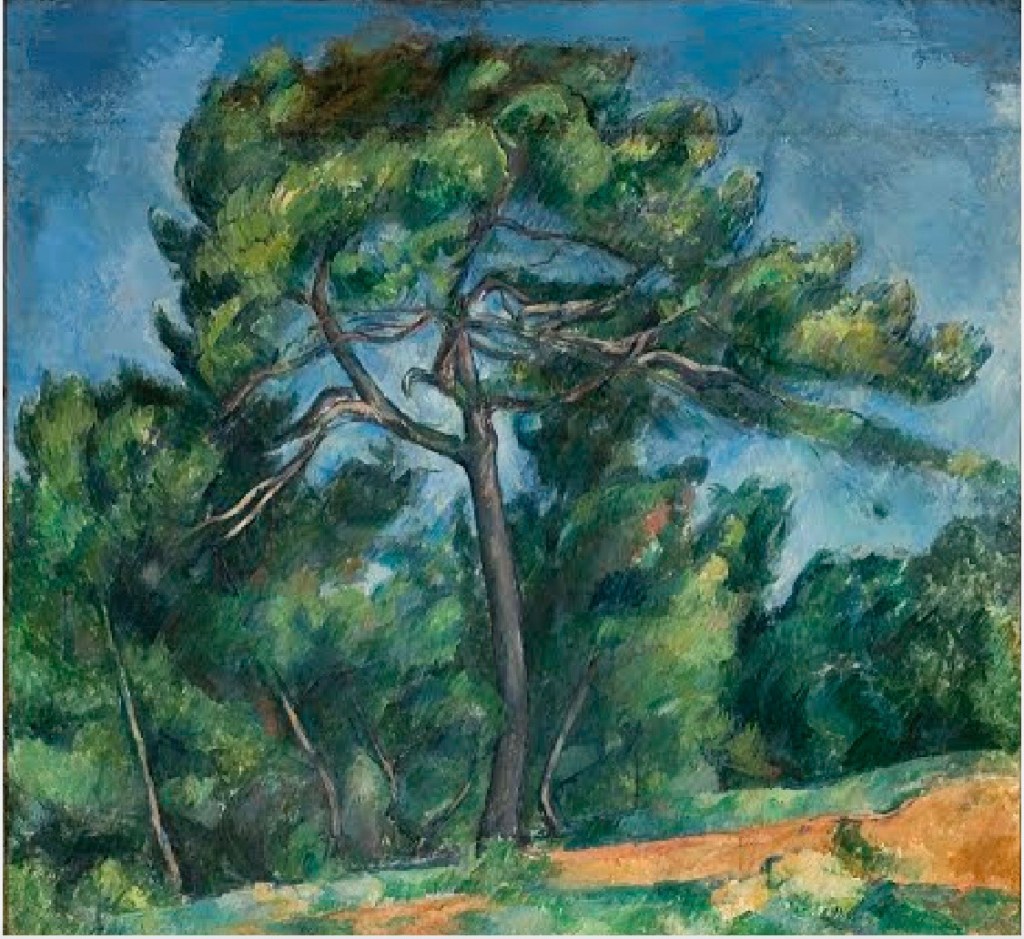
The painting above, with a pine tree as its central element, is particularly notable for Cezanne’s brushstrokes, which give a tangible sense of wind passing through the green leaves.
I find Cezane a great master of nonlinear geometry. He always uses it in his landscapes, creating spacious, airy vistas. This effect is well commented on in the documentary “Paul Cezanne and the Genesis of Cubism” as his ability to simultaneously create a strong, concentrated but expanding image, a concentration and expansion within the canvas. This painting above has a central tree painted on diagonally placed soil. This creates tension amplified with yellow-brown hues.
I also looked at his painting below since I have a sea element in my current project.
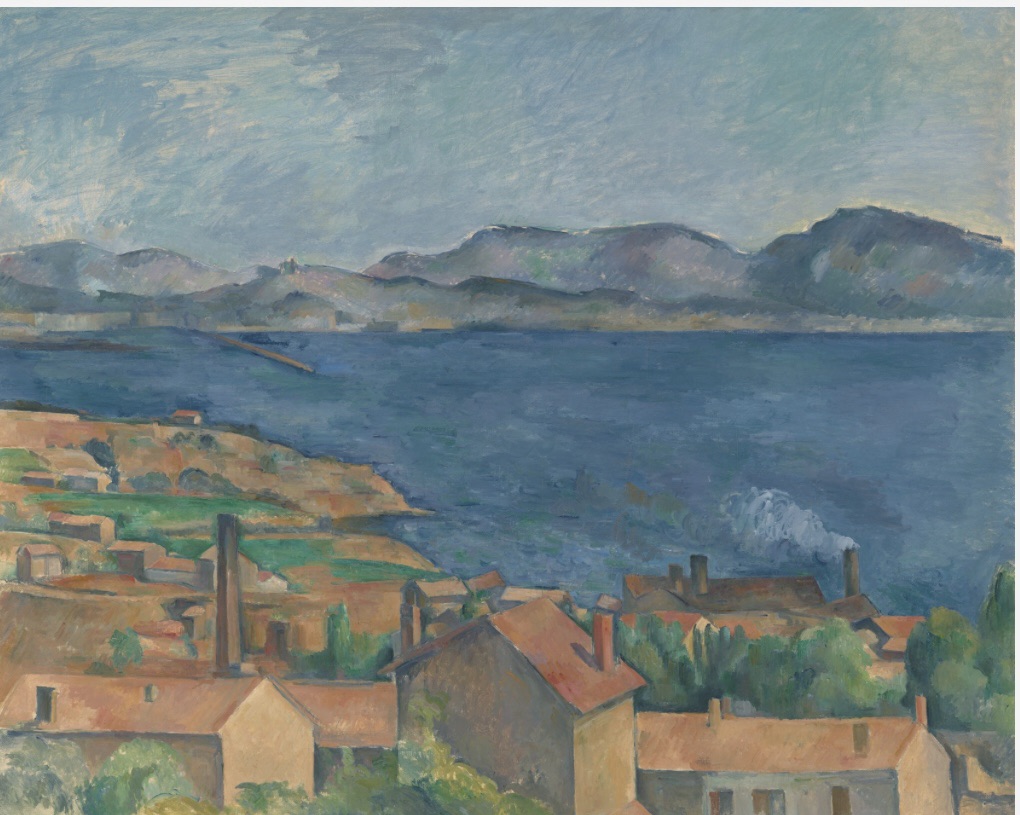
Somehow, Cezanne painted the waters in a way that made me feel the heaviness of its mass. The dialogue he created between the Earth’s gravity seen in the water and a ceiling of the skies. He used shades of blue and green for the sea, working with brushstrokes in patches.
I will try this technique with my inks for the sea element in my project and continue with different diagonal compositions.
Bibliography: Paul Cezanne and the Genesis of Cubism by Jacque Vichet, Documentary, Youtube, online on https://www.youtube.com/watch?v=TLbfSIVkzI4 [accessed on October 12 2024]; Paul Cezanne, Arts & Culture, online on https://artsandculture.google.com/asset/the-great-pine/1gETueQhfo41ew?hl=en&avm=2 [accessed on October 10 2024]; Paul Cezanne, Artchive, online https://www.artchive.com/artwork/mont-sainte-victoire-paul-cezanne-1902-1904/; [accessed on October 10 2024]; Paul Cezanne, Khan Academy, online on https://www.khanacademy.org/humanities/ap-art-history/later-europe-and-americas/modernity-ap/a/czanne-mont-sainte-victoire; [accessed on October 10, 2024]; Paul Cezanne, Met Museum, online on https://www.metmuseum.org/art/collection/search/435877 [accessed on October 10, 204];
 JeanArt