
Working on the project. Peer review.
Below is the development I did this September for my Advanced Practice course, Part Four.
In Part Three, I developed three panels—sheets with different trees in inks and soft pastels. In Part Four, I continued working with them as fragments of my larger painting. I had to work on empty parts, so I started developing the bottom part of the painting.

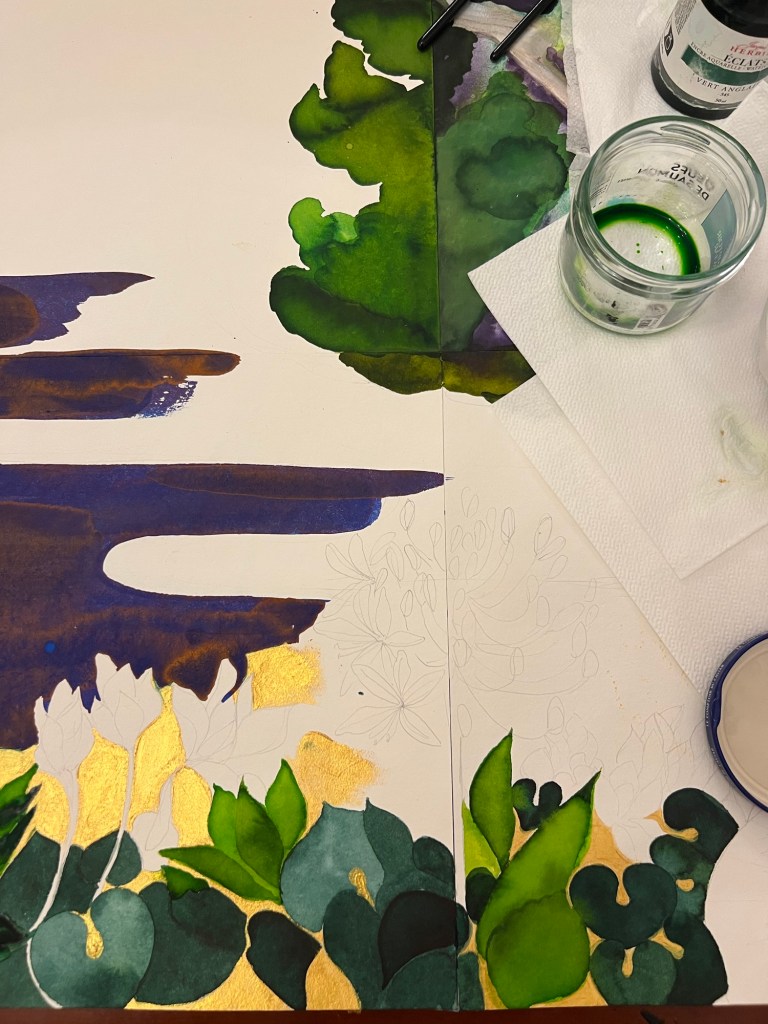
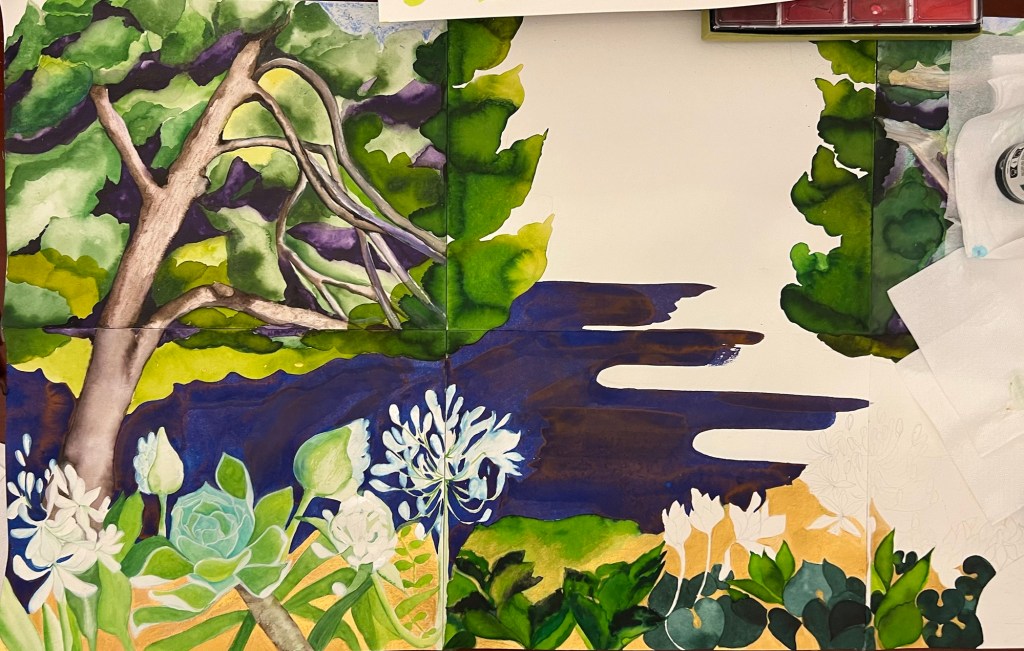

At some point, I hesitated whether I should go that wild and bold with colours. I didn’t understand where that hesitance and fear of overloading the painting with colour came from, so I explored the entire draft in a monochrome version. It was interesting to observe that the monochrome version tends to conceal the weak points, such as the green leaves at the lower central sheet, which I was not happy with.
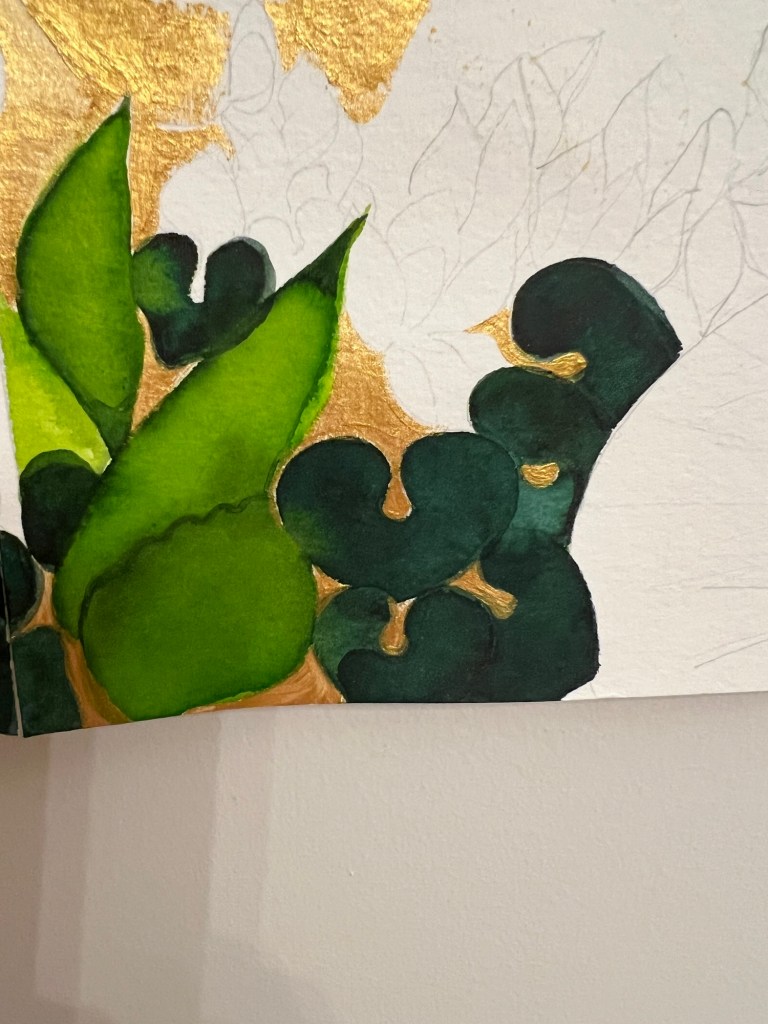
Below is my analysis of the details of the composition. The left sheet – the green leaves I don’t like; this is how I should not depict them. When I realised I should try something different, I developed different leaves – below in the middle, the round, heart-shaped leaves in dark green- I combined them with a gold background. So I think they will stay and I will develop them further. I think the flowers on the sheet on the right side are good and will remain for larger painting as an element.
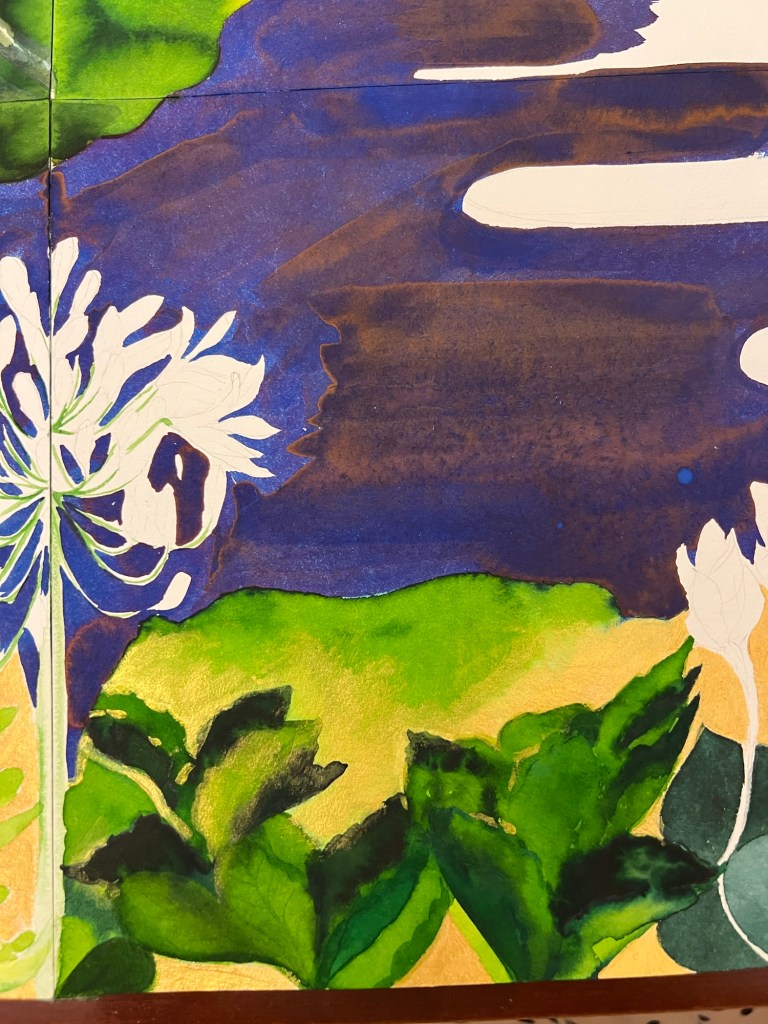

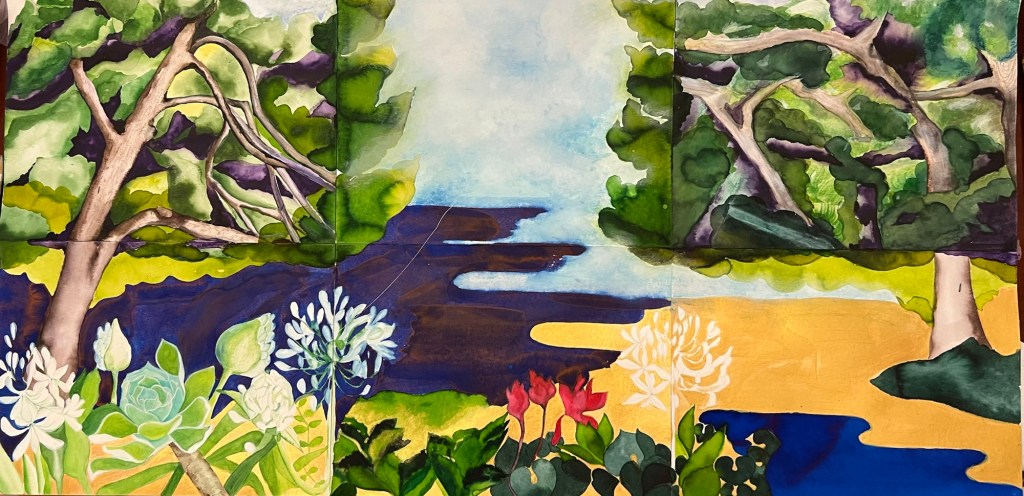
When I finished the bottom parts with flowers, I reached the point where I had to unite everything in one composition. So, I thought about how I would use the surface spatially, what I would pit between the trees, and whether I should continue the row of flowers from side to side. I also wanted to test how the gold shade would look in this kind of painting. For some reason, I didn’t feel good about placing the flowers just as a front row, remembering what I liked and what other artists’ compositional decisions resonated with me- below. These compositions are characterised by a common feature: a diagonal line.


Parahi Te Marae ( Là rèside de temple), Paul Gauguin, 1892, oil on canvas; image from the book below “Gauguin. L’alchimiste”, under the scientific direction of Claire Bernardi and Ophèlie Ferrier-Bouat, Art Institute Chicago, 2017;


I made the sky with a classic wet-on-wet aquarelle technique, working with a soft paper tissue to create clouds.

Placing two “busy” in terms of the number of elements and colours produces an interesting visual effect. It creates multiple viewing points, making me think about creating a painting layering the landscapes, which would be similar but different simultaneously. I liked the overall complexity of the two lawyers. Another thing I liked is the border between the sheets, which changes and kind of breaks the lines of the tree’s foliage. I find this imperfection interesting.
I thought about adding depth and worked over with a soft white pastel to scale down the dark blue sea line and diffuse it with a horizon. The foggy-mist-like effect is also interesting.

Above is the finished draft of the large painting I am working towards. I have mixed feelings when I look at it—I like it and don’t like it. I decided to put in a list below of things I liked and feel confident about the things I don’t like, where I have to work more.
- Trees stay, though more work is needed to refine the colours and foliage representation;
- Dark purple shades in green foliage stay;
- Flowers on the left side sheet -stay;
- Dark blue waters placed in a “Japanese” way – stay (maybe);
- aquarelle skies – stay; Mist – probably will stay;
- round hearth shape dark green leaves – stay;
- diagonal viewing line – stay;
Elements to develop more:
- more plant-flower elements are needed;
- central part green plain levels – NO!;
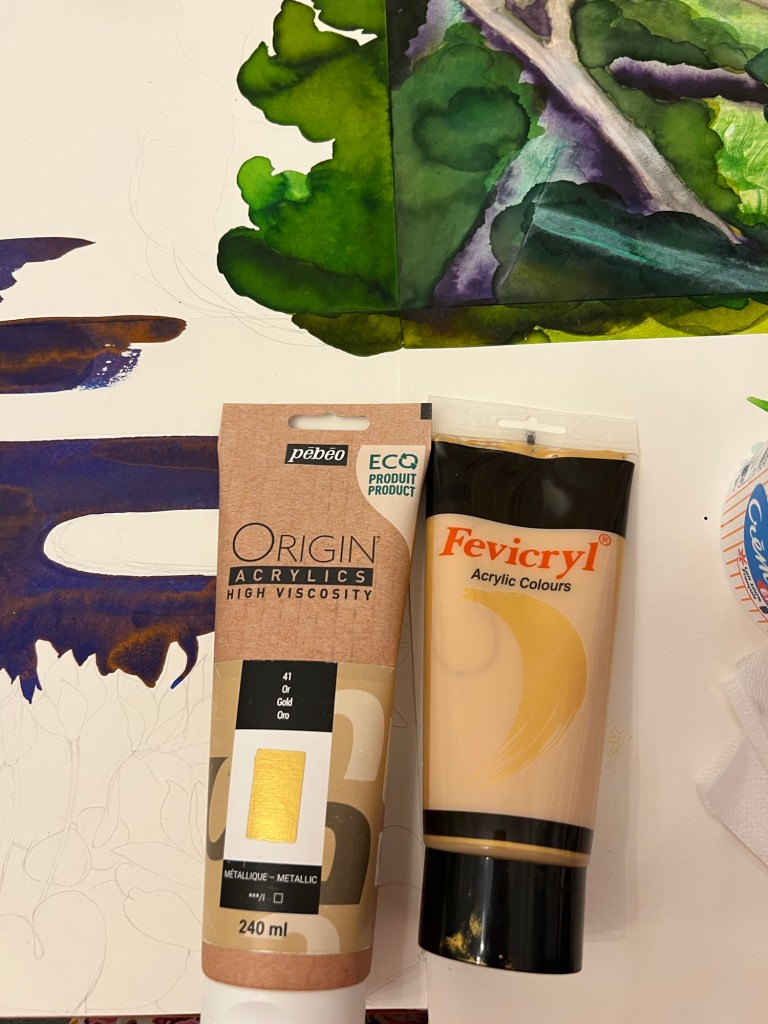
- gold area – I don’t know.
- The red flowers and red as a colour- not sure that the painting needs red.
At this point, when I completed a fort draft of my future painting, I started to feel very intimidated. Suddenly, I thought that everything was wrong. Also, I better understood the complexity of large paintings, which contain many elements. Every element must be perfect and in its relationship to all others. This is my most difficult task and my main challenge now.
PEER REVIEW / CRITIQUE
On October 23rd, I did a session with Lydia Halcrow titled “HE5 Open Studio, Research towards Practice.” I shared my current work via this post in my learning log and my Research course notes. There were two other students besides me, and we had a productive discussion.
Lydia recommended that I not stay rigid and traditional, stick to the shape of the canvas, and use canvas as a main surface. She suggested I try this project on fabric. This idea was supported by Tess – another student, who mentioned that silk would be appropriate. Claire noted that she liked the boldness of colours and found the deep dark blue colour intriguing. I asked whether they thought the red flowers were harmonious since I didn’t like them. Tess was sure they were in a good place and centralised the painting, though she also agreed that I had to work on them more.
 JeanArt