
Working with your research material and data to present or develop an argument or position.
Exercise 1. Sorting and categorising in Practice.
In this exercise, we must create headings to sort and divide our research material and data. I have to choose headings summarising the material I have collected and linked to my area of interest. Also, we have to identify which headings feel particularly important to you. Narrow this down to a maximum of three headings of your choice, and write down why you chose these headings and what overlaps you can see between the material under each heading. Analyse the material and form three sentences summarising each heading and its content. Record all of this work in your learning log.“
I find this exercise helpful in helping me progress my research paper. Thus, I started categorising and sorting out the research material I had accumulated up to this point. The narrowed-down headings or categories of data I need are the following:
- Pichwai and Byōbu Contextual Cultural and Social context – what is the core cultural idea and social role behind the artworks of my research interest;
- Pichwai and Byōbu Historical Timeline and evolution to modern days;
- Pichwai and Byōbu Ancient Artists and Their Artworks
- Pichwai and Byōbu Contemporary Artists and Their Artworks. I included this category in my research because my Tutor recommended it. I find this advice very helpful
- l since most of the ancient artwork in my research area is done by unknown artists.
It is recommended that we narrow our headings to three. I have four because I added contemporary artists and their artworks to my research. All four categories are essential in my research because I must deliver a clear framework for my research questions.
I must analyse the material, develop sentences for each heading, and summarize its content. Below, you can find the brief content for each heading. I included this brief description for my own purposes. I also included the summary of each heading in blue at the beginning.
Pichwai Contextual Cultural and Social Context. Pichwai is a traditional Indian visual art rooted in its rich and profound religious heritage. It was founded in the town of Nathdwara in Rajasthan, North India, by representatives of the Pushti Mag* sect in the XVI century. It is believed that the first Pichwai artworks appeared at the Shrinatji temple as an element of worship of Lord Krishna during various types of devotional service. Pichwai artworks were highly decorated textile backdrops or hangings behind the altar with deities in Vaishnavi* temples. The term “Pichwai” has two Sanscrit words: ‘pichh’, which means back, and ‘wai,’ which implies textile hanging. The subject of Pichwai paintings has always been exclusively focused on Lord Krishna and His “leelas” – divine activities, which are always a play for him. It is important to note that Pichwai is a type of visual art deeply intertwined with literary sources such as Bhagavata Purana*, Bhakti* poetry, and Gita Govinda*. Pichwai art stands out with its unique characteristics, such as devotion and Indian cultural heritage, reflected by its spiritual significance, elaborate detailing, fine workmanship and vibrant colours.
Pichwai’s historical timeline and evolution to the modern day. Pichwai is an ancient visual art tradition that is remarkable in its adaptation and thriving through the times. The town of Nathdwara and its temple were founded in the 19th century. The people of Nathdwara and local artists decorated the temple with hand-embellished rich embroidery and paintings depicting stories about Lord Krishna. By the XVII century, this art movement was recognized as Pichwai art. Due to its spiritual significance, the Pichwai art has travelled through centuries, adapting and evolving to its modern forms and becoming a collector’s item. It has always been a valuable gift. Besides well-established major schools of Pichwai art ( Nathdwara School, Kota and Bundi School, Udaipur School, and Jaipur School), there are contemporary Pichwai art movements. This research aims to observe the evolution of Pichwai’s art style.
Pichwai ancient artists and their artworks. Pichwai, mostly unknown ancient artists, established a tradition of elaborate, skilful artwork production based on ancient sacred texts, such as Bhagavata Purana and Gita Govinda. For my research, I have picked up the following ancient Pichwai artworks.
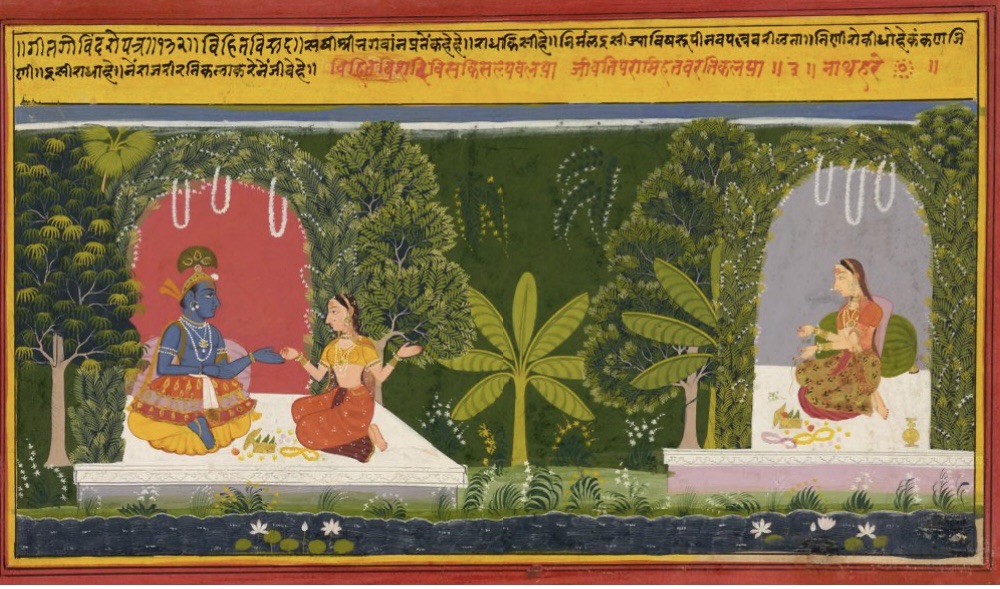


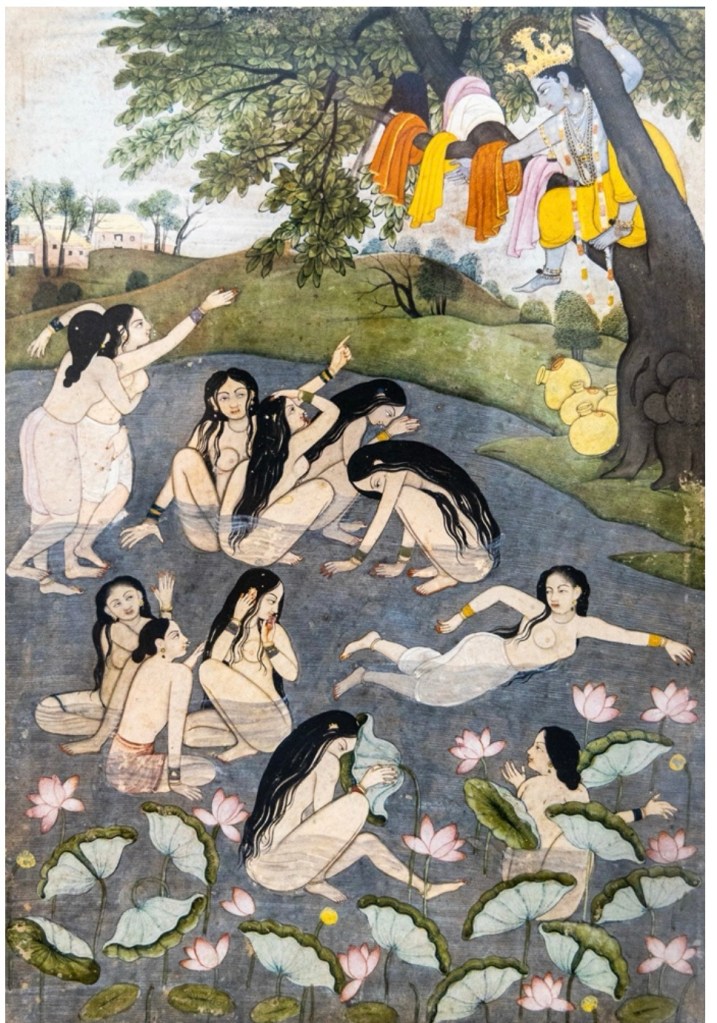
Vastra Haran- Gopies demanding their clothes from Krishna. Based on the story of the Bhagavata Purana, Kangra, Pahari. Circa 1800
Photo credit to: 👇🏻
Modern Pichwai artists. Modern Pichwai artists take the 300-year-old art tradition to new aesthetic and spiritual heights, combining ancient and contemporary visual art techniques and experimenting with media.
Below are the modern Pichwai artworks I have selected for my analysis and research.
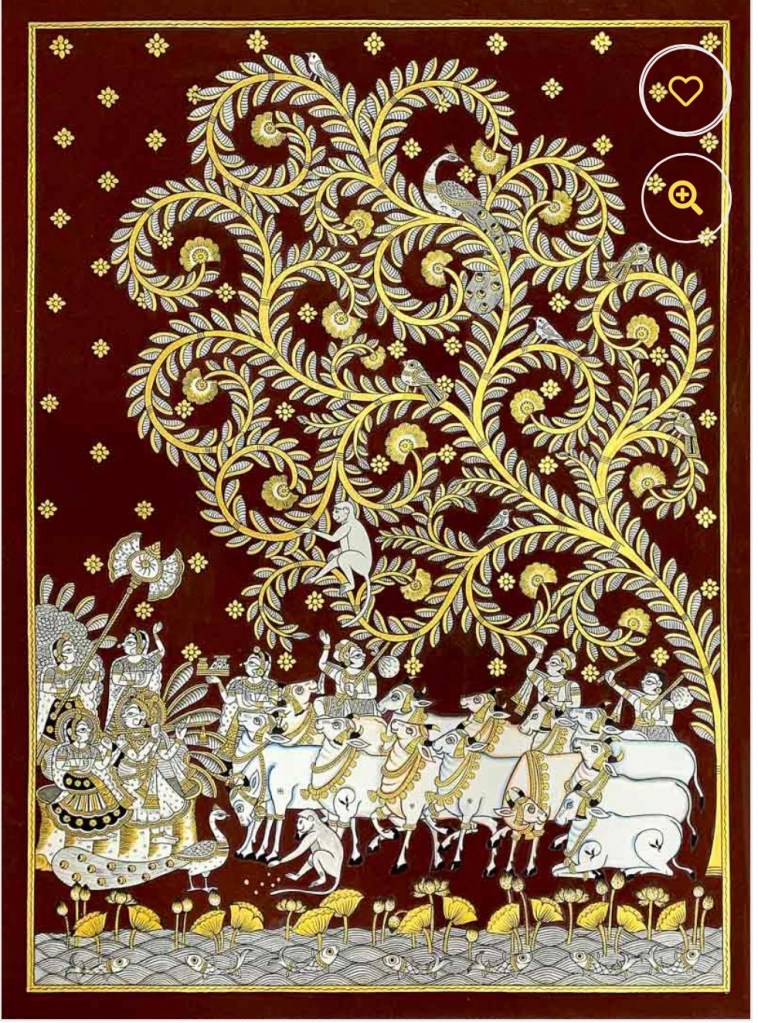
Sri Krishna with cows, Kalyan Joshi, had on paper, Image via https://thecurators.art/products/kajo-kalyan-joshi
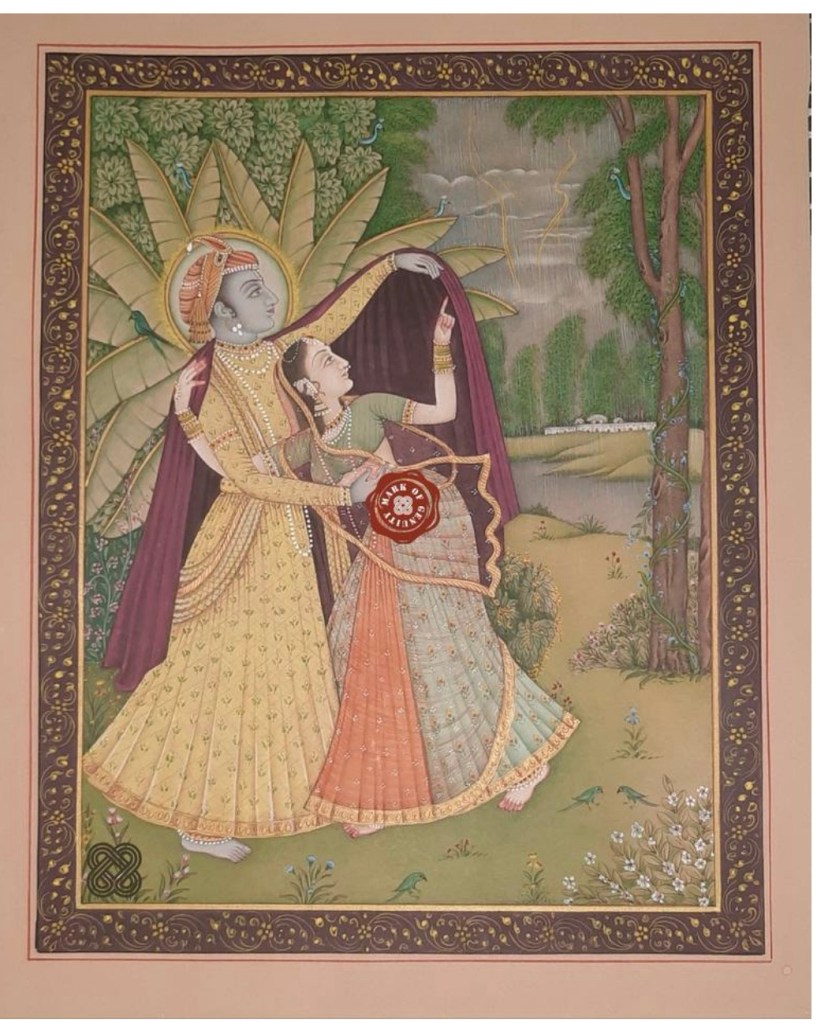
Sharma & Sharma Originals, Radha Krishna Ras Leela in Rain Painting, Suresh Sharma, watercolour on the paper image via https://www.saatchiart.com/art/Painting-Sharma-Sharma-Originals-Radha-Krishna-Ras-Leela-in-Rain/1682632/7995988/view
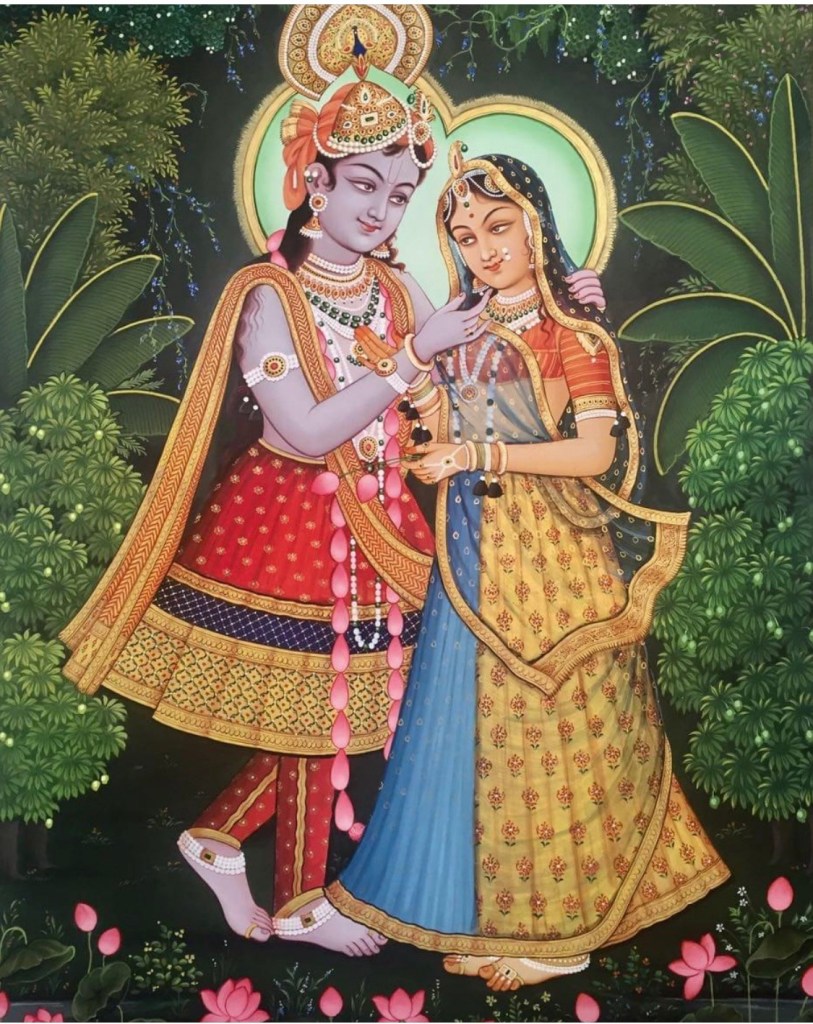
“Radha Krishna”, Rahul Sharma, natural pigments on cotton cloth, image via https://theartistsofnathdwara.org/arts/artists/rahul-sharma/
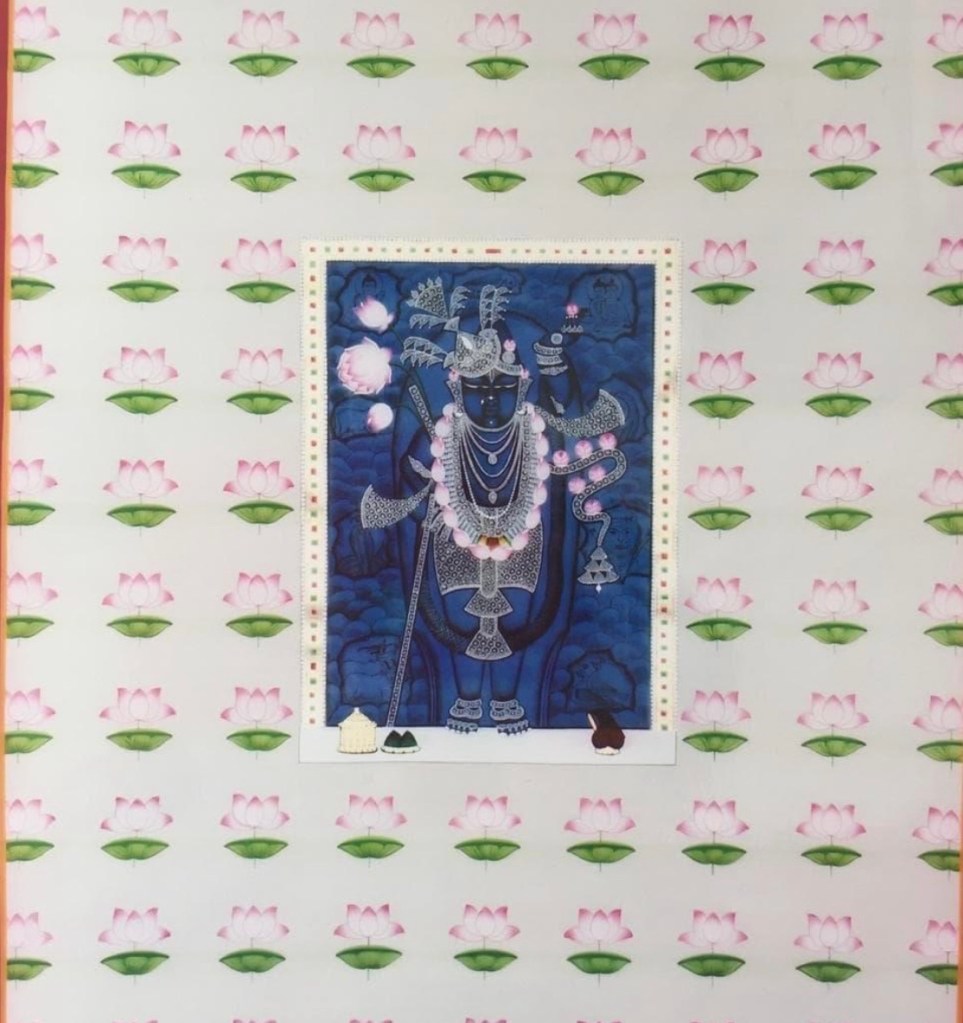
“Kamal Talai”, Madhuri Sharma, natural pigments on cloth, image via https://theartistsofnathdwara.org/arts/artist/madhuri-sharma/
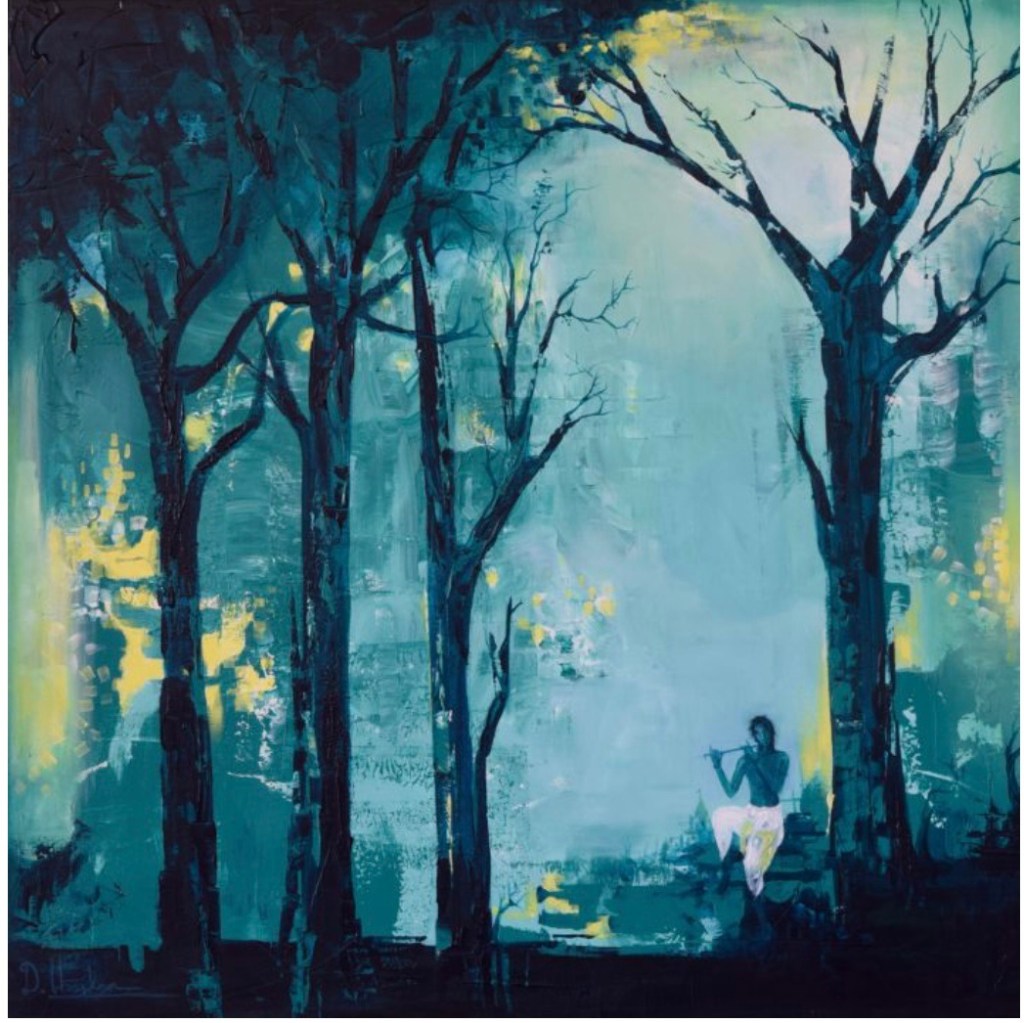
Artist Durshit Bhaskar’s painting “Krishna Calling”, oil & acrylic on canvas, image via https://www.beyondsquare.in/product-category/art/durshit-bhaskar-art/
I follow the same- headings -approach to the Japanese screens byōbu.
The Byōbu were made of “layers of paper, attached to a wooden framework on top of which a painting on paper or silk was affixed” (” Beyond Golden Clouds,” “Hidden Behind History,” Janice Katz, p.13). The Pichwai paintings were traditionally created on handmade paper or cloth. Special artisan communities/schools created both artworks, requiring tremendous knowledge and craftsmanship.
Traditionally, ancient byōbu screens contained images of nature, trees, blossoming flowers, birds, rivers, and mountains, often depicted in the dynamic of four seasons. The Pichwai paintings were devoted to particular Gods or Diety—Shiva, Vishnu, Durga, Surya, and Ganesha, as well as to Lord Krishna ( this type of Panchai is called “ShrinathJi”), depicting their existence on transcendental, not Earthy plane, visually represented by lavish nature.
The functional purpose of byōbu was to decorate a living space or specific location, display it on special occasions, and include a luxury gift. The Pichwai paintings also served for decorative purposes, especially in shrines. Both types of artwork are meaningful representations of the spiritual cultures of both countries and carry great devotional significance.
Exercise 2: Exploring and Uncovering.
This is a thinking exercise. I have now set up a structured system to house my research material and data and have begun to analyse it more deeply. I have also started forming sentences summarising and drawing out the main points and questions in the material and the relationships between things.
“Start by taking your three sentences, and think about what links you can find between them. Using your research material to support your enquiry, ask yourself the commonalities and differences between your sentences.” “Finally, consider the following order for constructing an academic argument: Critically evaluate, State the main features of the argument, Contrast to two or more in opposition”. ( Research course book, Part 3)
The sentences I think I have to concentrate on are:
Pichwai art stands out with its unique characteristics, such as devotion and Indian cultural heritage, reflected by its spiritual significance, elaborate detailing, fine workmanship and vibrant colours.
Traditionally, ancient byōbu screens contained images of nature, trees, blossoming flowers, birds, rivers, and mountains, often depicted in the dynamic of four seasons.
The unique characteristics of both types of artworks coming from different countries bring them together in unity because:
Both types of artwork are meaningful representations of the spiritual cultures of both countries and carry great devotional significance. The Garden and nature theme is a common feature and subject for both types of artwork.
Bibliography:
Japanese folding screens Byōbu. “Beyond Golden Clouds”, Japanese Screens from the Art Institute of Chicago and the Saint Louis Art Museum; edited by Janice Katz, essays by Philip K. Hu, Janice Katz, Tamamushi Satoko, Alicia Volk; @2009.
Kano School in traditional Japanese visual art, books: “Ink and Gold, Art of Kano”, Felice Fischer and Kyoko Kinoshita, Philadelphia Museum of Art, in association with Yale University Press, New Heaven and London, 2015;
Guide on Pichwai paintings- History, Type, Technique, Artists and Cost in India, online on Digital Education, https://thedigitaleducation.org/blog/pichwai-paintings-a-complete-guide/ [accessed on Sept 3, 2-24];
Traditions of Pichwai Art, Hrishikesh Patak, 10 June 2023, Medium, online on https://medium.com/@pathakhrishikesh13/tradition-of-pichwai-art-d16479ee3857 [accessed on September 3 2024]; History of Pichwai and How Pichwai Born, online on Shree Temple, https://shreetemple.com/index.php?route=information/blogger&blogger_id=5 [accessed on September 3, 2024];
additional sources on https://jayahegvknewmuseumstore.wordpress.com/2020/01/08/pichwai-the-backdrops-of-bliss/
Notes for myself.
As indicated on https://thedigitaleducation.org/blog/pichwai-paintings-a-complete-guide/, the names of prominent Pichwai masters are below.
Kalyan Joshi: Known for his intricate detailing and vibrant colour palette, Kalyan Joshi’s Pichwai paintings capture the essence of Lord Krishna’s divine presence and are highly sought after by art collectors.
Rajendra Sharma: Rajendra Sharma is celebrated for his mastery in depicting the intricate jewellery and clothing of Lord Krishna in his Pichwai artworks, which adds a sense of opulence and grandeur to his pieces.
Lalit Sharma: Lalit Sharma is recognized for his ability to infuse spirituality and devotion into his Pichwai paintings. His works often depict the serene and divine aspects of Lord Krishna’s life
Vijay Sharma: Vijay Sharma is famous for his advancement in Pichwai painting, mixing traditional procedures with contemporary interpretations. His exceptional style has earned fame both in India and abroad.
Laxman Sharma: Laxman Sharma’s Pichwai paintings are characterised by their intricate nature and vivid colour schemes. His artworks are known for their attention to detail and skilful portrayal of Lord Krishna’s stories.
 JeanArt