Exercise 9: First-hand perspectives. Reviewing public presentations of work.
Exercise 10: Critical reflections.
For this exercise, I attended an exhibition at Hunter II Dunbar Gallery in NYC in July this year. The gallery presented original works from various well-established visual artists under the thematic umbrella “Floral Abundance” Part II. Below, I place screenshots of the press release and the catalogue of this exhibition, https://www.hunterdunbarprojects.com. My 250-word critical writing piece is also below.


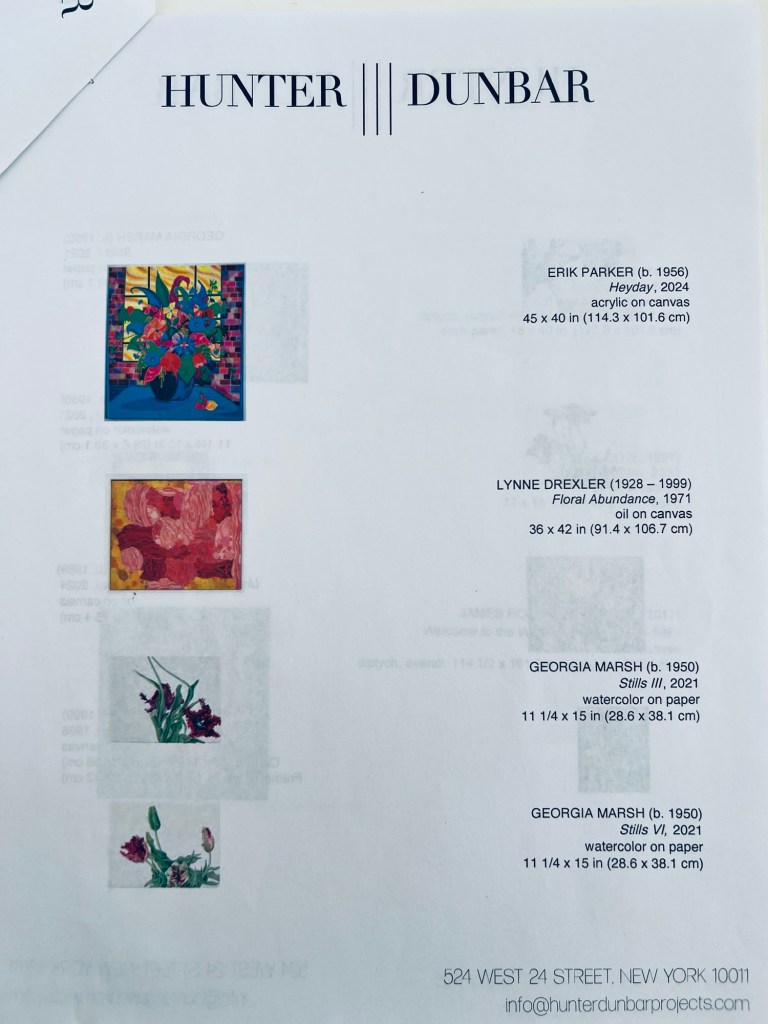
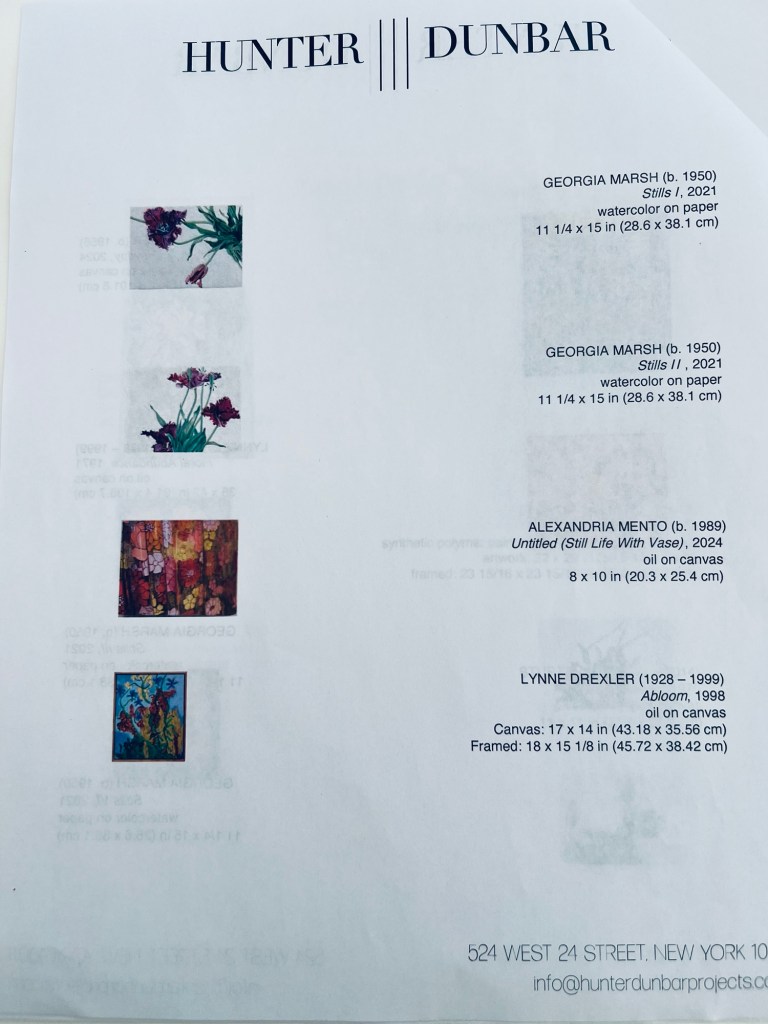


My critical review of the exhibition’s art piece.
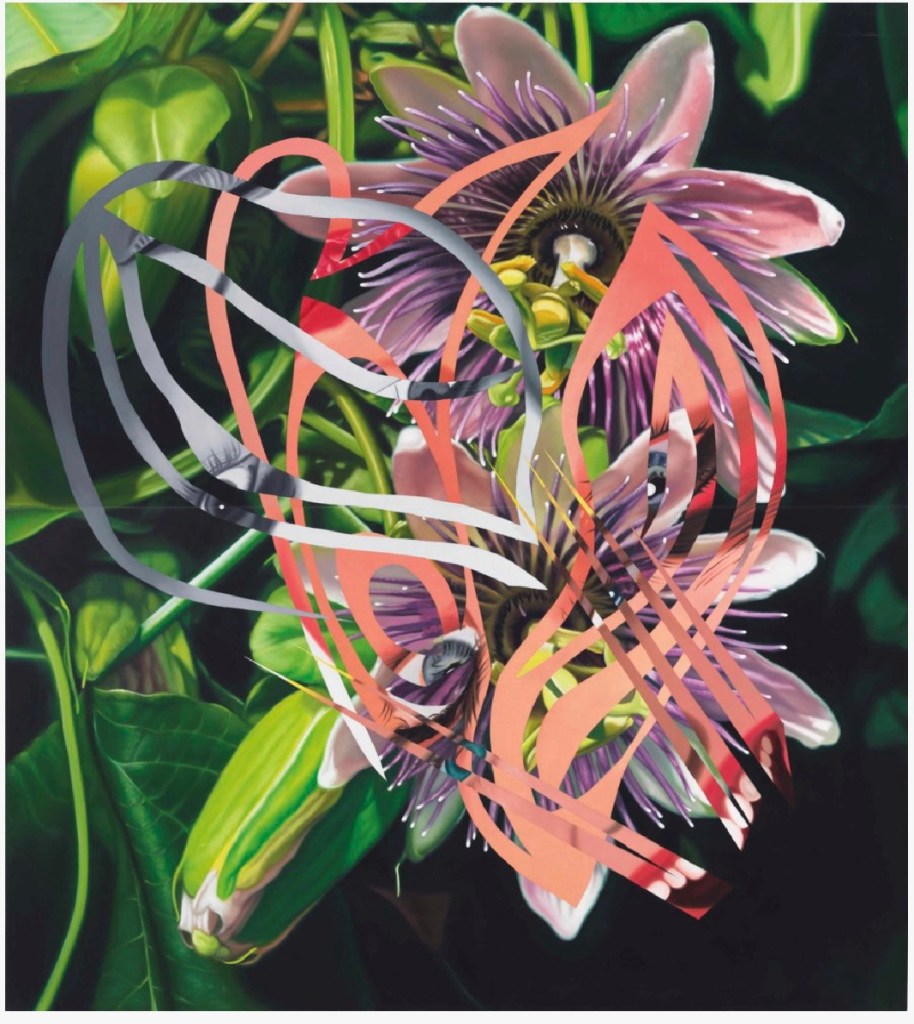
The exhibition collection displays a variety of stunning, high-quality artworks depicting flowers with an array of mediums such as oils, watercolour, installations, glazed ceramic and glass mosaic. Most artworks to view were created by living artists in the late 60s and 70s. It was interesting to note that the painting “Blue Iris” was created by a living artist, Lois Dodd, who is 97 years old this year. Among them, I was struck by the large painting “Welcome to the Water Planet VI” (1988-1989), oil on canvas, created by James Rosenquist (1933-2017), size 290.8*258.4 cm overall. The painting was overwhelmingly powerful to me due to its dimensions, intense but natural colours, and detailed flower close-up, all united with an impeccable grand master technique: when you enjoy a superb design and fine work and don’t see the brushstrokes, a fabulous, brilliant work. This is the style I resonate very much with – an immaculate quality and intense ultra-refined aesthetics of the final work.
As I did my research on James Rosenquist, I discovered that my sentiments toward his art are fully shared by many in the professional art world, including an art critic and curator, Julia Peyton-Jones, who finds his artworks “so radical, so tough, and they are so unexpected, I find them absolutely extraordinary”. As it is well explained on Guggenheim’s website about the artist’s painting technique: “When he applies paint to the canvas, he strives for a smooth, seamless surface that shows no sign of the artist’s brushstrokes. This application both links him with commercial advertising and gives his canvases a sense of anonymity.” Indeed, his flower paintings look like photographs, which also have a feature of anonymity in their abundance in the man-made world which surrounds us. In his interview in 1987 for Mary Ann Staniszewski, Bomb Magazine, the artist talks about his project “Welcome to the Water Planet”. He delivers his idea behind this project so well, so I think it is worth to put the entire piece from that interview:
“James Rosenquist: I realized that a number of things happened to me and occurred to me. Like they do to everybody. And these experiences were saved or accumulated and then I put them together in some peculiar way and that peculiar thing becomes a painting idea. Sometimes I think about a major question or a major theme and then I think about imagery in regards to that. So, currently one of the themes is called Welcome to the Water Planet. We live on a water planet. And it was an idea of people putting to bed, or putting under their pillow, the fear of the atomic holocaust, a nuclear war. So the idea, the division of the ideas in this series of paintings, came from early settlers in America hiding in lakes or streams while a forest fire went by. The imagery that occurred to me seemed like a water nymph hiding in a water lily while some star nova or nuclear thing went by far away. And also the idea, welcome to the water planet, was a “welcome.” It was sort of against chauvinism.” ( Bomb Magazine, Fall 1987)
In this project and this particular painting, which I viewed at the Gallery, I see how the artist united two basic human existential vibrations: appreciation and hunger for beauty, depicted as beautiful scaled-up flowers, and a primordial existential human’s fear of death, being destroyed, and vanished, depicted as abstract, chaotic lines on top of the flower’s image.
This project consists of 11 large-scale paintings created in the late 1980s. I looked at his artworks, and I can say that one of the reasons why this project of 11 paintings is so special is the fact that these flowers are actually the only natural objects he depicted. Most of his works are about man-made world objects, modern technology and its elements, about the artificial consumerist pop culture, which he often sourced from old magazines. You can find female and male portraits, shoes, space rocket parts, polished nails, and pizza. His paintings definitely resonate with the Superflat movement with their flatness, challenge of current cultural trends and values, vivid colours and commercial techniques;
In his interviews, he often emphasised the concept of multilayers, which exists in every art masterpiece, and the fact that a good viewer is one who can look at the painting for hours or is able to see a new and a new layer every time he/she looks at it. The flowers he made are very contemplative, being, in my opinion, dramatically different from his other works. There is an absorbing depth due to his masterful use of dark and vivid green colours, the sense of movement because of the fluidity of lines, and a quite tangible sense of flower breathing. Again, he used his favourite collage technique: we can see an array of grey and pink lines on top of the flower image, and inside these lines, we can see fragments of female faces. I watched his interview with Hans Ulrich Obrist, where the artist explains his fondness for collages. It was interesting to learn that he connects his use of collages with Eastern culture and literature, such as, for example, the ancient Japanese Tale of Genji (11 c.) and the Japanese tea ceremony, which both make the participant think, contemplative and imaginative, both cultural phenomena are not giving straight answers. As I understood, James Rosenquist liked collages for their unresolved ending and the non-finality of questions they pose to a viewer. Another fascinating comment of his about why he was using collages is that it helped him to get his artwork to a level where a viewer can sense something looking at his painting, and that sensation was crucial for the artist: “You can even discard the painting when you sensed..”. He preferred his artworks not to be straight explanatory but to be sensed or felt by the audience. This statement of his and this aspiration in his artworks makes him relative to the spirituality of traditional Japanese visual art, which has this aspiration to the viewer’s senses as its central part.
In relation to my research theme about the phenomenon of “Garden” in visual arts, taking into account his own comments about the “Welcome to the Water Planet Project”, I can say that James Rosenquist’s artistic appeal to a flower continues the spiritual theme of Garden phenomena in world culture, a reflection on human existence in its momentarily short, vulnerable, beautiful and fearful experience on Earth. Even though he considered himself an abstract painter, he didn’t do these flowers in an abstract manner. Probably because any abstraction is a simplification, while the human existence’s representation on a spiritual level, a level of sensing Life, is not about it.
Bibliography. James Rosenquist ( 1933-2017), Tate, online on https://www.tate.org.uk/art/artists/james-rosenquist-1866 [accessed on July 22nd, 2024]; Collage and Scaling -Up, Guggenheim, online on https://www.guggenheim.org/teaching-materials/james-rosenquist-a-retrospective/collage-and-scaling-up [accessed on July 23d 2024]; An Interview with James Rosenquist, Jeanne Siegel, Atrforum, online on https://www.artforum.com/features/an-interview-with-james-rosenquist-209996/ [accessed on July 23d 2024]; James Rosenquist by Mary Ann Staniszewski, Bomb Magazine, Fall 1987 issue, online on https://bombmagazine.org/articles/1987/10/01/james-rosenquist/ [accessed on July 23 d 2024]; Previously Unseen Extracts form James Rosenquist and Hans Ulbricht Obrist in Conversation, London Ely House, 5 November 2019, online on https://ropac.net/video/170-previously-unseen-extracts-james-rosenquist-and-hans-ulrich-obrist-in-conversation/ [accessed on July 23d 2024];
 JeanArt