Project 1: Preoccupations.
We must watch the video below, in which Philip Guston talks about ‘returning’ and his engagement with the painting processes. We must reflect on how his ideas resonate with our own experience of making work.
In this video above, the artist explains that he doesn’t have to analytically understand his creative process, as something in it must be left for a pure creative flow and should not be explained. My understanding is Philip Gaston mostly follows an intuitive approach in his painting practices. His approach falls in line with my Tutor’s advise he gave me when I was doing the PAD course on Level 2. The advice was to eliminate having a “pre-fixed idea” of the final result on the canvas. Philip Gaston shows in this video how his, as he thought one day finished painting completely vanished the next day when he started to make changes because the next day, he looked at it differently and felt that some parts of this painting must be redone. I must say that I have never had this kind of creative experience so far. Another point the artist brings up is that he takes his destroyed artwork done some time ago and restarts working on it. He takes something he abandoned because, with time, he discovered the new potential in the old piece of his work. It is interesting to realise that I perceive my old works as finished. I don’t have any work I did some time ago, let’s say 3-5 years ago, which I want to develop further. However, some elements which came out well to me in my earlier works travel with me into my current works.
Exercise 1.1: Return and Review
Question: “What is/are the thinking, approaches and themes you return to through your work? It is not uncommon for artists to return to themes and subject matter, processes and materials time and again, on each occasion approaching these from a different angle or perspective through new insights or experiences. In your learning log, reflect on the process and outcomes of returning to the familiar within your own practice.” ( p. 63, Advanced Practice, Part Three course book)
As I progress in my OCA studies toward my degree and accumulate work, I understand the importance of returning and reviewing my work. My “green—flowery-vegetation—trees-foliage” theme has been travelling with me since I started my studies in September 2017. My Instagram account has been a convenient tool for observing my work retrospectively. I can trace the improvement of my technical skills, as well as I can see how my personal artistic voice has been shaped since the beginning. In the earlier assignment for this Course, we were asked to do a complete audit of our work, sorting them out. I divided into two groups: the A group is about those works which I consider as key and “pivotal”, something that I am sure about in terms of the creative direction and significant progress of my technique, observational and compositional skills, including those works, which I want to develop further into the larger piece; group B– are works I can name challenging, not typical for me, but worth to continue to stretch my skills and aspirations further. They are “quieter” in terms of my understanding of what I was looking for and “less resolved” in terms of the final result, but they are existentially necessary for my development as a visual artist. I did it in my post here:https://zhanartcom.wordpress.com/wp-admin/post.php?post=13512&action=edit.
Exercise 1.2. Conversations.
“The Incoming Voice invites you to seek out voices external to the arts that connect to your practice. Who, outside of the arts, would you like to sit down and have a conversation with? Perhaps these people work in science, sports, technology, agriculture, archaeology, business, religious setting, etc.? Stepping out of your comfort zone and putting yourself in another’s shoes can help you achieve a different or refreshed perspective on your own ideas and working practices.” We are also invited to reflect on our Inner and Unknown Voice – anything that interests and influences us and lies beyond visual arts. We have to think about how these interests overlap, influence and inspire each other.
Besides my interest in visual arts, I am constantly exposing myself to some areas of human knowledge such as Jyotish – Vedic astrology, Hindu mythology; my spiritual practice – Sadhana Dharma; and the scientific theory of Intelligent Design and a Theory of Reincarnation. All these three themes are rooted in my deep faith in God. I listen to my faith podcasts, mantras and Jyotish lessons every day. My creative work in my studio continues my immersion into these themes and their integral part. I have described the connection between my spiritual practice and my art pursuits in this post earlier here: https://zhanartcom.wordpress.com/wp-admin/post.php?post=13512&action=edit.
I explore this direction through a number of permanent components in my artwork: flowers, trees, celestial theme – clouds, Moom, Sun, hands, green, blue and golden colours, and words in Sanscrit.
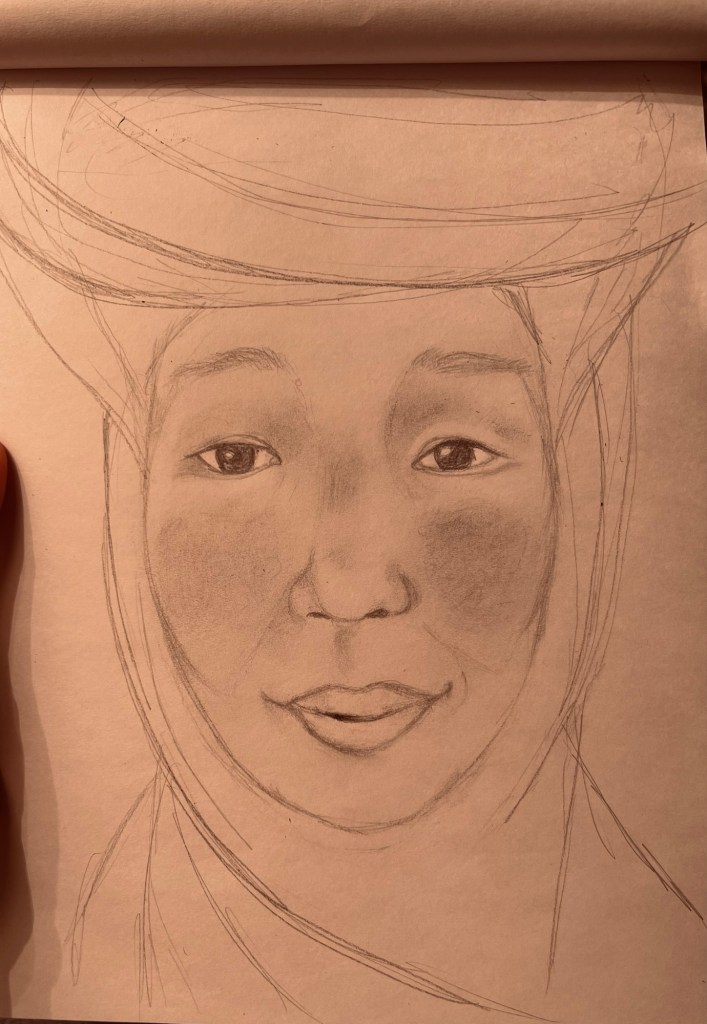
Another non-visual art area which interests me and sometimes becomes quite emotionally intense is my ethnic heritage and politics. This direction puls me into portraiture and ornaments of my Qazaq people.
Below, I place some of my works resulting from the overlap and mutual inspiration of concepts and ideas I follow beyond the visual arts.


 JeanArt