
Below is my research on compositional solutions and elemental structures for my project “Riviera Flowers”.
I used the book “Landscape Painting Now. From Pop Abstraction to New Romanticism”, edited by Todd Bradway, an essay by Barry Schwabsky, and contributions by Robert R. Shane, Louise Sørensen, and Susan A. Van Scoy. Published by Thames & Hudson, 2019;
It contains an excellent selection of modern landscapes I can study for my project. Below, I placed some images of those paintings I resonate with regarding their compositional solutions. These paintings share the theme: garden, flowers, foliage, greenery.
Disclaimer: All images are from the book “Landscape Painting Now. From Pop Abstraction to New Romanticism”, edited by Todd Bradway, essay by Barry Schwabsky, contributions by Robert R. Shane, Louise Sørensen, and Susan A. Van Scoy. Published by Thames & Hudson, 2019;


After I searched this book, I came up with certain types of compositional solutions, which I named below. I also paid a great deal of attention to several elements in the painting since my Tutor advised me to think about this aspect, too. In his feedback for Part Two, which I did earlier, he advised me to study the structural elements and other artists’ decisions regarding how they use negative space and how many elements they include in their paintings.
Group 1: Emphasis on one large front element.
Below: Davos, Gerhard Richter, 1981, oil on canvas.

Below: 4 pm, Alex Katz, 2014, oil on canvas ( 356.8*273.3 cm)

Below: Barn Door View, Lois Dodd, 2009, oil on linen,

Group B: Tunnel view with strong panoramic perspective
Below:
A Closer Winter Tunnel, February-March 2006, David Hockney, oil on six canvases, 91.4* 121.9 each, 182.9* 356.7 cm overall.
Late Spring Tunnel, David Hockney, May 2006, oil on two canvases ( overall size is 121.9*182.9 cm)

Group C: Perspective, wide panoramic view.
Below: Under the Trees, David Hockney, 2010-2011, oil on twenty canvases, each 91.4* 121.9, 356.7* 609.6 overall.

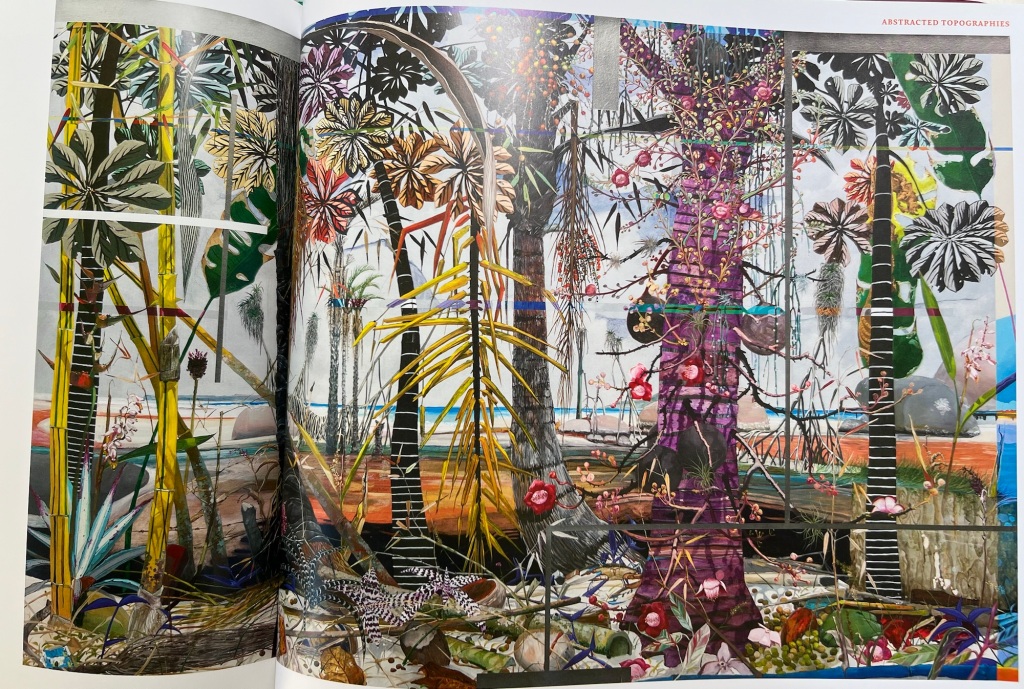
Below: High Definition, Luiz Zerbini, 2010, acrylic on canvas, 250 *400 cm;
No perspective, flat, “wallpaper” style.
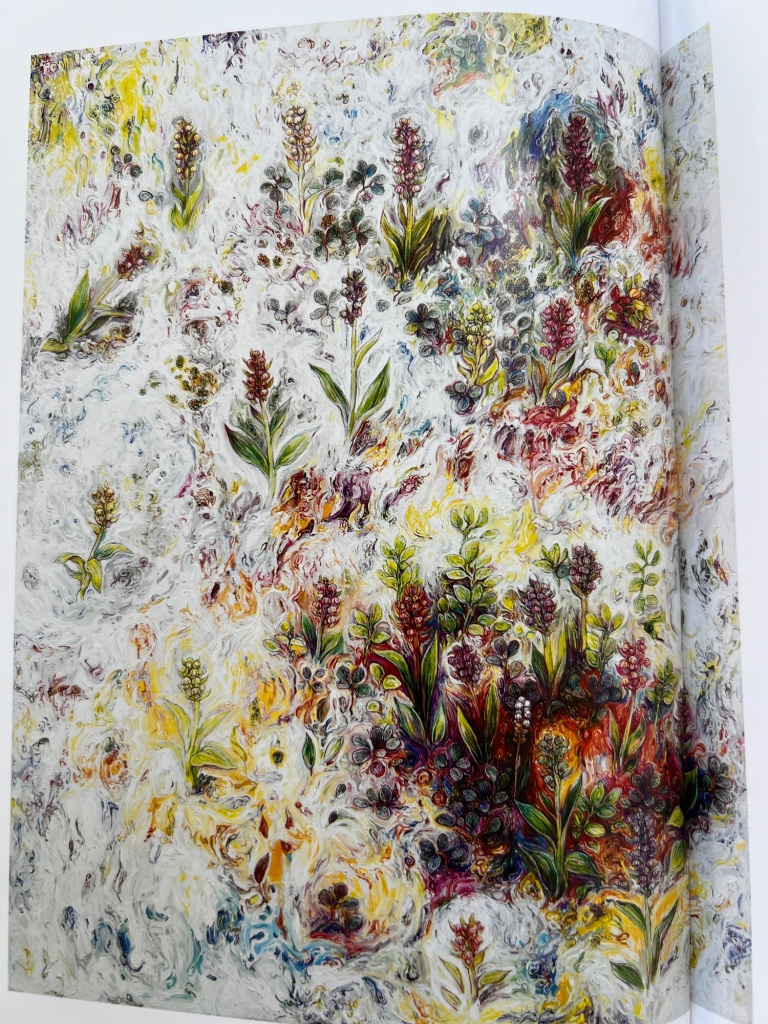
Above: Untitled/Án titils (Barnarót), Eggert Pétursson, 2011-12, oil on canvas (100*80 cm)
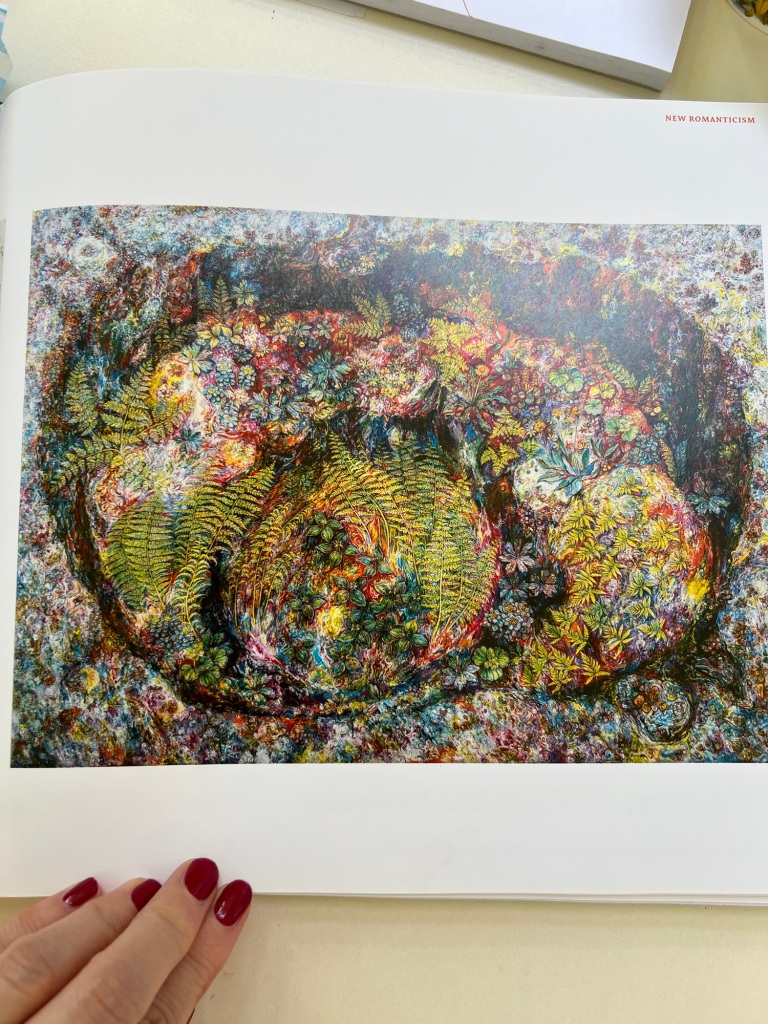
Above: Untitled, Eggert Pétursson, 2015-18, oil on canvas (190*260 cm)
I did some schematic sketches on paper to help me reflect on compositional elements and structures.


I am glad I did the analysis above because it helped me develop my compositional decision and elemental placement solution. It was important for me to note that all paintings didn’t follow the approach of creating a strict geometric linear perspective. All horizontal lines were not perfectly straight, and all were deliberately curved, being quite off the centre and far from perfect geometry. I understood what I wanted to have in my project:
- I want to keep many elements, which are different flowers I have been working on, trees’ stems and foliage;
- I don’t want to develop it in an abstract or semi-abstract style, so I won’t be using just blocks of colour;
- I will not place one element as a dominant element in front of the viewer’s eyes;
- I want to develop a wide panoramic view with lots of breathable space for my elements.
- I will use dark tones at the centre or bottom corners of the surface.
I decided to develop my “Riviera Flowers” project’s drawings using the compositional and elemental placement solutions of the above paintings:
On the left below High Definition, Luiz Zerbini, 2010, acrylic on canvas, 250 *400 cm;
On the right below Barn Door View, Lois Dodd, 2009, oil on linen; I place them below together so you don’t have to scroll up again to find them.
 JeanArt