The next four exercises are about my own studio, so I placed them on one post page.
Exercise 1.2.
“Analyse your own studio/working space. Complete this exercise using the following processes: a list of all the contents, a list of all the actions you take in the space, and a map of the space, including furniture, objects and entrance and exit points.” ( Advanced Practice course book, p. 46).
I have two spaces, which I use as my Studios.
One is a long narrow room adjacent to my kitchen. I work in this when I have only 1-3 hours to dedicate to my drawings and research. The larger space is not close to my house, so I use it when I can find more than 4 hours in my day to dedicate to my studies.
Below are photos of my small studio.

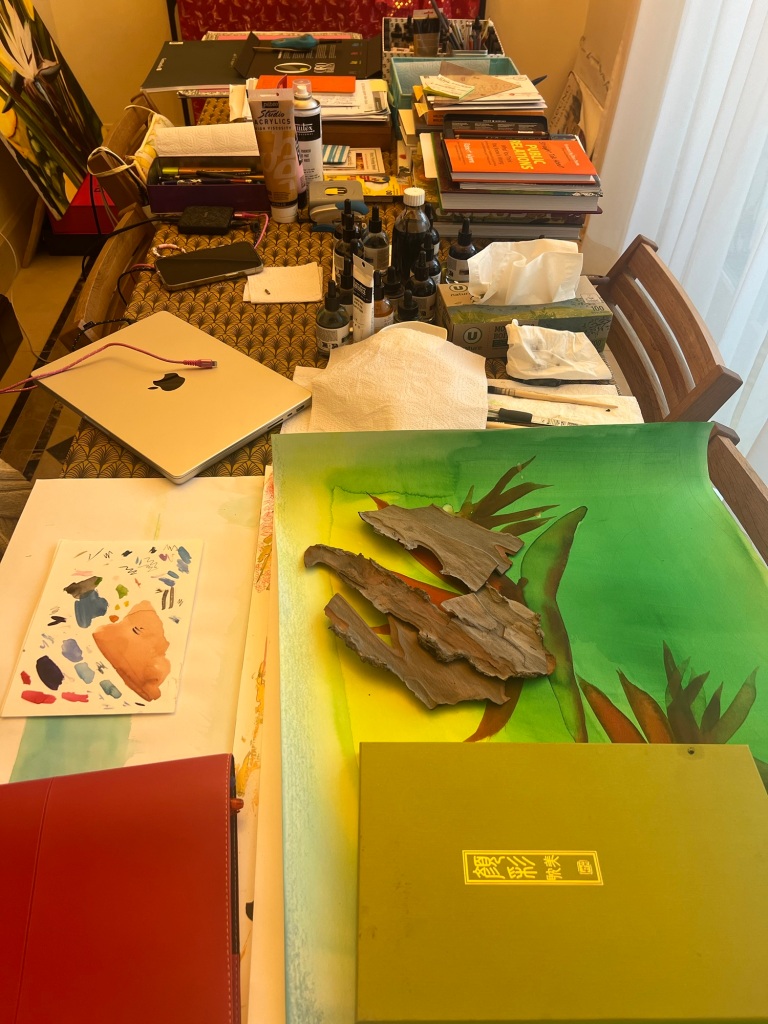


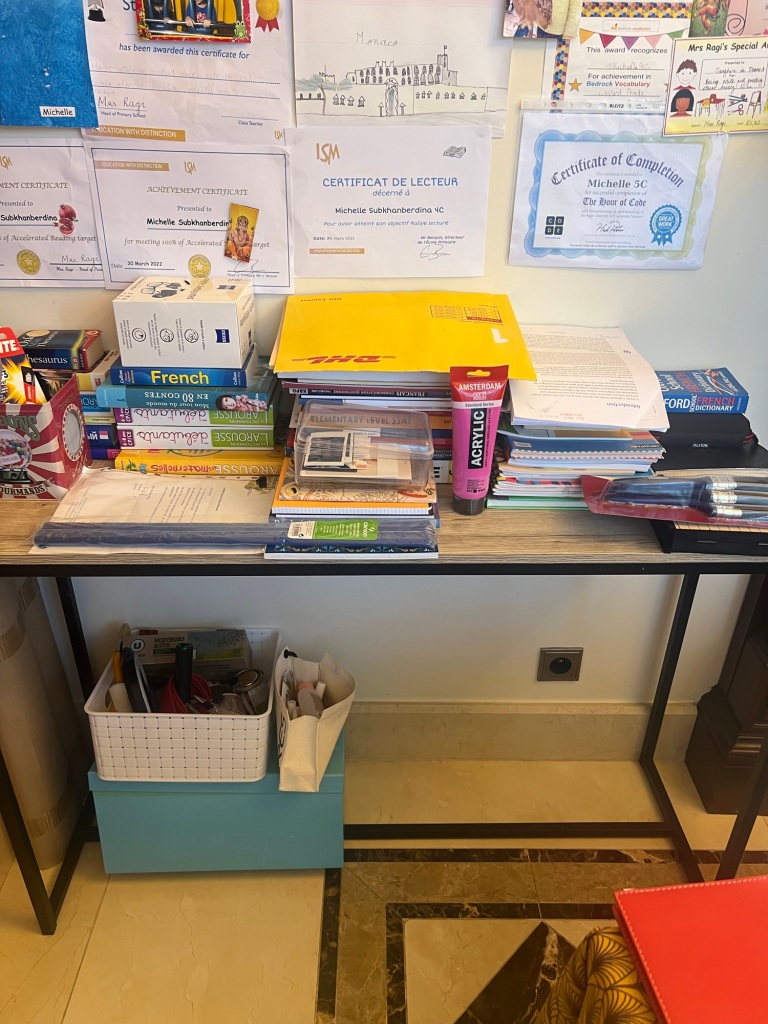

In this studio, I keep the following items:
– working materials such as mediums, papers, scissors, cutting knifes, painter’s knifes, kitchen towels in paper rolls, pencils, pens, erasers;
– magazines from art fairs and catalogues from my art supply shop;
– thick large books about artists;
– plant material, such as dry pieces of large leaves and tree bark;
– my fridge and coffee machine;
When I work, I listen to mantras and podcasts on spiritual thematic. I also eat in my studio to save time. Important detail is that my studio is my praying and spiritual practice space.
My main challenge is to find more time to work in the studio.
The Studio work is all about establishing a routine, which I don’t have yet due to my life workload since I have kids of school age. The one thing I know for sure is that all great artists did nothing other than paint and create. They were not torn apart between many people’s needs during the day, taking care of them and their needs. True artists can exclude everything alien, hostile, and damaging to creativity and their creative needs in the first place. This is what I can’t do yet.
I was curious about Pablo Picasso’s studio practice and researched this theme. However, there are no long documentaries where we can see him in his studio. I found some videos depicting him working, but they were not very informative regarding how his studio is organised and what kind of things he has in the studio. The one is made with the help of his grandson, Bernard Picasso, in the Boisgeloup. I have noticed from the collection of short videos of Picasso in his studio that he often liked to work barefoot, wearing no shirt or T-shirt. At some point, I found a video by Nathaniel Drew, who studied Picasso’s studio work routine and tried it himself. It was amazing to know that Picasso’s normal daily schedule was like this: he started his day at 11.00 am, then spent 2-3 hours meeting friends and dining. At 2 pm, he used to shut himself in his studio and worked until late evening; dinner was usually at 10.00-11.00 pm. After dinner, he returned to his studio and worked until 3 am. After watching the abovementioned video about Picasso, I found another two by the same author about Van Gogh’s intense schedule and Frida Kahlo’s. Van Gogh is known for his intense, fierce, fast-movement approach. In his letters to his brother Theo, he mentioned the timing of his work. He used to start at 7 am and could work with very short breaks till 6 pm.
Bibliography: “I tried Picasso’s incredible daily routine: What I learned Ep.3”, Nathaniel Drew, 2021, Youtube on https://www.youtube.com/watch?v=gJ7CyM1Zrqc [accessed on May 21, 2024]; “I tried Van Gogh’s Intense Daily Routine- Ep.8”, Nathaniel Drew, Youtube https://www.youtube.com/watch?v=fcFdD5LEjE4 [accessed on May 21. 2024];” Bernard Picasso speaks about his grandfather studio”, February 2017, Youtube https://www.youtube.com/watch?v=tKwsT_t8eYU [accessed on 17th May 2024];
Exercise 1.3. Visualising the Studio.
I want to come back to this exercise later when I feel that I can write something meaningful. At this time I don’t understand the benefit of this exercise.
Exercise 1.4. Leftovers and debris.
I don’t have lots of leftovers and debris since I don’t do collages or sculptures. However, I can observe that I think that I tend to keep my failed work as a reminder of what went wrong. This is very useful to me. I keep some of my bad paintings close to my observation so I can navigate better in new projects. Another reason for me to keep them is that I usually reuse them, stripping them apart the upper layer of it was on paper, using canvas or wooden board. I also keep the cutouts I made for ornaments.
Exercise 1.5. Gathering, Collecting and Archiving
Reading Point
Briony Fer, The Scatter: Sculpture as Leftover, 2005 from Materiality: Documents of Contemporary Art, London: Whitechapel Gallery and The MIT Press, ed Petra Lange-Berndt, p.186, 2015 Please refer to the resources section of the VLE for reading resources. https://learn.oca.ac.uk/course/view.php?id=223§ion=6#section-6
Bruce Nauman. In Conversation with Michael Auping, 2001.
https://contentstore.cla.co.uk/secure/link?id=8aed230f-2b24-eb11-80cd-005056a f4099 [Accessed 17 November 2020]
Ed. Hoffman, Jens (2012) The Studio, Documents of Contemporary Art, London: Whitechapel Gallery and The MIT Press, ISBN 978-0-85488-197-0
 JeanArt