Project 1: Working Space. The studio as a subject.
Exercise 1.1: Working Space
We are required to research the studio of Francis Bacon and write a short 300-word analysis of what we have found in the learning log.
Francis Bacon’s studio.
Francis Bacon’s famous studio is the one he settled in October 1961, 7 Reece Mews in South Kensington, London. The studio was a tiny space, 4*6 m2, containing tonnes of photographs, books, newspapers, different painting materials, empty boxes, dried brushes, used jars, paint spray bottles, buckets of household paints and discarded canvases. The state of things can be described as “chaos” and “bedlam”, and indeed, the artist famously said: ” I feel at home here in this chaos because the chaos suggests images to me.” ( http://www.francis-bacon.com, “The Studio” [accessed on May 7th 2024]. It was interesting to find his thoughts about his artworks, which he found “accidental.”:
‘You know in my case all painting – and the older I get, the more it becomes so – is accident.’ ( Francos Bacon, Francis Bacon 1909-1921, Modern Originals, 20th century artists editions, online on https://www.modern-originals.com/francis-bacon).
That made me think about how he did his research, which he did since he was digging into those numerous books, photographs and magazines, as well as observing other artists’ artworks. As Joanna Elizabeth Russel describes:
“The use of photographic images by Bacon became known as early as 1952 with the
publication of photographs made by Sam Hunter of source material in Bacon‟s studio
(Hunter, 1952). Bacon frequently stated that he „looked at everything‟, therefore
identifying all of his artistic and visual influences is an enormous task. … As has been well
documented, Bacon looked at the work of old masters such as Rembrandt and
Velasquez, more modern masters van Gogh & Picasso, wildlife photography, action
shots of sportsmen, diagrammatic images of the body in medical sources, Muybridge‟s
sequences of human motion and film stills. He also appeared to use his own earlier
works as sources, sometimes referring to much earlier compositions to produce drawn-
out series of images on a common theme.” (Joanna Elizabeth Russell, A Study of the Materials and Techniques of Francis Bacon 1909- 1921, , Volume I of 2, PhD, 2010, p.10).
The chaotic environment in his studio and Bacon’s thinking about his paintings allow me to assume the artist’s method was waiting for the moment of being struck with a creative idea like a flashlight instead of a linear path from one concept and idea to another. Also, I think he was very good with what my Tutor describes as not having a prefixed idea of what you want to get at the end. It is really nearly impossible to prefix any idea in chaotic environment. I looked through photographs on http://www.francis-bacon.com posted on the “Studio” page and “working material” section to see what was feeding Bacon’s visual language. He was interested in facial expressions and human and animal bodies in different states and positions to create his famous “Study for a Portrait” (1952) and many others like “Reclining Woman” (1961), ‘Seated Figure” (1961), “Study For Portrait II ( after the Life Mask of William Blake)” (1955), “Portrait of Isabel Rawsthorne” ( 1966). Most of his figurative drawings express human existence’s existential suffering and tragedy. Any artist’s studio and artworks directly reflect their personality in terms of psychological features, prevailing psychological state, dominant emotion, and the creative methods used for their artworks. Bacon’s artistic legacy refers to the term “London School”, along with Lucian Freud (1922-2011), Franchj Auerbach ( 1931-), and Leon Kossoff (1926-2019). the London School is well known for its strong focus on figurative painting and psychological depth of emotion, expressive use of paint, and urban themes.


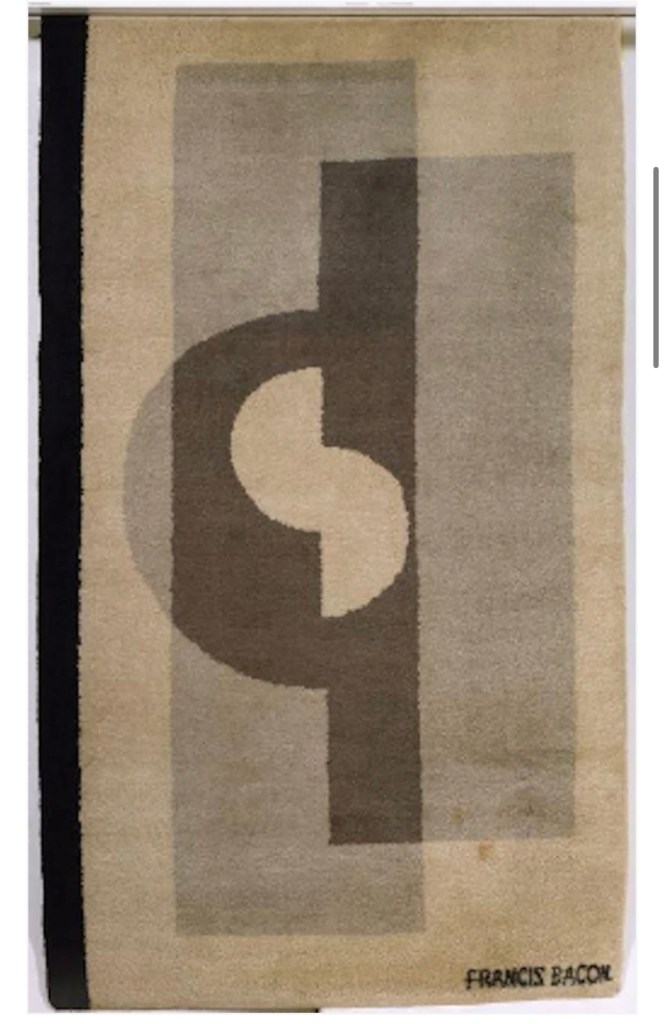
Wool rugs by Francis Bacon, image via http://www.selvedge.com

Bibliography: Francis Bacon’s Studio, High Lane gallery, online https://hughlane.ie/arts_artists/francis-bacons-studio/ [accessed on May 7th, 2024]; Francis Bacon biography and paintings, online https://www.francis-bacon.com/paintings [accessed on May 7th 2024]; Francis Bacon, David Hockney and Picasso: Inside Their Studios, Meticulously tidy or a horrible mess? To really know an artist, just look at their studio, ART REVIEW WALDEMAR JANUSZCZAK, Sunday March 27 2022, 12.01am GMT, The Sunday Times, online on https://www.thetimes.co.uk/checkout/thank-you [accessed on May 7th 2024]; Francis Bacon 1909-1921, Modern Originals, 20th century artists editions, online on https://www.modern-originals.com/francis-bacon [accessed on may 7th, 2024]; A Study of the Materials and Techniques of Francis Bacon 1909- 1921, Joanna Elizabeth Russell, Volume I of 2, PhD, 2010, online on https://core.ac.uk/download/pdf/4148915.pdf [ accessed on May 7th 2024]; ChatGPT “London School”, [accessed on May *th, 2-24];
Research Point 1:
At this Reserach Point we have to read the essays below and “As you read them, consider your own working space and its impact on your body of work. Take this thinking through to the next exercise in which you can explore these ideas more fully”. ( Advance Practice coursebook, p.46)
Caitlin Jones essay The Function of the Studio (when the studio is a laptop); Extract from Rozsika Parker’s text – Housework first published in Spare Rib magazine no.26 (1975). Rozsika Parker, Housework p.199-2001.
My reflection on the ideas in the essays.
The link provided in the Course book is not functional. I have found Caitlin Jones’s essay The Function of the Studio on this link https://faa218.wordpress.com/wp-content/uploads/2014/08/jones_caitlin.pdf
Caitlin Jones writes about the digital era phenomenon when technology allows artists to create visual art mainly, if not only, with the laptop. The laptop/computer has become a postmodern studio or “post-studio,” which is not limited to walls of physical space. This new type of artistic studio is for those artists who can escape from the “ossifying” and rigid influence of the physical space and work in an open environment, manipulating with new technology available via computer usage.
After reading this essay, I thought that this approach to creative work completely excludes the concept of materiality as an essential part of the creative process in visual arts. That reminded me of one dispute I had with one of my friends at some point. He was sure that the AI would eliminate visual artists since the AI could come with any image. That is a very digital approach in the attempt to reflect on what visual art is about, narrowing everything created to a digital image. However, most artworks produce stunning and different effects if you observe them in their original due to their materiality. Today, I attended an Artist’s talk by Fine Art PT Dr Michele Whiting about her creative practice. We viewed her ocean series paintings. She shared the experience of going for long walks and getting into the ocean water and cold beach sand with bare feet. I saw her bare feet sensation in the colour of the water she did.
Another thought was that digital art is related to the Superflat art movement. Any digital image is deprived of depth to a great extent; it is just flat. The destiny of any digital image is to be printed, and this simple fact determines its flatness.
 JeanArt