For Assignment 1, the Research course, we are required to do the following:
“From the material you have compiled throughout Part One of the course, select
the two areas of interest that you feel most drawn to and that have some
significant associated research material. Write a 300-word summary of these two
ideas, listing the initial resource material you have identified for each.” (p. 37, Fine Art: Research course manual);
I started this year developing four projects, and throughout the first Parts of the Advanced Practice and Research Units, I began to focus on the Chrysanthemums and Reincarnation. These are not the final titles.
My project below has taken a new direction for development, suddenly becoming about bringing different structures and new details. I showed the flower’s development at work in my previous posts. Below, you can see the painting I developed, which I had to take further, applying all new reflection and research skills such as practice audit and mind mapping.

Thus, with the help of a mind map, my creative process started with the chrysanthemum flower and then moved to Asian colour symbolism and pattern symbolism. I ended up researching types of clouds and mist in traditional Japanese paintings, which are “Kasumi”, “sumo”, “kumotori”, “zuiun”. I also found new artists, such as Miya Ando ( American, 1978-) and Ryoko Kimura ( Japanese 1971-). Then I started to check the symbolic patterns in Hokusai’s artworks and now he viewed them differently. T
The Reincarnation project was also heavily influenced and evolved under the development of the Mind Map and the research it stimulated. You can find the Mind map for it below.
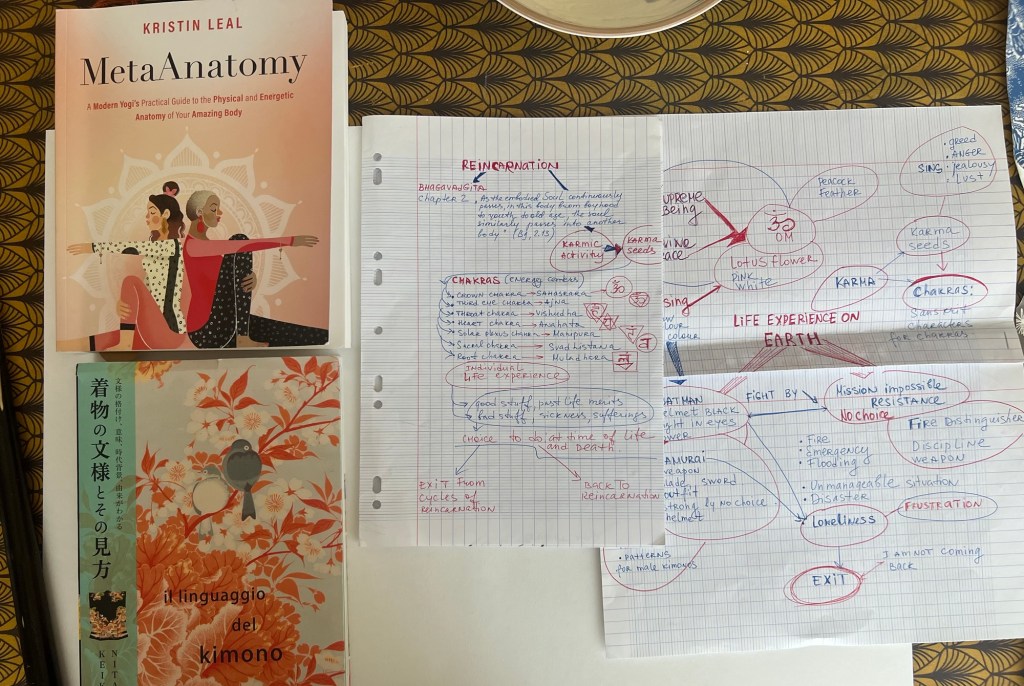
Below I post my reflection on my learning process and the new outcomes through this Part of the Research Course.
The primary outcome is my new level of understanding of the importance of the research stage in improving the project’s final result, such as a particular drawing/painting in my case. I used to do the research earlier, but I narrowed my focus to particular creative ideas and explored them in depth for the first time. However, this is a never-ending process, so the outcomes I have now are not final. I have discovered a powerful tool to enhance my creativity and refine the visual outcome: Mind mapping. Yes, I have been aware of mind mapping but have yet to apply it to my creative practice.
Another good thing was I felt confident in conducting the research and searching for books and online resources. The Internet is a great advantage for any artist of our time. Mind mapping is an entirely new strategy to develop the project. It helps to overcome a problem when your result is limited or restricted from the beginning, with your prefixed idea of how it should finally look. It helps with experimenting and finding new, unexpected solutions you could not have imagined when you started the project. I have outlined the new visual developments for two of my projects in the post for Advanced Practice Part I. This is the link to read further how my research is linked to particular changes in my projects. The development of these two projects as a body of work with an influence of the new research can be viewed in this post https://zhan-art.com/2024/03/11/level-3-advanced-practice-project-4-planning-towards-the-body-of-work/
THE LIST OF RESEARCH MATERIALS:
Books:
#1. Èloi Rousseau, “Hiroshige, Hokusai & les grands maîtres de l’estampe”, 2023, @LAROUSSE,
#2.Felice Fischer and Kyoko Kinoshita, “Ink and Gold Art of Kano”, Philadelphia Museum of Art, 2015;
#3.Olaf Mextorf, “Hokusai”, @2017 Könemann, Editions Place des Victoires, Paris.
#4.Kazuhiko Tajima, “Flores de Edo Enciclopedia ilustrada de flores japonesas”, Traduccion Daniel Aguilar, @2022, Satori ediciones, España;
#5.Kristin Leal, “Meta Anatomy”, 2021, Sounds True Inc., Louisville;
#6.Keiko Nitanai, “Il Linguaggio del Kimono”, 2014, @Snake, SA2020, Swizzera ( Switzerland);
Book #7. “Frida Kahlo”, Helga Prignitz-Poda, Gallimard, Munich, 2003;


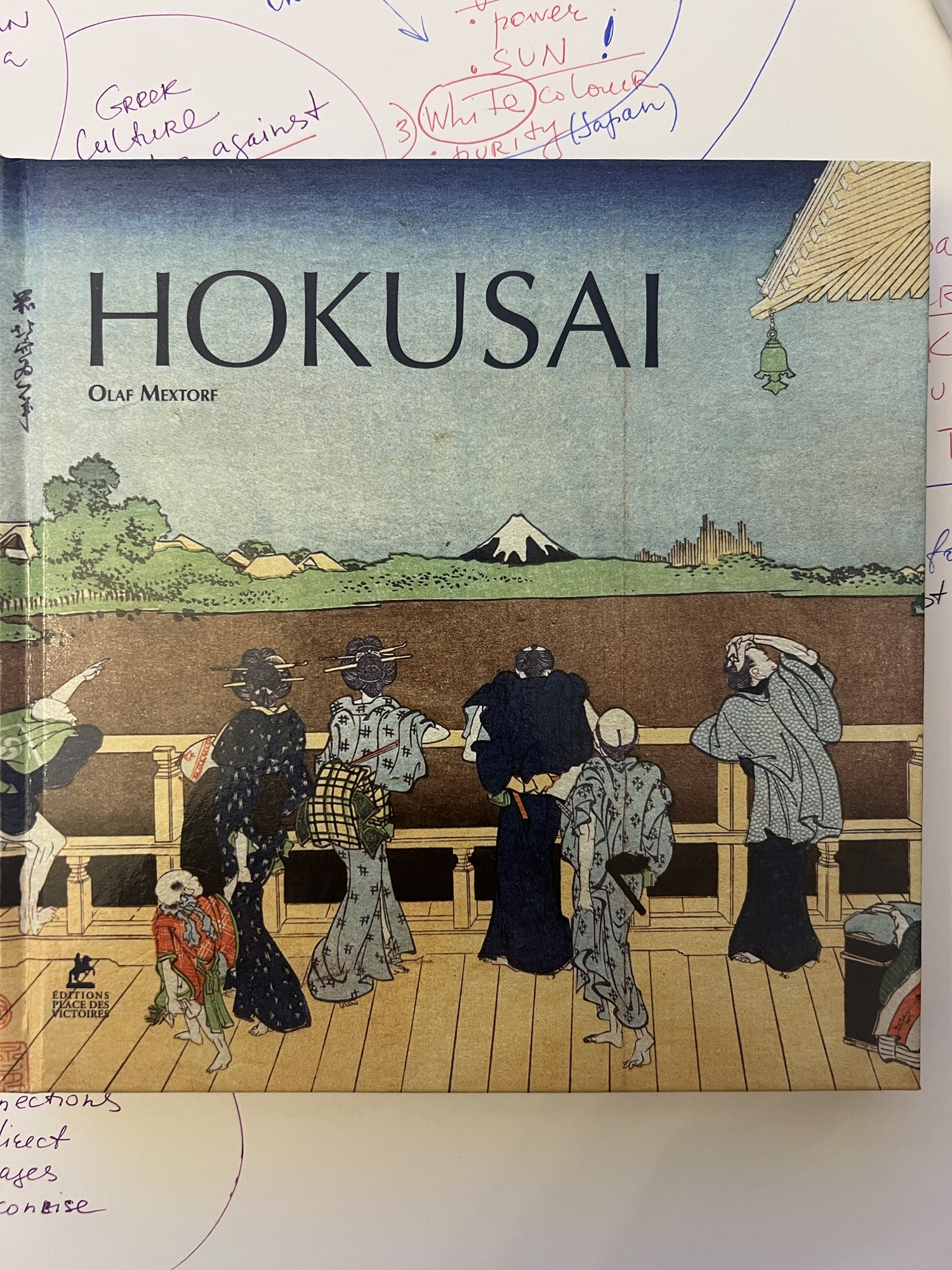


Below I place new artworks of Hokusai I discovered via research on painting clouds and mist. They are marked by me with red arrows.

The Mishima Pass in Kai Province, from the series 36 views of Mount Fuji, 1830-34, fragment, coloured wood, image via “Hokusai” book by Olaf Mextorf, p. 161, @Edition Place des Victories, Paris, @ 2017 Könemann;
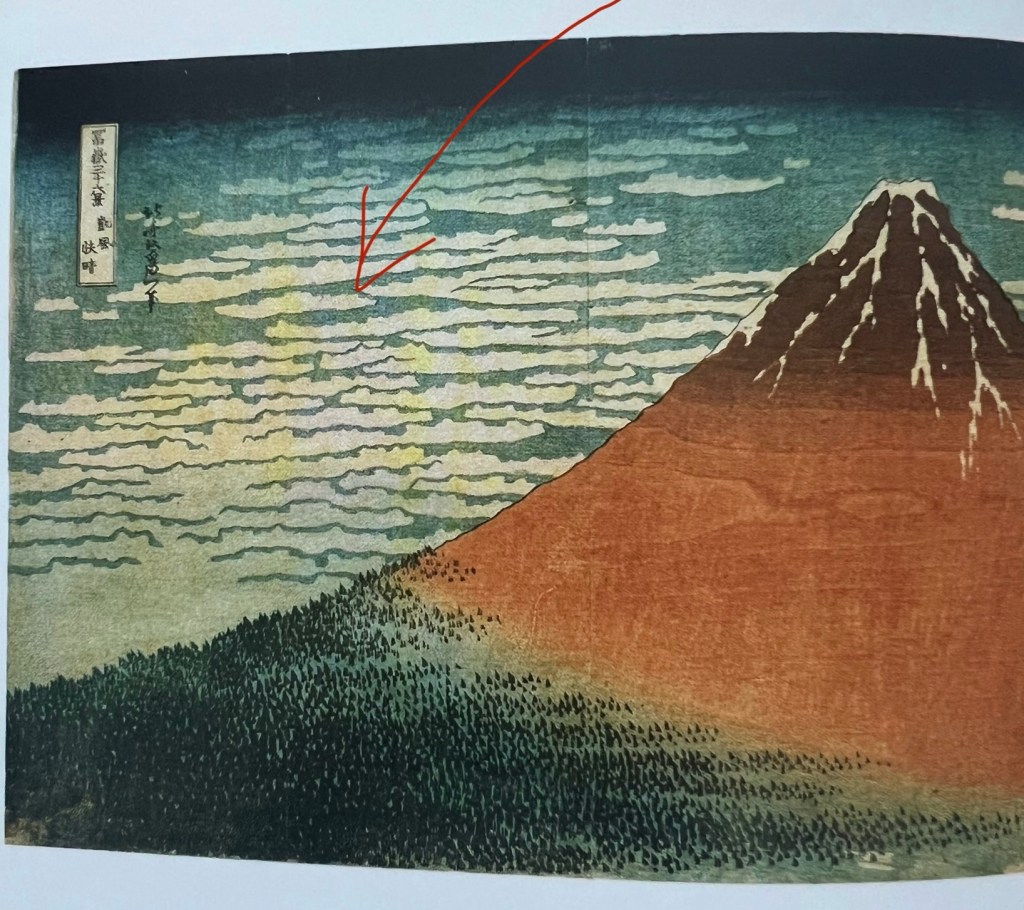
South Wind, Clear Morning, from the series 36 views of Mount Fuji,1830-34, fragment, coloured wood, image via “Hokusai” book by Olaf Mextorf, p.153, @Edition Place des Victories, Paris, @ 2017 Könemann;
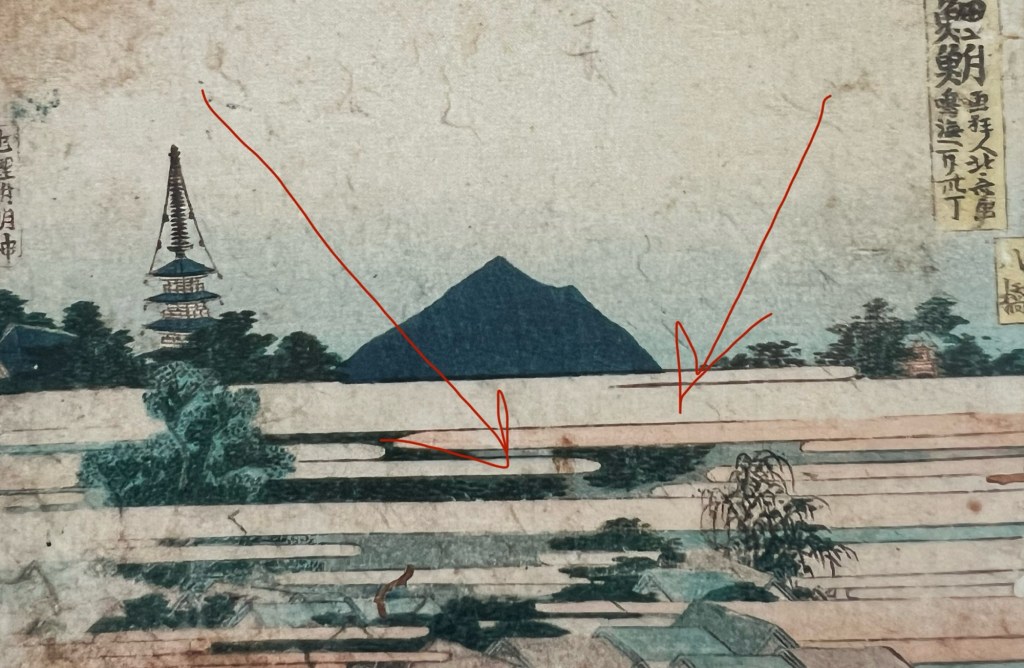
Chiryu ( Station 40), from the series 53 Stations of the Tōkaidō, 1804, coloured wood, image via “Hokusai” book by Olaf Mextorf, p.148, @Edition Place des Victories, Paris, @ 2017 Könemann;

A Bridge in Edo, rom the series 36 views of Mount Fuji, 1830-34, fragment, coloured wood, image via “Hokusai” book by Olaf Mextorf, p. 9, @Edition Place des Victories, Paris, @ 2017 Könemann;

You can find how this research is reflected in my creative process in post here https://zhan-art.com/2024/03/11/level-3-advanced-practice-project-4-planning-towards-the-body-of-work/
Online resources:
“Colours in Chinese and Japanese Culture. Colour Symbolism”, Devone Denomme, online on https://study.com/academy/lesson/colors-in-chinese-japanese-culture.html [accessed on March 10 2024]; “Colours in Japanese and Chinese Culture- Kaito Japan Design”, online on https://kaitojapandesign.com/blogs/colors-in-japanese-chinese-culture/colors-in-japanese-chinese-culture [accessed on March 10, 2024]; “Japanese Colours Meanings- Symbolic Colours in Japanese Culture”, Charlene Lewis, Art Context, October 2023, online on https://artincontext.org/japanese-color-meanings/. [accessed on March 10 2024]; “The Fundamental Forbidden and Permitted Colours in Japan”, Polina Couture, online on https://polinacouture.com/en/the-fundamental-forbidden-and-permitted-colors-of-japan/ [accessed on March 10, 2024]; “The Meaning of Natural and Landscape Elements in Japanese Crafts”, Japanese Motifs of Nature, Polina Couture, online on https://polinacouture.com/en/meaning-of-natural-and-landscape-elements-japanese-crafts/ [accessed on March 10, 2024]; “The Meaning of Flowers and Shrubs in Japan”, Polina Couture, online https://polinacouture.com/en/the-meaning-of-flowers-on-japanese-fabrics/ [accessed on March 10. 2024]; “Japanese brush painting: Water, mist and clouds”, 2010, Camelliateas channel, https://www.youtube.com/watch?v=0RhK1VHqlu4 Youtube, [accessed on March 11, 2024];
 JeanArt