In this part we are supposed to reflect on our primary and secondary sources and organise our research materials.
My primary sources of creative process are: 1) my personal impressions from things/ objects/situations/people; 2) my childhood memories or even they can be called as they are called in Sanskrit “samskaras” – strong complex emotional imprints in consciousness; 3) reference books I buy about particular artists and artworks; 4) photographs I make daily; 5) museums and galleries visits when I travel;
My secondary sources are: 1) technical reference information online or in books, magazines and Youtube, Pintrest; 2) textbooks; I realised that I don’t read a lot of art criticism and even if I would that would not impact my creative process : neither in negative nor in positive way.
Exercise 2.1. Online Search
“Colours in Chinese and Japanese Culture. Colour Symbolism”, Devone Denomme, online on https://study.com/academy/lesson/colors-in-chinese-japanese-culture.html [accessed on March 10 2024]; “Colours in Japanese and Chinese Culture- Kaito Japan Design”, online on https://kaitojapandesign.com/blogs/colors-in-japanese-chinese-culture/colors-in-japanese-chinese-culture [accessed on March 10, 2024]; “Japanese Colours Meanings- Symbolic Colours in Japanese Culture”, Charlene Lewis, Art Context, October 2023, online on https://artincontext.org/japanese-color-meanings/. [accessed on March 10 2024]; “The Fundamental Forbidden and Permitted Colours in Japan”, Polina Couture, online on https://polinacouture.com/en/the-fundamental-forbidden-and-permitted-colors-of-japan/ [accessed on March 10, 2024]; “The Meaning of Natural and Landscape Elements in Japanese Crafts”, Japanese Motifs of Nature, Polina Couture, online on https://polinacouture.com/en/meaning-of-natural-and-landscape-elements-japanese-crafts/ [accessed on March 10, 2024]; “The Meaning of Flowers and Shrubs in Japan”, Polina Couture, online https://polinacouture.com/en/the-meaning-of-flowers-on-japanese-fabrics/ [accessed on March 10. 2024]; “Japanese brush painting: Water, mist and clouds”, 2010, Camelliateas channel, https://www.youtube.com/watch?v=0RhK1VHqlu4 Youtube, [accessed on March 11, 2024];
Exercise 2.2. Searching the Library.
I don’t have a town library, which would have the books I need, so my library is my own library I built searching and buying art books. Usually I can find them at local FNAC store and in museums’ gift shops. Below are the books I have been using for my latest projects.
Èloi Rousseau, “Hiroshige, Hokusai & les grands maîtres de l’estampe”, 2023, @LAROUSSE,
Felice Fischer and Kyoko Kinoshita, “Ink and Gold Art of Kano”, Philadelphia Museum of Art, 2015;
Kazuhiko Tajima, “Flores de Edo Enciclopedia ilustrada de flores japonesas”, Traduccion Daniel Aguilar, @2022, Satori ediciones, España;
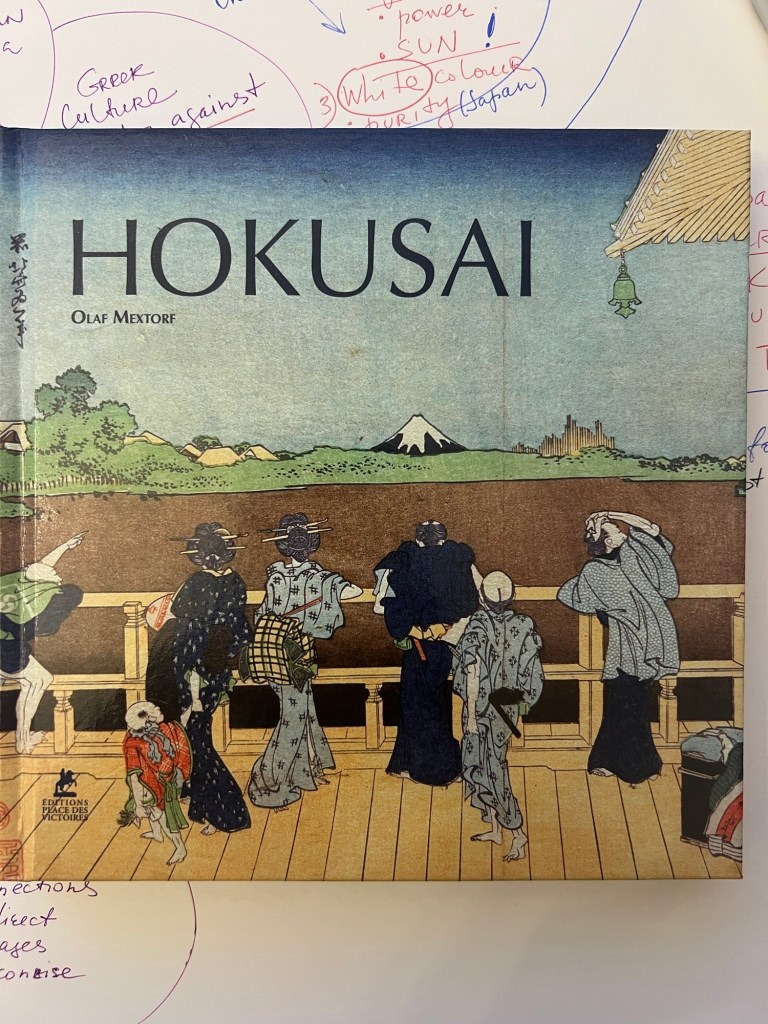
Olaf Mextorf, “Hokusai”, @2017 Könemann, Editions Place des Victoires, Paris.


 JeanArt