Exercise 2.1 A Continuing Practice.
After conducting an Audit of our practice and reflective commentary, we are required to produce several pieces of developmental work. This work will form a beginning of the central, core artwork we create for this course.
I am thinking about several projects I want to realise this year.
Project #1: Riviera Flowers.
This project will be about the surrounding greenery I observe daily around my location. I started to develop my trial sketches of different fragments, which I will unite on a large canvas. I don’t have any compositional decisions yet because, intuitively, I think the composition will depend on the results of different fragments. I plan to work with acrylics, aquarelle and inks on canvas. Now, I develop sketches on paper; the best outcomes will be included in the large painting. I work on new shapes, textures, colour approaches and techniques for leaves, petals and stems. I develop these projects by taking lots of photographs of the plants, which seem interesting to me, and then I try different ways ( medium and style, colours) to reproduce them on paper. I don’t have a fixed idea of what kind of result I want to get; I just paint and see what comes out, and this is my primary research – I am open to all outcomes. Also, I plan to research composition options and check artworks depicting greenery and plants. As usual, I will use the app to make collages and find the most exciting composition decisions.
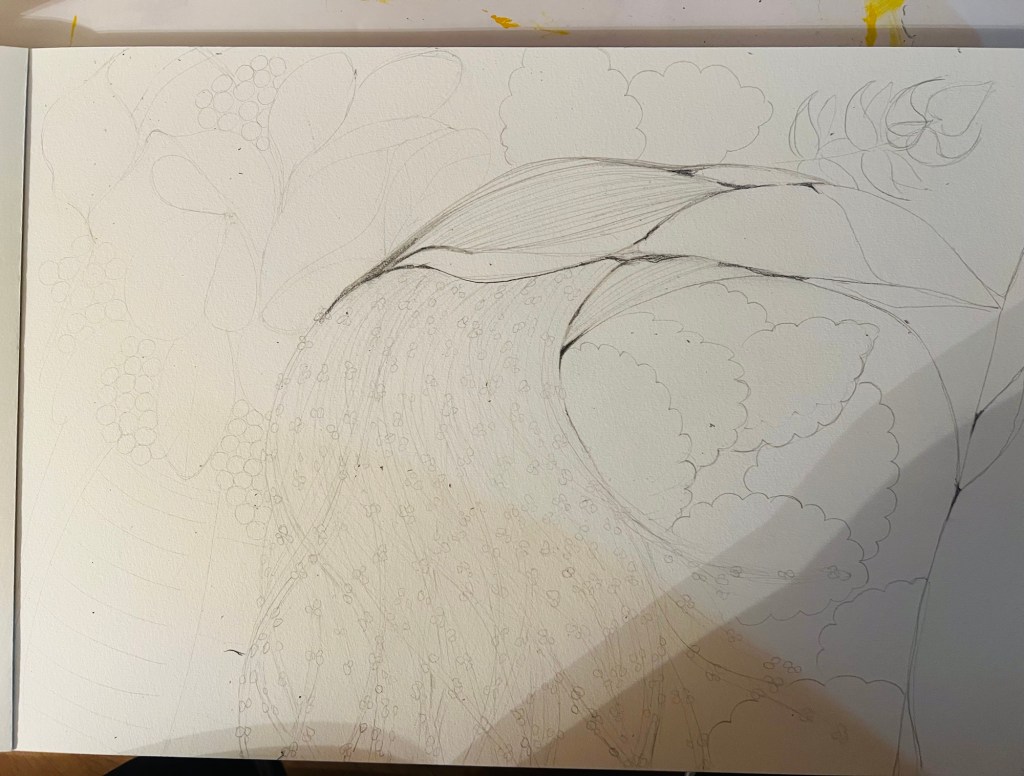


This work of mine was also developed in January this year as a part of a future larger painting, and will also be used as a reference for the new project.
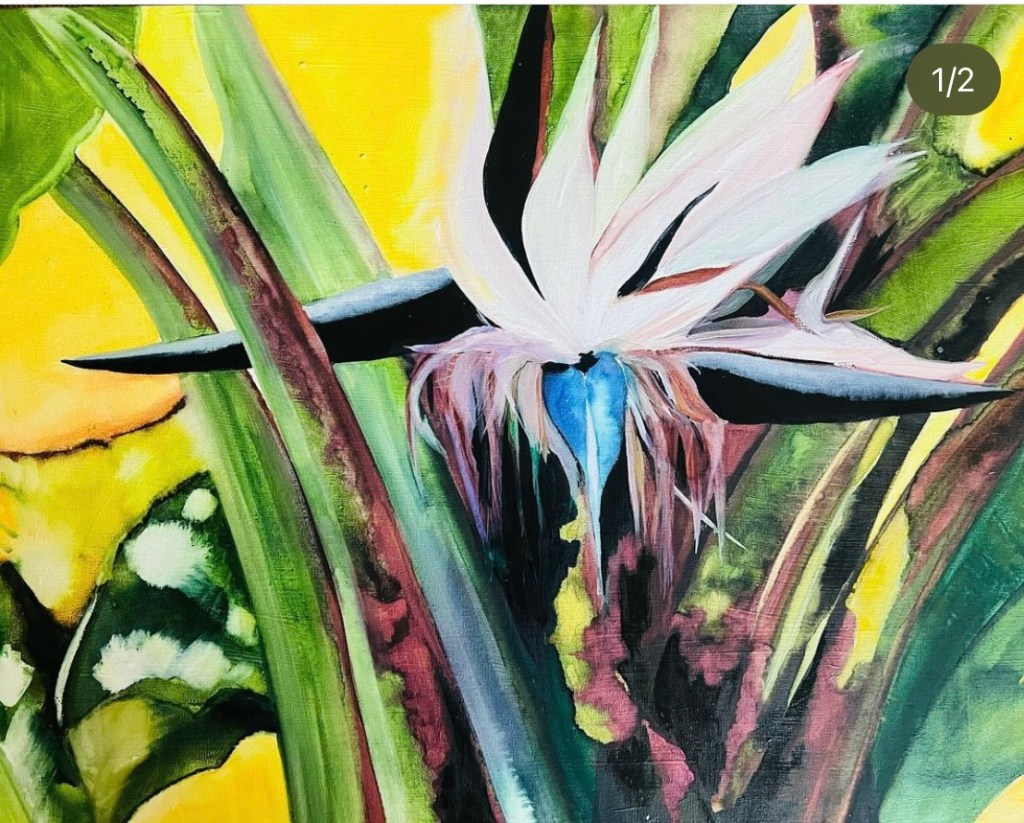
Project #2: Untitled.
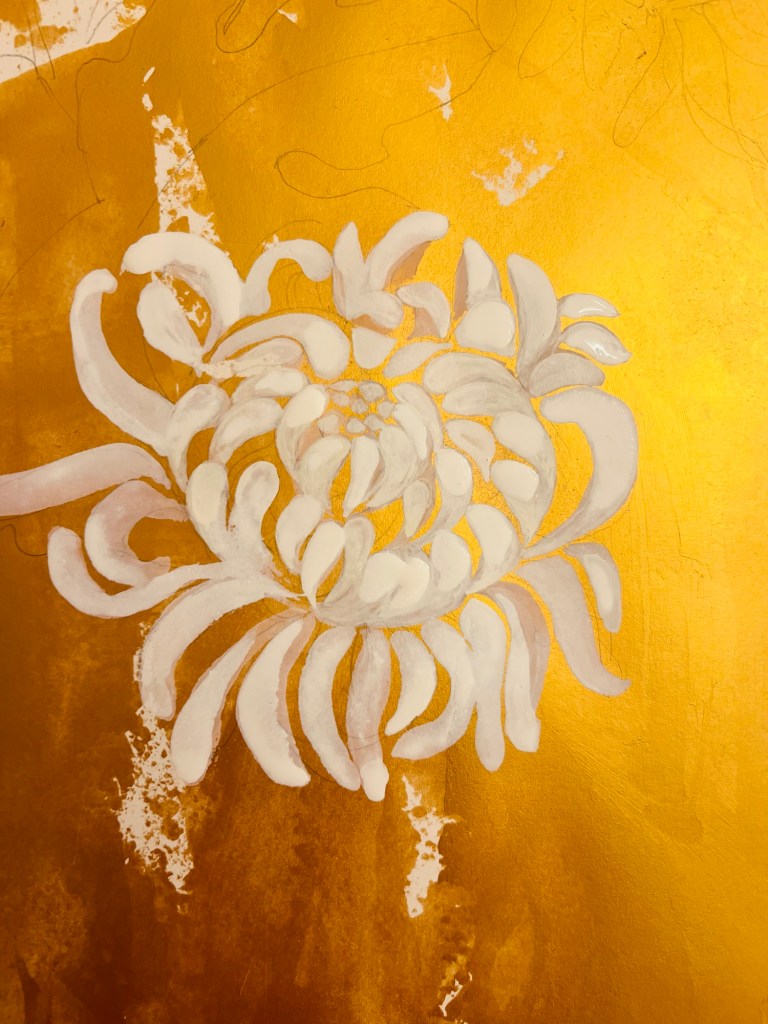
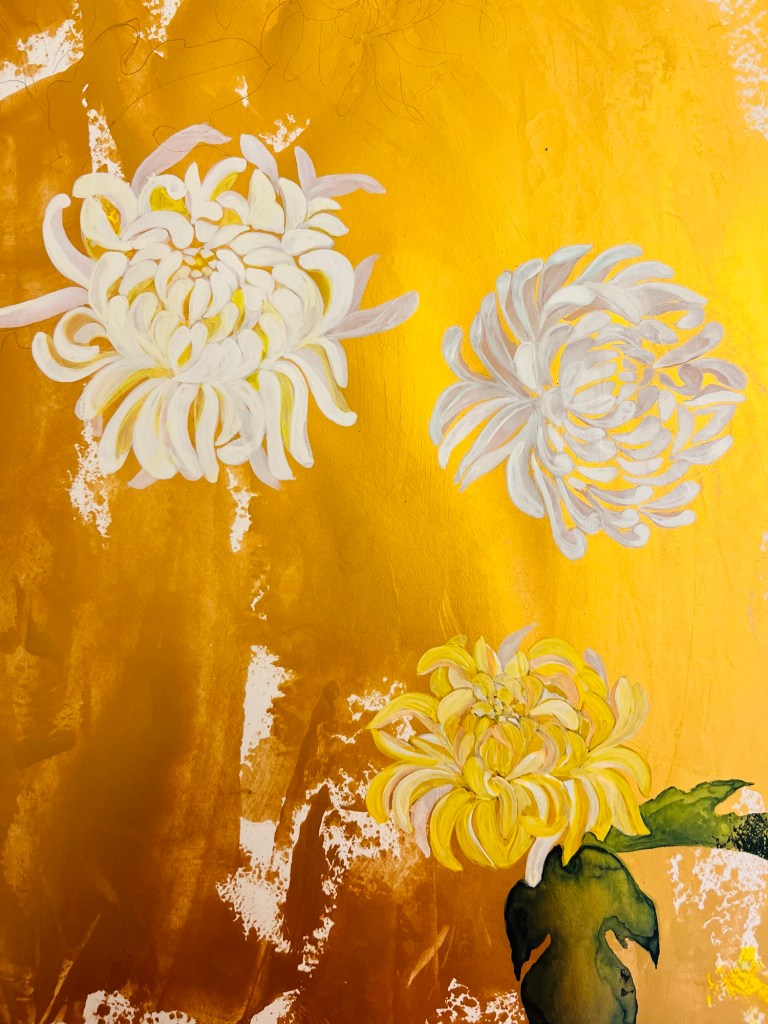
I started developing the Project below in January this year while waiting for the OCA to open my courses for Level 3, so I have included the developmental sketches and drawings in this exercise. This Project is my breakthrough in inventing and mastering my technique to produce my style Chrysanthemum flower and its leaves. I am also sure about the gold background. I made good progress on this Project since I produced an A2 size painting on paper in colours. All flowers are different since I tried different brushstrokes and practised different flower’ bulb shapes. I also experimented with a colour for the leaves, trying shades of green and blue. My plan to develop this Project is to make it in a larger size, either on canvas or on a wooden board, and incorporate poetry of my own or by a poet I will find resonating with my painting. I must decide about the font and its place on the canvas, so the compositional decision is still open. My research is about artworks with poetry. This genre is called “ekphrastic poetry”. There is a Japanese tradition of “tanka” or “haiku” poetry, which is often paired with ink paintings or calligraphy. Thus my research is branched out to “Ekphrastic poetry”: a) I am interested in works of Cy Twombly (1928-2011) who often incorporated fragments of poetry into his abstract paintings. He included quotes from Sappho, Homer, Virgil, Mallarmé, Rilke and Cavafy; b) “haiku” and “tanka” genre; c) Philosophy and poetry about life experience and spirituality;
Below you can see my development and research for the project. This is not my first or only trial for the flowers, I place here the recent one for this exercise.



Option 1

Another option for composition. The collage below gives me an idea of placing the poetry text at the upper part of each vertical plane. In the option above, without the collage, I am thinking about placing the text diagonally on top of the flowers, either in black or blue or green ink.
Option 2

Option 3

It was interesting to discover that Cy Twombly had an extensive, large and rich library as a part of his studio and often worked on his paintings with an opened book in front of him. As Mary Jacobus explains in her book “Reading Cy Twombly” : “…he never really separated painting and literature” (Princeton University Press, 2016 ). He also was interested in “astral transcendental geometry” and space.I want to bring some quotes from Mary Jacobus’ above mentioned book, because it exactly describes the artist’s working and research practice: ” The Twombly anthology permits unique insight into an artist’s thought process and working methods – the reading, brooding, and imagining that take place during the extended processes of pictorial composition” ( “Reading Cy Twombly”, p.3), “His books include handwritten mark- ups, rough notes, textual cuts, paint marks and illustrative doodles” ( “Reading Cy Twombly”, p. 2). The research Cy Twombly did with a poetry often was taking poems further, editing them and deleting parts of verses.
Bibliography: “Twombly and the Poets”, Gagosian Quaterly, Summer 2018 issue, online on http://www.gagosian.com [accessed on Feb 13, 2024]; ”Reading Cy Twombly: Poetry in Paint”, by Mary Jacobus, Princeton University Press, 2016, Literature, online on http://www.press.princeton.edu [accessed on Feb 13, 2024]; Book Talk: Mary Jacob’s – Reading Cy Twombly: Poetry in Paint, Cornell university Library, Youtube, 2016 [accessed on Feb 13, 2024]; 10 vivid haikus to leave you breathless, Read Poetry, online on http://www.readpoetry.com [accessed on Feb 16 2024]; “The Real Rules of Haiku” online on http://www.writebetterpoems.com [accessed on 16 Feb, 2024];
Project # 3: Night Sky in Miami.
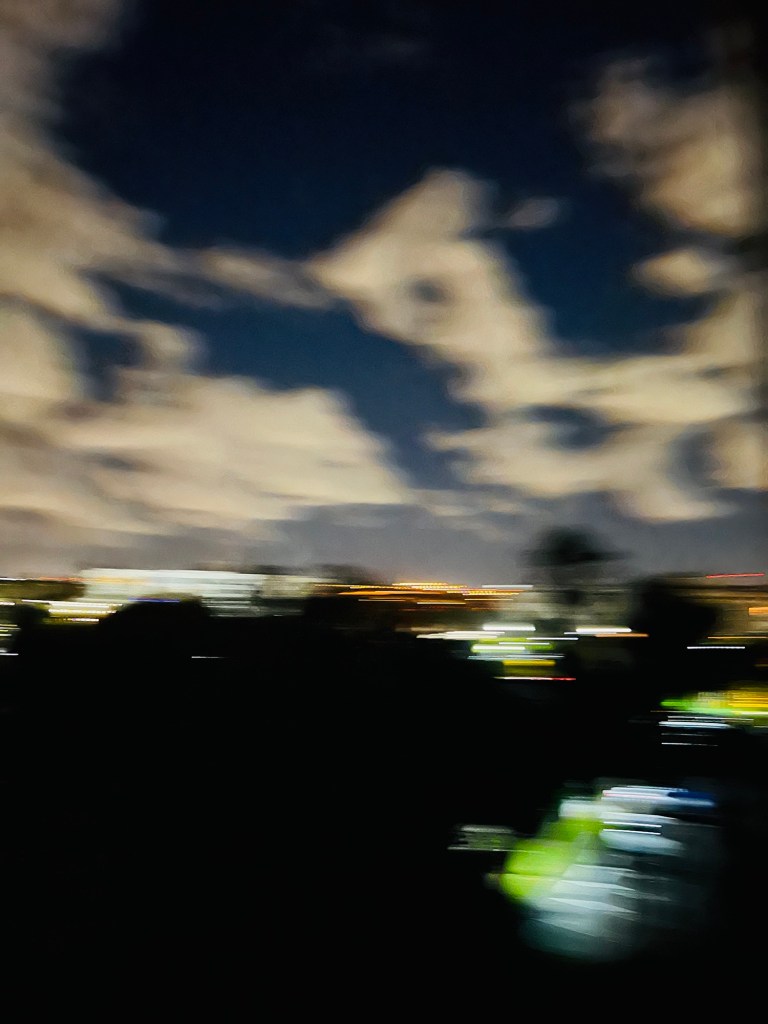
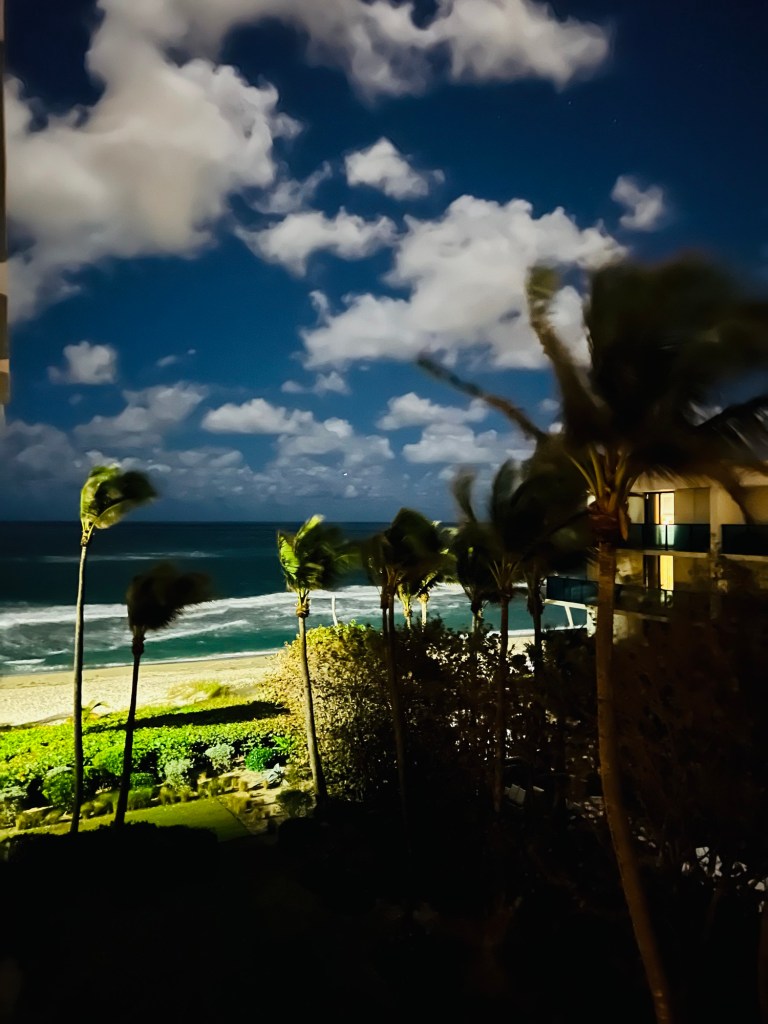
This project below emerged from my impressions of night skies in Miami Visited last. I took photos with my iPhone camera and plan to work in soft pastels or oils. The middle photo appeared very engaging – the objects are kind of smashed, united in one powerful dynamic of colours and lights. I like the deep darkness at the lower part of the middle photo and the contrast of moon lit beach and a dark part at the lower right corner on the right photo.


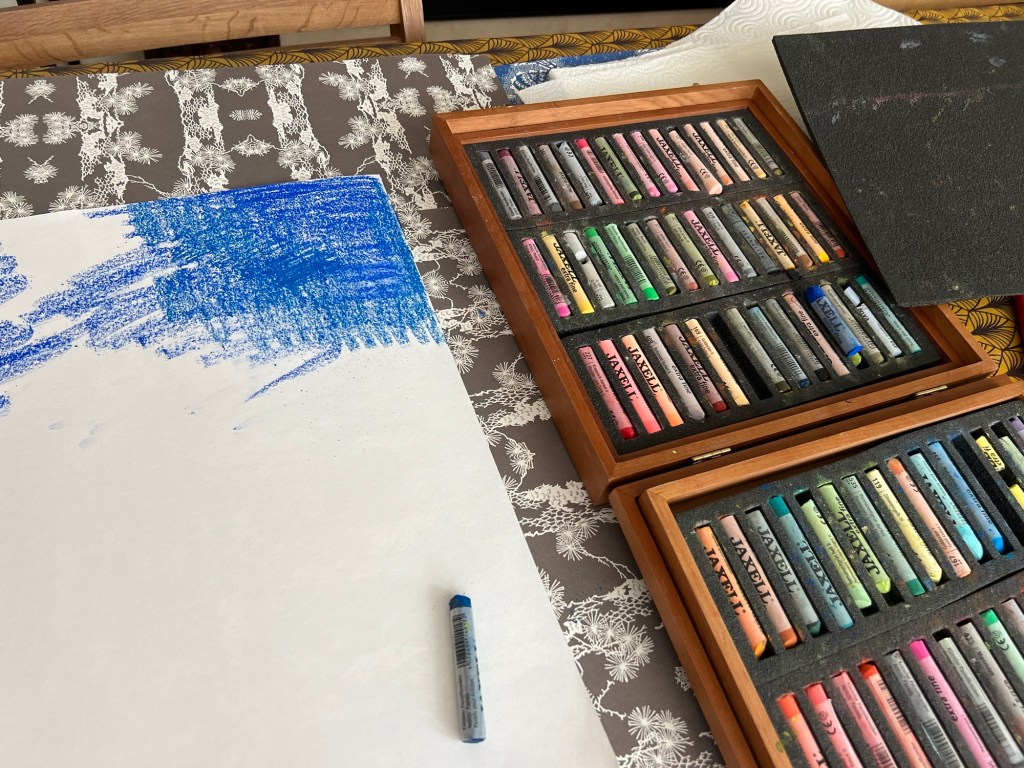
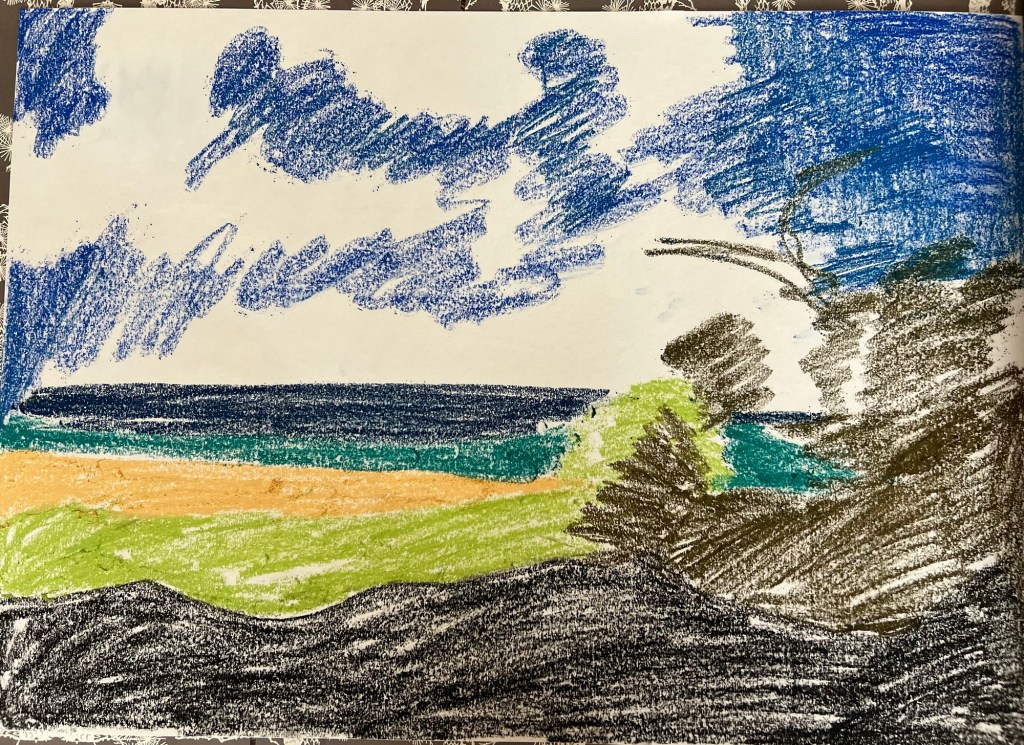
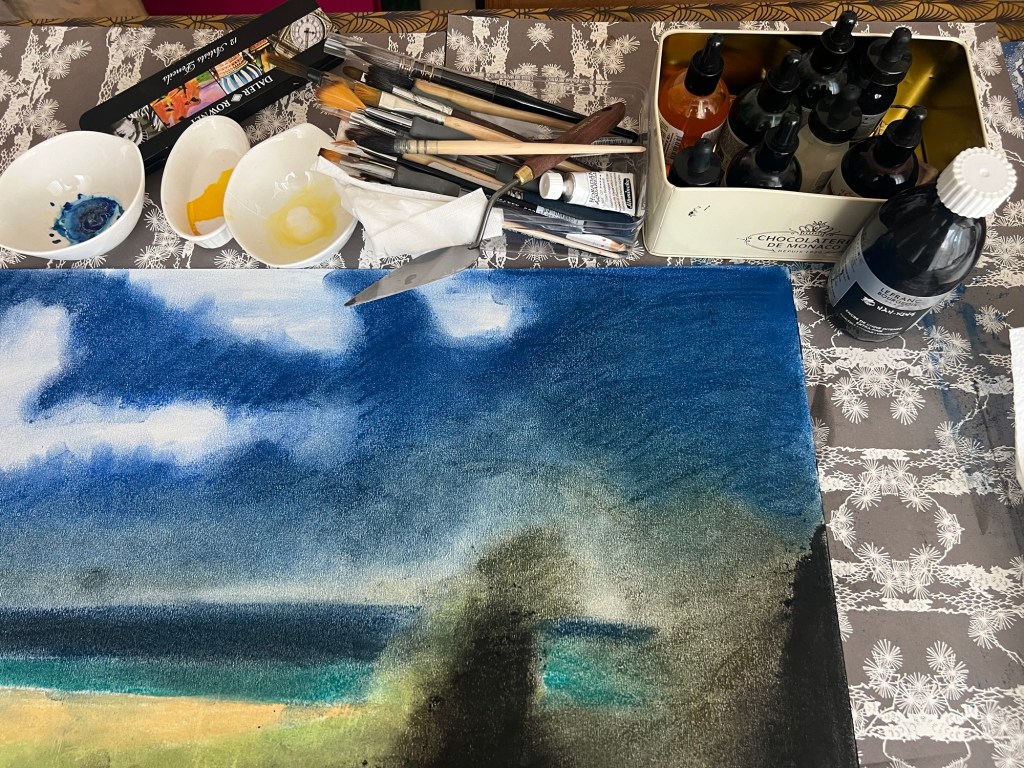
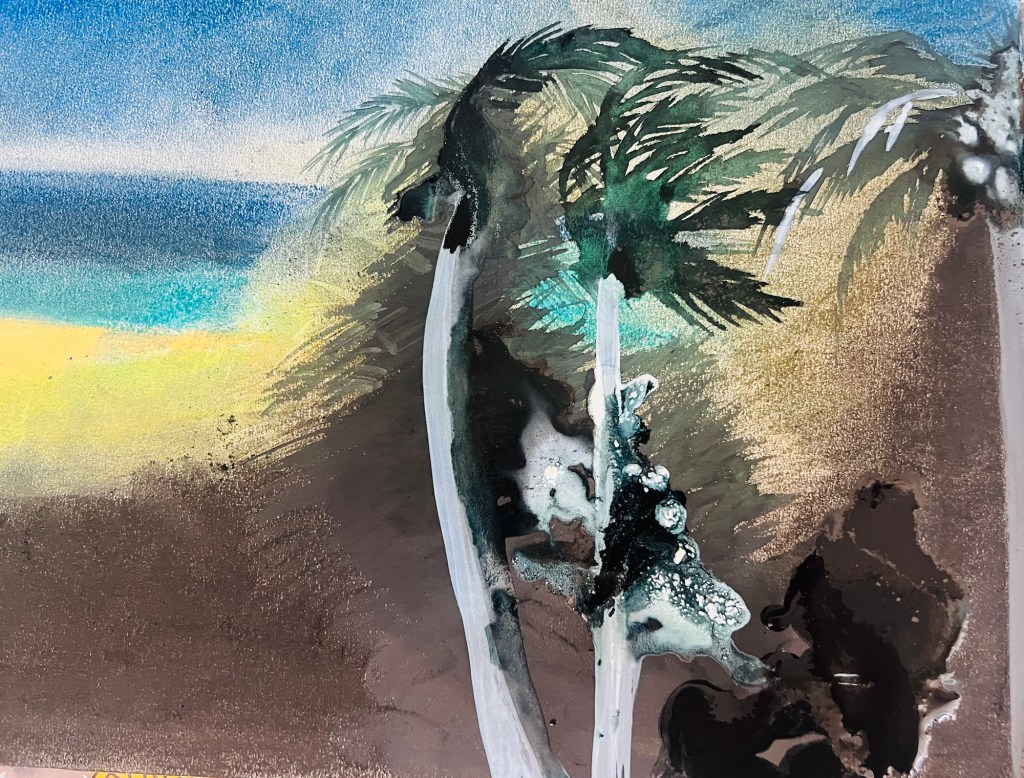


I left the sketch above and walked away for two days, “digesting” and reflecting on intermediate result. I liked the transparent white effect on the black pigment. It transformed the black mass into vivid and live happening. I wanted to try the white pencil on top of the layers if soft pastels and inks. The sketch developed into the following:


After I worked with white pencil, i added colours to the sand, sea and sky areas. After that o worked with a rubber eraser all over the surface. Below is a finished sketch as a prototype for future project.
Exercise 2.2. Artists at Work.
In this exercise we have to do a research on visual artists who follow different approaches and use different methods working in studios and developing their projects. We must reflect on intense periods of production versus embracing “the immediacy and expediency as a tool for discovery”. We also have to watch a video about Anthony Cairns and consider his processes, approaches and intentions.
I also watch the video “Anthony Cairns- London by Night” on Tate Youtube channel.
Anthony Cairns is a British photographer who is well known for his experiments with traditional and digital photography production processes. He creates altered photographic images of large urban areas and cityscapes.
Charles Gaines (1944-)
I got interested in the magnificent and complex works of American conceptual visual artist Charles Gaines (1944-) when I visited the Institute of Contemporary Art in Miami in December last year. He is famous for his large-scale paintings on clear acrylic plexiglass sheets. His two major projects are “Numbers and Trees” and “Numbers and Faces”, dedicated to the exploration of “formulas and systems and a closer look at ideas around identity and diversity” ( Katy Cowan, 1.02.2021, Creative Boom).
His creative process includes research he makes doing photographs of trees, different materials, drawings, as well as inviting people who would self-identify themselves as multiracial or multi-ethnic.
Charles Gaines explained his interests as studying systems and the point when “their relationship to any idea is arbitrary” ( Katy Cowan, Creative Boom). That arbitrariness he brought to the surface of his artworks, developing images as an independent result of a system’s functioning. The system was a certain sequential overlapping of images.
He well described his creative process in his interview with Art21, which I watched with a great interest. Charles Gaines believes that being an artist doesn’t require studying painting practices, art is more about your intuition and imagination, as well as intellectual inquiry. However, his artistic research is about looking at and identifying systems which create their one arbitrary result. For example, he converted a piece of literature text into music, which was written as a result of the algorithm he identified/created from the text. Another example is his “Trees” project, which he started in 1972, studying the form of a tree in the mathematical language of a grid.
I think even though the artist emphasises the independent factor of the system’s own rules and intrinsic logic, I find a lot of his imagination and artistic taste contribute to his artworks. For example, the colours and sizes of the artworks he picks up for his digital breakdowns of structures such as faces or trees are not determined by some system. They are a result of his own artistic decision. Looking at the stems and branches of his trees I find his artworks very elegant. Why did he place the structures on white negative space? Probably to accentuate the structure and bring the focus of the viewer’s attention to the system, which is represented by the mathematical grid. Another creative decision was his intention to use modern materials such as transparent acrylic sheets and modern technology of photograph printing in these materials. This adds a lot to his artworks, making them stand out. Paradoxically, I find lots of his own original and decisive creativity, while he is aiming to obtain a result free from it and be a result of independent system operation.
I find his approach and creative working process unique and it stands out for me for its elegant and laconic yet rich visual language. Charles Gaines’ visual aesthetics have common features and vibrations with the Japanese traditional art I am very fond of.
I was thinking about what is different about Charles Gaines and me in our perception of things and inspiration. He is very interested in how structures and systems work, digitally “dissecting” a particular object. I am interested in the interaction of systems or system elements when you can spot and trace a dialogue between an object and its surroundings. My need to explore the dialogue between different objects of one large System is my spiritual and existential perception.

Above: Numbers and Trees: London Series 2, Tree #2, Compter Passage. 2022 Acrylic sheet, acrylic paint, lacquer, wood, 152.4*210.2*14.6 cm; image via http://www.housewirth.com [accessed on February 25, 2024];
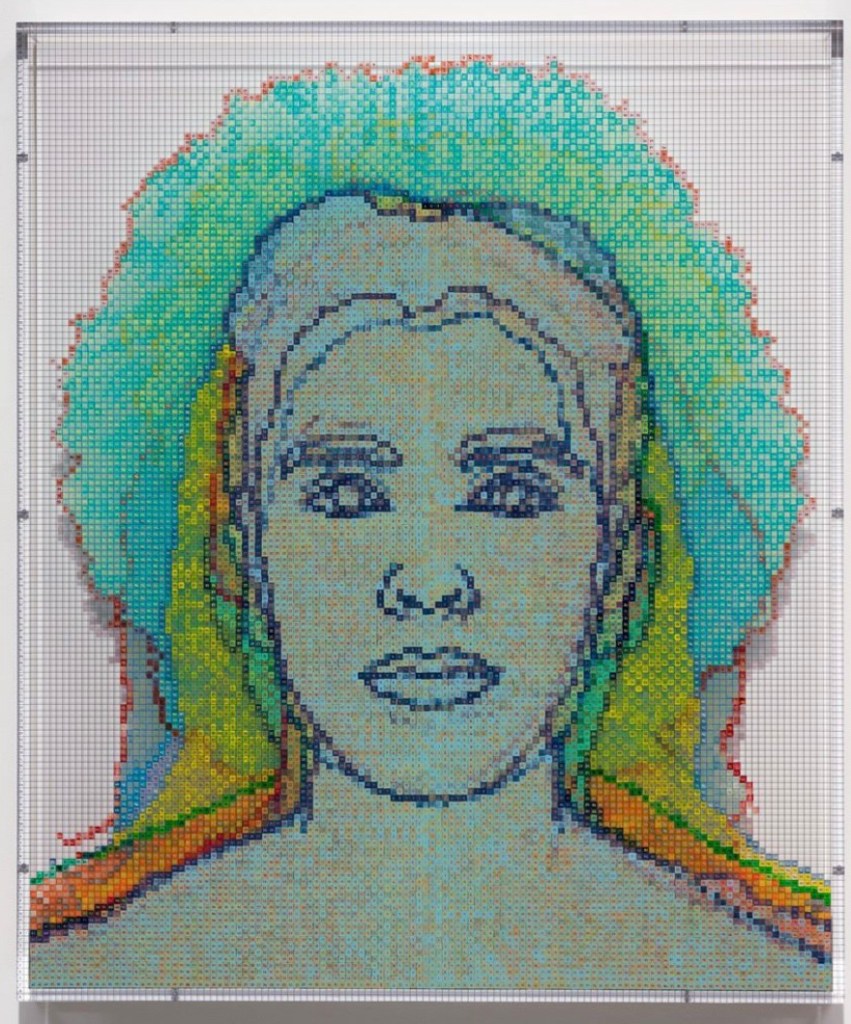
Above: Charles Gaines, Numbers and Faces: multiracial ethnic combinations series 1: face #13, Ellen Yoshi Tani, ( Japanese, Danish, Irish, English); acrylic paint, acrylic sheet and photograph, 2020; online on http://www.housewirth.com [accessed on February 25, 2024];

Above: Charles Gains, Numbers and Trees: Arizona Series 2, Tree # 4, Kanab, 2023; Watercolour and ink on paper 64.8 x 54.6 cm71.4 x 61.3 x 5.1 cm (incl frame), online on http://www.ocula.com [accessed on February 25, 2024];
Gerhard Richter ( 1932-)
Gerhard Richter is considered one of the most influential modern visual artists famous for his paintings like blurred photographs, abstract paintings and his unique painting technique. He doesn’t use a brush that much, his main tool is a custom-made large squidgy. On YouTube, there are many videos of him at work in his studio. A filmmaker Corinna Abel made a documentary about Gerhard Richter following him working. He is known for his disciplined approach to the creative process, he starts working at the studio at 8 am and finishes at 5 pm. His creative process is notable with his conscious decision to delegate preparatory work ( paints preparation, mixing) to two of his assistants so he can exclusively focus on the creative part. Nothing should distract him while he is thinking about the artwork in process, so his studio is clean and contains minimal objects, literally just paints, canvases and ladders. It was interesting to hear his answer in his interview for Louisiana Chanel to a question when he thinks the painting is finished. The answer was “when nothing bothers me”.
Even though I am not a fan of his abstract paintings, I resonate with his idea about what is Art. Here what he said: “
Art is not a substitute religion: it is a religion (in the true sense of the word: ‘binding back’, ‘binding’ to the unknowable, transcending reason, transcendent being). But the church is no longer adequate as a means of affording experience of the transcendental, and of making religion real – and so art has been transformed from a means into the sole provider of religion: which means religion itself.”
Gerhard Richter, Notes, 1964-65, 1964-65
I see he also considers art as a spiritual, transcendental experience. However, his next quote below makes me think that he shares Clement Greenberg’s view on art.
“Theory has nothing to do with a work of art. Pictures which are interpretable, and which contain a meaning, are bad pictures. A picture presents itself as the Unmanageable, the Illogical, the Meaningless. It demonstrates the endless multiplicity of aspects; it takes away our certainty, because it deprives a thing of its meaning and its name. It shows us the thing in all the manifold significance and infinite variety that preclude the emergence of any single meaning and view.
Gerhard Richter, Notes, 1964-65, 1964-65
It is always surprises me how abstract painters devalue “interpretable pictures”. I always had a problem with Greenberg’s views on art, which should be free from ideas and interpretation. In Richter’s case I also can’t understand why he thinks the interpretation is a kind of limitation for an artwork. To my view, abstract paintings which are hard to “interpret” comparing with “interpretable” non abstract paintings don’t possess more value. I think a statement that abstract paintings, which are not limited by “interpretation” have better/bigger value is the same thing as to state that meaningful texts have less value comparing to a bunch of random letters, which don’t carry any sense. Also, it is worth to note that uninterpretable paintings have their own limitation as well, since the viewer can’t interpret them and that ambiguity of the image is a limitation. To me, the abstract painting which is difficult to understand has same, if not less value to a non abstract painting, which efficiently invites a viewer to a dialogue. The dialogue can be different in terms of intellectual level, fir example kitch mass art is a shallow thought, however, not all abstract art is highly intellectual just because it is abstract. Abstract art doesn’t have any exclusive right on intellectual discussion with a viewer. I think many abstract painters avoid discussing this aspect:).
Below I place some of his artworks I find interesting.
Gerhard Richter, Uncle Rudi, 1965, oil on canvas, 87 x 50 cm, image via http://www.gerhard-richter.com

Gerhard Richter, Abstract Painting, 780-1, 1992, oil on canvas, 260.03*200.03, image via http://www.gerhard-richter.com

George Kondo ( 1957-)
While searching for videos of artists at work, I discovered the artworks of American contemporary visual artist George Condo (1957-). I watched the videos about his drawing process “Bus Driver’s Dream”, 2017 and The Way Think made in his studio. I liked his manner of painting which is relaxed and smooth, he has strong linear skills and I can see his sense of humour in his artworks. George Condo draws and paints with soft pastels and oils, he is very outspoken and sincere, I enjoyed listening to him. He is interested in capturing human’s emotions in his artworks, trying to get to a surface the emotional/ mental state of a human. He also developed this concept of “double portrait”- an abstract cubistic style portraiture, which is his way to bringing together polar emotions or emotions of several people into one person’s/character’s portrait. It was interesting to read about some details about his working practice in his interview to Jacoba Urist he gave before Frieze Art Fair in LA, 2023: “I like a small studio space so that I’m surrounded by my paintings: one here, one there, one right behind me. While that painting is drying, I can work on this painting a little bit, and I can see from the corner of my eye, something over there on that one. But if they were 300 meters apart or I had a basketball-court-size studio, and they were all lined up as if they were going off to a gallery, it just wouldn’t feel like I’m making paintings for the sake of the paintings themselves. I painted the big, red double-wide composition, Double Heads on Red, 2014, [currently on view] at the Broad, in a one-car garage. When the work is right up close to me—literally 2 feet away—there’s a tactile aspect to it, and a friendship between me and the artwork itself.”
It seems that he kinds of lives surrounded by his painted characters and that close physical neighbourhood with them in his small studio nurtures his creative process.
I place here another his quote describing the artist at work.
“Your paintings personify an art historical mad genius. Do you work frenetically?
Let’s put it this way. I paint whenever I want. If I get up at 2 o’clock in the morning and I feel there’s one thing bothering me about this painting, I go into the little room where I paint at home and I’ll work on it. Then, I go back to sleep. When I get up in the morning. I have this or that in the studio with everybody working on books and on projects. But then I say, “OK, I have to get working on these paintings.”( ARTNews, Jacoba Urist, Feb 2023).
Below I place some works I like.
George Condo, self Portrait in Paris I, 2018, offset lithograph poster; image via http://www.artsy.com
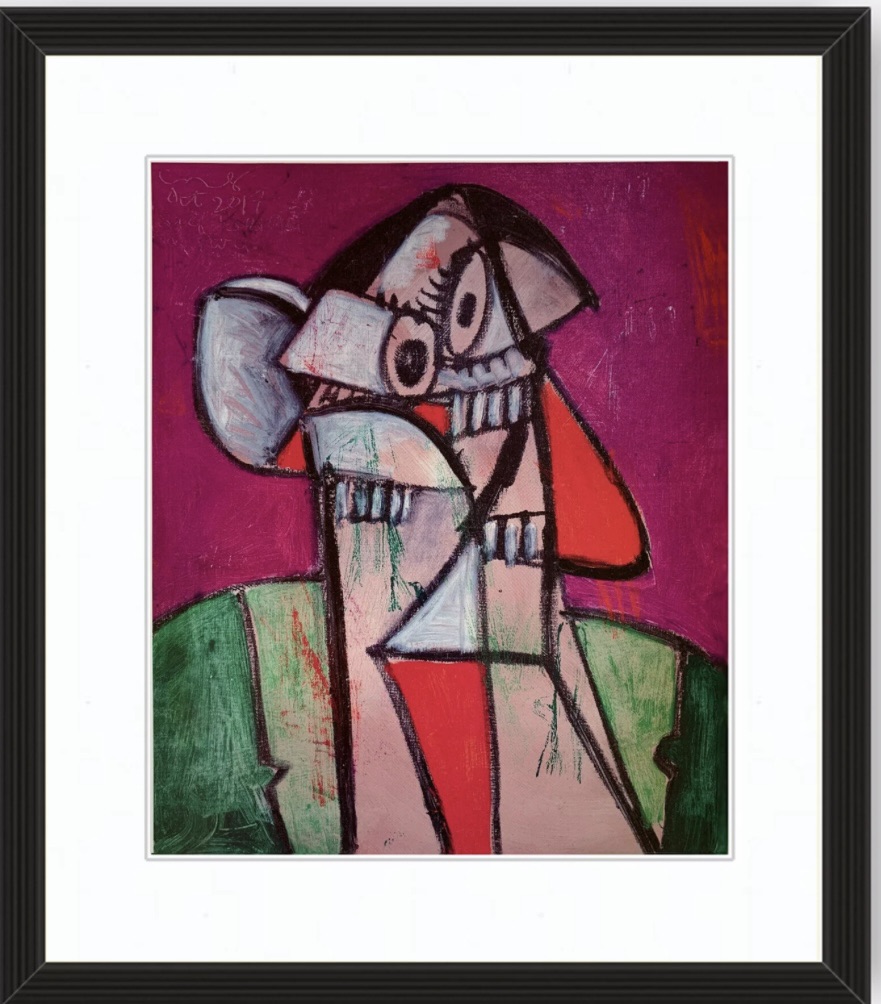
Below: George Condo, Force Field, 2010, acrylic, charcoal, pastel on linen; image via http://www.mutualart.com;

Below: George Condo, Reclining Blue Form, 2011, oil on canvas; image via http://www.mutualart.com;

My reflection on my creative practice:
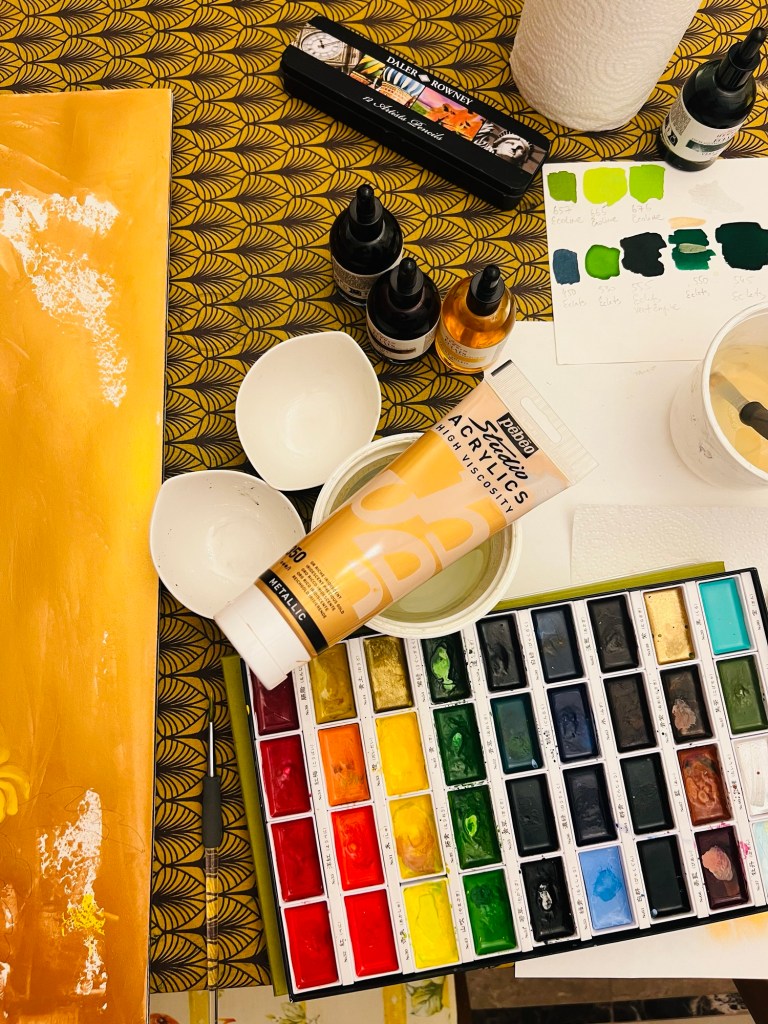
I have outlined in the previous exercise that my weakness is the fact that I don’t spend enough time working in the studio. Over the time, I have adapted to the deficit of time and established a working place near my kitchen, which is quicker to reach since my studio is at some distance. Thus my working materials are distributed between two spaces. I keep oils and everything that is related to this medium ( turpentine, brush cleaning solutions, etc), as well as large-size canvases in my studio. At my working station which I use almost every day, I keep inks, pastel sticks, preliminary drawings, papers and books. I also like to keep some of my finished drawings and paintings close to me, so I can live with them. In this habit, I resonate with George Condo. I don’t need a minimalistic environment like Gerhard Richter. The central part of my research for every project is taking photographs I make with my iPhone camera. I can’t pass by without gazing at interesting plants and their details, as well as artworks I see in galleries, museums and exhibitions. Then I refer to art books about particular artists and specific literature. While watching the creative process of different well established artists I noticed that they don’t show much about their research phase, and they start their projects differently. However, the creative process always follows one pattern: they start, stop, observe, continue, then stop again, observe, sometimes walk away, come back, continue, qaze at the artwork again, continue working until “nothing disturbs” them in the artwork ( as Gerhard Richter said) or “when nothing can be added” ( George Condo).
Bibliography: “New grid system works by Charles Gaines, the artist who paints faces and trees by numbers”, Katy Cowan, 1 February 2021, Creative Boom, Inspiration, online on http://www.creativeboom.com [accessed on February 25, 2024]; “Charles Gaines: Systems and Structures”, Art 21 “Extended Play”, YouTube, [accessed on February 25, 2024]; “Charles Gaines: Why is a bird a bird, and I am not?”, San Francisco Museum of Modern Art, 2021, YouTube [accessed on February 25, 2024]; Interview: Charles Gaines at Gallérie Max Hetzler, Berlin 2018, Galerie Max Hetzler, YouTube [accessed on February 25, 2024]; Gerard Richter (German, born 1932) online on http://www.artnet.com [accessed on February 26, 2024]; “Gerhard Richer Painting: watch the masterpiece artist at work”, 2012, YouTube, Nowness, [accessed on February 26, 2024]; “Gerhard Richter Interview: In Art We Find Beauty and Comfort”, 2017, Louisiana Chanel, YouTube, [accessed on February 26, 2024]; “Filmmaker Corinna Abel’s on Gerhard Richter Painting”/ Insider Insights, 2021, The Met, YouTube, [accessed on February 26, 2024]; “The Story of Gerhand Richter (1932-Today), Contemporary Art, YouTube, [accessed on February 26, 2024]; “How to paint like Gerhard Richter”, 2014, Joshua Namdev Hardisty, YouTube [accessed on February 26, 2024]; “Gerhard Richter in the Studio”, GerhardRichterVideos, YouTube, [accessed on February 27, 2024]; “Gerhard Richter. Quotes”, online on http://www.gerhard-richter.com [accessed on Feb 27, 2024]; “George Condo: The Way I Think”, Louisiana Channel, 2017, Youtube, [accessed on February 29, 2024; “George Kondo: What Drives Him to Create Biliguil Portraits: I want my portraits to remember me”, Jacoba Urist, 16 February, 2023, ART News, online on https://www.artnews.com/art-news/artists/george-condo-hauser-and-wirth-west-hollywood-opening-1234657800/# [accessed on February 29, 2024]; “My Floating World: Miyuki Tanobe”, 1979, documentary by Ian Rankin, Stephan Steinhouse, Mark F.Vaizard, National Film Board of Canada, YouTube, [accessed February 29, 2024];
 JeanArt