
Research Point: We have to research the theory of reflective practice, the works of John Dewey, Donald Schön, Graham Gibbs, David A. Kolb;
Reflective theories generally explore individuals’ ability to understand the world through observation, introspection, reflection, analysis, critical thinking, imagination, and creativity, establishing connections between an individual’s life experience, thoughts, ideas, beliefs and actions. Reflective theories are extensively developed and applied in various disciplines, such as philosophy, psychology and education.
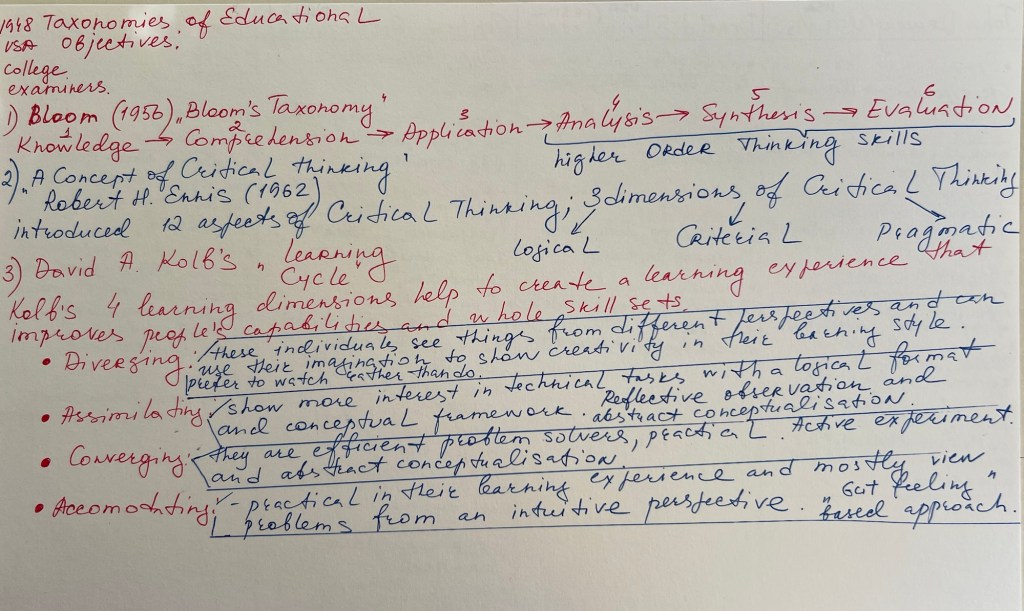
Landmark contributions to development of philosophical concept of critical thinking in education process:
- “Bloom’s Taxonomy” (1956), developed by Benjamin Bloom with collaborators Max Engelhart, Edward Furts, Water Hill and David Krathwhol.;
- “A concept of Critical Thinking” (1962) by Robert H, Ennis.
- David A. Kolb’s, 1970-1972 Learning Style Inventory: Learning Cycle + Learning Styles
I thought it wood be good to outline the main features of all four reflective theories in a chart below.

All these reflective theories share the following features: a) they all recognise that learning happens with real direct interaction, involvement, and engagement with the situation, event, or experience; b) they all admit that any learning is an ongoing, continuous process, it is about establishing connections between individual’s existing knowledge and familiar concepts with the new ones; c) they all include a critical thinking stage, what is analysis; Many educators, psychologists and sociologists have developed these theories further over the years in the XX century. Some essential additional evolutional concepts have been introduced, such as understanding and categorising dimensions of critical thinking and learning styles/ types.
Bibliography: “Supplements to Critical Thinking, History”, David Hitchcock, @2022, Stanford Encyclopedia of Philosophy, online on http://www.plato.stanford edu [accessed on February 3, 2024]; “Bloom’s taxonomy””, Patricia Armstrong ( 2010), Vanderbilt University, online on http://www.cft.vanderbilt.edu [accessed on February 3, 2024]; “Reflective writing: Schön”, Hull University Library, updated Jan 19, 2024 online on http://www.libguides.hull.ac.uk; [accessed on February 3, 2024]; OpenAI. (2024). ChatGPT (3.5) [Large language model]. https://chat.openai.com [accessed on February 3, 2024]; “Kolb’s Learning Cycle”, Paul Main, September 9, 2022, Structural Learning, online in http://www.structural-learning.com [accessed on February 3, 2024];
Exercise 1.2. Describing your reflective practice;

I decided to draw a chart of my creative, reflective practice ( above), which I do while working on my drawings and paintings. My reflective practice can be described as follows:
1st Stage: Accumulation of knowledge, which is always based on observation, reading, research, and experimental trials of fragments of future projects;
2nd Stage: Reflection on the outcome of my experimental practice: I try to think about what came out as good and strong and what I did as bad and weak. Why did it happen like it happened? What is interesting? What is the most engaging and exhilarating for me? How can I take it further in the project I am thinking about?
3d Stage: Developing further the most engaging and potential idea: working on details, experimenting further with the medium and composition, trying unusual approaches in terms of resources and perspectives;
4th Stage: Evaluation, Conclusion and Action Plan Development: all decision-making about all main characteristics, features and all the details, implementation, submission/presentation to the Audience;
5th Stage: Getting Feedback from the Audience: reflection of the Feedback, reflection on my and the Audience’s underlying assumptions, reflecting on successful and weak/problematic points;
Exercise 1.3. Writing a reflective summary.
In this exercise we are asked to write a reflective commentary on our recent practice, minimum 500 words, taking into account the key reflection points.
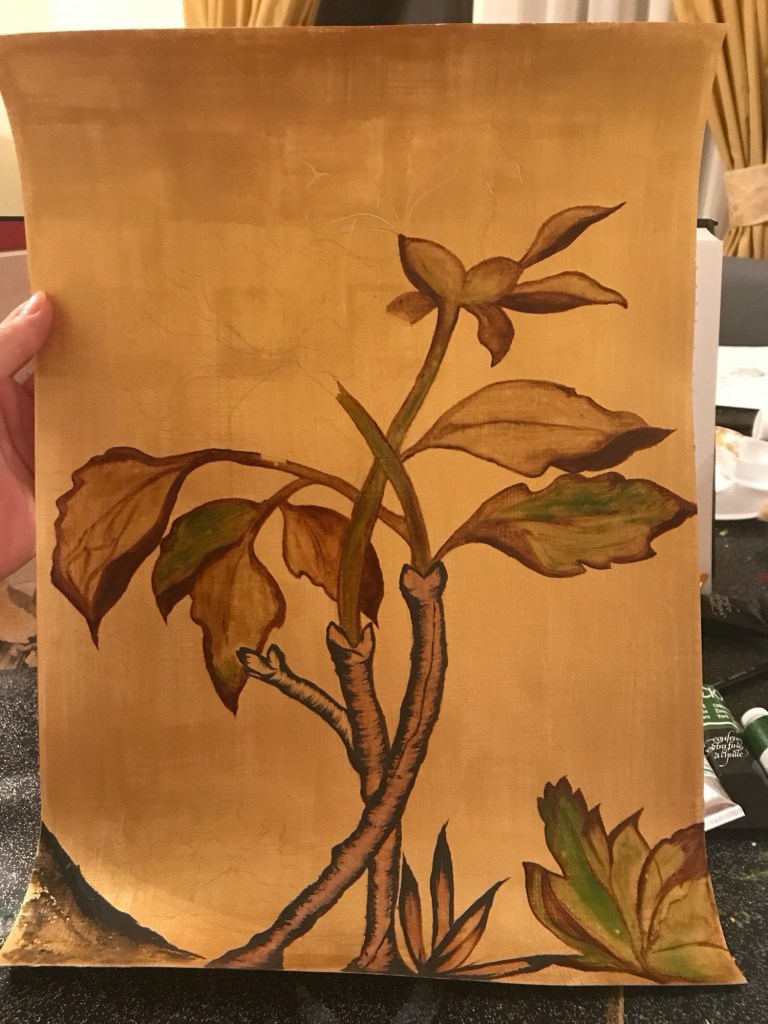
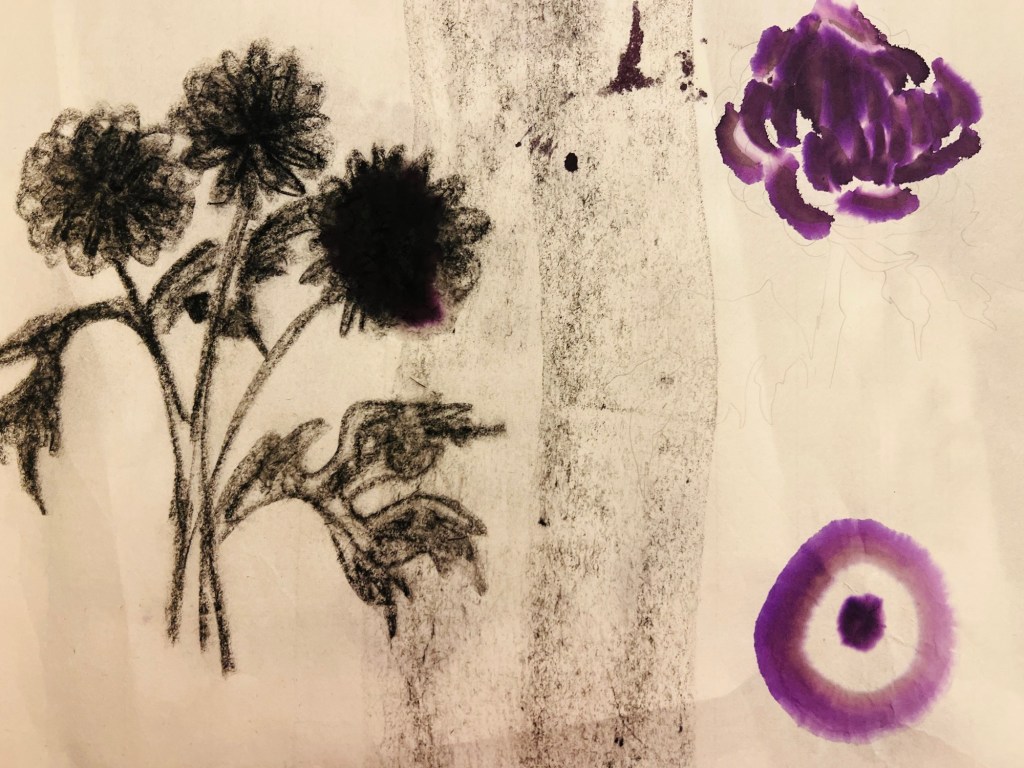
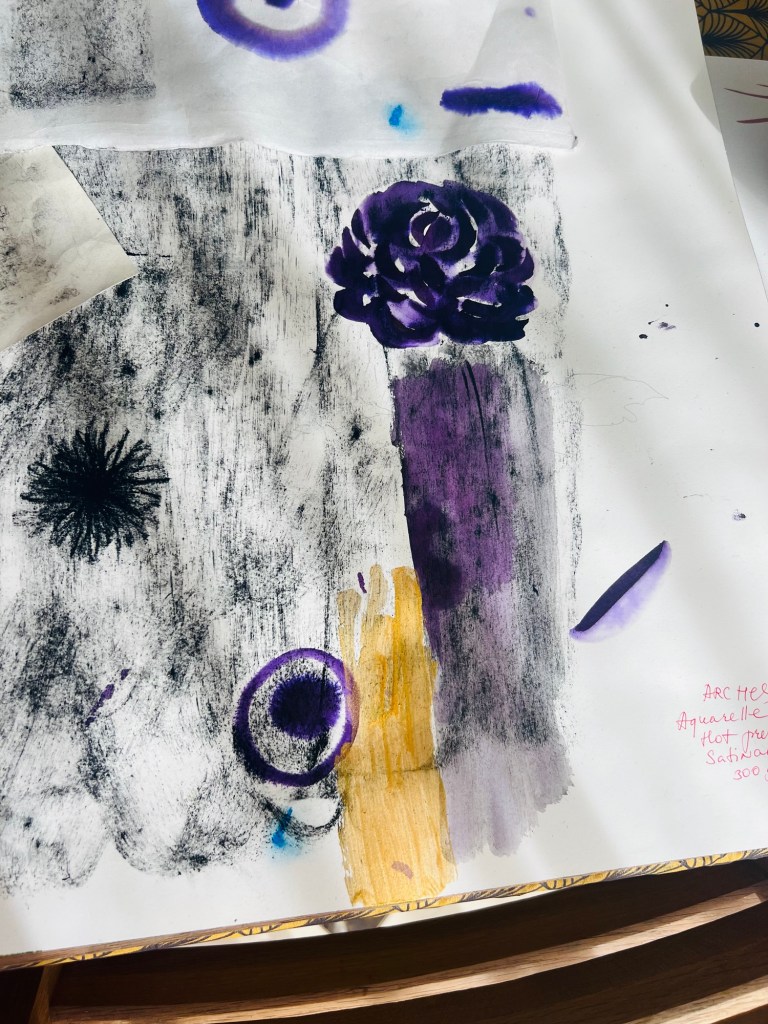
I am writing about my lasting practice of painting flowers. Below, I placed in historical sequence some development sketches, and the evolution of the flower as my subject is evident.
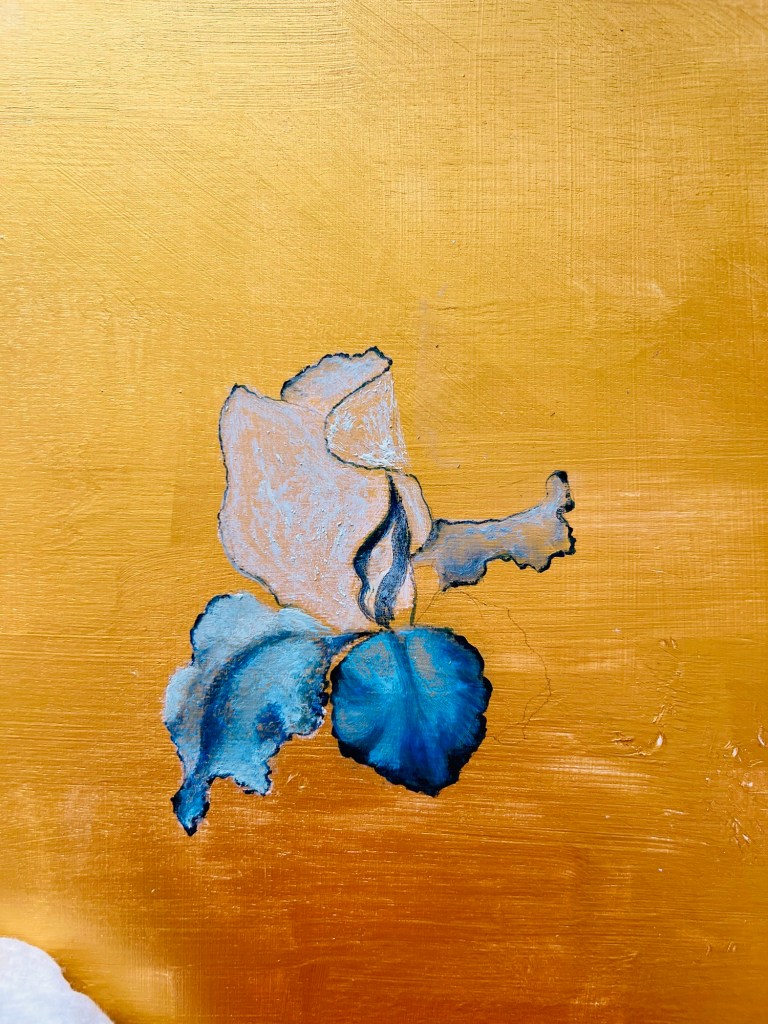
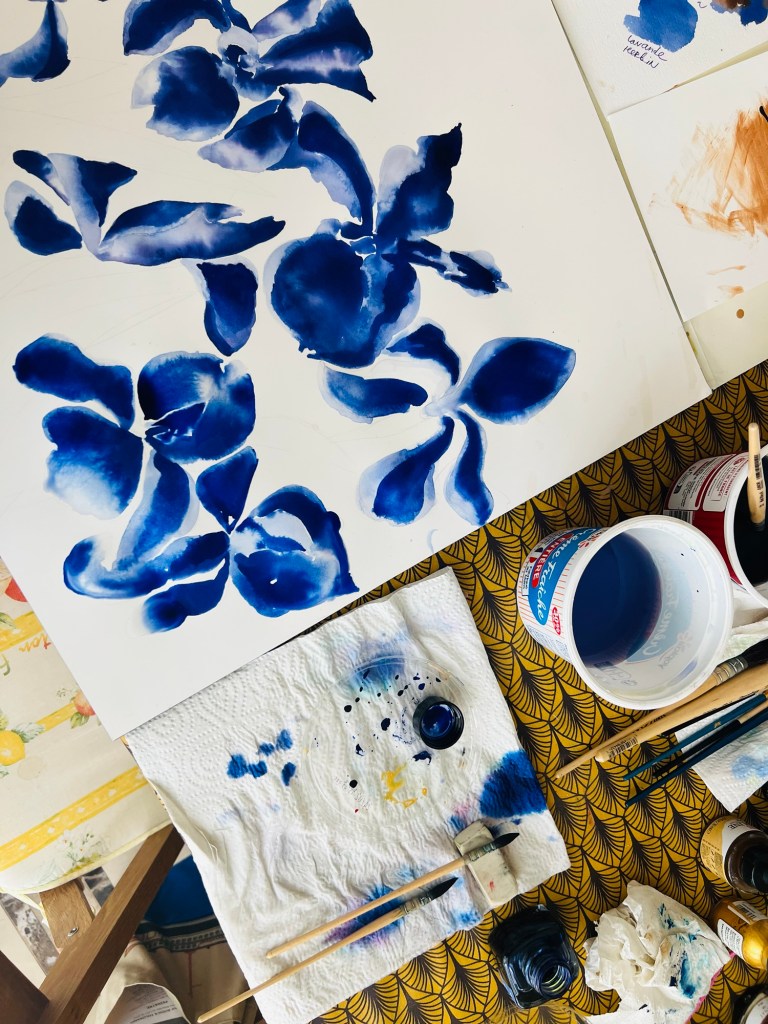
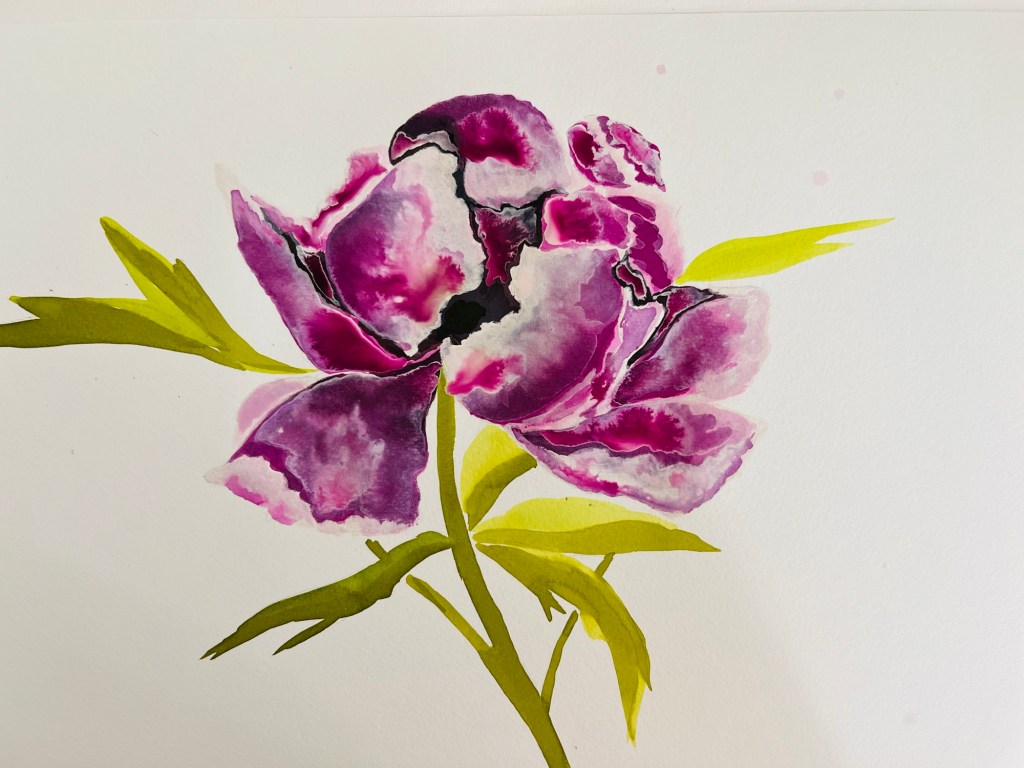
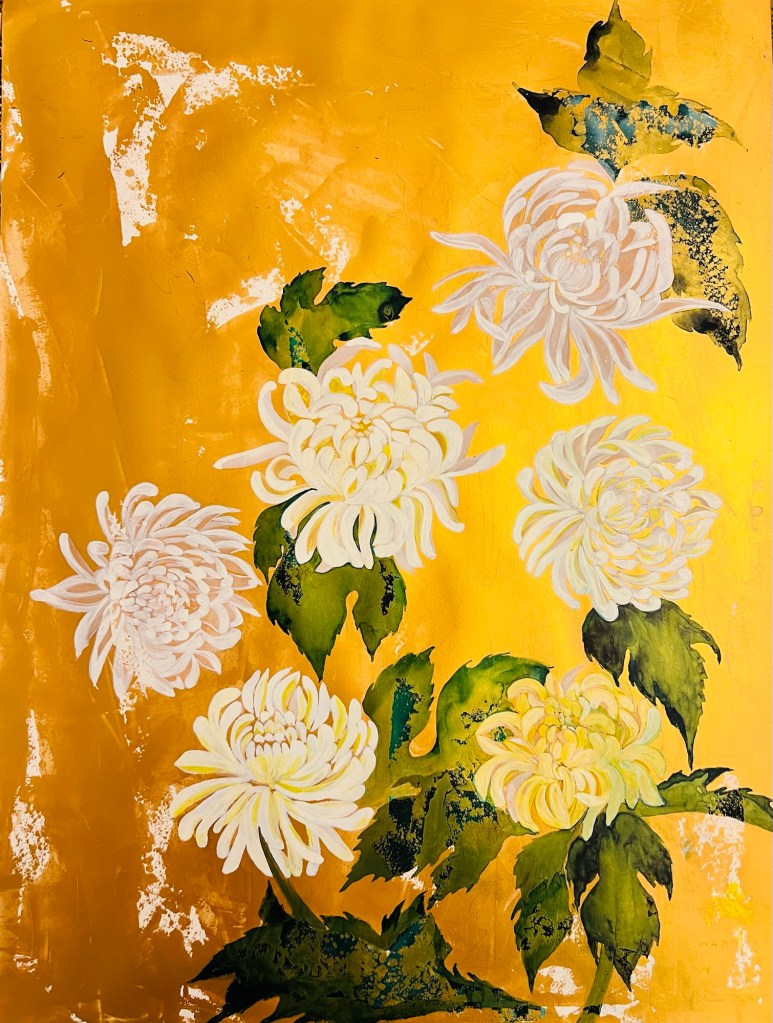
There were several critical moments in the development of my subject: the first was about what kind of flower I wanted to depict; the second was about inventing my technique to paint a flower. Naturally, I was fond of irises, chrysanthemums and peonies; roses or tulips did not attract me. So, I started to paint them with different mediums – oils, aquarelles and inks. The results were different. The critical point was my understanding that I should continue working on them with inks since this medium appealed to me in terms of how I manage it and the result I achieve with its spontaneity and fluidity, as well as with the ability to work in many transparent layers. Below, you can see the flowers I did in oils and inks. Unfortunately, oils are difficult for me. The flowers I painted in oil appeared as too heavy, not elegant, and chunky. From a technical point of view, I had several breakthrough moments when my flowers improved dramatically: shape, petals, and colours. I placed fragments of my journey below, sketching them and trying different media. The breakthrough moment is easy to notice: the irises made in inks on wood and paper and the white chrysanthemum flowers I did on a complex gold background. I placed my sketches and drawings in a historical sequence,
One of the factors influencing my decision to continue my trials with ink was my Critical writing assignment for my Personal Approach to Drawing course. I wrote about the classical Japanese painting traditions. I was deeply enchanted with the works of traditional Japanese artists – Kano Masanobu ( 1434-1530), Kano Motonobu (1476-1559), and later works of Ogata Kōrin ( 1658-1716), which are considered as an anticipation of Japanese modernism. The aesthetics of their paintings are so captivating, so I continue to explore them in my drawings, and this connection runs through my developmental sketches and works.
Below are some of my works to look back and observe the evolution of my technical skills and individual approach, the development of my artistic voice.











Another idea running through my work is an idea of spirituality and transcendentalism, which any human can explore and experience in a Lifetime on Earth. In my works, I think about the soul’s reincarnation, Divine Grace and the support humans receive throughout their life journey. These works are about symbolism, and I definitely tend to work in this genre: I paint symbolic images, using Sanskrit characters and flowers as Hinduism symbols, as well as hands, which are some of the most well-known symbols.


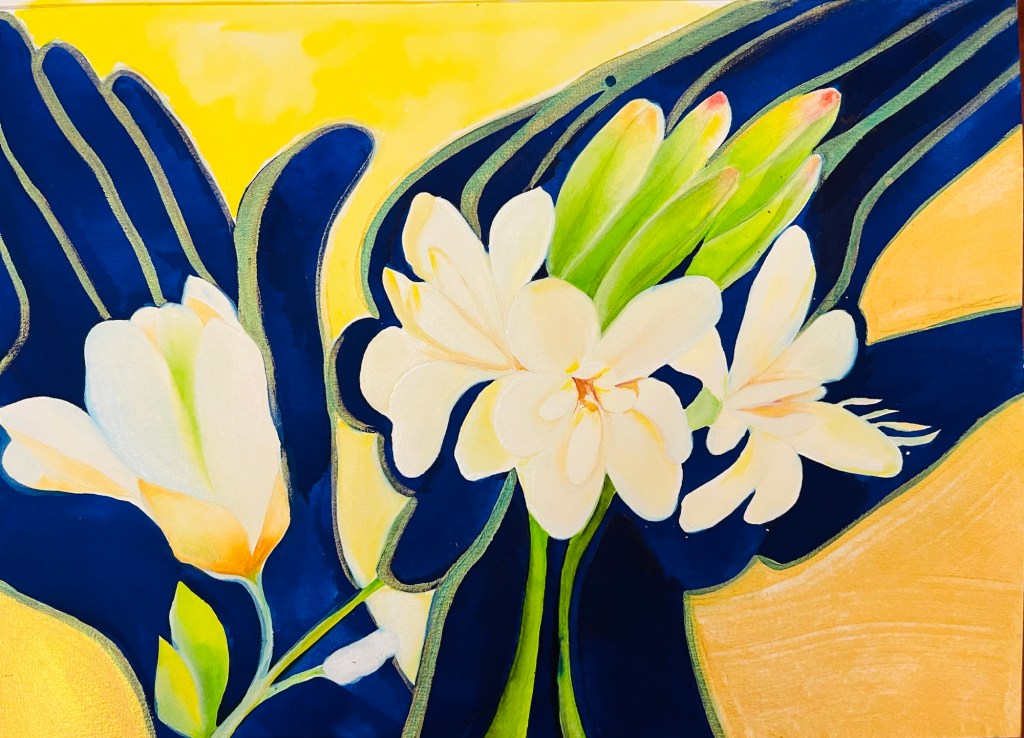
So far, I am producing artworks significantly influenced by traditional Japanese visual aesthetics in terms of the subject – flowers, trees, colours – the golden background and composition – floating items, and mediums – inks. However, my outcomes are quite different from traditional Japanese paintings, ironically because I don’t have such mastery but also because of my evolution as a visual artist. I have my artistic view and approach at a stage when I accumulate some knowledge to align my emotional vibration with an outcome on the surface.
The area to grow is incorporating more ideas about my spiritual life and my legacy as a Qazaq, representing a culture with rich decorative traditions and visual art in textile work. I am reflecting on my different ideas because I want my work to impact a viewer significantly, transforming the space and self-sense of the Audience. My fondness for cinematography and literature, my spiritual conscience, and my aspiration to achieve a highly aesthetic result on the surface drive me to storytelling. Thus, another dimension to grow is to start working on the surfaces on a large scale. I don’t want to paint my traumas, comparing them to a world where they are insignificant and little, I want to tell amazing stories to elevate someone’s spirit.
 JeanArt