Research point* William Kentridge
https://art21.org/watch/extended-play/william-kentridge-pain-sympathy-short/
I agree with the idea that a well-established research practice is essential for enriching your visual art outcome. Research helps to sharpen your intellectual and creative focus on the theme and subject while you work on your artwork. Any visual artist must go through this “simmering” or “brewing” period while accumulating the energy for their work: in general and in every little detail, which will be seen on the canvas and sensed while a viewer will gaze. After watching the recommended video of William Kentridge, I see the research practice is individual in terms of the source of interest and inspiration. In his video, he shares how observing other people’s pain influences the quality of his art, which is dedicated to social injustice issues in South Africa. He has witnessed apartheid times and earned his Bachelor’s degree in Politics and African studies at the University of Witwatersrand. I agree that you can not draw and paint someone’s suffering without observing other people’s pain, you can’t talk about it on your canvas if you don’t look at it closely. You have to come close, follow, and study in depth before you come up with how to channel your idea onto canvas.
That resonates with what I heard in the video from UCLA Professor Richard Walter, whose main idea about the quality of artwork (although he talks about movies, he extrapolates it to all forms of visual art, mentioning his visits to MOMA) is that a “Great art” must possess a “life-changing effect”, while there are lots of “bad, lousy art” – “boring art”. William Kentridge’s aspiration to show and channel pain equals an ambition to profoundly impact someone’s thinking or produce a life-changing effect. This direct and sincere opinion about the “boring art” of Richard Walter is quite insightful regarding the research any visual artist does. If you have an ambition to be noticed, you have to produce an interesting, dramatic, enchanting, thrilling, stimulating, thought-provoking outcome; you have to find a unique way to tell the story. It makes a lot of sense to check how the same story has been told so far by other people, and this is the research. I would continue Walter’s idea about “lousy” art and say that without research, there is a great risk of producing a lousy art- poorly thought out, unfinished, and dull.
Exercise 1.1: Approaches to Research
We are asked “to identify an artist whose work encompasses an interesting approach to research”.
Since I am developing a project, which will include a poetry piece, I decide to research on Edwin Parker (Cy) Twombly ( 1928- 2011) who often incorporated poetry into his abstract works.
Cy Twombly’s artistic research was often ( if not always) centralised about poetry. He once said : ” I like poets, because I can find a condensed phrase…. I always look for the phrase” ( “Cy Twombly:Poem Painter of Evanescence”, August 9, 2022). It was interesting to discover that Cy Twombly had an extensive, large and rich library as a part of his studio and often worked on his paintings with an opened book in front of him. As Mary Jacobus explains in her book “Reading Cy Twombly: Poetry in Paint” (Princeton University Press, 2016 ) : “…he never really separated painting and literature” . He also was interested in “astral transcendental geometry” and space. He had a broad literature interest and was especially fond of classical Greek poetry and philosophy, myth and allegory. Twombly used quotes of Theocritus, Ovid and Virgil, Horace, Catullus, also of Edmund Spenser, Ezra Pound, Rilke and many more. I want to bring some quotes from Mary Jacobus’ above mentioned book, because it exactly describes the artist’s working and research practice: ” The Twombly anthology permits unique insight into an artist’s thought process and working methods – the reading, brooding, and imagining that take place during the extended processes of pictorial composition” ( “Reading Cy Twombly”, p.3), “His books include handwritten mark- ups, rough notes, textual cuts, paint marks and illustrative doodles” ( “Reading Cy Twombly”, p. 2). The research Cy Twombly did with a poetry often was taking poems further, editing them and deleting parts of verses.
Bibliography: “Twombly and the Poets”, Gagosian Quaterly, Summer 2018 issue, online on http://www.gagosian.com [accessed on Feb 13, 2024]; ”Reading Cy Twombly: Poetry in Paint”, by Mary Jacobus, Princeton, Literature, online on http://www.press.princeton.edu [accessed on Feb 13, 2024]; “Cy Twombly 1028-2011”, Tate, online on http://www.tate.org.uk [accessed on Feb 12, 2024]; “Cy Twombly: Poem Painter of Evanescence”, August 9, 2022); Book Talk: Mary Jacob’s – Reading Cy Twombly: Poetry in Paint, Cornell university Library, Youtube, 2016 [accessed on Feb 13, 2024];
We are also asked to reflect on the following: “Connections or threads which run through your work”.
● Actions, processes and practices, questions, ideas, thinking, theories,
interests, knowledge and experience that you bring to bear on your work.
● Particular concerns or questions that you address or that you feel are
specific to your chosen specialism.
● How the interaction of disciplines (if you work across disciplines)
contributes to your working process.”
I know now that my artistic impulse originates from my sense of the world, which is deeply spiritual. I celebrate the existence of the world around me together with a Creator. I am not the one who wants to reflect on and channel their traumatic/uncomfortable/disturbing life experience on the canvas, even though I have some heavy ones. Among all my works, I have only one about my challenging life experience- my father’s depression; So far, I have done only two works directly addressing social and political issues. The rest is all about the vibration I sense observing the Creator’s creative power. For example, I paint lots of plants because I see them as one of the most sensual manifestations of the Creator’s aesthetics: I am deeply attracted by their colours, shapes, structure and versatility. Flowers are a pure, highly elevated positive Creator’s emotion, and I humbly try to pass a tiny fraction of it to my canvas.
The main idea behind my perception of the world, reflected in my artworks, is that God is a Persona. God has a personality, and we can have deep, intimate, direct contact with Him/Her. The works of Dr. Stephen Mayer about the scientific concept of Intelligent Design and an ancient text and philosophy of Bhagavadgita profoundly influenced me. These ideas interest me in Hindu and European iconography and Japanese traditional painting artworks and practice since there is a substantial spiritual component. I have yet to produce any iconographic artwork because I needed to sharpen my technical skills first. This kind of work is in my plans.
I am deeply enchanted with the works of traditional Japanese artists – Kano Masanobu ( 1434-1530), Kano Motonobu (1476-1559), and later works of Ogata Kōrin ( 1658-1716), which are considered as an anticipation of Japanese modernism. The aesthetics of their paintings are so captivating, so I continue to explore them in my drawings, and this connection runs through my developmental sketches and works.
I am thinking about installations where I could use Sanscrit mantras chanting and other music, human’s voice singing. I also think that I would love to collaborate in installations with other artists, because I like to work in a team and joint creativity might be super exciting and powerful. One of my aspirations is to work with a movie director Baz Luhrman, who is well known for his musical and highly creative movies ”Romeo and Juliette”, “Moulin Rouge”, “The Great Gatsby”, “Elvis” – all notable for their elaborate design ( a huge contribution of his wife, a professional designer Catherine Martinez) and musical soundtrack approach. I see myself more in cinematography and filmmaking rather than an artist for museums placing a silent numb installations. I am very fond of literature and texts, music and human voices.
Bibliography:
Film Courage, “Biggest Difference Between Bad Art and Great Art by UCLA Professor Richard Walter”, Youtube, 2016, [accessed on Jan 21, 2024]; William Kentridge (South African, b.1955), online on http://www.artnet.com; [accessed on Jan 19, 2024];
Another exercise we have to do is to make a SCOR chart based on a personal analysis: “This
method can also be used to analyse your work and is particularly useful when
you are selecting pieces to take forward for further development or looking at
several ideas for development”. p. 19, “Research”;
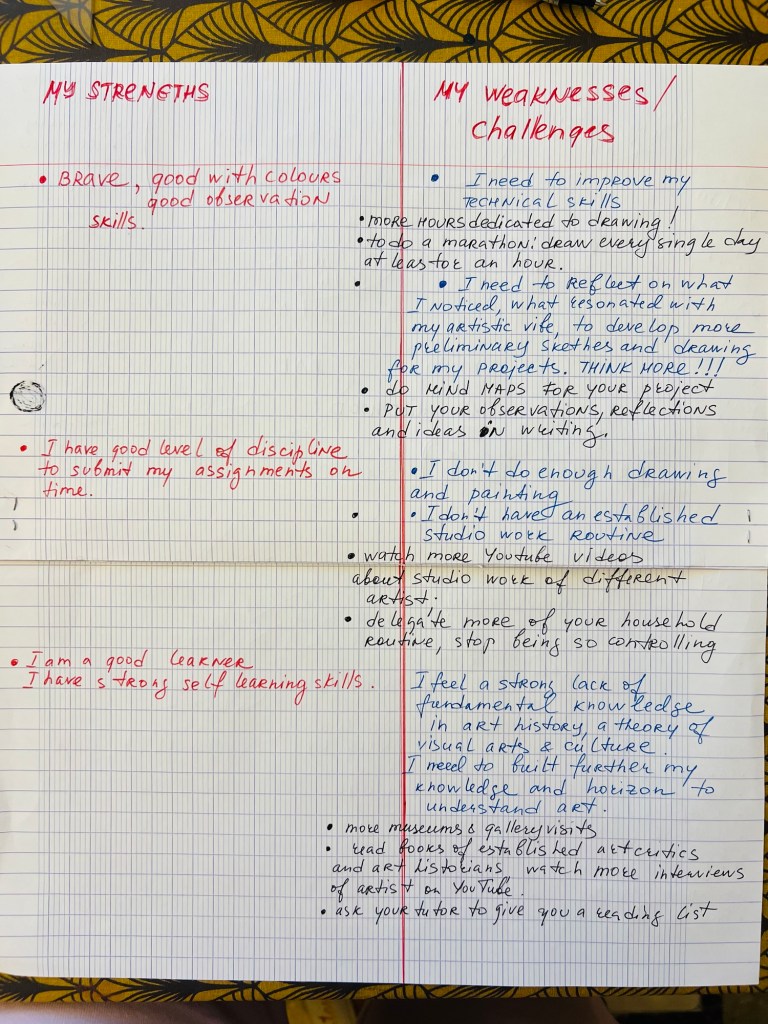
My Strength: I am brave. I work well with colours; I am not afraid of them, which allows me to create exciting and engaging decisions on the surface. I also like to work with mixed media and push myself out of my comfort zone by trying different styles and genres. My portfolio comprises different works.
My Challenge: I need to narrow my focus, research more specific topics, and practise particular styles and techniques. I tend to rush; my attention is often scattered. I wish to spend one year painting with oils or go to Japan for three years to study the Nihonga painting style.
My Strength: I am good with planning and preparations and stick to deadlines.
My Challenge: I still need to establish my working routine in my studio. I am disciplined with my studies but must dedicate more time to studio work, engaging with preliminary drawings and experimenting with media.
My Strength: I have good observational skills, so I always feel inspired because I am constantly overwhelmed by the beauty of the world around me. I never feel stuck as an artist;
My Challenge: I need to have more time to put my impressions into writing, drawing and sketching so I can reflect more on them as an artist. I tend to be overwhelmed and pass by without taking my inspiration further to detailed work.
My Strength: I grasp new ideas and concepts quickly. I have good clarity in my thinking; I am analytical and a good reader.
My Challenge: I need to read more about the theory of visual culture, visual art history, and philosophy; I lack fundamental knowledge in these fields.
Exercise 1.2: Flow of conciseness – approaching new challenges. We have to continue working on the personal SCOR analysis as follows: “
In your learning log write out a list of the words that come into your mind when
you think about approaching something new. Try not to think too deeply but
instead write quickly and directly, noting down the words as they come into your
mind. Consider the strengths and challenges in your list.” p. 20, “Research”.
When I approach her encounter with something new, I think about Growth, Opportunity, Freedom, Bright Light, Fresh, Exciting, Positive, Orange Colour;
Below you can find my SCOR chart, where I put in blank ink the ways I can mitigate/minimise my weaknesses and challenges.
Exercise 1.3. Mind Mapping.
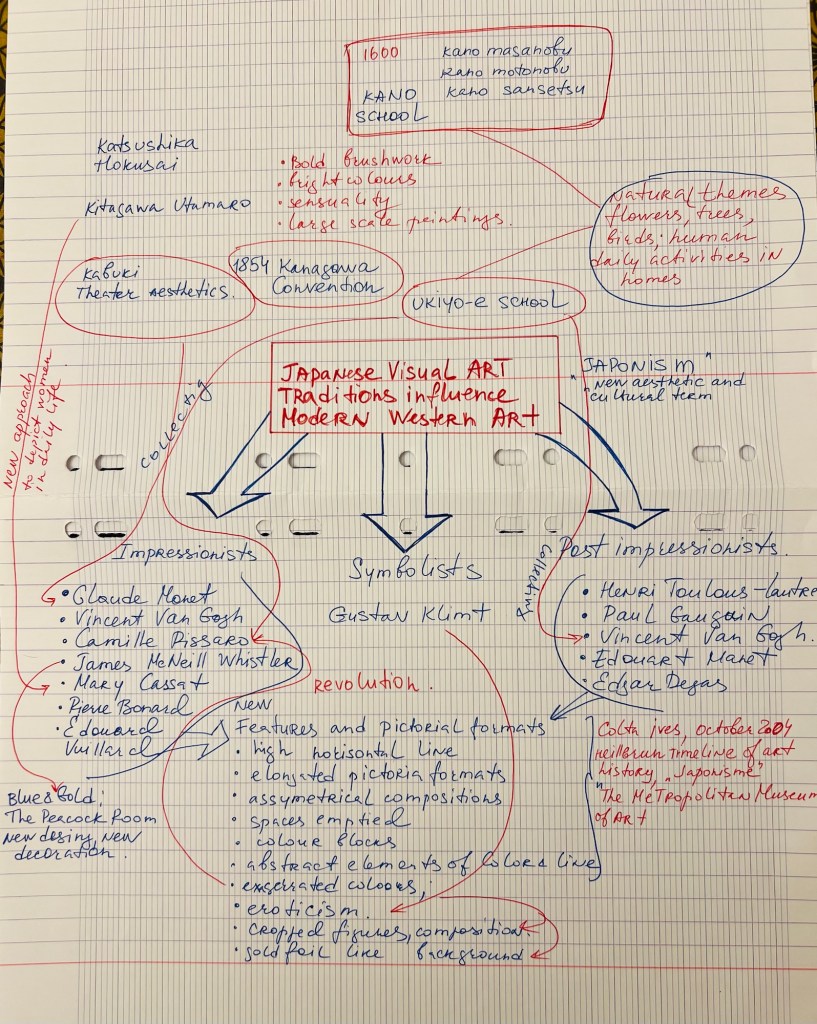
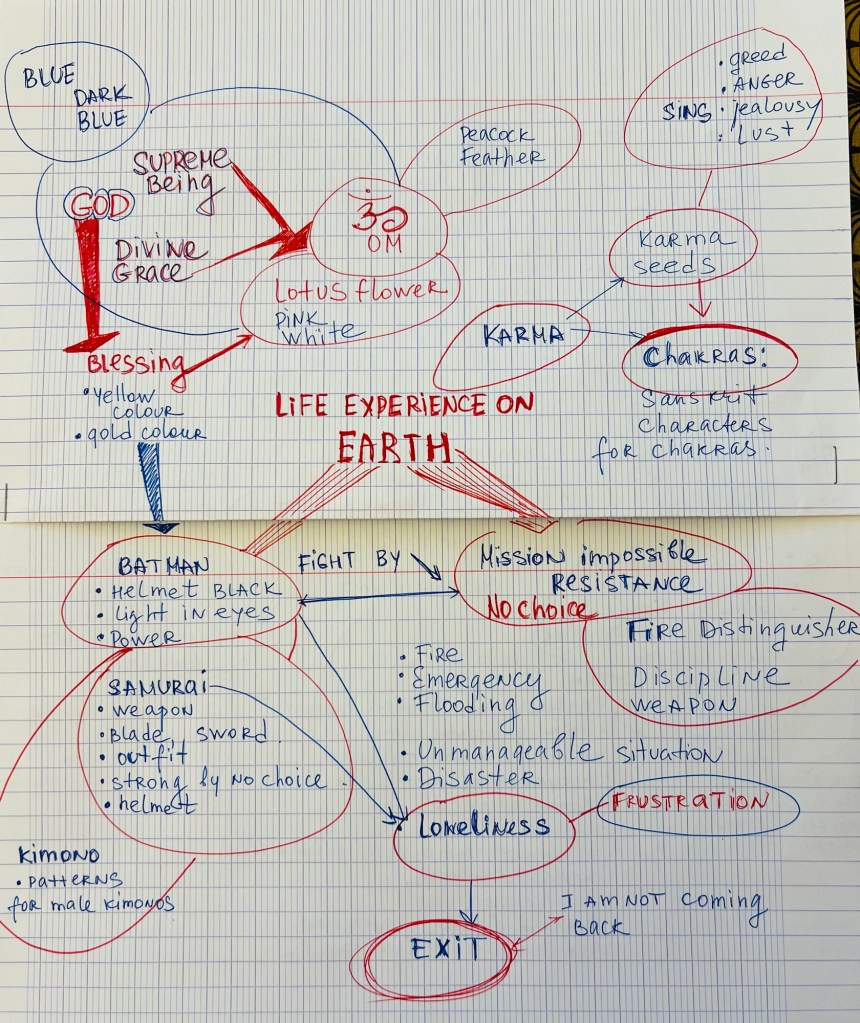
Below you can find the mind maps I did for some of my projects from my practice. One is about my critical writing piece I did “Japanese Visual Art influence Modern Western Art”. Another two are for my painting projects under development, is mind mapping appeared as a great toll to reflect on them in general and in details, working on unfolding new dimensions, which can be visually transferred on canvas/paper.
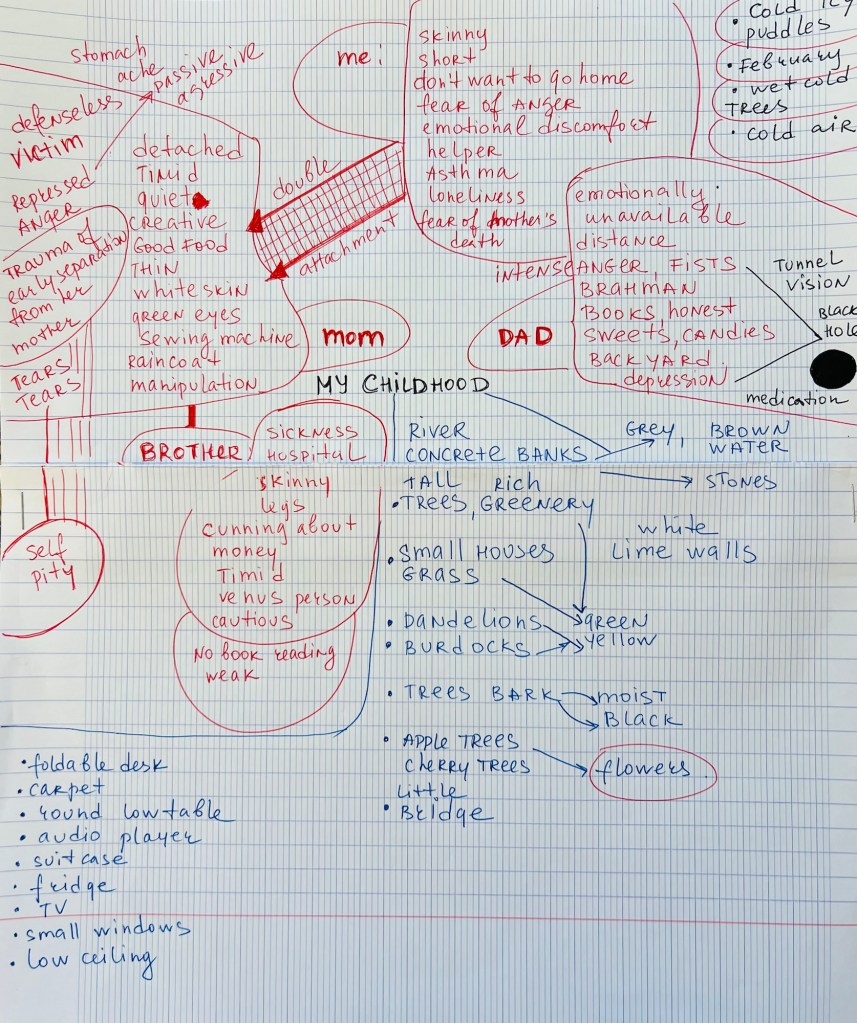
The Concept Map for a concept of depression from the “Childhood” mind map.
Bibliography: “Depression in Parents, Parenting and Children:Opportunities to improve Identification, Treatment and Prevention”, national Research Council (US) and Institute of Medicine (US) Committee on Depression, Parenting Practices, and the Healthy Development of Children; England MJ, Sim LJ, editors, Washington (DC), national Academies Press, 2009, online on http://www.ncbi.nil.nih.gov [accessed on Feb 10th, 2024];
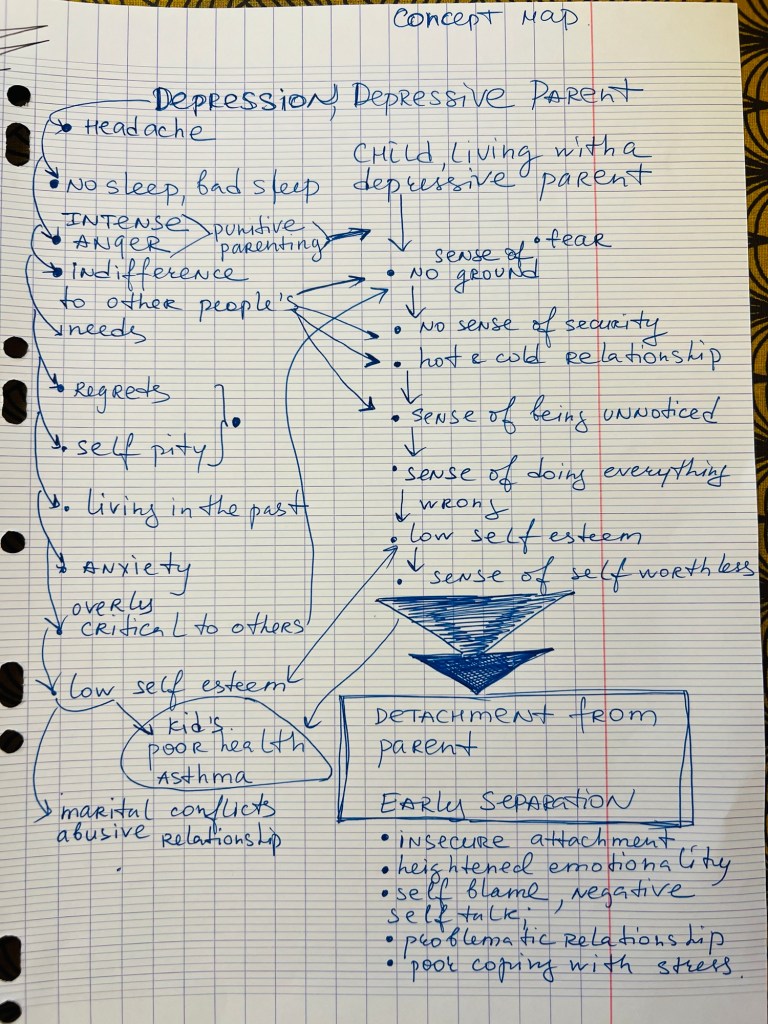
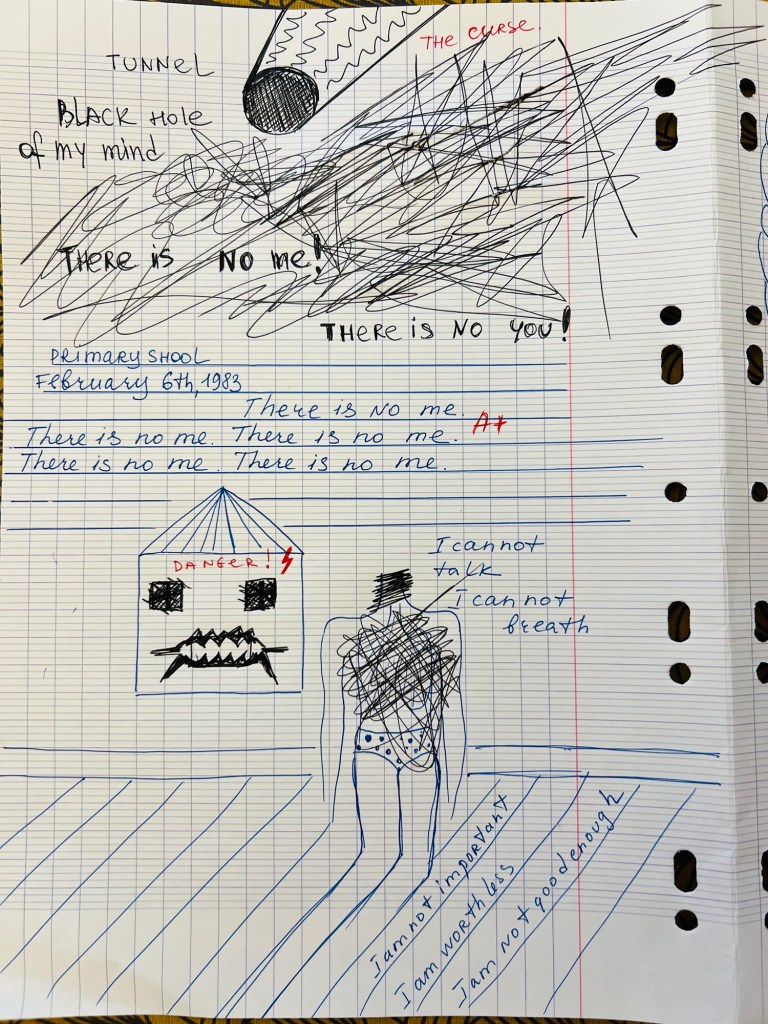
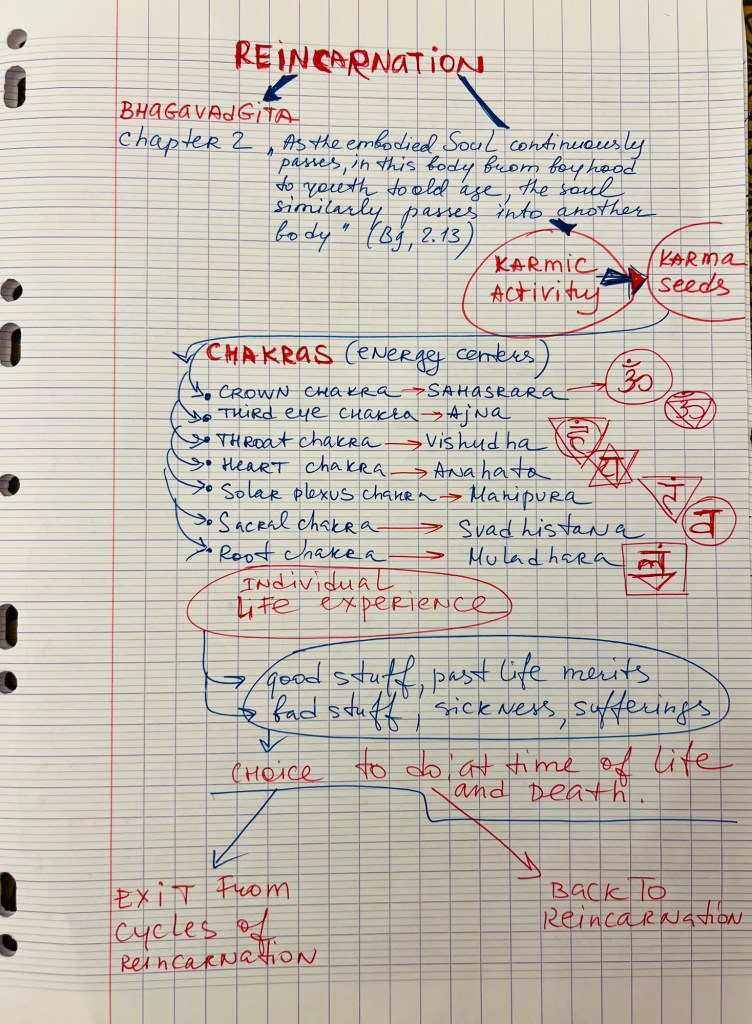
Reflection on Mind Maps and Concept Maps:
Since we were given the freedom to choose the theme for any map to develop, I should treat the outcomes and the topics I have been thinking about as my current creative interest, which subconsciously came to the surface of my thinking. I have analysed the themes of two projects – “My Childhood” and “Life Experience on Earth” with Mind Maps and the themes of “Depression” and “Reincarnation” with Concept maps. There was also a third Mind Map about my critical writing piece, but I will put it aside from this reflection since it was an academic exercise and academic interest. The other four were about my creative projects in progress.
The Mind map about my childhood times and the concept map about Depression is actually one theme; there is a lot of psychology in there. The same comes to my mind map for the “Life Experience” on Earth and the concept map about Reincarnation. The same theory of Reincarnation unites them and is explored from different angles, though having the same structure: Beginning/Arrival – Earth Experience – Exit from cycle /back to Reincarnation cycle, as well as overlapping in the notion of karma and karmic seeds. It is interesting to see that all maps contain information about feelings. In the map for the “Life Experience on Earth”, I develop the Earth experience into psychological states of warriors – the Batman and the Japanese Samurai. I emphasise the feeling of loneliness, which is also present in the concept map about Depression. These Mind Maps ( “The Life Experience on Earth” and “The Childhood”) can not be considered finished. Every branch there should be developed as a search of symbols and visual decisions for the surface of my painting. These mind maps help me understand where I have unfinished gaps and an absence of thinking about certain details; they also help me find a new way to develop the visual outcome. I caught myself in a loose meditative state ( while doing them) of deep immersion into reflection on the past and my memories, writing spontaneously my feelings, colours, and textures I still remember. These associations, memories and feelings are the driving force for the project. Ideally, they should be placed on the wall in the studio and must be completed and filled with photographs, sketches, and texts. They are a powerful tool for creativity and refining my research reflection on what I want to bring to the canvas.
 JeanArt