I had a wonderful trip to New York at the end of May, and visited eight Art Galleries in West Village and Soho areas. I wanted to see what kind of artists those galleries present, the artworks, to get acquainted and understand different artistic approaches, techniques, and what it takes in terms of final product as an artwork in all its details to be wanted and presented in NYC Art gallery. I was eager to see the sizes of the canvases, the mediums, the subjects and etc. Besides the fact that this gallery tour was just amazing, fantastic and super enjoyable, the main result of my visit was liberating, giving me even more hope and motivation to continue my BFA degree work. I see my perspective very clear again, and I strongly feel again that I am on the right path in my life, studying visual art. Below is the list of galleries I have visited.


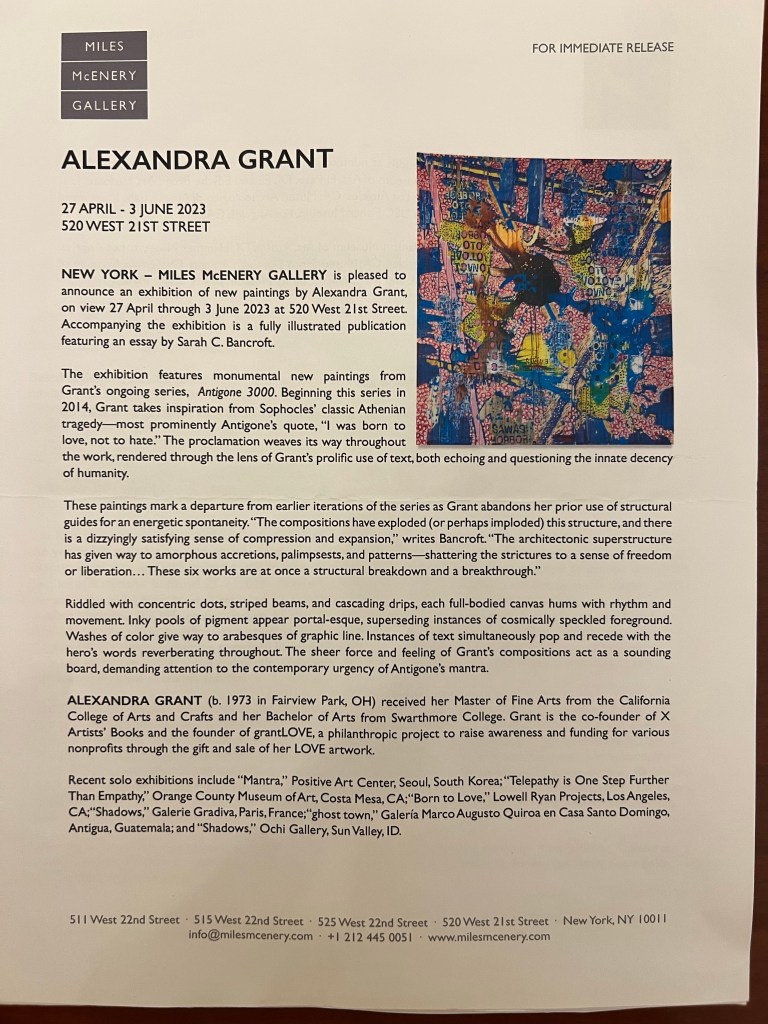

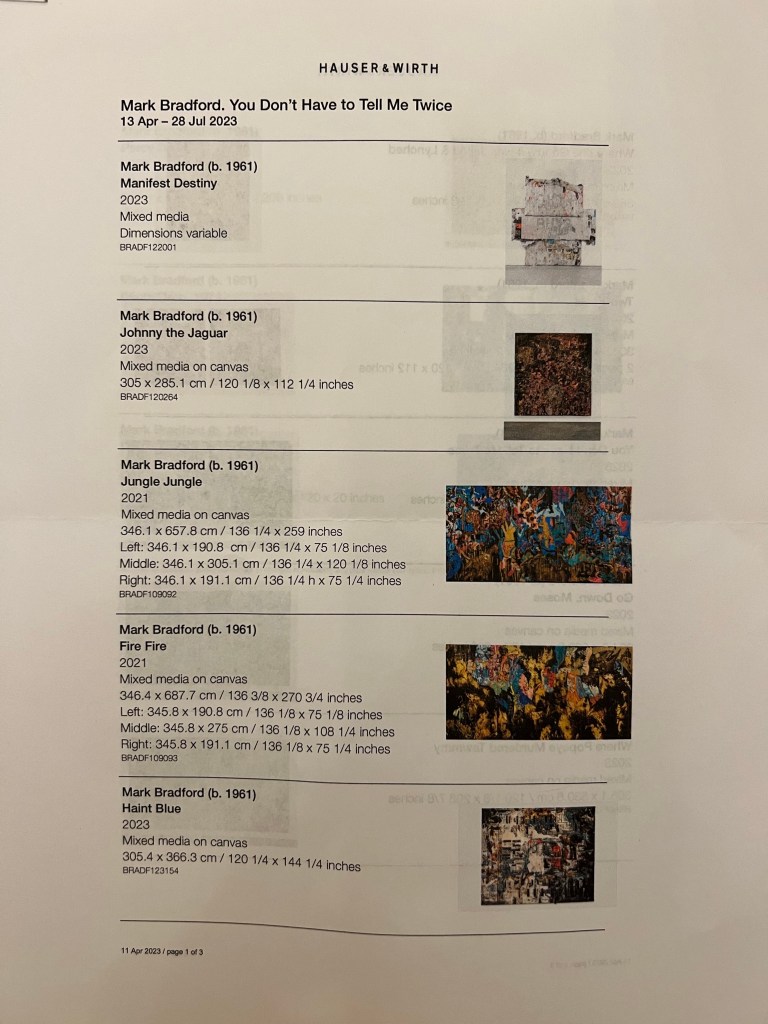

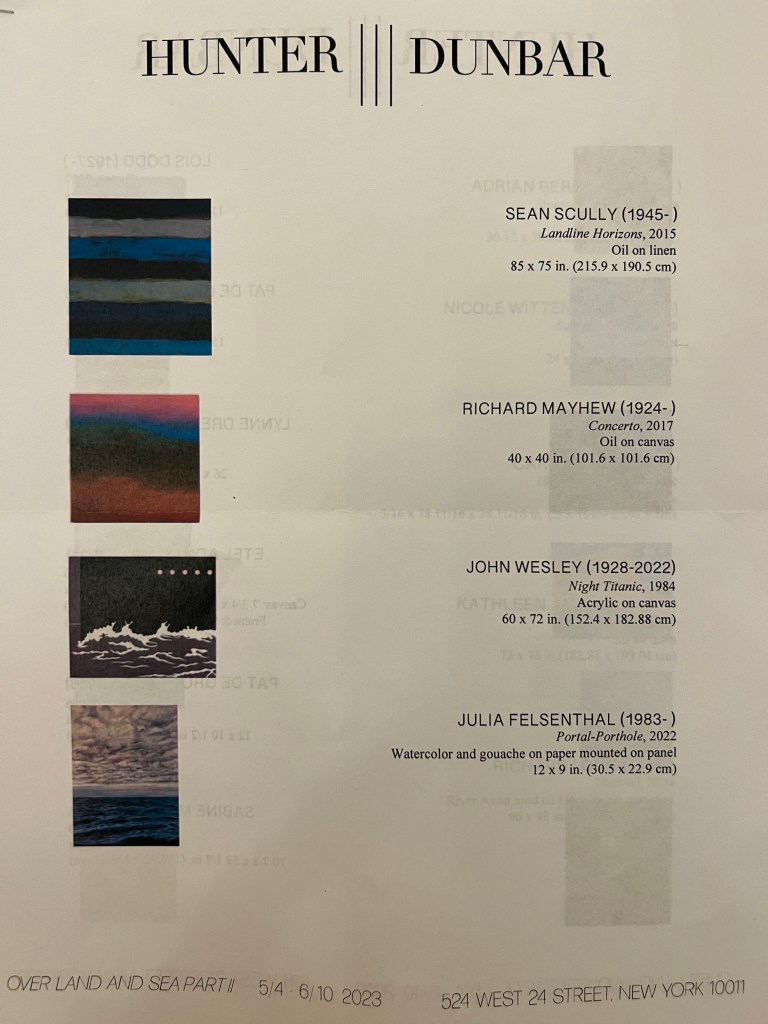
It was interesting to observe and note the following:
- 7 out of 8 Art Galleries were presenting solo exhibitions of one artist and one was presenting several artists.
- The variety of presented artists was very international, I looked up at artworks made by artists from all over the world: Poland, China, UK, Nigeria etc.
- Half of Galleries organised artistic debuts – presenting artworks of particular artists in NYC/ USA for the first time.
Below I place some artworks I liked, my research on artists who created them, and my reflection. This gallery tour happened while I was reading “How to Write about Contemporary Art” by Gilda Williams, 2014, Thames & Hudson Ltd; This made me read more carefully, with a new understanding, all the “evaluating” and “explaining texts” in galleries booklets and websites, as well as artists’ statements while I was doing my research and wrote my own short critical writing pieces as my reflection.
Mark Bradford (b.1961).
Mark Bradford is a contemporary visual African-American artist from Los Angeles known for his large-scale abstract, complex, textured artworks from different kinds of paper and everyday materials sourced at hardware stores. His projects have social engagements, exploring the vulnerability of marginalized communities with limited access to museums and other cultural institutions; they are about struggles of race, poverty, and AIDS. As a timid child, he was bullied at school, beginning his early career as a hairstylist working in his mother’s hair salon. He started to take his first art classes when he was almost thirty, winning a scholarship to the California Institute of Arts and eventually obtaining a BFA and MFA degrees.
My reflection: Mark Bradford’s artistic approach toward the mediums for his artworks: all kinds of paper, maps, billboards, movie posters, comic books, “merchant posters”, pieces of wood, and hairdresser’s paper and bobby pins, remind me of Jean Michel Basquiat (1960-1988). His artworks look as containing lots of small details requiring hours of work. I usually look up at any artwork very closely, and it is evident that he doesn’t limit himself to a brush and pencil. Still, he actively engages in physical work with his hands – tearing, twisting, sanding, bleaching, and glueing the materials he will place on the canvas; he says he is “grappling” while creating. His massive artwork “Deep Blue” (2018), which is on display in the Broad Museum, is based on the map of LA, representing the city’s grid with large mounds of paint and paper, signifying Watts Rebellion’s violence and destruction that happened in 1967. Mark explains in his interview with Anderson Cooper, who documented the “Deep Blue” (2018) creation process, that he (Mark) brings together the event’s history, the city map and his imagination. The artist covered the city map he created with different materials, glued them on it, and then sanded the surface, ripping off some fragments. He describes this process as an “archaeological digging”, asking himself – what he was digging for.
Mark Bradford’s artworks attract me primarily by his technique, which I have never tried. Probably, because I am still in the traditional painting and drawing paradigm, while he is entirely out of it: he doesn’t work as a traditionally educated artist, focused on technical drawing/painting skills to create a magic light or skin colour or clear linear perspective or great shadowing. Mark Bradford’s art is not about these things at all because his technique determines a different outcome on the surface. However, even though his artworks are the result of his “grappling” with the mediums – tearing, squashing, sanding, glueing, ripping off- they come in the end elegant and sophisticated. Below I put two of his artworks I found in the Houser & Writh Gallery, NYC.
Jungle Jungle, Mark Bradford, 2021, mixed media on canvas, 346.1*657.8 cm, image via Hauser & Wirth Art Gallery artist presentation print out booklet; @ Hauser & Wirth; https://www.hauserwirth.com/artists/2838-mark-bradford/
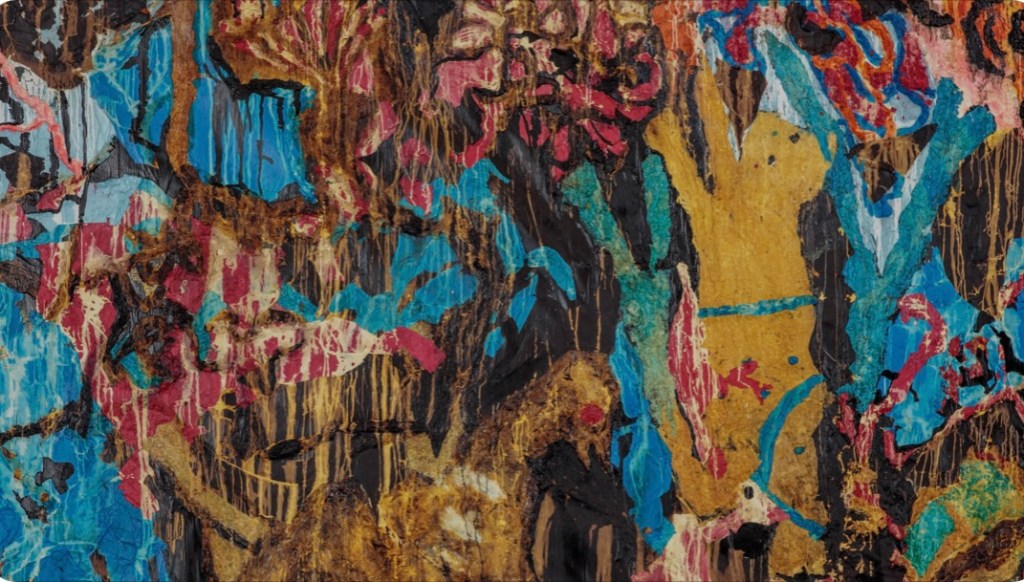
Fire Fire, Mark Bradford, 2021, mixed media on canvas, 346.4*687.7 cm, image via Hauser &Wirth Art Gallery artists presentation print out booklet; @ Hauser & Wirth;
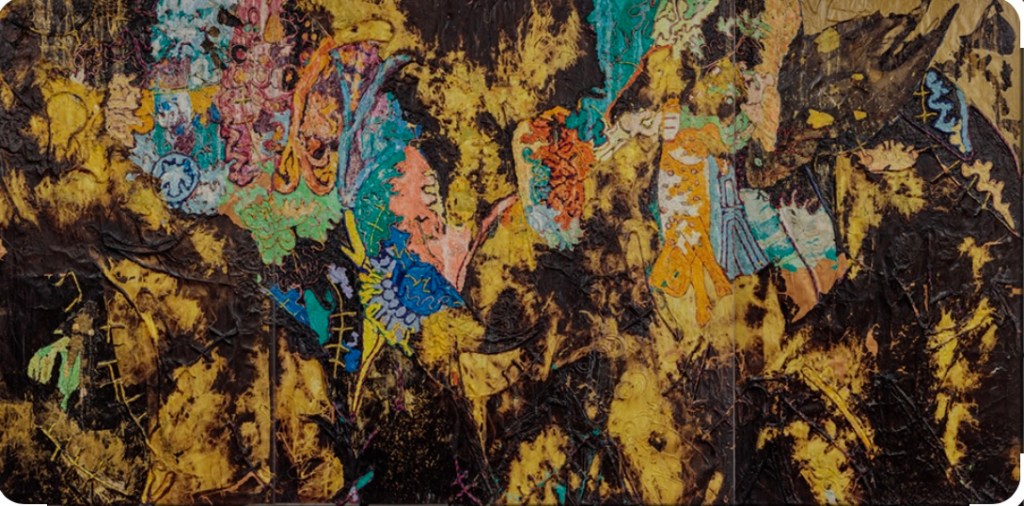
Alexandra Grant ( b.1973).
Alexandra Grant is a Los Angeles-based contemporary visual artist who explores the power of text and language in various media. She often collaborates with other artists and writers, incorporating specific texts into her paintings. Her artistic style is also influenced by her childhood spent in Mexico, France and Spain. She uses the mediums such as inks, acrylic inks and paints, wax rubbing, pencils, mounting papers on fabric, and making collages. At the Miles McEnery Gallery NYC, Alexandra Grant exhibited monumental paintings from her ongoing series Antigone 3000, beginning in 2014. She was inspired by Sophocles’ classic Athenian tragedy, by a most famous quote, “I was born to love not to hate”. The viewer can read it throughout the paintings.
My reflection:Even though this artist gets inspired by ideas in texts: words, and quotes, placing them on the surface of her canvases, you need to figure out and read what is written, make an effort to read the words. Initially, when I entered the viewing room, I instantly resonated with her artworks mostly for their fresh and vibrant colours and rich patterns, reminding me my favourite Gustav Klimt (1862-1918). She transforms the energy of words and sayings, ideas, articulated in texts, into colourful vibrations of inks and paints. I was pleased to see how she exploits and loves inks, feeling very free with colours as much as I do. That made me feel more confident as a visual artist; often, I feel intimidated by artworks with monochrome or limited colour palettes. Alexandra Grant’s paintings, rich in diverse, complex patterns, remind me of images of deep distant Cosmos, which we can sometimes see while watching the news about the Hubble telescope on TV. I looked at her works on her Instagram account @alexandragrantstudio; they all look very cosmic, especially because she is abstract in her inspiration: she doesn’t emphasize any pain from any material Earthy conflict, such as social unrest, for example, or war or social injustice. Instead, she celebrates the vibration from the word “love” as an elevated level of our existence. I see unfolding multiverses, dying galaxies, and stars to be born. The “chaos” she creates on her canvases is musical and poetic – this is what I see and feel in her paintings. Below are some of her artworks.
Parallax, Alexandra Grant, 2023, Acrylic, acrylic ink, coloured pencil and silk screen on canvas, 228.6*203.2 cm, image via http://www.milesmcenery.com; https://www.milesmcenery.com/exhibitions/alexandra-grant

Twilight, Alexandra Grant, 2023, Acrylic, acrylic ink, coloured pencil and silk screen on canvas, 228.6*203.2 cm, image via http://www.milesmcenery.com;

Liu Xiadong (b.1963)
Liu Xiaodong is a leading Chinese contemporary visual artist working in Neo-Realism and creating large-scale figurative drawing paintings. He depicts modern China’s people and ordinary life scenes, exploring themes of population displacement, migration, environmental crisis and economic hardship and struggle. Liu Xiaodong received his formal training in visual arts at the Central Academy of Fine Arts, getting BFA and MFA degrees, where he now holds the position of professor. He also studied at the Academy of Fine Arts, University Complutense, Madrid, Spain. His artworks have been well exhibited internationally. Loose brushstrokes characterize Liu Xiaodong’s style.
My reflection. I’m not fond of figurative painting in terms of following it by myself. It happens because drawing human figures is highly complex for me. Another reason is I don’t get inspired by human bodies as much as with flowers:). The maximum I can do so far is a portrait. Thus when I entered the Lisson gallery in NYC, bumping into Liu Xiadong’s huge canvases depicting a group of young men in Gucci outfits was scary. My first thought was: “I don’t like it”, but that was a thought pushed out with a firm overwhelming delight and admiration for the artist’s sense of modern China and the artistic talent to channel it. Luckily, he has an account on Instagram where he uploads his works, preliminary sketches and close-ups of his final results, where you can see very loose, free, thick and robust brushstrokes. This technique differs greatly from mine because I work with small, precise brushstrokes. I am still getting ready for large-scale canvases because I lack technical skills- I clearly understand my limitations. From what he shared on his Instagram account, I understood that he doesn’t work much on preliminary sketches for details like patterns on the figure’s cloth or fragments of grass, skies, trees, or buildings. His preliminary sketches are predominantly about composition and elements of human figures he plans to paint in the final artwork. It was amusing and curious to see photos of his work in progress, where he stands in front of a vast canvas (300*400 cm!), sketching a group of 7 people posing for him. There are a lot of photos like this. In this sense, he works as a film director – setting up a whole scene: he picks up the location, brings people he needs and arranges them as seated or standing or mixed. Thus he often creates large-scale artworks not in the studio but under open skies, painting the local landscape or in particular locations he gets inspired with.The way he places figures in his compositions on the canvas and the tension arising from these placements reminded me of Van Gogh’s painting “The Potato Eaters” ( 1885). Liu Xiaodong is an absolute master of showing a scene – a group of interacting, engaging in conversation or socialising humans: it is addictive to stare at every figure in the painting to decipher the conversation or reason of the gathering on the canvas. I admire his ability to compress such a complex phenomenon of human existence which is a conversation, into the square of cotton fabric on a wooden frame. His artworks usually contain many characters engaged in active social interaction, which makes any picture – a photograph or a painting – complex by its nature. He adds his intense and bold painting style to the genuine complexity and tension of human interaction as an evitable part of our existence, making his art outstanding.
Shaanbei, Liu Xiaodong, oil and acrylics on canvas, 2021, image via http://www.lissongallery.com; These works as many others from Shaanbei project can be viewed via this link to Lisson Gallery viewing room: https://www.lissongallery.com/exhibitions/liu-xiaodong-shaanbei-664e0bad-ce52-460c-92b1-3f38ab4c5664


Szawel Plociennik (1987-)
Szawel Plociennik is a Polish visual artist who sources his inspiration from Polish culture: mythology, fairy tales, and his childhood memories and emotions. He received his formal training in visual arts at the Faculty of Painting at the Academy of Fine Arts, Warsaw. Szawel Plociennik is also known as an author of essays and short stories.
My Reflection: I was charmed by this artist’s paintings because of their escapist and mysterious atmosphere. He depicts imaginary mythological characters on canvases of different scales, some of them 195*502 cm. I resonate with his painting style regarding mythology as a source of inspiration and the atmosphere he creates with deep colours.
From left to right: Mamuna III, Szawel Plociennik, 2022, acrylic on canvas, image via http://www.annazorina.gallery; Persona 333, Szawel Plociennik, acrylic on canvas; image via http://www.annazorina.gallery; https://www.annazorinagallery.com/artists/szawel-plociennik


Bibliography: Alexandra Grant, online on http://www.alexandragrant.com [accessed on may 23, 2023]; @Alexandragrantsudio, Instagram; @liuxiaodongstudio, Instagram; Mark Bradford, online on http://www.hauserandwirth.com [accessed on May 23, 2023]; Mark Bradford, online on http://www.artnet.com [accessed on May 23, 2023]; “Art on 60 Minutes”, interview of Mark Bradford to Anderson Cooper, Dec 27, 2021, online, Youtube, [Accessed on May 24, 2023]; Liu Xiadong, Artists, Lisson Gallery, online on http://www.lissongallery.com [accessed on May 23, 2023], Liu Xiadong (Chinese, b.1963), online http://www.artnet.com [accessed on May 23, 2023]; Liu Xiandong, online on http://www.lissongallery.com [accessed on May 23, 2023]; Szawel Plociennik, online http://www.annazorinagallery.com [accessed on May 23, 2023]; Mark Bradford, online on http://www.houserwrith.com [accessed May 23, 2023]; Szawel Plociennik, Anna Zorina Gallery, online on http://www.annazorinagallery.com; [accessed on may 25th 2023]; @Szawel.plociennik, Instagram;
 JeanArt