Project 1: Viewing from above
Research Task: Tiffany Chung
Bibliography: “The Art of Mapping”, Katharine Harmon, TAG Fine Arts, 14-26 November, 2011, The Air gallery, London UK, online on http://www.tagfinearts.com [accessed on April 19th 2023];
Exercise 1: Bird’s Eye View. In this exercise we have to make different bird’s eye view drawings of the following subjects: the country we live, the childhood places, bedroom, a room we are working on this assignment. We have veto reflect on: 1) our thoughts and feelings while makings these drawings; 2) how we can develop this drawing approach in future;

The birds eye view sketches I produced for this exercise and my reflection on them.
It was interesting to note that the sketches came out as very different. The sketches of the rooms – my teenage bedroom and the room I was working on my studies appeared very different from the other two sketches – the places of my childhood, where I depicted the street I used to live on and that was my playground as well, including my walk to school when I was ten years old. Another point is that the childhood time drawings were more exciting and engaging for me, bringing lots of sentimental moments of distant memories. So not a surprise they come out quite vibrant and more visually interesting. My street was very green, with many tall, leafy trees covering the small street we played on under their crowns. We also had s small river in front of our houses, so I had to cross a little wooden bridge every day twice to go and come back from my school. So it was an effortless sweet flow for me to depict the bird’s eye view of my childhood time location.


The sketches observed altogether in different combinations.


I decided to concentrate on my childhood time sketches – below- to look for potential to use/ develop then further, because my memories/emotions felt as a powerful driving force to work on these theme further.
Any Art is emotionally charged. The emotion behind the art object determines its power to a large extent. The medium I used for these drawings – the oil pastels – worked wonderfully on textured paper, creating lots of shades, hues, and appropriate colour transitions. The greenery looks abundant, exactly how I felt as a kid, the roads and pathways look as earthy and natural as they used to be. These sketches remind me of the Japanese multiplication drawing style, a little of Miyazaki movies. As for their development, I think I can connect it with my previous drawing I did about my childhood, depicting myself and my father. I can make some elements of that future painting work oil pastels and some elements- figures, faces, flowers, which will require more precision, I will do brushes and oils. The sketch which connects my childhood memories with those I made for this exercise is below. I placed it under collage trials of two birds eye view sketches for this exercise.


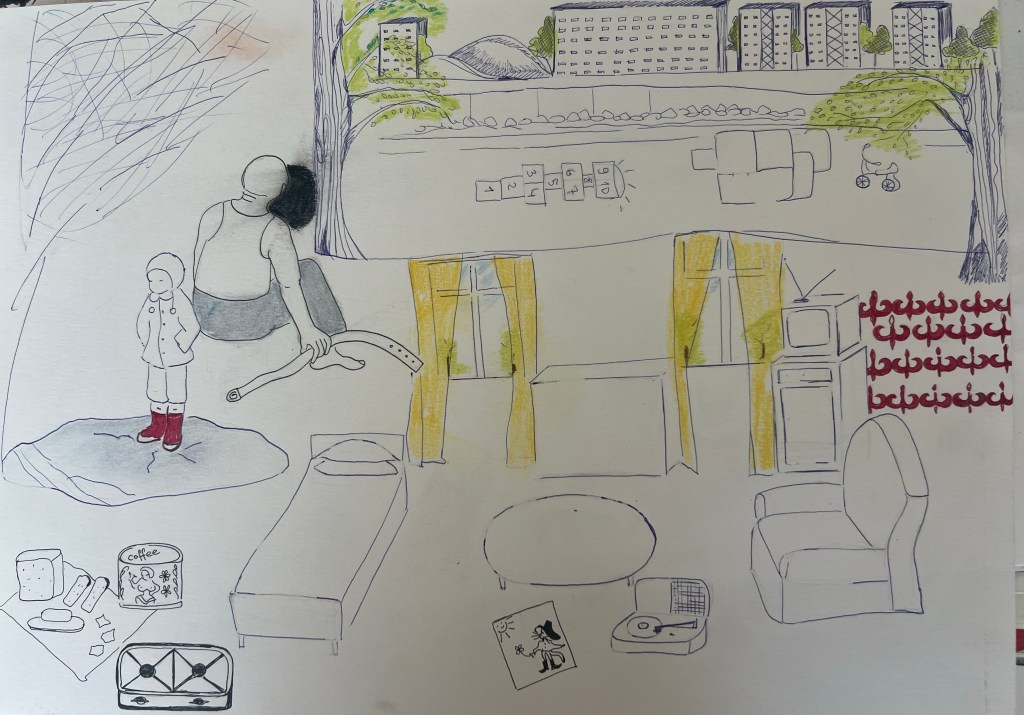
I pulled out from my work archive the sketch above and reflected on it again as a perspective for developing the birds eye view sketches I did for this exercise. It was a good moment and chance to look at it critically, it was 6-7 months I didn’t have it in front of my eyes, so I looked up at it again, checking now how do I feel about decisions I made a while ago. It was interesting to observe my feeling that I did the composition right: I placed the girl and her father as they turned their backs to each other, because the girl was neglected and lonely. That was right decision. The room is under the road, the road and outside space puts a pressure on the constraint living space. The outside space was the same space I recalled for this exercise( you can see a road, the tres and the river)- so I can work in it, taking into account what I did for the exercise. May be I will rearrange it, bringing the bridge and emphasise more the river and the trees. I am not sure yet how to develop the space on the sides- this is what I have to think about. One idea is to enlarge the outside area to show the place I lived in, and when the depression of my father hit me most.
 JeanArt