Research Task: Dryden Goodwin
Dryden Goodwin (1971-) is a British contemporary visual artist who created an array of different visual art projects, incorporating drawings, photography, live action videos and soundtracks. He is very well known with his project “Breath 2022”, which is well described on his website http://www.drydengoodwin.com: “‘Breathe:2022’ produced by Invisible Dust, commissioned for Lewisham – London Borough of Culture, is a multi-part, multi-site public artwork combining over 1,000 drawings from May-Dec 2022 appearing as large-scale still and moving digital and printed posters, shown close to the heavily polluted South Circular Road in Lewisham, on Euston Road, and across London and parts of the UK, culminated in a large projected animation on Lewisham old town hall; ‘Held’ & ‘Sensed’, multi-part installation commissioned for the central atrium of the new Grafton Building, University College London Hospital (UCLH) 2021”. The “Breath 2022” project is presented as animated 12 seconds digital posters, installed for showing in different places – over 200 roadsides, train stations hoardings across London and the UK.
We have to reflect on the following questions: 1) what are your thoughts on drawings relevance to the digital age? 2) Do you feel that in terms of the reportage the traditional discipline of drawing has an important place? 3) are there artists you admire working with reportage as an integral part of their practice?
In his Instagram profile, I watched his film about his creative process of “Held” (triptych I, II) and “Sensed” (6 watercolour studies), his motivation behind these two works and his personal connection with leukaemia. These artworks are permanently installed as large-scale banners in the main atrium of University College Hospital London, New Grafton building. He studied the relationship of human interaction “in the heart of haematology”. The banners are held floating in space as a reflection of his idea of the great uncertainty people experience in this place. The “sensed” examines the interaction between people and human interconnection in the particular moment of being held at this place of treatment and fatal disease. I liked how he explained the aquarelle as a medium for this project. He needed to express a lot of tiny strokes, which reflect the psychological condition of patients at the haematology department: they are very attentive to the treatment details, and life comes for them as much more detailed experience in everything – from the hospital treatment to inter-human interaction.
When someone puts in a conflict between the drawing and the digital image – it is the same discussion about whether all those artists who draw and paint in traditional methods ( paints, brushes, canvases, etc.) will vanish soon, being substituted by the Artificial Intelligence, which can generate complex images in seconds. The answer requires reflection on: do we all need photographs only? Is the artwork all about the image idea and nothing else? How about the unique human’s craftsmanship and human’s personal story, the humane personal narrative the viewer connects with while gazing at the painting? Do we all prefer to interact with the Artificial Intelligence and exclude humans from our interactions?
I am convinced that the drawing is in absolute harmony with the digital age. Turning pictures into animated videos using digital technology is a new space for visual art with great potential for every artist. I see no contradiction between traditional hand drawing as a genre and the digital age, digital technology. Drawing is an essential, primary factor, a basic tool, underlying any type of visual art, including digital art. My answer is that the AI operates only within that scope of data which has been uploaded/ created by human. It can perform well, it can outperform an average human, but it doesn’t create as a human, including a simple fact as it doesn’t have good hands and emotions.
Regarding reportage, for the last 50 years, reportage technology has shifted to camera work for the news industry – photography and TV. The drawing as a reportage tool is left only for closed legal/judiciary cases in courtrooms and visual art as a genre. However, even though today we are much more used to and fed by camera reportage on our digital screens, drawing still has an important place because humans need art. TV news reportage is a different product compared to drawings. TV reportage is never still, while the picture/drawing/photo is a moment of stillness that produces a fundamentally different effect on human consciousness with different outcomes.
Stella Tooth, an award-winning artist and drawing tutor at the National Portrait Gallery, gives a good review on reportage artists in her blog article at http://www.skykarkgalleries.com.
Contextual research on reportage.
Sir Staley Spencer (1891-1959)
Sir Stanley Spencer was a British painter. He received his formal training in visual arts at Slate School of Art. His artworks depict Biblical scenes, as well as First and Second World War reportage drawings, such as great murals for the Sandham Memorial Church and ship-building in port Glasgow. Below I put some of his works I resonate with.
I resonate with Stanley Spencer’s artworks because I like how he did the self-portrait below. It is his first self-portrait, which he painted with oils at 23. The Old Masters’ style inspired him. Besides undoubtful strong technical skills, I also appreciate how he created his facial expression of a young man who just started his life. Strong neck and jaw lines are very masculine; they hint at the physical strength of the young male body. It is a very male portrait. The dark rich colours add heaviness to facial features, projecting the burden of material reality. I like the dissonance between the naive, open facial expression and the dark background. The colours and tones remind me artworks of Michelangelo Merisi da Caravaggio ( 1571-1610) and Rembrandt’s (1606-1669) which are also done in contrasting human flesh tones and the background, increasing the sense of drama and tension, bringing a great focus on facial expression.
Another Stanley Spencer artwork that is appealing to me is his Cookham landscape painting. It is serene, calming, and meditative because of his superb skill of creating perspective and incredible harmony among the planes of the painting: the skies, the hills, and the greenery. It is amazingly balanced in terms of composition and colours.
Cookham, 1914, Stanley Spencer, image via public domain US;

Self- Portrait, 1914, Stanley Spencer, oil on canvas, @Estate of Stanley Spencer, image via http://www.tate.org.uk;

The Resurrection of the Soldiers, 1929, mural, oil, Stanley Spencer, image via http://www.nationaltrsutcollections.org.uk;

Norman Cornish ( 1919 – 2014)
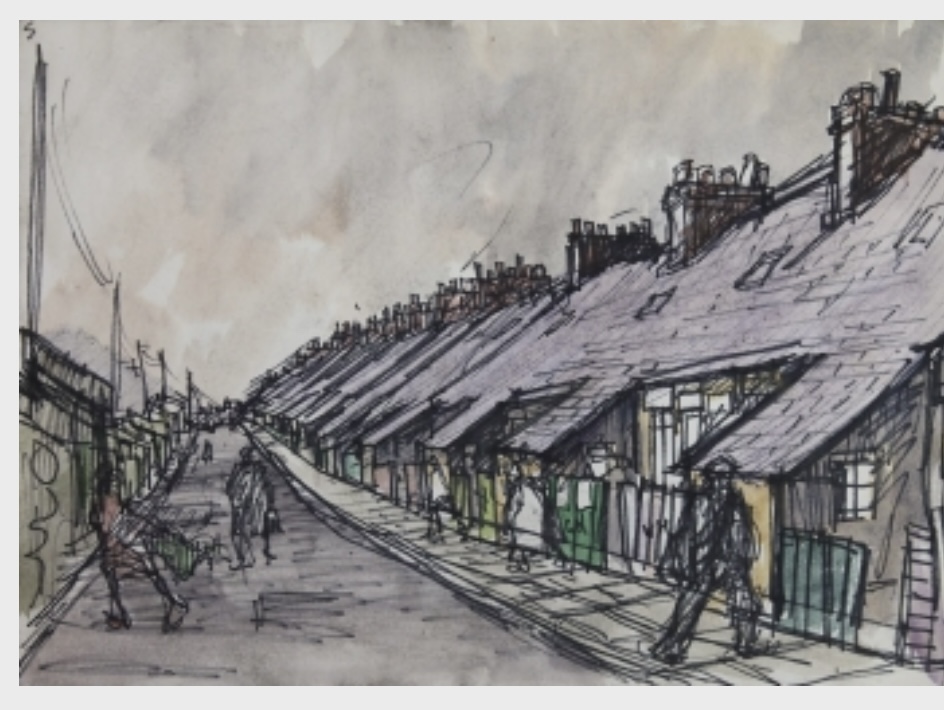
Norman Cornish is one of the most celebrated British painters of the last century. He spent his life amongst mining community having its ordinary life as a great inspiration for his paintings with socio-historical context. It is worth to mention, he never received a formal training in visual arts and worked as a miner for 33 years. He was exposed to visual arts for the first time when he attended a local sketching club exhibition. That was a turning point in his life when he realised his deep inclination to drawing and painting. Below I place his artworks, which I find amazing.
Norman Cornish’s paintings have indeed become a great discovery for me. I find all his paintings charming and joyful. He was a great master of channelling the beauty of simple everyday life scenes on canvas/paper. His works are incredibly atmospheric and detailed, depicting the mood of his subjects on the wet rainy street and inside a busy bar. In addition to my view, he was an artist with elegant taste, which is revealed through his approach to lines, colours and composition.
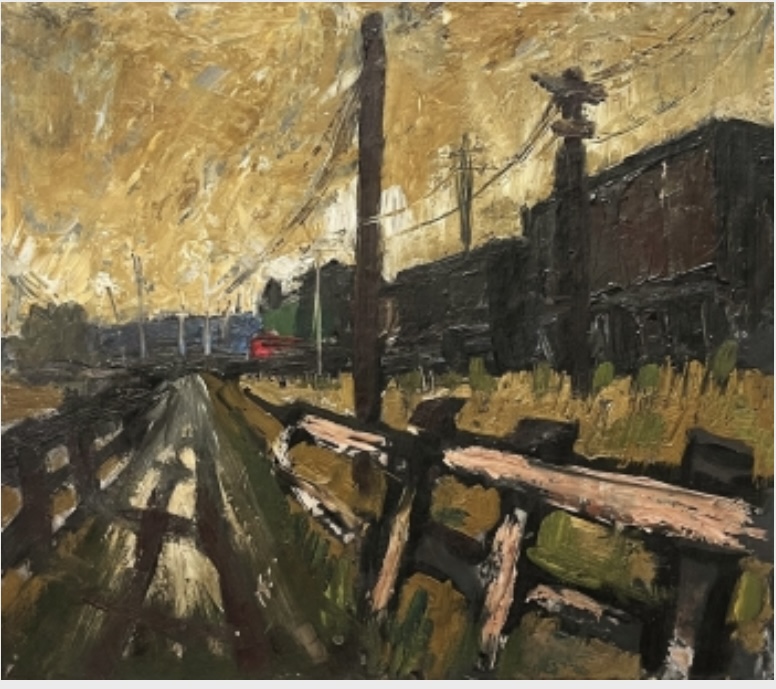
His “A Back Lane” painting is super elegant because of the way he paints the roofs in a light purple shade, which enlightens the whole greyish image. Another scene in “Pit Locomotive and trucks” strikes me with thick dark brown lines of wooden electricity poles and the brutality of the locomotive, yellow skies and the fence – everything is united incredibly. The “Wet Friday” painting makes me feel the smell of the wet rainy air. This artist is just amazing to me.
I also noticed an interesting fact about his artworks which made me feel especially engaged and, in some way, comfortable. His paintings and drawings are very different; they look different, like different persons painted them. I have noticed the same thing about my works: they really look out of one style. Mostly because their look is determined by the medium I use, but also because I bring a different perception of a particular object/scene. That style inconsistency worried me, but now, after researching Norman Cornish’s works, I see that I should treat it as a normal way of artistic functioning.
Wet Friday, 1975, Norman Cornish, oil on board, image via http://www.artuk.org;@the artist’s estate, photo credit: Laing Art Gallery.

Pit Road with Telegraph Poles and Lights, 1963, oil on paper, Norman Cornish, image via http://www.artuk.org;

Busy Bar, oil on board, Norman Cornish, image via http://www.artuk.org;@the artist’s estate, photo credit: Laing Art Gallery.

A Back Lane, Norman Cornish, ink and watercolour on paper, image via http://www.artuk.org;
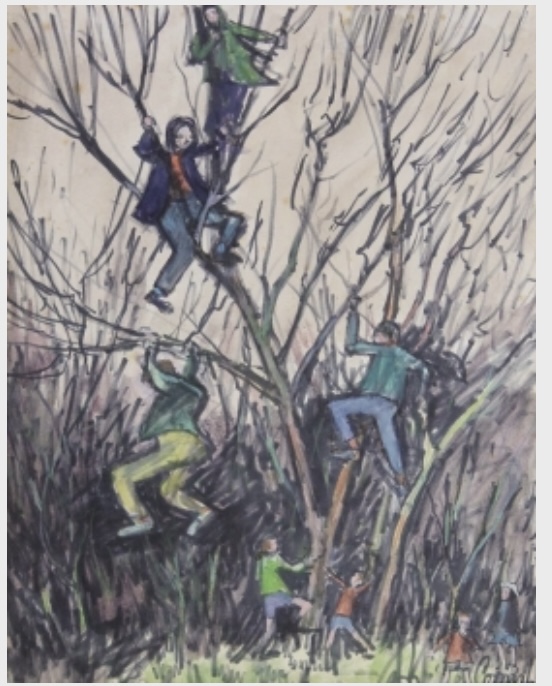
Boys climbing tree, ink and watercolour on paper, Norman Cornish, image via http://www.artuk.org;
Pit locomotive and trucks, oil on board, Norman Cornish, image via http://www.artuk.org;
Bibliography: Dryden Goodwin, Biography, on https://www.drydengoodwin.com, [accessed on March 27th 2023]; @Drydengoodwin, Instagram profile, [accessed on March 27th 2023]; “Reportage Art – capturing stories by Art & Soul” by Stella Tooth, June 29, 2021 online on http://www.skylarkgalleries.com [accessed on March 27th, 2023]; “Sir Stanley Spencer” 1891-1959, Tate, online on http://www.tate.org.uk, [accessed on march 27th 2023]; “Stanley Spencer. Tate Britain Exhibition, 22 march – 24 June 2001”, Tate, by Timothy Hyman and Patrick Wright online on http://www.tate.org.uk. [accessed on March 27th, 2023]; “Norman Cornish”, online on http://www.castlegatehouse.co.uk, [accessed on March 27th 2023]; “Norman Cornish: In His Own Worlds” by Sorry Fox, online on http://www.artuk.org [accessed on March 27 2023];
 JeanArt