Today I visited the Opera Gallery, below I place some artworks and my reflection on them and artists.
A.R. Penck (1939-2017)
Born Ralf Winkler, a German painter, who took a pseudonym in 1968 after reading the work of the archaeologist Albrecht Penck. He is recognised as a Neo-Expressionist and best known for his Neo-primitive symbols and patterns. as it is put in the article about him on the opera gallery website: “… his interest lay in the development of a pictorial language based on a simple system of signs, which would be possible for everyone to decode… Penck was driven not by any system or rational narrative, but by apparent chaos and emotion.” Below is his painting I viewed at the Opera Gallery viewing room this March. This painting is an excellent example of the visual art style, which conflicts with my aesthetical perception of visual art as an object for inspiration. I sound very subjective, in my opinion. Still, I place it here as a reminder that visual art is expansive, welcoming any expression and offering great freedom for anyone. Though the symbols are represented as simplified silhouettes of human figures, I need help to decode the narrative, at least for me. I would be happy to discuss this art piece with my Tutor.

Opera Gallery, Monte Carlo
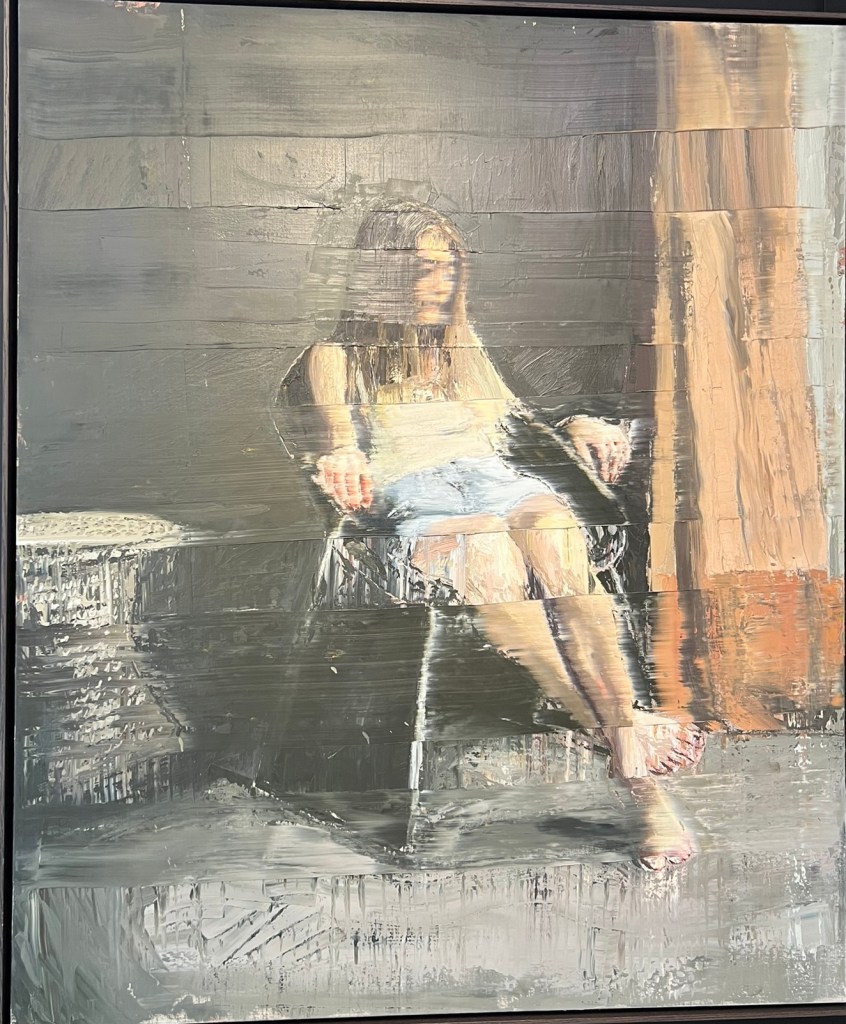
Andy Denzler (1965-)
Andy Denzler is a Swiss contemporary visual artist living and working in Zurich. He received his formal training in visual arts in the UK; he holds a Master of Fine Arts degree, graduating from Chelsea College of Art and Design, London. His style is well described in the article on the Opera Gallery website: “Denzler has created a signature style encompassing bands of pigment that alternate between static, thick marks and blurred, flowing sweeps”. He creates large-scale paintings, primarily portraits and seated or standing human figures. I find his style very poetic, and his technical skills are superb. I also admire the colour palettes in his artworks: subtle, dark, nude, kind of muted colours which are in much contrast with my painting style. All his artworks are exquisite; the human figures are super enigmatic, welcoming to gaze and reflect on the emotional narrative behind the image. His artwork’s theme was in line with what I covered in Part Three of the current Drawing course – reportage painting, studying the space/landscape with human figures. His special attention is female portraiture: soft and romantic but very modern. His approach to portraiture is appealing because he channels the subject’s emotions without painting an evident facial expression with facial features. Instead, I see that he focuses on the pose, little nuances of the subject’s posture, body movements, torso angle, and hand gestures, even feet’s postions are very carefully thought.
Bernard Buffet (1928-1999)
Bernard Buffet is considered one of the greatest contemporary expressionist painters. He was born in Paris, France, and lived through the Nazi occupation, deprivation and torments of war. His visual art talent was noticed by his teacher at age 15, which resulted in him entering the School of Fine Arts at an early age. Besides traditional paintings, he created lithographs and engravings. He produced more than 8000 works over his lifetime. His paintings’ themes were women, circus, naked men, landscapes and still-life. His clown theme acquired special attention and recognition from art critics and the public. Many art critics and the broad audience find him genius. So do I.
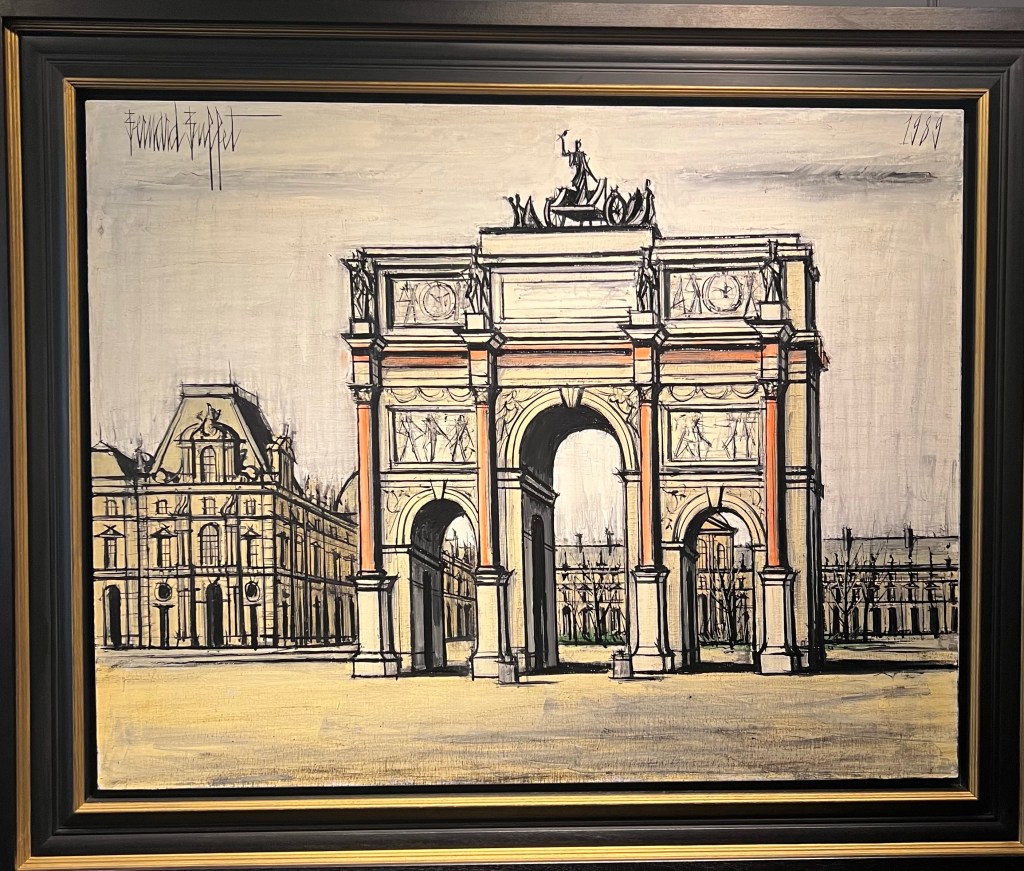
Below is the photo of his original painting of clowns’ portraits. I checked two websites with catalogues for artists – http://www.artnet.com and http://www.artsy.com, but I didn’t manage to find the exact title of the paintings I viewed. Unfortunately, the Gallery usually doesn’t put any printed labels near the painting. Another photo below is his large scale artwork depicting an architectural theme.
Bernard Buffet is a genius. His paintings are distinctively powerful, and his graphic style is unique. Even though his approach is not in line with what I usually like, I find his artworks – all of them which I could view on the website catalogues – mindblowing. One thing that strikes me: is his manner of outlining the elements in the painting with a thick black line. Once, I did the same in my ink and aquarelle drawing for Level 1, Painting One studies, but my tutor pointed out that I should never do so, because outlining objects is not good, this is a quote from her feedback report: “However, you have posted (7 Feb onwards) several photographs of trees which you have taken yourself. I have also received some sketches of the trees in various medium. Try not to draw outlines of the branches to shade in. Objects don’t have outlines in real life.”
So I stopped outlining objects:). This is the link to that post with my work on my learning log https://zhan-art.com/2018/02/17/winter-platan-tree-awaits-for-spring/
After discovering Bernard Buffet, I will resume outlining and bring more edgy graphic lines to my work. It is quite predictable that I enjoy his flower still life paintings. The paintings of architectural pieces are also an example of the great mastery of composition and linear skills.

Marc Quinn (1964-)
Marc Quinn is a well know British contemporary artist who creates paintings, installations and sculptures. As it is explained on his website: “Marc Quinn makes art about what it is to be a person living in the world… Man’s relationship with nature and how it is mediated by human desire; or what identity and beauty mean and why people are compelled to transform theirs;” He was noticed by the public eye and art professionals in 1991 with his sculpture Self (1991), which is a cat of the artist’s head, made entirely with his blood, frozen and left under sub-zero temperatures by its own refrigerated display unit. Marc Quinn is worldly famous for his monumental sculptures such as Planet ( 2008), All of Nature Flows Through Us (2011), bronze iris, Alison Lapper Pregnant (2005); He is also well known for his hyperrealist oil and acrylics paintings of flowers, created using an airbrush. One of his flower paintings I viewed in the Opera Gallery this March. On his website http://www.marcquinn.com I have found a detailed description of his flower paintings technique. He does them in the following way: “Quinn creates a still-life arrangement,ent in his studio using flowers and fruit bought in London on a particular day. Since most of the flowers and fruit in this compositions would never bloom at the same time, or even be found together in the natural world, they show us the way in which human desire has created new seasons-bringing together in one geographical location things that nature would not assemble…. Often large in scale and dramatically coloured, there belies a sinister subtext: the relentless human desire to control nature.” The painting indeed is hyperrealistic, it made me think that I was viewing a photograph. I couldn’t find the title of this particular painting below, even though I searched it through the catalogue of Marc Quinn’s flower paintings on the wws.artsy.net.
Hyperrealism requires a most advanced and developed level of technical skills. Marc Quinn’s flower paintings appeal to me because I also love plants, and flowers, particularly orchids. I love bright deep, and expressive colours. Reflecting on these paintings, I understood that Marc Quinn’s artworks made me feel more comfortable with my desire and fondness for bright and daring colours. I feel I can be more confident, even brave in my aspirations because he is showing me how unstoppable he is while painting flowers – making them on large-scale canvases and super bright colours. His paintings are audacious to me; they are a statement, an exclamation. Viewing Marc Quinn’s artworks on his Instagram account and reading his posts made me think that he is one of the most talented contemporary artists: his mind is broad, as well as his creative techniques: he does a whole array of genres and regimes: social protest paintings, modern life issues, sculptures and installations, poetry and beauty of a nature.

Bibliography: A.R.Penck, Opera gallery, online on http://www.operagallery.com [accessed on March 15th 2023]; A.R.Penck, online on http://www.artsy.net [accessed on March 15th, 2023]; Andy Denzler, Studio Andy Denzler online on http://www.andydenzler.com [accessed on March 15th, 2023]; Andy Denzler, online on http://www.artsy.net [accessed on March 15th 2023]; Bernard Buffet, his life and work, Galerie Estades, online on http://www.estades.com[accessed on March 15th 2023]; Bernard Buffet, online on http://www.artnet.com [accessed on March 15th 2023]; Marc Quinn, Biography, Artworks, online on http://www.marcquinn.com [accessed On March 16th]; Marc Quinn, Flowers, online on http://www.artsy.net [accessed on March 16th, 2023];
 JeanArt