
Exercise 2: Picturing words. In this exercise we have to find a passage in any book, which we can visualise and produce some sketchers of the visualised scene.
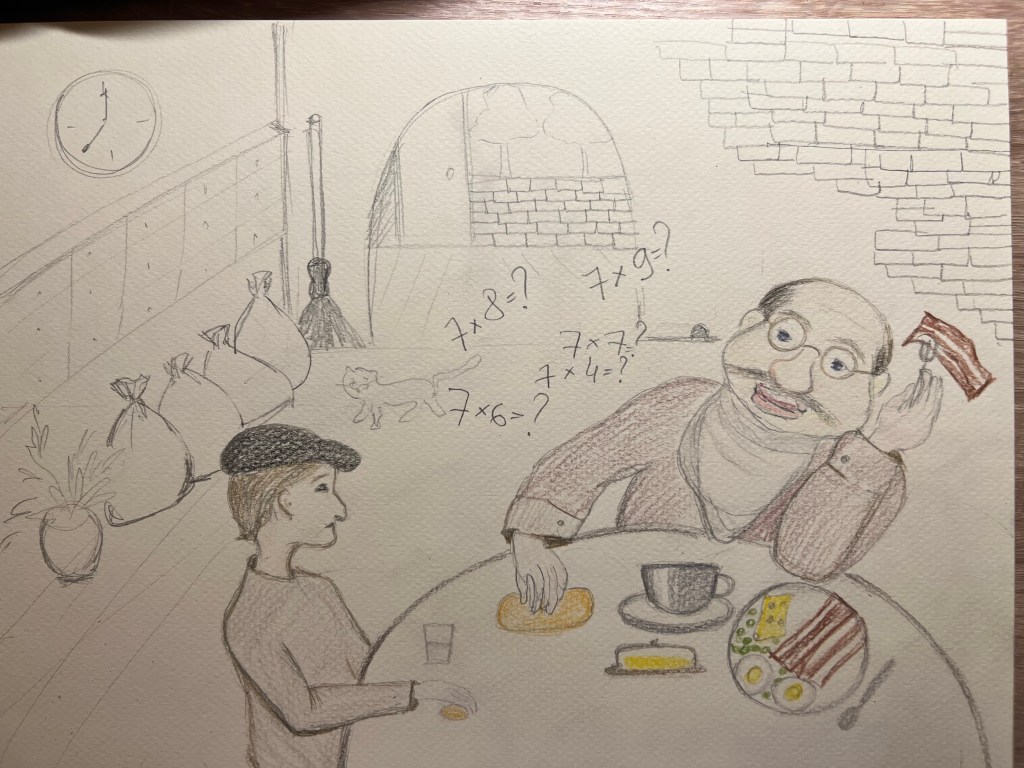
I have picked up the following passage from “Great Expectations”, Charles Dickens, Penguin Books,1996; London.
“Mr Pumblechook and I breakfasted at eight o’clock in the parlour behind the shop, while the shopman took his mug of tea and hunch of bread and butter on a sack of peas in front of the premises….. Besides giving me as much crumb as possible in combination with as little butter, and putting such a quantity of warm water into my milk that it would have been more candid to have left the milk out altogether – his conversation consisted nothing but arithmetic. On my politely bidding him Good morning, he said pompously, “Seven times nine, boy!”….. “And Four?”, “And Eight?”, “And Six?”, “And Two?”, “And Ten?” …. while he sat at his ease eating bacon and hot roll in a gorging and gormandising manner“.
I used paper from Canson for pastels, Mi-Teints and 2HB pencil for my sketches below.


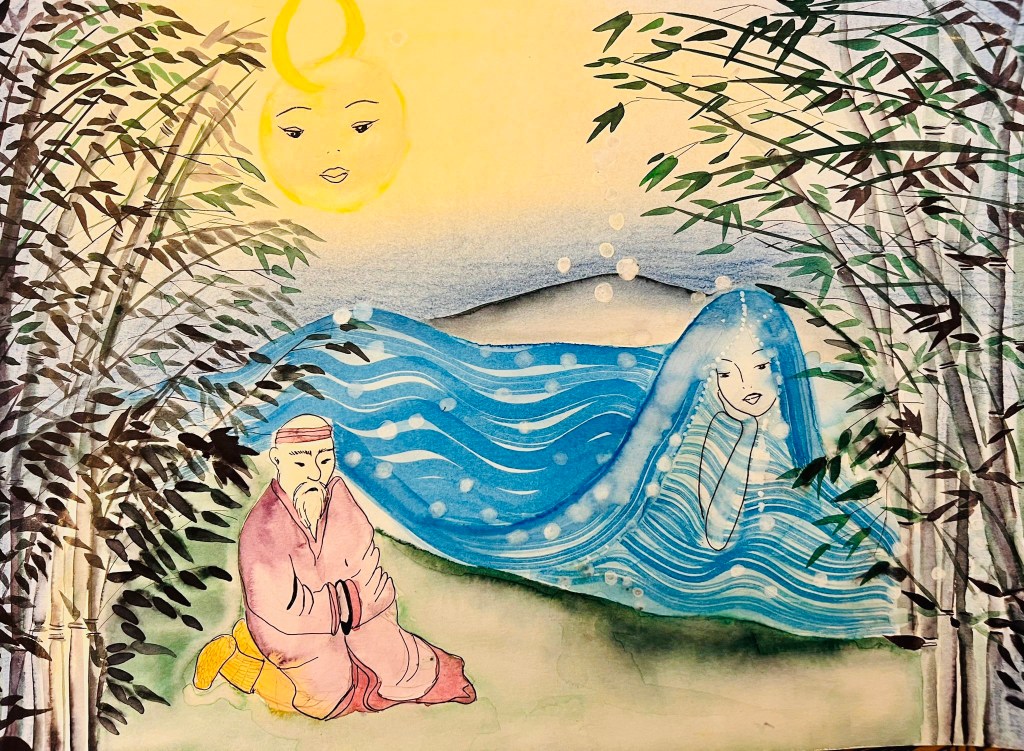
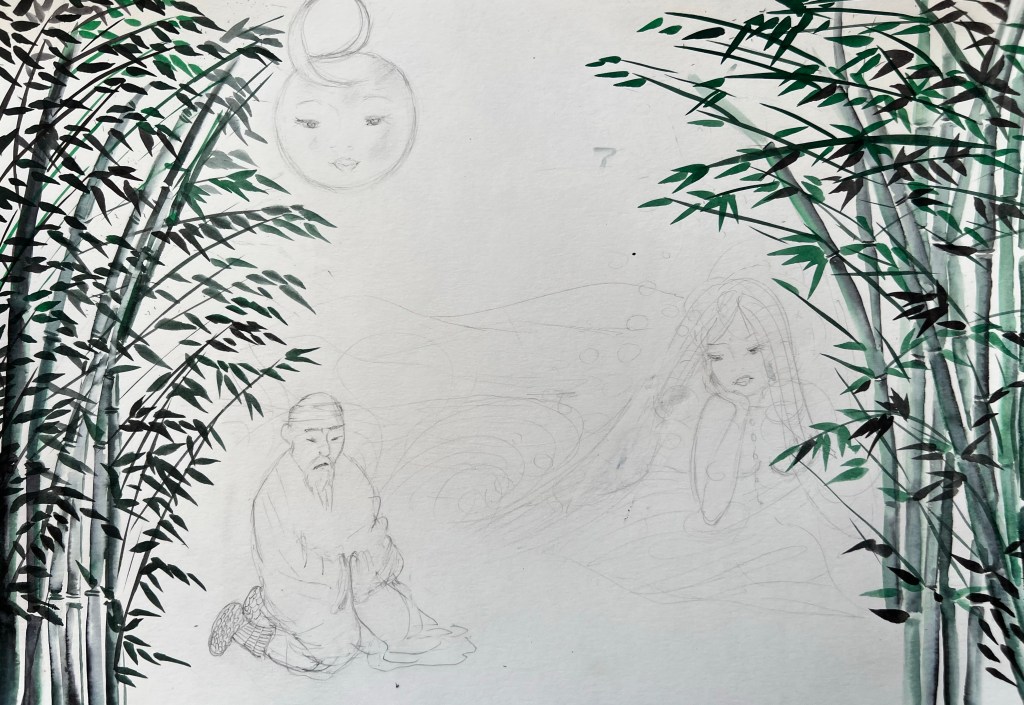
Here is an extract from Japanese fairy tale “The bamboo cutter and the moon child” (by Yei Theodora Ozaki, online on https://etc.usf.edu/lit2go/authors/62/yei-theodora-ozaki/)
“Long, long ago, there lived an old bamboo wood-cutter. He was very poor and sad also, for no child had Heaven sent to cheer his old age, and in his heart there was no hope of rest from work till he died and was laid in the quiet grave. Every morning he went forth into the woods and hills. One morning as usual he had gone out to his work, and having found a nice clump of bamboos, had set to work to cut some of them down. Suddenly the green grove of bamboos was flooded with a bright soft light, as if the full moon had risen over the spot. Looking round in astonishment, he saw that the brilliance was streaming from one bamboo. The old man, full of wonder, dropped his ax and went towards the light. On nearer approach he saw that this soft splendor came from a hollow in the green bamboo stem, and still more wonderful to behold, in the midst of the brilliance stood a tiny human being, only three inches in height, and exquisitely beautiful in appearance.
Here I used A3, 200 gr/m3 mix media paper from Canson, liquid aquarelle from Ecoline, ink brushes, flat brush, 36 colours Japanese aquarelle Tambu set, dry pastels from Jexell.
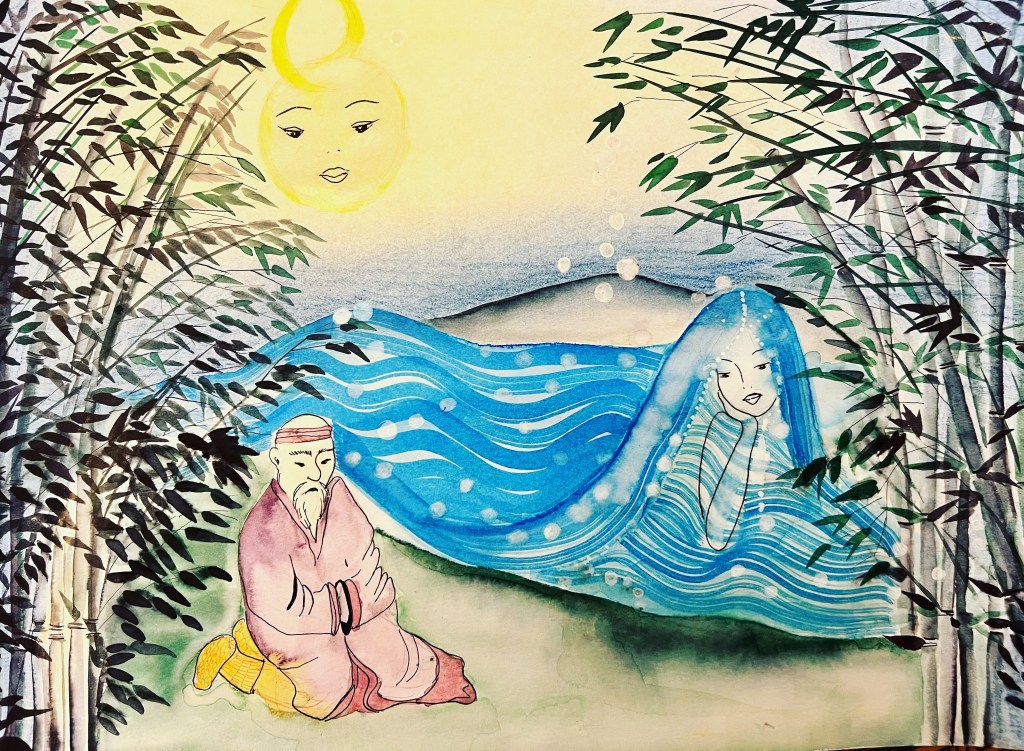
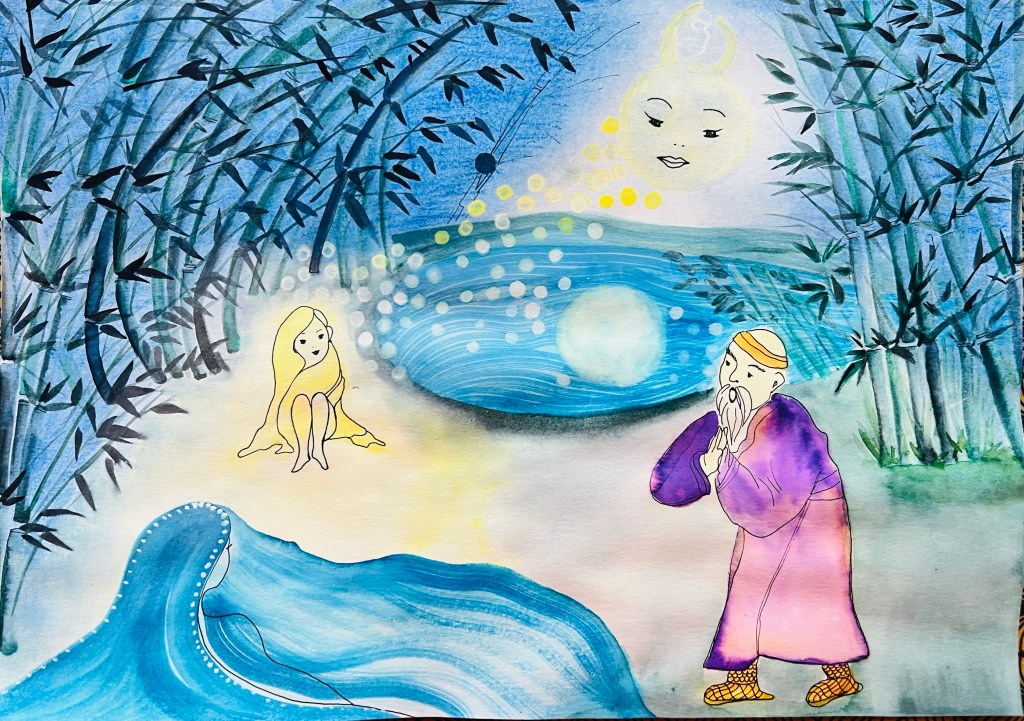
Some work in progress


Reflection on the exercise:
This exercise brought a lot of fun for me and pushed me beyond my usual practice. I have never tried to illustrate stories, mainly because I don’t read fiction, especially the fantasy genre, preferring texts about psychology, philosophy, history and biographies. Another reason, which was a difficulty at the same time, is that I am not fond of figurative drawing. Thus it took some time for me to find a passage to illustrate. Intuitively I came up with children’s literature.
The writer’s talent does help with the flow of ideas for an illustrator. The more details are present in the text, the easier the work is to illustrate the subject. I did well with capturing the scenes and the subjects for both passages. For the Japanese fairy tale passage, I have incorporated my own idea of the river, which is not mentioned in the fairy tale. However, I found it an exciting addition, enriching the visual representation of the story. It helped to create the mood and the world where the bamboo cutter existed.
Research Tasks: Monoscenic Narrative
We have to do a research and reflect on the following visual artists: Jörg Immendorff, Paula Rego, Peter Doig, Fra Angelico, Sandro Boticceli and others. The questions to reflect on: “mood and atmosphere” in their artworks and the impact of it on our insights of artist’ work; make a comparison between the classical works and contemporary, distinction between the approach.
I have made my research on Paula Rego earlier, here is the link https://zhan-art.com/2022/01/26/painting-two-part-three-research-points-for-project-1/(opens in a new tab)
Jörg Immendorff (1945-2007)
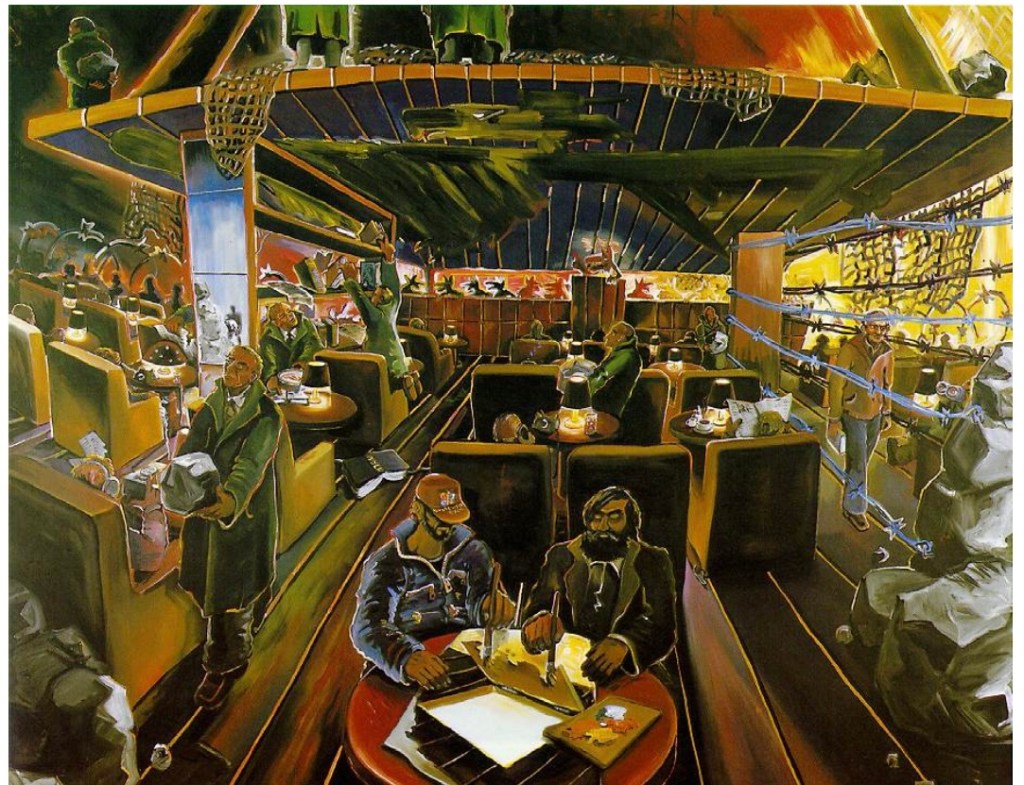
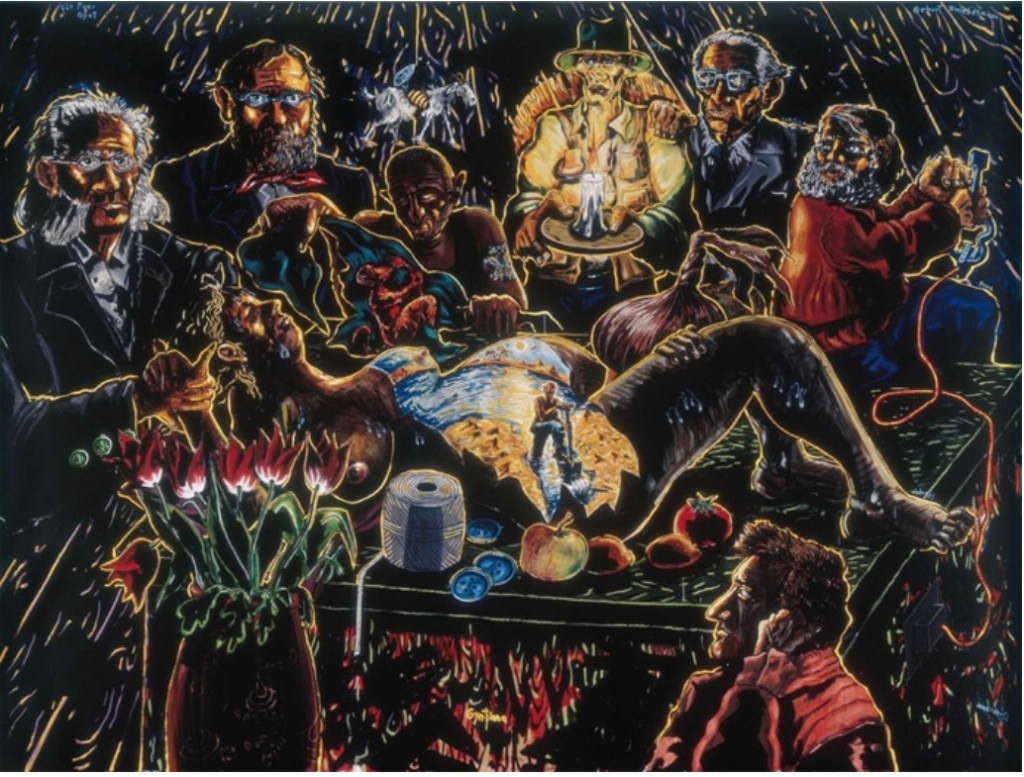
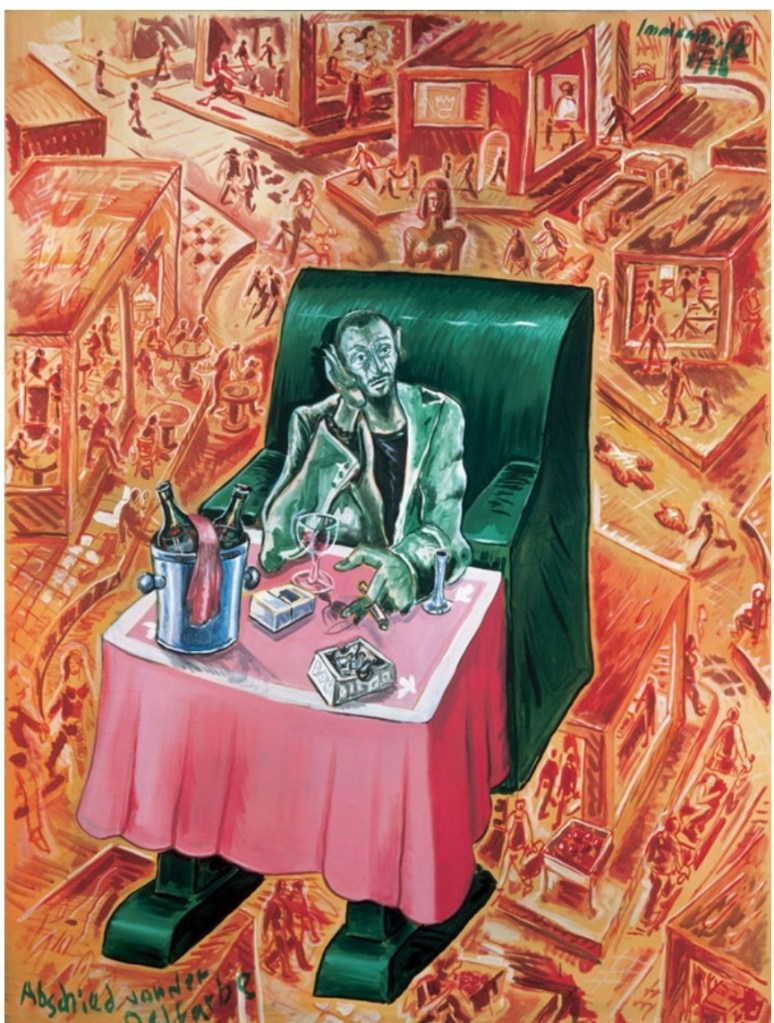
Jörg Immendorff was a German Neo -expressionist visual artist who produced notable works as a painter, sculptor and stage designer. He was born in Bleckede, Germany and studied at Kunstacedemy, Düsseldorf, learning from the famous artist Joseph Beuys. However, eventually, he revolted against that early influence, which manifested in his work “Beuys as a Non-Swimmer” (1968). It is interesting to note that he was expelled from the Kunstacademie, Düsseldorf, for his political views and activities as a member of the Communist Party. Jörg is also known for his anti-Nazi and anti-colonialism views, which were reflected in his artworks as well. His first exhibition in the USA was held in 1982 at the Museum of Modern Art in NYC, as a significant part of public interest in German paintings. His artworks are included in the collections of the National Gallery of Art in Washington D.C., Bilbao Fine Arts Museum, the Weserburg Museum of Modern art in Bremen, and the Art Institute of Chicago, Museo National Centro de Arte Reina Sofía. One of his most artworks is his series “Cafe Deutschland”(1978)- paintings and images of stage sets, which was his artistic response to German politics. Art critics describe his approach as urban, expressive, bold political propaganda, a “convincing political painter” (David Carrier, 2019), disinterested in nature and abstract. He has said, “I am a narrator with a superabundant urge to concoct stories, someone who perhaps comes right out of a fairy tale” ( from “The Endlessly Inventive Jörg Immendorff”, David Carrier, December 28, 2019, online on http://www.hyperallergic.com). He didn’t share the “Art as for art’s sake” approach and believed art should reflect social and political reality. His artworks are done on a large scale. They are uniquely expressive, contain lots of details, multilayered, intense, emotionally charged, politically opinionated, and calling for action. Below I pout some of his artworks I found as especially amazing to me.
Cafe Deutschland IV, Jörg Immendorff, 1978, oil on canvas, image via http://www.artchive.com;
Cyntiana-Gebur t Zwiebelmann (Gyntiana- The Birth of Onionman), Jörg Immendorff, 1092, oil on canvas, image via http://www.saatchgallery.com;
Solo, Jörg Immendorff, 1988, oil on canvas, image via http://www.saatchgallery.com;
Peter Doig (1959-)
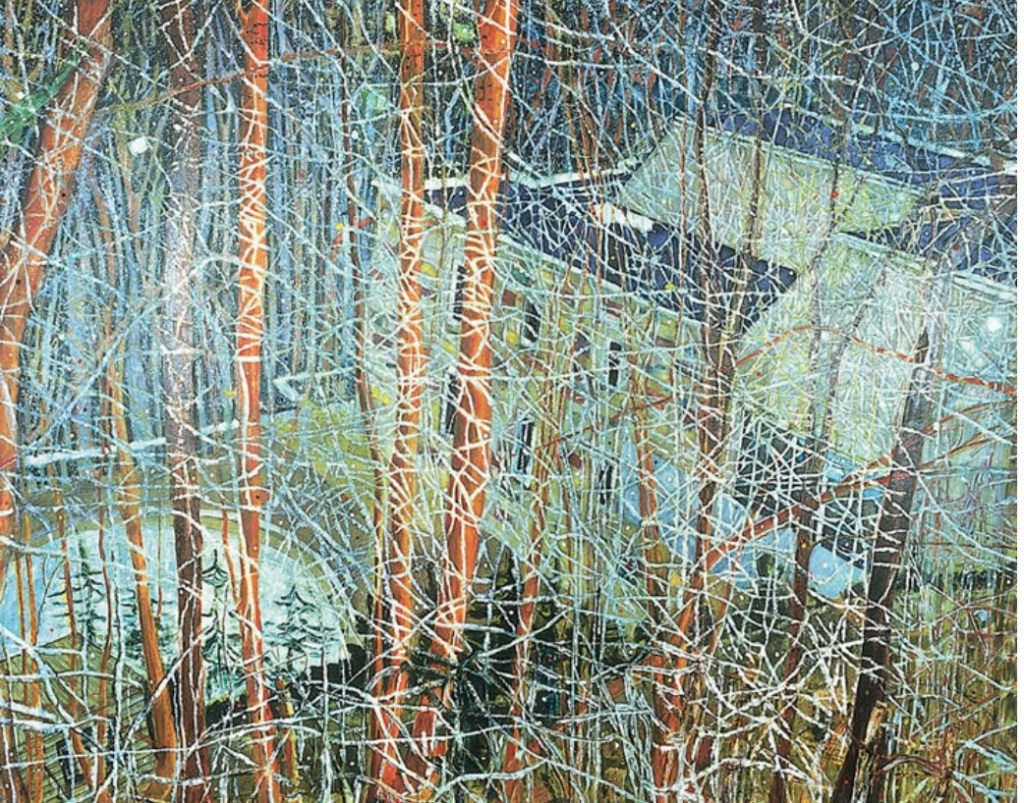
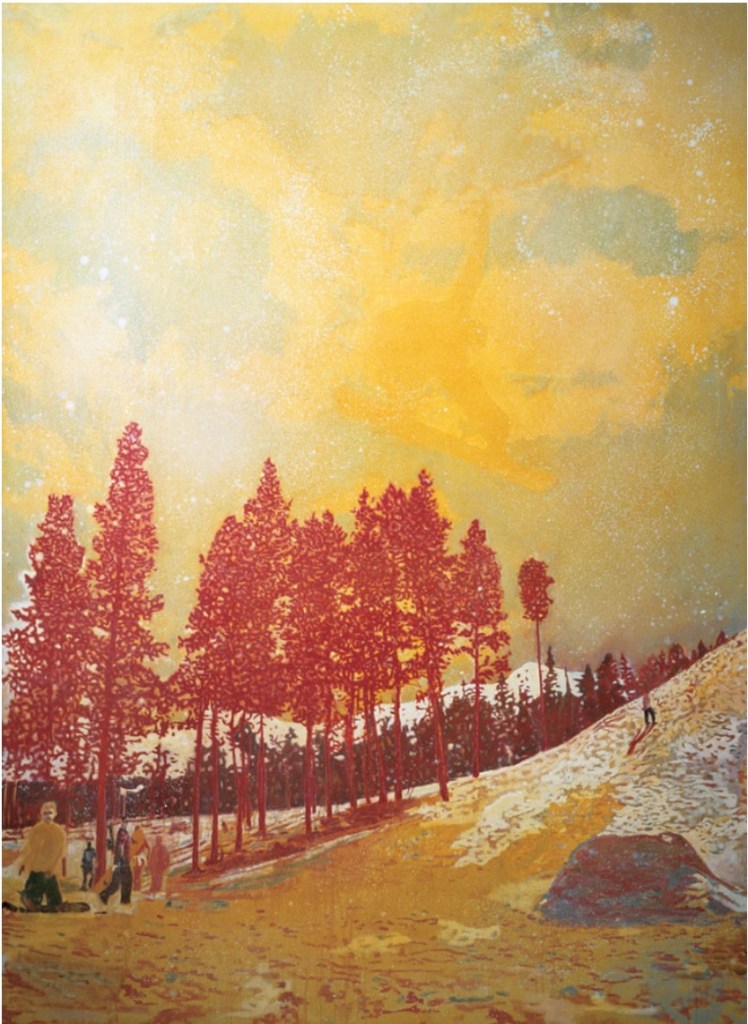
Peter Doig is a Scottish/British painter who devoted his visual art talent to depicting landscapes he travelled. He has received extensive training in visual art, graduating University of the Arts London Wimbledon College of Art, then the Central Saint Martin College of Art, MA at Chelsea School of Art in London. His artworks are described as “dream-like”, “filmic”, “drenched in enigmatic aura”, and “mysterious” or “magical realism” (Peter Doig, CAU, Youtube). He finds his inspiration in his personal memories, photographs, and films. He is recognised as one of his generation’s most important and influential artists. Below are some of his works, which I admire.
The Architects Home in The Ravine, 1991, Peter Doig, oil on canvas, image via http://www.saaitchigallery.com;
White Canoe, 1990-1, Peter Doig, Oil on canvas, image via http://www.saaitchigallery.com;

Orange Sunshine, 1995, Peter Doig, oil on canvas, image via http://www.saaitchigallery.com;
Fra Angelico (Giudo di Pietro) (1395-1455)
Fra Angelico (Guido di Pietro, later known as Fra Giovanni da Fiesole and Beato Angelico) was one of the most significant Italian painters of the XVth century. He was born in Vicchio, Florence and was initially trained as a lay painter, also by another great painter of that time Lorenzo Monaco. He successfully commissioned altar paintings and chapel decorations in Florence and Rome. He is considered one of those artists who pioneered new stylistic trends in the Italian Rennaissance period, “including the rational treatment of pictorial space and the volumetric modelling of forms with light and shadow” (Ross Finocchio, October 2006, http://www.metmuseum.com). As it is described on the National Gallery of Art website: “He also was a master of Brunelleschian perspective permitted daringly with convincing spatial effects in architectural settings”. Below are some of his artworks.
Stories of the Desert Fathers, Fra Angelico, c.1419-1420, tempera and gold on panel, image via http://www.museodelprada.es

Coronation of the Virgin, with Adoration pf the Christ Child and Six Angels, Fra Angelico. c.1429-31, tempera and gold on panel, image via http://www.museodelprado.es

The Virgin with the Pomegranate, Fra Angelico, ca.1426, tempera on panel, image via http://www.museodelprado.es.

Sandro Botticelli (1445-1510)
Boticelli’s original name was Alessandro di Mariano Filipepi.
He is one of the greatest painters of the Florentine Renaissance. His most famous work are The Birth of Venus (c. 1485) and the Primavera ( c.1477-82). He received primary training under Filippo Lippi, a well-known and much-admired Florentine master. His teacher gave him a panel painting, fresco and linear perspective knowledge, skills and techniques, and linear sense of forms, costuming and unique shades of hues. Sandro Botticelli also learned a lot from other leading painters of his time Antonio Pollaiuolo and Andrea del Verrocchio.
His artistic style is characterised by harmonious compositions and beautiful, sensuous human forms “with compelling vitality” (Ronald W.Lightbown for Encyclopedia Britannica, 2022). In addition, Botticelli is famous for the precise rendering of narrative texts, such as biographies of saints or stories from Boccaccio’s Decameron or Dante’s Divine Comedy. However, he is also known for producing secular works, though many of them are lost. Sandro Botticelli commissioned orders from the church to paint altarpieces in fresco, tondi- round paintings, small triptychs and panel pictures. Three of his finest artworks are part of the decorations in the Sistine Chapel. It is worth to mention he was a master of portraiture and mythological paintings. Below I put his paintings I admire.
Birth of Venus, Sandro Botticelli, c.1485, tempera on canvas, image via http://www.britannica.com;

Primavera, Sandro Botticelli, c.1477-82, tempera on wood, image via http://www.britannica.com;

Reflection on researched artists.
I agree that all artists we researched and mentioned on page 31 of the coursebook as “working within the monoscenic narrative” create a particular mood, which I can describe as intense. It is not subtle; it is intense in the prevailing emotion depending on the narrative. It can be the political opinion of Jörg Immendorff, the meditative state of mind of Peter Doig, personal female drama in Paula Rego’s painting or a pure extase of sensing the beauty in Boticelli’s artworks, such as the Birth of Venus or The Primavera. I think the creation of the atmosphere is a primary medium for how the artist communicates with a viewer and delivers his artistic impulse. I strongly resonate with peter Doig’s paintings, their narrative and their atmosphere.
The differentiation between contemporary artists with those who lived centuries apart from our time in their visual language and technique, I can find the following:
Fra Angelico and Sandro Botticelli used tempera on wood, while modern mainly painted with oils on canvas. That gives a difference in colours and overall colour quality: tempera, when it dries, is matt and opaque, while oils dry in a hard transparent layer, giving a “glazes” effect. Both mediums can create rich colours, though tempera dries much quicker. “Tempera paintings achieve a smooth matte texture with more colour saturation. as it allows for the use of cross-hatching technique with a variety of brush sizes, it can be utilised for artwork that is more exact”. (www.onlineartplatform.com, 12/12/2021). I can describe the visual style of representing the ancient figurative reality as very fine, elegant and sophisticated. The composition is also well structured, with a clear linear perspective. In contrast, modern paintings are created without strict compositional rules. Human figures are distorted, aggressive, and harsh. The mood is very different as well. Ancient classical works bring a clear sense of a metaphysical higher level, God’s existing reality coming upon humans, elevating the human spirit. At the same time, modern artworks exclude God and religious, mythological narratives, focusing on Earthy daily reality and human interpersonal relations.
Bibliography: “The Endlessly Inventive Jörg Immendorff”, David Carrier, December 28, 2019, online on http://www.hyperallergic.com, [accessed on October 1st, 2022]; Jörg Immendorff, Editors of Artnet, online on http://www.artnet.com, [accessed on October1st, 2022]; “Jörg Immendorff, For All the Beloved in the World”- Exhibition Film, Haus Der Kunst, interview of Jörg Immendorff, YouTube, 2019, [accessed on October 2022];
Peter Doig, Editors of Artnet, online on http://www.artnet.com, [accessed on October1st, 2022]; Peter Doig, online on http://www.saatchigallery. com, [accessed on October 1st, 2022]; Peter Doig, British, born 1959, MoMA, Jenny Harris, 2018, online on http://www.moma.org, [accessed on October 1st, 2022]; The Story of: Peter Doig (1959-Today), Contemporary Art Issue, 2022, YouTube, [accessed on October 1st, 2022];
Fra Angelico, Italian painter, by Mario Salmi, Encyclopaedia Britannica, online on http://www.britannica.com, [accessed on October 1st, 2022]; Fra Angelico (ca 1395-1455), by Ross Finocchio, October 2006, The Met, online on http://www.metmuseum.com [accessed on October 1st, 2022]; Fra Angelico, Florentine, c.1395-1455, by Editors of the National Gallery of Art, online on http://www.nga.gov [accessed on October 1st, 2022];
Sandro Boticelli, Italian painter, Ronald W.Lightbown, Sept 15, 2022, Encyclopaedia Britannica, online on http://www.briatnnica.com [accessed on October 1st, 2022]; Know the Artist: Sandro Botticelli, Several Circles, Art History, YouTube, 2020, [accessed on October 1st, 2022]; Oil and Tempera: 15th century, online on http://www.historyworld.net [accessed on October 1st, 2022];Tempera vs Oil Paint, 12/12/2021, online on http://www.onlineartplatform.com, accessed on October 1st, 2022];
 JeanArt