Exercise 1.2. Relationships with Materiality.
We have to reflect on the following quote in relation to our own practice:
“What does it mean to give agency to the material, to follow the material and to act with the material?‘ by Lange-Berndt, 2015;
We have to reflect on and write about the material we work with, our favourite materials, why we chose them and how we explore their qualities within our work. We also have to extend our reflection after reading the extract from “Introduction. How to Be Complicit with Materials”, Petra Lange-Berndt;
Before I write my reflection, I put below some valuable ideas and quotes from the above mentioned reading.
- “Material generally denotes substances that’ll be further processed… From a critical perspective, the term “material’ describes not the prime matter but substances that are always subject to change, be it through handling, interaction with their surroundings, or the dynamic life of their chemical reactions’ (p.12);
- In Aglo-American intellectual and philosophical tradition form and design are more important than material. Forms and objects have been extensively studied while material is often sidelined.
- “Clearly material have agency, they can move as well as act and have a life of their own, challenging an anthropocentric post- Enlightenment intellectual tradition’ (p.13);
- The term “materiality’ is still valid and actual to our era Art because it is very wide and includes as physical as not physical substances such as words or sounds or digital files;
- There is a certain dispute among key philosophical concepts of materiality and materialism. Traditional Marxist view encounter the matter as something “dead and useless unless human fancy activates them’ (p.17). Another view of contemporary Anglo-American new materialism, including agential realism of feminist theorists the matter is understood as “a dynamic and shifting entanglement of relations rather than as a property of things.” (p.17);
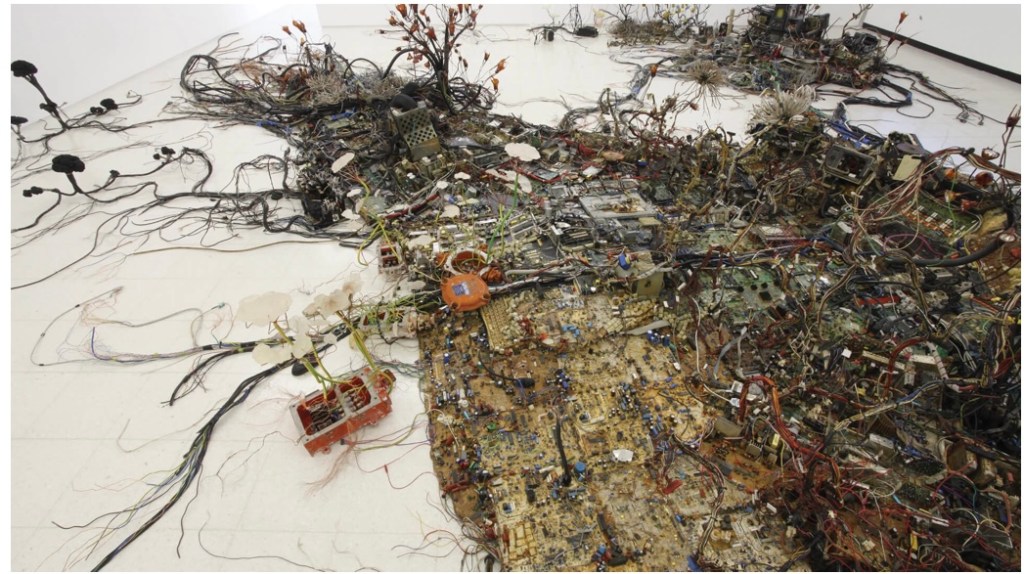
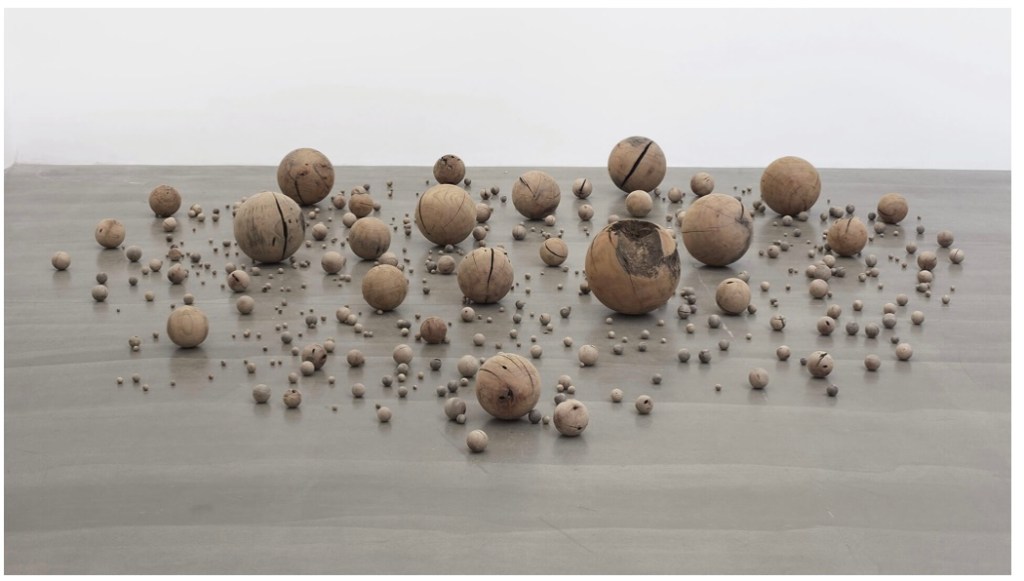
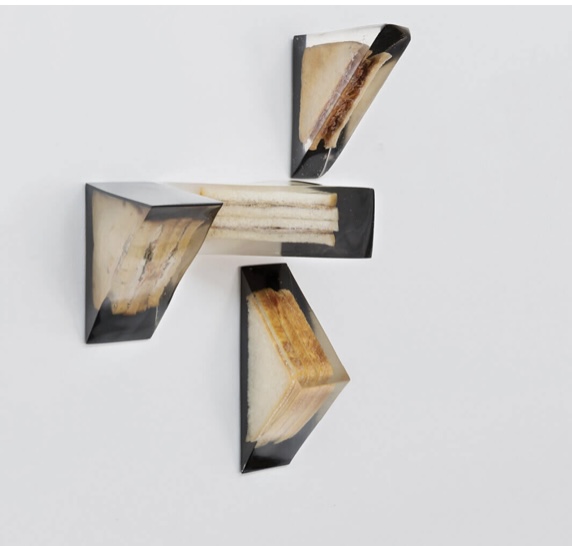
I did some additional research on the concept of materiality in Art. I have found a great overview on some artists, which approach the materiality in Art in unconventional way. I place some images below because I find the relevant to this topic of the course. I also post a link to that article on http://www.stirworld.com; https://www.stirworld.com/see-features-artists-who-pushed-the-boundaries-through-materiality-in-their-art
From left to right. 1)” Postnaturalia”, Kristof Kintera, Image: Courtesy of Kristof Kintera, image via http://www.stirworld.com; 2) “Egg, on the far left, and Adi on the right”, by Boshudhara Mukherjee Image: Courtesy of TARQ, image via http://www.stirworld.com; 3) “Beads No. 2”, Li Gang, Image: Courtesy of Galerie Urs Meile, image via http://www.stirworld.com; 4) “Tuna Mayo on White Bread (Coop), Corned Beef on White Bread (Tesco), Cheddar and Red Onion (Tesco), Chicken and Roast Vegetables on Rye Bread (Tesco)”, Alex Frost, Image: Ollie Hammic, image via http://www.stirworld.com;

My relationship to Materiality.
Materiality – dealing with a material medium is a natural and inevitable way of making art. Any art object in its broadest sense is manifested via a specific medium, whether it exists in physical or non-physical form. For example, writers manifest their art via words and texts. Movie directors use the largest set of mediums, such as humans as actors, exploiting their artistic plasticity and the widest range of material objects- props, buildings and streets, and elements of nature, they also use non physical materials such as words and texts. Visual artists have been using all sorts of materials as well – traditional and modern, unconventional to visualise their creative ideas and artistically articulate their thoughts and feelings. Anything around us is a medium and can be a medium=material for an artist. I find this variety and vastness of our choice of medium=material, which we can exploit in creating art, as the main reason for Petra Lange- Berndt’s note that the study of materiality has been sidelined in art theory and history.
My relationship with the materials I work with is constantly changing and can be described as a dialogue. I “speak” with a material, and it “speaks” to me. The material is subject to my ideas and thoughts, and I am also fully subject to its inner voice, adapting my ideas to its qualities and wishes. There is no doubt that it is a universal practice for all artists. Creativity is very much about communication with your medium/mediums. You can not be deaf to what your material is saying to you, and you can not be blind to its qualities. I can also add to Petra Lange-Berndt’s idea that we need to study this particular communication process between artists and material. At the same time, we tend to look at and study the final result of this dialogue, ignoring the creative process itself. Art is not just a final result; art is a process, which is a dialogue/interaction with the material, a sense of the material.
My first experience with materiality comes from my fashion designing attempts. I am very fond of fabrics, experimenting with silks, laces and wool. In visual arts, my favourite materials are oil paints and inks in painting. I like the softness and thickness of oils and the delicate transparency of inks. I like paper more than canvas because of its smoothness and the way it absorbs the pigments of inks.
Bibliography: “Introduction. How to Be Complicit with Materials”, Lange-Berndt, Petra, Materiality, Documents of Contemporary Art, London: Whitechapel Gallery and the MIT Press, p.13, online on http://www.learn.oca.ac.uk, [accessed on April 15, 2022]; “Materiality as the Basis for the Aesthetic Experience in Contemporary Art”, Christina Murdoch Mills,2009, The University of Montana, University of Montana, ScholarWorks at University of Montana, online on http://www.scholarworks.umt.edu, [accessed on April 16, 2022]; “Artists who pushed the boundaries through materiality in their art’, by Rahul Kumar Published on : Dec 22, 2021, online on http://www.stirworld.com, [accessed on April 16, 2022];
 JeanArt