Assignment Three. Final Project.
The idea for the final project in Part Three, Painting 2 course, came to me quite quickly. I have reviewed the exercises and research points, reflecting on what could be inspiring and relevant for the final assignment. Over Part Three, I had to learn and reflect on new ideas for me as an artist. I enjoyed the process of discovering my artistic potential. Another important aspect is the fact that I found this Part very philosophical. I clearly understood that my visual creative inspiration is often profoundly related to the philosophy of human existence, God and faith. So this Part was in tune with my daily vibration. Manipulations with cloth, cloth making and cloth/costume drawing evoked a whole new direction for my artistic development. Suddenly these exercises have become a bridge to my daily thoughts about Life and existence. I have found that cloth indeed signifies a lot of ideas about living on Earth and the Earthy experience. In this sense, I am, of course, not alone. It is probably the same feel as sculptor Pawel Althamer and painter Boo Ritson, who emphasise appearance, clothing, and costumes in their artworks. I was less engaged with reflective surfaces and the ideas of “rupture of pictorial space”. However, the cloth/costume/ as a whole or in its elements and any external attributes, which are permanent human companions, are very engaging because of their ability to express our ongoing personal transformation. This constant transformation is my daily thought and challenge. This Part of the course made me rethink a lot of my personal existence concepts, bringing them to another level, almost upgrading them from daily thoughts to the level of making them as artworks. Developing a narrative in the artwork came to me also as “very welcome!” because I actually needed some support from Art Theory. I really enjoyed the reading from James Elkins, who so efficiently discussed the construction of narrative in visual art.
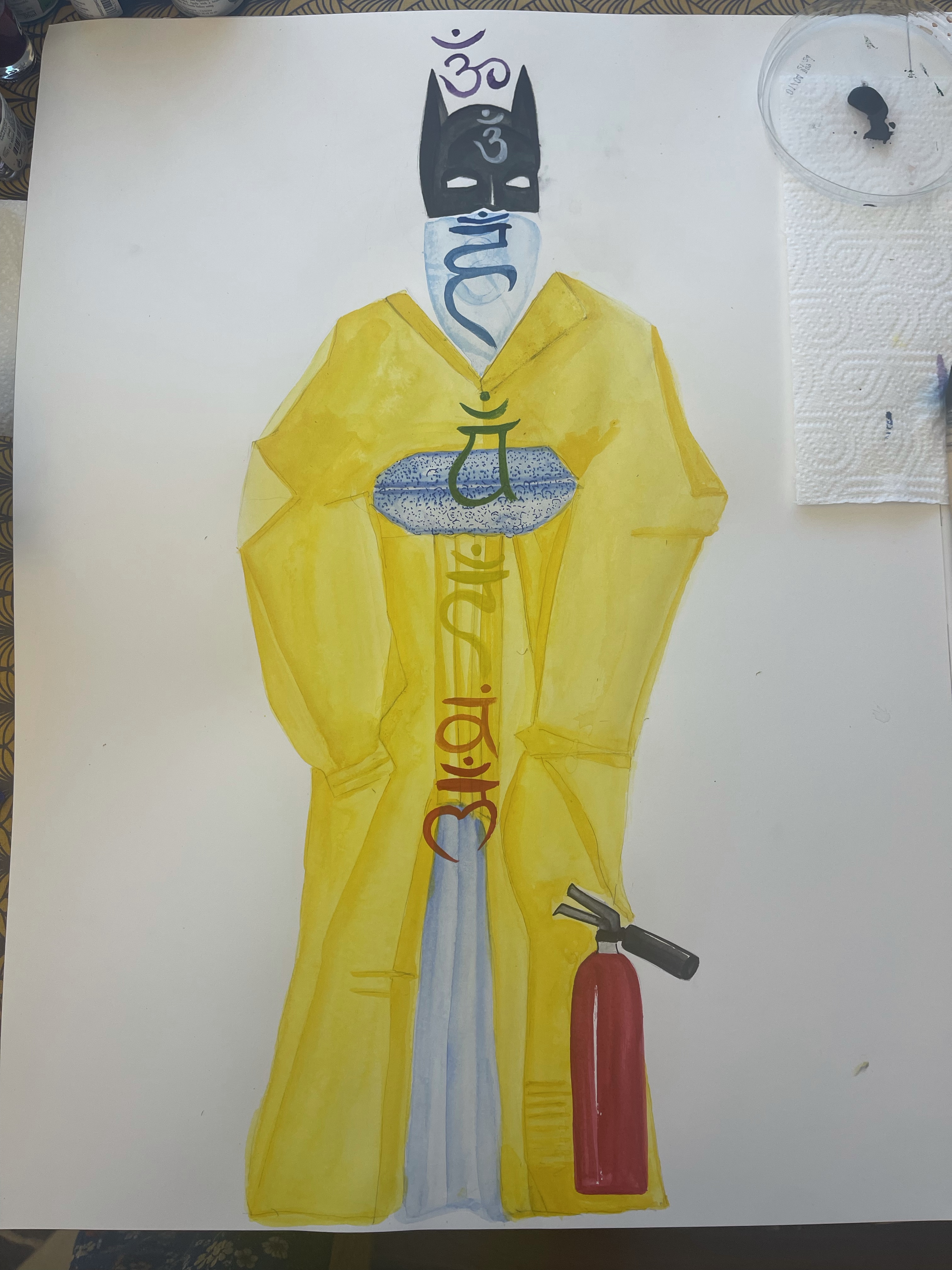
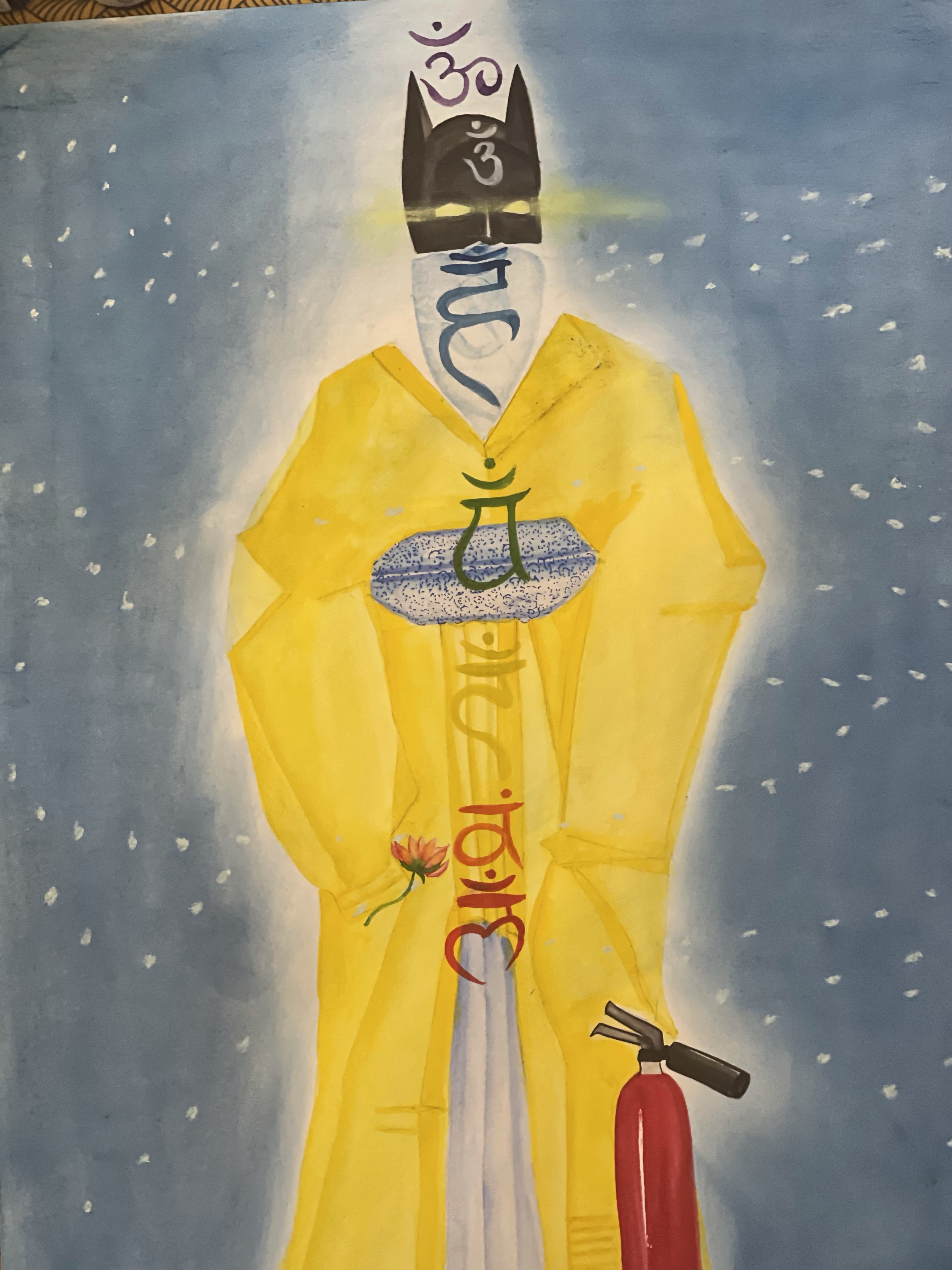
As a result of my latest studies, I came up with a very new and more educated way of creating and thinking about visual Art. I had made a new trail of installations and assemblage, which always have been “terra incognita” for me, before I started the Painting 2 course. However, without the exercises and readings in the course, I would probably never reached and developed any of my own installation ideas. This Part enabled me to paint my thoughts about myself, which is a big revolutionary step forward for me. I tend to stick to more decorative ideas and limit myself to “just eye-pleasing” ideas. Below is my final project for the part Three, Painting 2.

Work in progress


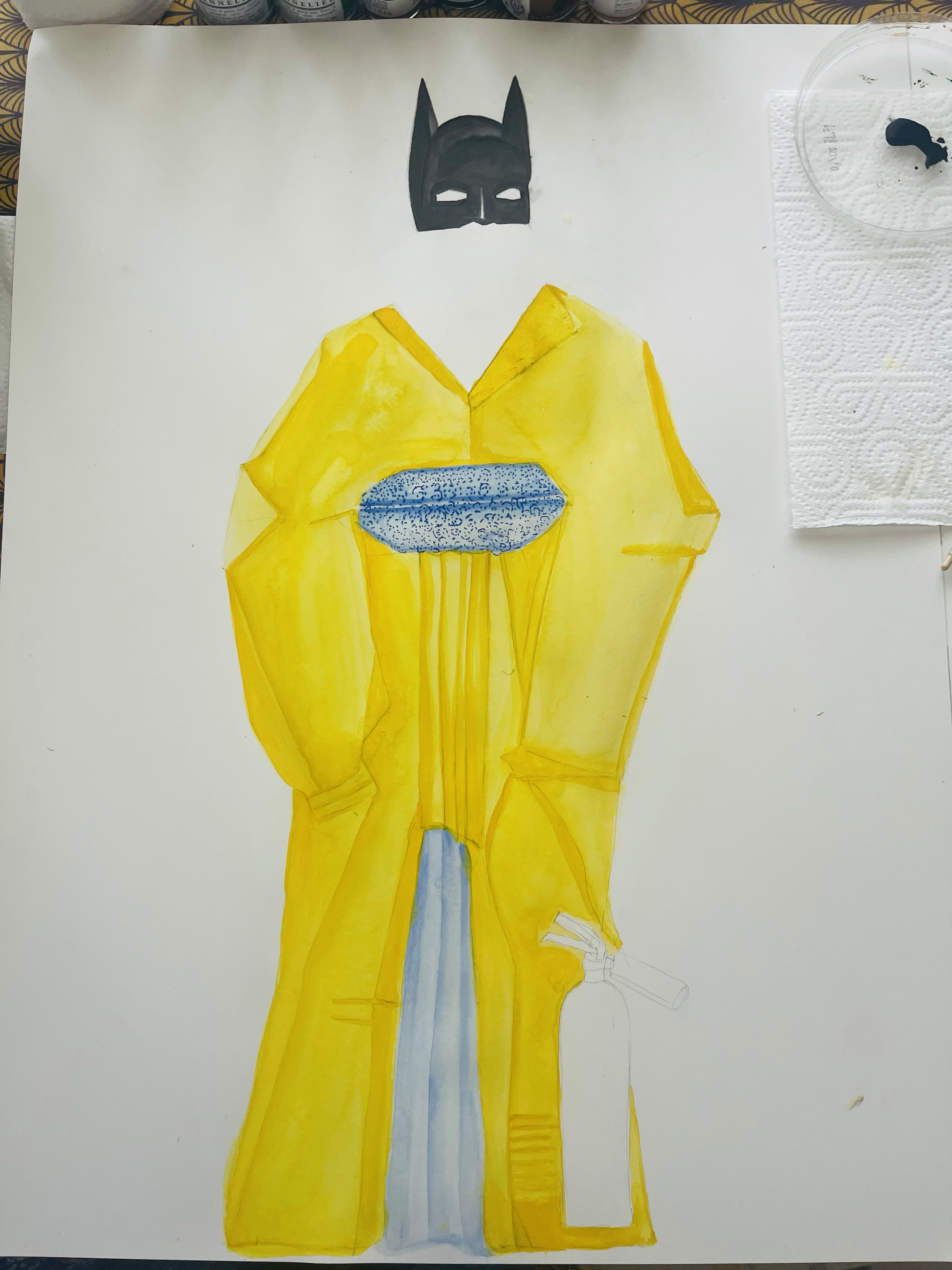

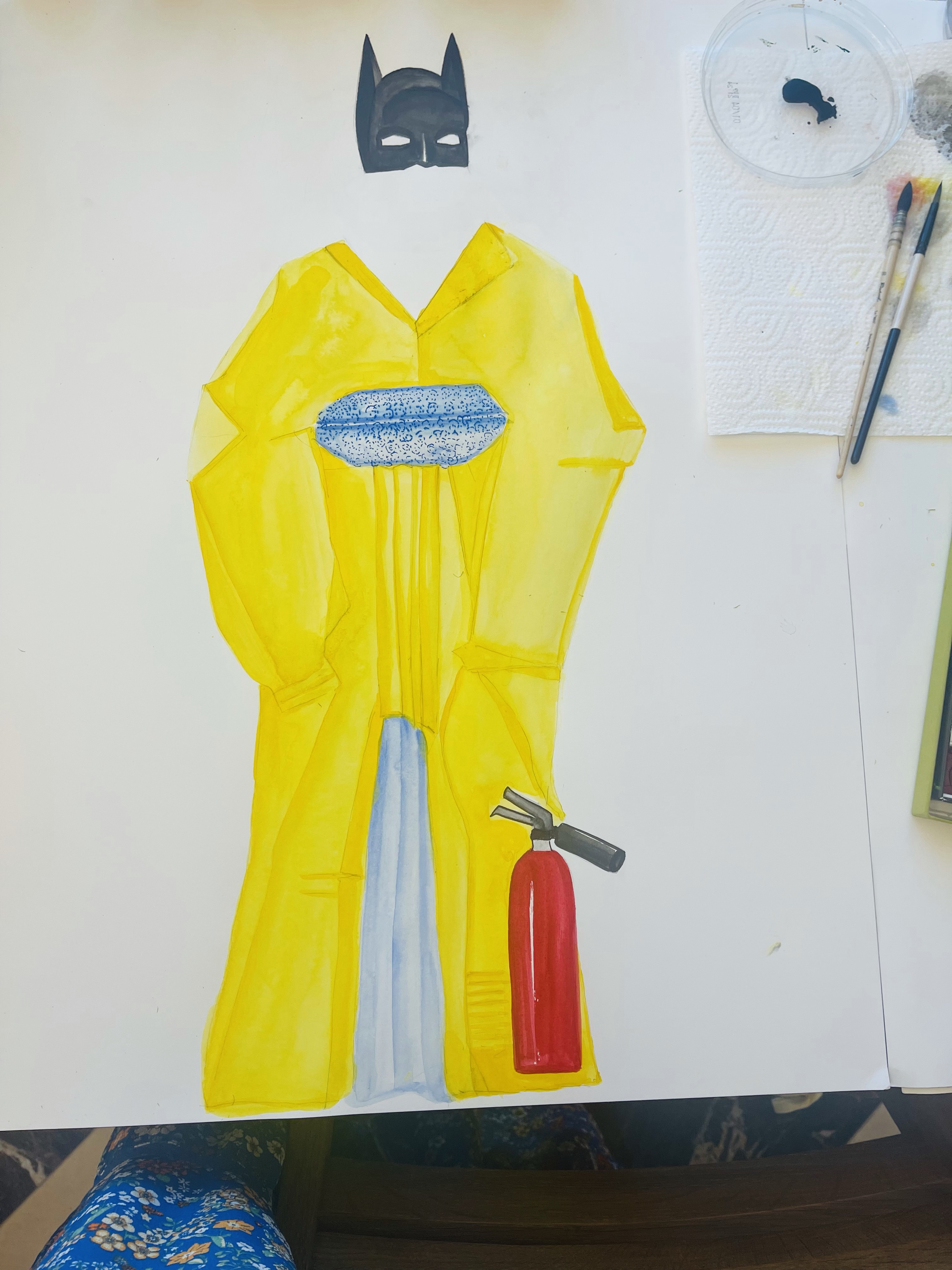

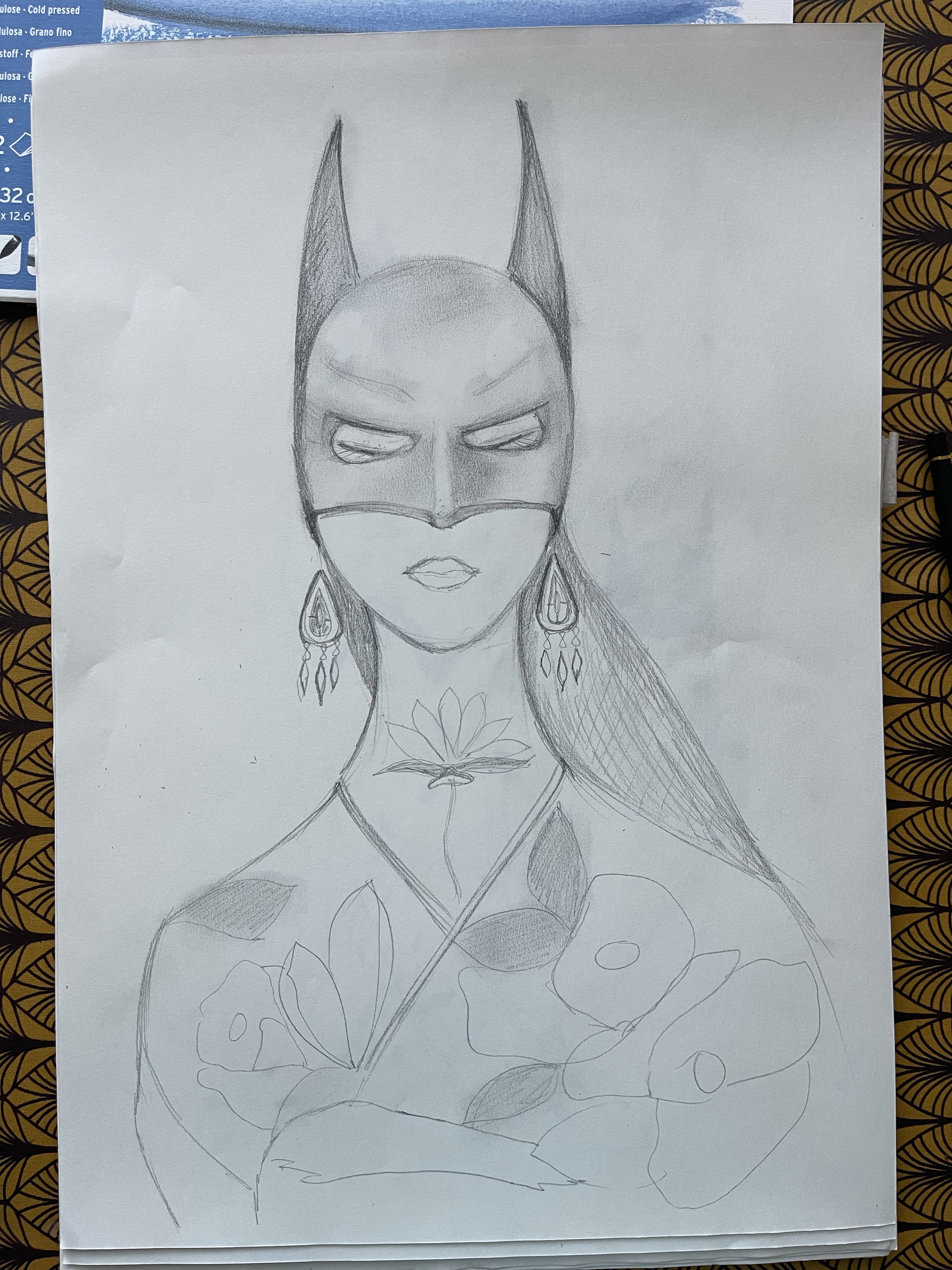
Sketches for the assignment




When I assembled my yellow paper kimono piece, I had no idea that I would develop it into an art project. However, the kimono started to live its own life straight from the beginning as soon as I stuck it to the wall. Now I understand that the piece began to “pick up” a contextual focus immediately, straight away. Batman’s black plastic mask’s installation idea quickly came naturally because the kimono was “asking” for a “head” to complete the image. Without the top, it was powerful but incomplete. The paper kimono directed me into a concept of “mission”, the mission of samurai, the mission of dutiful engagement in the battle. Batman’s mask revealed my constant inner tension and feeling of unavoidable fighting we have to endure while living our lives. Life on Earth is a sort of “mission impossible”. Any soul’s journey is to learn stoicism in hardship and courage, differentiate the Good from Evil, learn how to resist Evil, and fight it back. The same is related to the philosophy of samurai. That is why I think this mask and the kimono are in harmony. The image of the warrior shows the problematic existential crisis, which is always a part of living for every human. The fire extinguisher signifies the emotion of being often quite helpless in Life. Even if you don’t have any means to deal with the situation, you always have to deal with it somehow. I deliberately picked up a fire extinguisher instead of a sword or gun because it shows the conflict: we have to fight though we are not always are born warriors; we have to be ones. Maybe a plastic toy sword could signify our helplessness as well. That was my thinking at implementing exercise 1.
Throughout working on my research and readings, I understood that I could build a narrative with this beginning and initial installation. I find that the concept of existence, building and creating a narrative is integral to the cloth if it is used as an object in visual art. We can even say that cloth is always a story because it is a complex symbol containing many details from specific cultural contexts. It is never empty of ideas and meanings, as well it is never free from the viewer’s attempt to read these symbols and signs. So my story was naturally unfolding further from the initial installation to the final project. My realisation of the final image would not be possible without the exercise of taking photos of the paper made piece of cloth. When I placed the kimono I made on the chair outside, it looked tired and being left, as we leave our bodies as worn off cloth when we die. I can develop this idea into a triptych, which I sketched by implementing exercise 1.2. For the final assignment, I have decided to concentrate on one image, which would tell the first part of Soul’s journey, the beginning. I added seven chakras Sanscrit symbols, which contain seeds of our Karma. The seeds come as tiny white dots around the yellow kimono dress projection of the future body on Earth. Another addition is the lotus flower in the right “hand”, which I added as a symbol of God’s blessing he gives to each Soul. She just forgets about that.
It does require some knowledge about the Theory of Reincarnation and Hinduism, which are my project’s main contextual focus points. I like the outcome also because even if someone is not familiar with the details of the concept of Karma, chakras, etc., the image is still quite engaging. It is interesting to look at it. Most viewers get curious and try to understand the idea behind it. Even from the visual point of view, it appears as something not banal. Batman’s mask is familiar and intriguing at the same time. I am not humble here. I see a lot of potential for developing this idea further. I can do it as a triptych. I also can change the look of the kimono and make a female story. There are plenty of opportunities to play with it, think, and add more details.
I also have to review my work in relation to the assessment criteria. Therefore, I put the Assessment Criteria below in their order as they are placed on page 11, Introduction, Painting 2.
- Demonstration of technical and Visual Skills: Materials, techniques, observational skills, visual awareness, design and compositional skills; My comment: over the assignment, I followed all the instructions given for implementation of the exercises, which certainly somehow guarantees a versatility of technical approaches, tools and techniques, as well as a lot of experiments with them, design and compositions. I used different materials: paper, readymades, plastic toys and masks, equipment, and various types of mediums such as conventional and Japanese aquarelle, soft and dry pastels, oils and inks. I have made photographs, collages and installations, as well as drawings. I worked in aquarelle technique, pastels technique and oil paints techniques.
- Quality of Outcome: content, application of knowledge, presentation of work in a coherent manner, with discernment. The conceptualisation of thoughts, communication of ideas. My comment. The quality of my works’ content definitely varies. I have some more or less satisfactory pieces, such as the final project, installations and cloth-making using paper, and less successful works, such as the exercise about the reflective surface and hands staging.
- Demonstration of Creativity: Imagination, experimentation, invention, development of a personal voice; My comment: I feel very confident about the progress I have made so far in developing my personal artistic style. I started to deploy myself in something different from still life, which has been dominant in my artworks. I began to explore and learn abstract paintings and installations. There are no problems for me with being imaginative and creative.
- Context: Reflection, research (evidenced in learning logs). Critical thinking (evidenced in critical review). My comment: I have done all the research and readings required for the course so far. I put valuable notes for myself, write about the concepts learned, and make a link with my works.
 JeanArt