
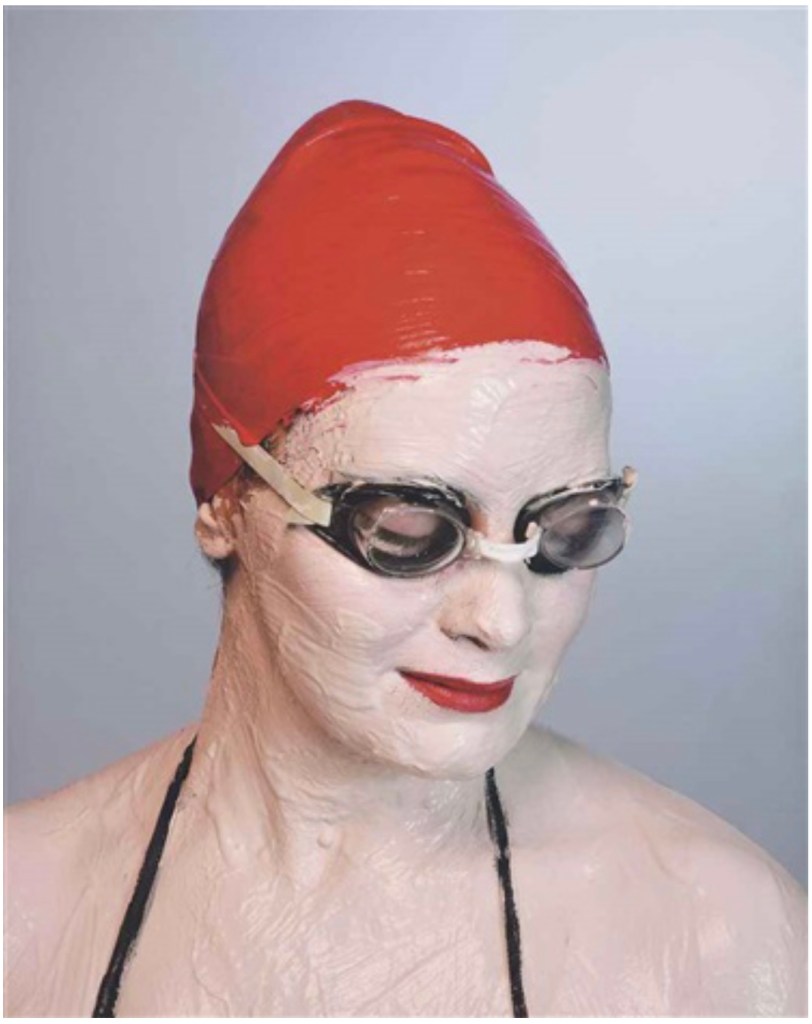
Research Point: The artist Boo Ritson. We have to do a research about Boo Ritson, about her artworks and working progress. We must reflect on following questions: What kind of questions her artworks raise? How do they speak about portraiture? In what ways does the paint act as a mask? What is the relationship between the paint, the sitter and the viewer?
From left to right: Joannie, Boo Ritson, 2008, image via http://www.artnet.com;
Red Swimmer, Boo Ritson, 2006, image via http://www.artnet.com;
Pilot, Boo Ritson, 20027, image via http://www.artnet.com;


Boo Ritson (1969-)
Boo Ritson is a British artist with a very original style of literally painting people, her models and recreating characters of American stereotypes. Her artworks blend sculpture, portraiture, photography and performance art. It should be noted that she usually has around 20 minutes for creating her artwork before the paint dries. So the paintings are short-lived and exist further only on photographs. Boo Ritson started her very original artistic journey as a trained sculptor. However, as the artist says in her interviews, she felt constrained working with one medium, so she experimented with her own body and painted people she knew. She has exhibited her works at different galleries in London and Los Angeles. Unfortunately, I could not find a video of her in a studio in the working process. Still, she describes her work process in detail in her interview with some local Oklahoma TV channel while having an exhibition there.
Boo Ritson writes a story, makes costumes, then looks for clothing, often on flea markets, finds models, dresses them up and covers them in household paint, usually using about 50 different colours. Finally, she takes photographs while the paints are still wet. She says people are her “three-dimensional canvas”.
What I think about Boo Ritson’s artworks. They are about stereotypic characters of American social life. She made up a Pilot, a Godfather, a Diner Waitress, a Trucker, etc. The artist shares her fascination with modern American culture. I think her artworks reflect how we feel in a society where we all have to perform a specific role and deal individually with social stereotypes related to particular social masks. At this point, it is precisely where the thick layer of paint comes to think about. It is a mask and a second skin—our artificially, socially constructed image of ourselves, totally covering and hiding our true identity? The viewer rarely sees the performance, the living ‘sculpture’. Most viewers only see photographs, flat, not three-dimensional images.
Bibliography: Link 27, Painting 2 Course book, “Rachel Russel”, online on http://www.rachelrussell.co.uk, [accessed on Feb 13th, 2022]; Boo Ritson, online on http://www.artnet.com, [accessed on Feb 13th, 2022]; “Boo Ritson”, by Lucia Davies, Nov 28, 2011 online on http://www.anothermag.com, [accessed online on Feb 13th, 2022]; “Boo Ritson: still alive”, by Aline Smithson, Oct 21, 2014, online on http://www.risekult.com, [accessed on Feb 13th, 2022]; “London -based artist views America through art”, August 10th, 2012, The Oklahoma Video Archive, Youtube, [accessed on Feb 13th, 2022];
Research Point 3: on Symbolism and significance of hands/feet across cultures.
Most symbolic meanings and significance of hands and feet are greatly represented in Hindu spiritual history and culture. Hindu visual arts traditionally incorporate a large number of symbolic hands gestures – “mudras” on images depicting God and His numerous forms. Hindu symbolic and philosophical tradition, which involves hand gestures, is especially rich, developed, versatile and profound. There are about 500 different meanings of hand gestures only in Hindu classical dance. This symbolism later has travelled across many countries, faiths and traditions. The most recognisable hand gestures are a greeting “Namaste” and an open, giving hand of Goddess Lakshmi.
From left to right: Lakshmi, Ravi Varma Press, 1894, lithograph,image via http://www.metmuseum.org; The Virgin Appearing to St Philip Neri, Carlo Maratta,1675, oil on canvas; image via http://www.en.artsdot.com;


We can often observe the famous Namaste gesture on religious paintings and in spiritual practices:


It is fascinating to observe mudras on Christian traditional visual arts objects, especially Jesus Christ images. He is often portrayed with a hand gesture, which looks like Hindu Prithvi Mudra, promoting healing and mental stability. At the same time Christian tradition explains thus hand gesture as Christ’s initials “ICXC”.


The symbol of Healer’s Hand in native American Culture, which look the same as North African and the Middle East “Hamsa” or Muslim tradition “Hand of Fatima”- right open hand, represented a presence of man, symbolised protection and healing. In the Christian faith tradition, open hand also represent trust, sincerity and the absence of evil. Hand as amulet appears in many cultures worldwide, starting from Ancient Hindu, Egyptian, Phoenician, Roman, Nubian, Berber and Arab, as well as Christian and Jewish. Mostly hand gestures are present in religious and spiritual artworks.
Hamsa hand print, Indu Prasad, Fine Art paper, image via http://www.saatchiart.com;
Feet are very symbolic object as well. “Lord Krishna’s lotus feet”, ” Lord Vishnu’s feet”, “Sri Lakshmi’s lotus feet’, “Guru’s feet” – these are ancient Hindu concepts which are still very common in India, vastly expressed in traditional visual culture. Washing or touching feet of God or Guru is a symbol of sincere expression of total respect, submission of ego. These rituals are deeply spiritual and meaningful.
Krishna’s Feet Drawing, Gauri Arora, Ballpoint pen on paper, image via http://www.saatchiart.com;

Krishna at the Feet of Radha: page from a Dispersed Rasikapriya,1634, ink and opaque watercolour on paper, Rogers Fund, image via http://www.metmuseum.org;

There are many paintings, depicting a Bible scene of Jesus washing feet of His disciples. I put some of them below:
Jesus Washing Peter’s Feet, Ford Madox Brown, 1852-6, oil on canvas, image via http://www.biblestudytools.com;

Christ Washing the Disciples’ Feet, Tintoretto, 1548-49, oil on canvas, image via http://www.museodelprado.es;

As it is explained on Bible Study Tools website: “By washing the feet of His disciples, Jesus demonstrated the way we should live by serving others in the name of the Lord. Jesus truly embodied humility and love for His neighbours as we should aim to emulate His example”.
Bibliography: ‘The Secret Language of Hands in Indian Iconogrpahy”, Andy McCord, illustrations by Richard Johnson, Feb 17, 2016, online on http://www.smithsonjanmag.com, [accessed on Feb 15, 2022]; “Mudra, symbolic gestures”, Surabhi Sinha, 2014, the editors of encyclopaedia Britannica, online on http://www.britannica.com; “Lakshmi”, The Metropolitan Museum of Art, online on http://www.metmuseum.com, [accessed on Feb 17, 2022]; “The Native American Healing Hand’, July 9, 2018, Kachina House, Your source for Native American Arts and Crafts, online on http://www.blog.kachinahouse.com, [accessed on Feb 17, 2022]; “Chironomia ( The Language of Gesture”, November 15, 2019, Trinity Iconography Institute, sacred icons, ancient techniques, online on http://www.trinityiconographers.org, [accessed online on Feb 17, 2022]; “Reaching Across the World: the Hand of Fatima”, January 15, 2016, by Lucian Dieterman, Hand iconography in Islamic and other cultures, The Jerusalem Fund for Education and Community Development, online on http://www.thejerusalemfund.org, [accessed on Feb 17, 2022]; Jesus Washes the Feet of His Disciples, March 29th, 2021, Editors of Bible Study Tools, online on http://www.biblestudytolls.com, [accessed on Feb 21, 2022];
Reading Points: LINK 28, Jan Verwoert, “Living with Ghosts: From Appropriation to Invocation in Contemporary art” online on http://www.artandresearch.org.uk, [accessed on March 30th. 2022];
Sherrie Levine “Statement” on http://www.theoria.art-zoo.com, [accessed on March 30th, 2022];
“Glenn Brown Conversation with Rochelle Steiner”, in ed.Myers, Terry, 2011, Painting,Documents of Contemporary Art, London:Whitechapel gallery and The MIT Press, p.167-168. on http://www.glenn-brown.co.uk; [accessed on March 30th, 2022];
The readings above make us reflect on the concept of originality in Art and the appropriation of ideas/concepts/ techniques/approaches in Art. Sherrie Levine’s “Statement” explains that it is impossible to create something 100% original: “We can always imitate the gesture that is always anterior, never original…. A painting’s meaning lies not in its origins, but in its destination”. Jan Verwoert delivers the same idea: people permanently have been appropriating things- thoughts, ideas, commodities, knowledge, integrating them into their lives. It is worth bringing the quote from “Living with Ghosts” by Jan Verwoert: ” Artists… take objects, images or practices from popular (or foreign) cultures and restage them within the context of their work to either enrich or erode conventional definitions of an artwork can be.” This saying is one of the most precise and comprehensive statements about Art I have read so far.
It would be helpful to illustrate the question raised in the readings, so I write about Glenn Brown. I have found interesting the discussion between Rochelle Steiner, a former Chief Curator & Director of Curatorial Affairs and programs atPalm Springs Art Museum and Glen Brown, a British artist famous for his reproduction of other artists’ works. As it is stated on his website: “Starting with reproductions from other artists’ works, Brown transforms the appropriated image by changing its colour, position and size.”(www.glenn-brown.co.uk). Below I put his artwork “Reproduction”, 2014, oil on panel. image via http://www.glenn-brown.co.uk
This painting is based on the work ” Bearded Man with a Velvet Cap” (1645)by Dutch artist Govert Flinck (1615-1660), image via http://www.metmuseum.org; Flinck was a student of Rembrandt. Brown changed the colour of the skin and the overall colour palette; he also remade the beard. Brown brings a parallel of freedom of speech to his way of creating artworks, using reproductions from other artists’ works. His own brushstrokes over them he considers as comments people do about someone else’s ideas and thoughts.
 JeanArt