
In the Research Point we have to look at works of the following artists:
Paula Rego (1935-)
Paula Rego is a well known Portuguese-British visual artists, specialising in figurative drawing. She was born in Lisbon in a family of electronic engineer who was anti-nazi and had liberal political views. She creates collages, paintings, large-scale pastels, ink and pencil drawings, etchings. In her artworks she brings intimate personal relationship narrative as well as feminist and political agenda. Art critics and art curators describe her works as “concerned with a struggle against domination, both sexual and political'(Juliet Rix, studiounternational.com). On of her most famous paintings is a series of works devoted to illegal abortions, they are described as ‘visceral’, ‘raw and powerful’. Most of her artworks are about women, as art critic Kate Kellaway says: ‘painting them in pain, power and surrender”.
I personally find Paula Rego’s artworks as very appealing to myself, because they are super emotional and sincere. Though I am not a big fan of figurative drawing as a visual arts genre. Nevertheless I adore her artistic manner of painting with large expressive block of colours and brushstrokes, which are powerful and sharp. Though her paintings are very expressive they seem to be very balanced. I like the fact that you can trace a story gazing at them.

Triptych, 1997-8, Paula Rego, pastel on paper, mounted on aluminium, Paula Rego Courtesy Marlborough Fine Art, image via http://www.studioonternational.com;
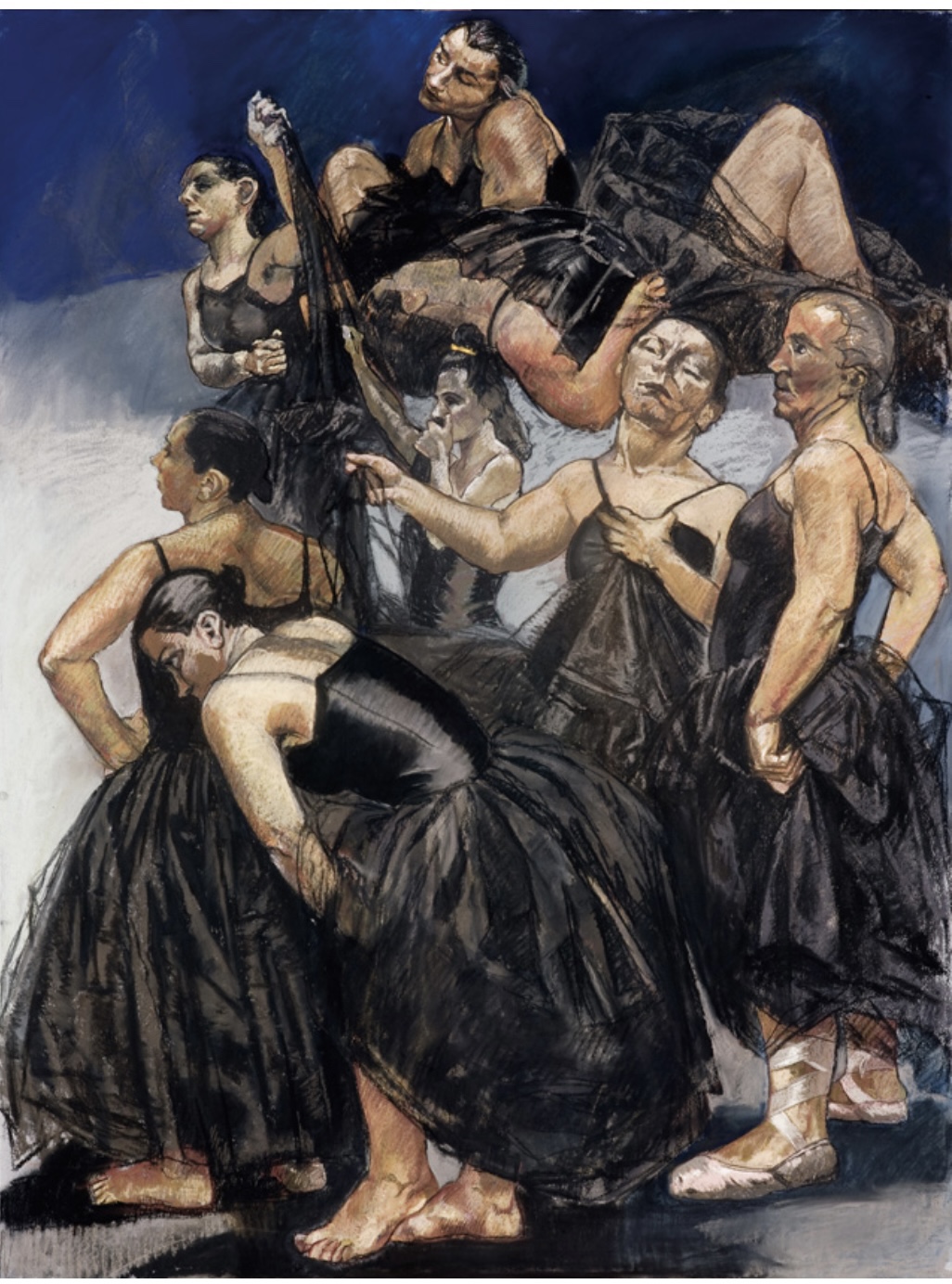

From left to right: Dancing Ostriches, 1995, Paula Rego, pastel on paper, mounted on aluminium, Paula Rego Courtesy Marlborough Fine Art, image via http://www.studioonternational.com;
An early Dog Woman drawing, 1952, Paula Rego, @Carlos Pombo, Courtesy Marlborough Fine Art, image via http://www.studioonternational.com;
Bibliography: LINK 25, OCA learning platform, Paula Rego: Telling Tales Clip, Jake Auerbach, Youtube, [accessed on Feb 1st, 2021]; Paula Rego, 7 July-24 October 2021; Tate Britain exhibition online on http://www.tate.org.uk; [accessed on Feb 1st, 2021]; “Paula Rego: “making a painting can reveal things you keep secret from yourself’, by Kate Kellaway, July 4, 2021, online on http://www.theguardian.com; “Paula Rego- interview: “I’m interested in seeing things from the underdog’s perspective. Usually that’s female perspective’, by Juliet Rix, July 4th, 2021; online on http://www.studiointernational.com, [accessed on Feb 1st, 2021];
Lisa Milroy (1959-)
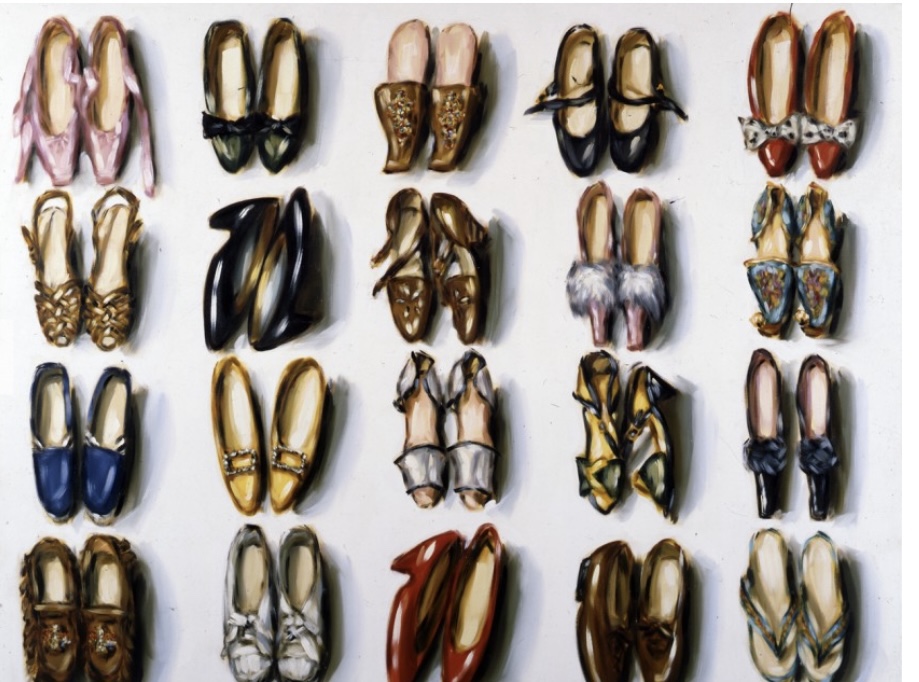
Lisa Milroy is an Anglo-Canadian visual artist. She received her formal art education at St Martin’s school of Art and Goldsmith College of Art, London. She paints everyday and household objects. She has been doing her solo exhibitions since 2004 in London, Zurich and Bristol. Her original artistic style is, as it is called, ‘ everyday objects arranged in a grid pattern against an off-white background” ( editors of http://www.artuk.org, a Dictionary of Modern and Contemporary Art. She also paints landscapes, building facades and portraits. She was awarded the National Museums Liverpool’s John Moores Prize in 1989. Lisa Milroy was also elected member of the Royal Academy of Arts in 2005.
From left to right:
Shoes, 1987, Lisa Milroy, oil on canvas; (image via http://www.lisamilroy.net);
Espadrilles, 2021, Lisa Milroy, digital print on Hahnemuhle photo rag, image via http://www.lisamilroy.net;
Party of One, 2013, Lisa Milroy, installation, painting and painting performed, image via http://www.parasol-unit.org;


Bibliography: LINK 26, OCA learning platform, Lisa Milroy, online on http://www.lisamilroy.net; [accessed on Feb 1st, 2021]; Lisa Milroy RA (b.1959), online on http://www.royalacademy.org.uk, [accessed on Feb 10th, 2022]; Lisa Milroy, Studio visit, TateShots, Youtube, Tate channel, [accessed on 10th, Feb 2022];
Pawel Althamer (1967-)
Pawel Althamer is a Polish sculptor, was born in Warsaw and attended the Academia Sztuk Pieknych, earning a degree in sculpture. He is also famous with his performances, installations and collaboration projects. He often works with organic natural materials such as wax, glass, grass, leaves, aiming to create fantasy and mystic worlds. Althamer’s works are very complex and not banal, I would say. He investigates simultaneously several dimensions in his installations, such as social, communal relationship, as well as transcendental, spiritual and supernatural elements in human’s existence.
From left to right:
“The Encyclopedic Palace”, Installation View, Pawel Althamer, 2013, plastic and plaster on metal construction, from the collection of UCCA center for Contemporary Art, image via http://www.artsandculture.google.com;
NOMO,”I (am)- Announcments -e-flux, 2009, Paweł Althamer, image via http://www.hamhelsinki.fi;
Self-Portrait as a Businessman, 2002, Pawel Althamer, image via http://www.tate.org.uk;


Bibliography: Pawel Althamer, B.1967, Warsaw, editors of Guggenheim, http://www.guggenheim.org, [accessed on 10 Feb, 2022]; Pawel Althamer, Self -Portrait as a Businessman, 2002, with additions 2004, online on http://www.tate.org.uk; [accessed on Feb 1st, 2021]; Pawel Althamer, born 1967, editors of Tate, online on http://www.tate.org.uk; [accessed on Feb 10, 2022];
As my own addition to this row of artists, who engage with clothing in a very artistic way, I would like to add Kenzo Takada and his artworks.
Kenzo Takada (1939-2020)
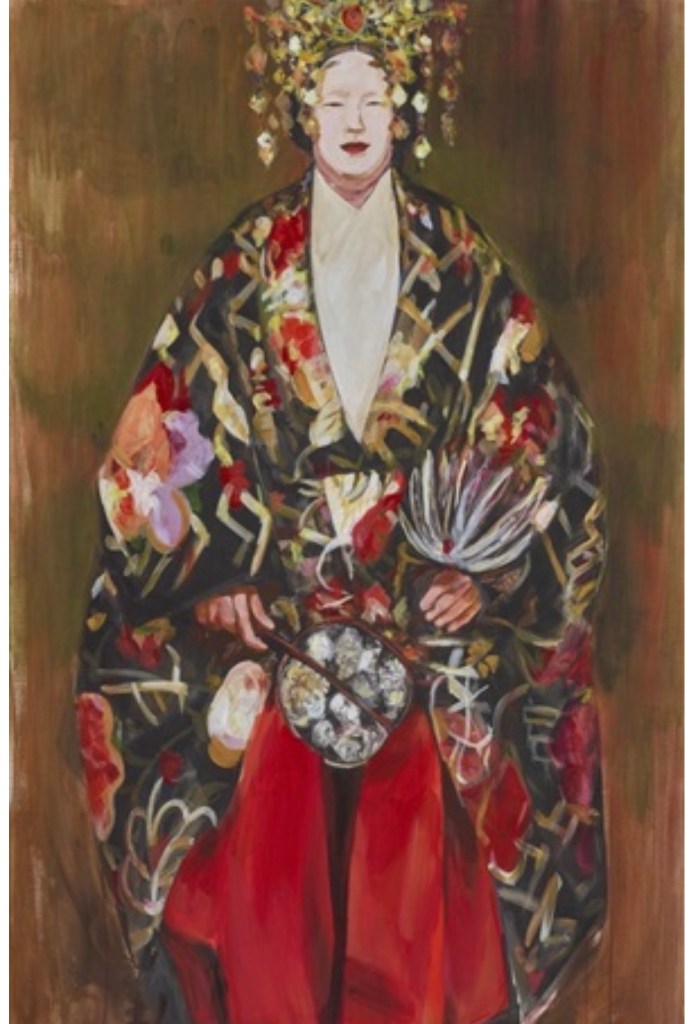
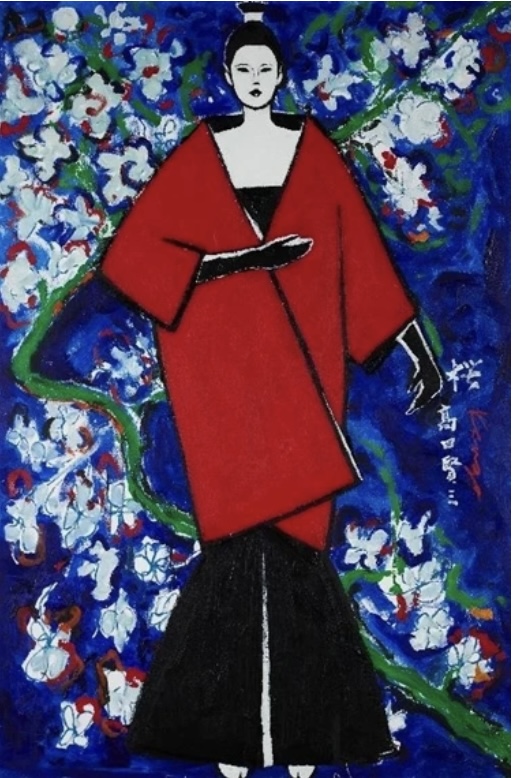
Kenzo Takada is mostly known as a Japanese fashion designer, who had become very successful on west with his fashion label Kenzo. He was born in Himeiji, Japan. Kenzo Takada received his training in fashion design at Tokyo’s Bunka Fashion College. Though his parents were very ,much opposite to his fashion pursuits, his talent was recognised by the industry as early as in 1960, when he received the prestigious Soen prize and started his professional fashion career at Sanai department store, designing girl’s clothing collections. In 1964 he moved to Paris and was invited to work for Louis Feraud, as well as to several department stores, Pisani textile group. In 1983 he launched his first menswear collection under the table Kenzo, in 1993 his brand was bought by LVMH. he retired in 1999 and died in 2020 in Paris.
Below I put some of his artworks. From left to right:
“Personnage en tenue de dignitaire japonais’, Kenzo Takada, oil on canvas, image via http://www.artnet.com;
N 6, 2010, Kenzo Takada, oil on canvas, image via mutualart.com;
Sakura II, Kenzo Takada, acrylic on canvas, image via http://www.mutualart.com;

Bibliography: “Kenzo Takada”, Bibby Sowray, 26 March 2012, online on http://www.vogue.co.uk, [accessed on Feb 12th, 2022];
We have to reflect on whether we enjoy and relate to these artists’ styles and artworks. I found Paula Rego’s artistic style and artwork very compelling to me. They are very emotional and powerfully made. I like the colours, the strokes and the compositional approach. Her subjects are very immersed in daily real-life, and their cloth is part of this deep immersion in reality. Lisa Milroy’s style is more abstract and less “speaking”. Her narrative is relatively silent and detached from the real world because she paints clothes without people wearing them. I consider these two artists as relatively polar views on reality around us: one is living a whole drama of Life, and another is showing us just some detached and cold fragments of this Life. Pawel Althamer’s works are very complex technically. I found his style amazing. He uses cloth as symbols of Life’s mission someone has to do. His NOMO serie is very much about the costume and attributes. He puts a lot of meaning in these elements of his artworks. Kenzo Takada as a fashion designer, had a great emphasis on showing the colours and shapes, patterns and decorations on the cloth. For him, the cloth he imagined and painted was the main object of the painting, a centrepiece of the artwork.
In all these artworks, the cloth is an integral part ( in Lisa Milroy’s paintings is a single part) of the idea or concept they tried to depict on the canvas.
 JeanArt
[…] I have made my research on Paula Rego earlier, here is the link https://zhan-art.com/2022/01/26/painting-two-part-three-research-points-for-project-1/(opens in a ne… […]
LikeLike