Exercise 1.1. In this exercise we have to heighten our observational skills and study our compositions rigorously in terms of everything we can observe: negative space, spatial relationships between the objects and the edges of the paper; we have to make a series of quick sketches observational studies of sections and details of the table. It is recommended to mix the drawing and painting media, to use the whole area go the paper. ‘The exercise is designed to develop your familiarity with and understanding of of the material qualities and spatial relationships that exist on the table.” (OCA, Painting Two course book, page 36);
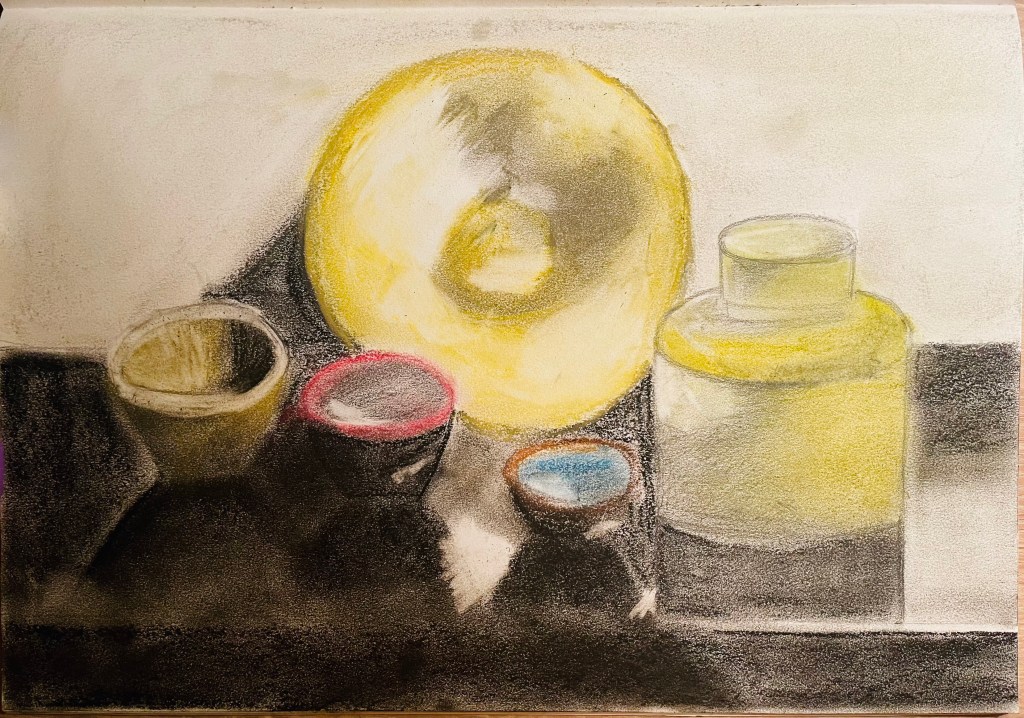
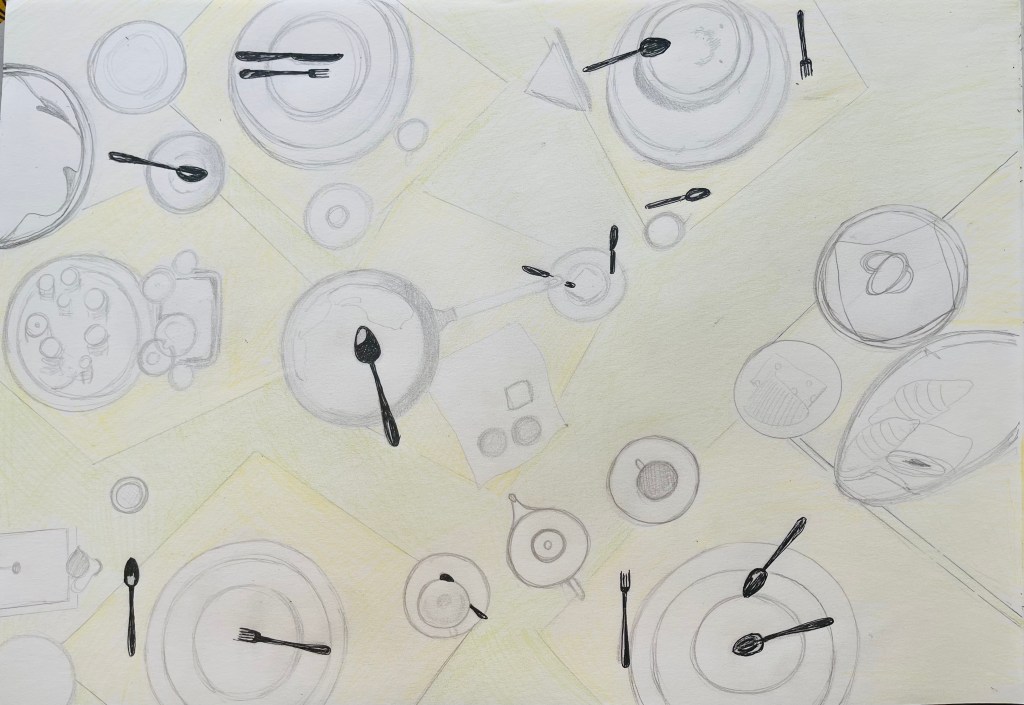
Below are my studies of my collection of objects. I used my Canson drawing paper in A3 size and different mediums from Derwent and CarandAche.


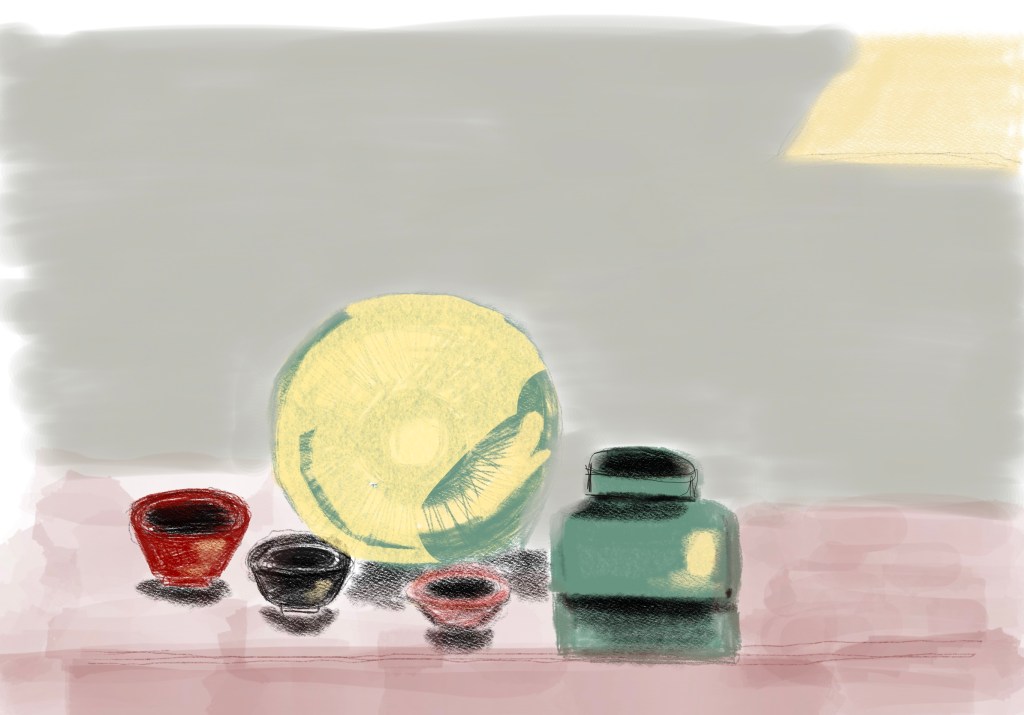
I also started to learn how to create digital art and made a sketch in Procreate app on my iPadPro 11 inch. tablet.
After I did my studies of my different compositions, I saw that I got very engaged with #1,#2 – both on black lacquered console, and #5 – which is one out of my four bustling and super interesting “after breakfasts” landscapes of plates and cutlery. Also, I enjoyed working with dry pastels – #1. Actually, at first, I did another composition with oil pastels with water on top. But, with dry pastels, it came out much better, more expressive and balanced. The negative space, such as the smooth light grey background wall behind the objects, came out even and played nicely with rich black shadows and sparkles of reflected light on the black console. It seems this study has more depth and volume. Study #2, which is, in reality, was done earlier, came out as very different because of the negative space – the background wall appeared as very busy with stripes and lines. However, I liked the shadows from the white porcelain teapot, a milk saucer and olive coloured vase. The reflected shadows from the objects on #2 on the console appeared delicate. But this study looks a bit flat.
Study #5 is one of my most perspective artistic ideas among these objects we had to assemble. I get very excited about this mess I observe on the dining table. It is a very different composition compared to studies #1 and #2 and #4. Because the view is from above and there is no play of light. The whole idea is about observing little details on the flat surface and finding a structure within this mess of plates, cups, forks and knives. Here I see the play of shapes and edges. This study #5 reflects my first view, but it can be developed in many more ways, for example I can do in abstract painting manner or in illustration genre. I consider this landscape as a good candidate for my parallel project.
 JeanArt