Exercise 1.1.Painting without the brush. In this exercise we have to set up a series of experiments that allow us to work with paint, apply it to a surface and expand the idea of gesture. Work at a large scale either on the floor or on the wall.
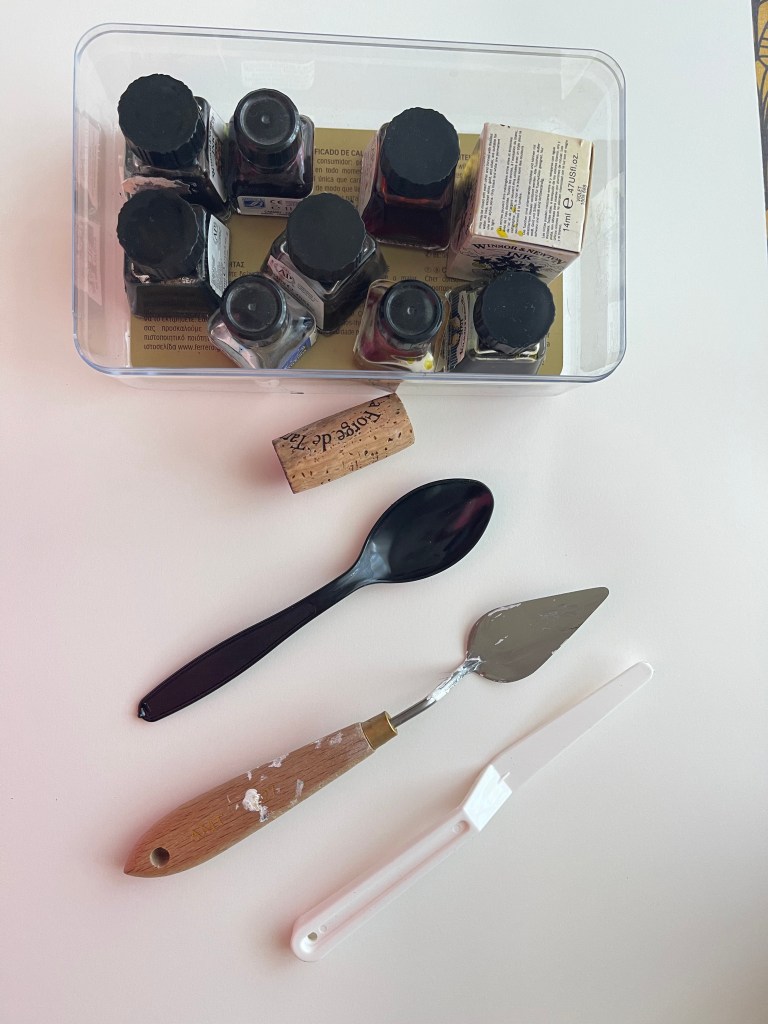
Below are my “brush substitutes”: a cork, a plastic spoon, a painting knife and a plastic knife. I used my collection of inks from Winsor and Newton and acrylic paint in Gold -AC23 from Fevicryl. The paper was from Canson, 75*150 cm.
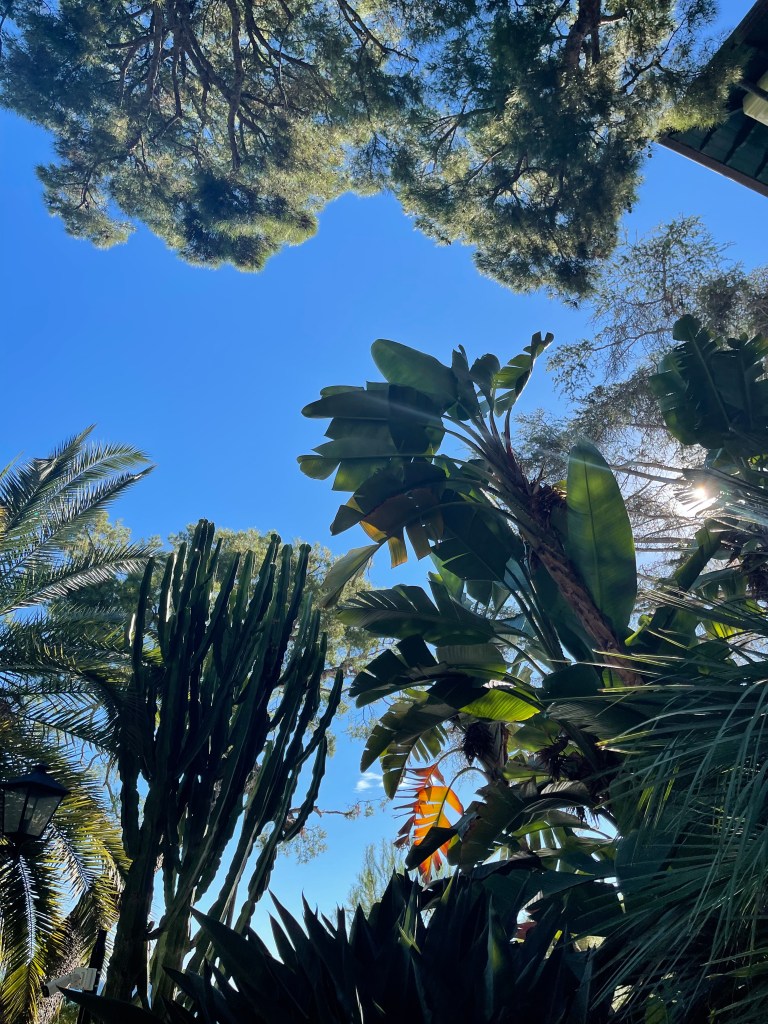
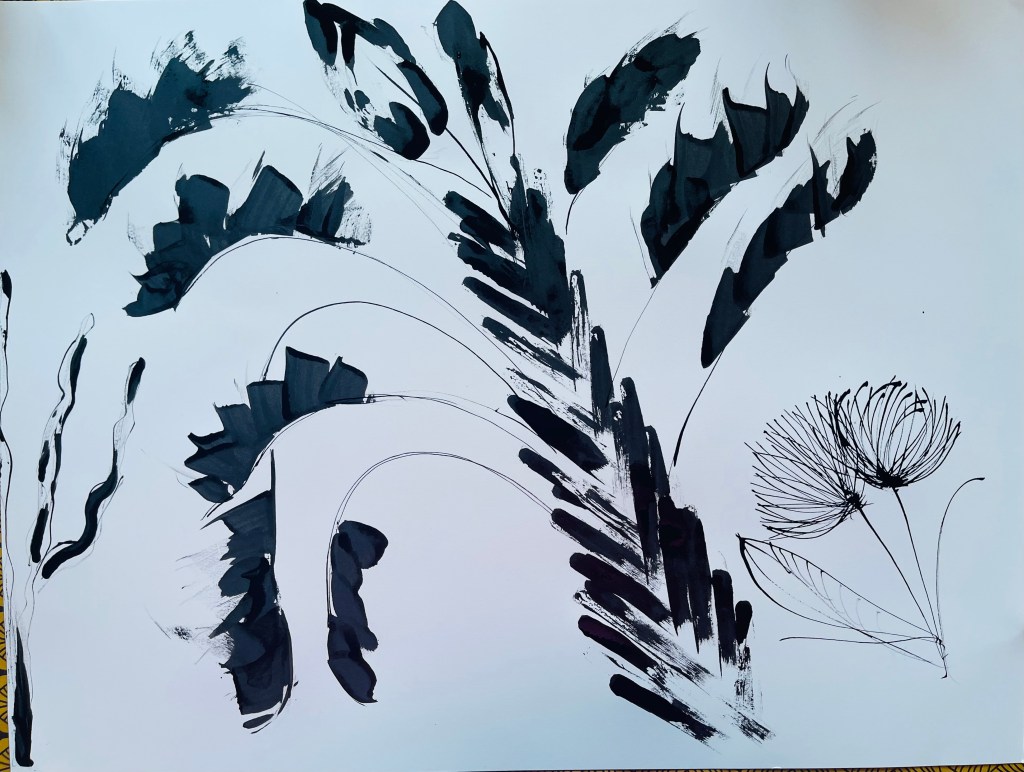
From left to right: 1) a fragment of the banana tree, leaves. Black ink and plastic knife. 2) cork, ink on paper.
3) plastic spoon, ink, acrylic on paper.
I used the painting knife for my abstract painting down below.
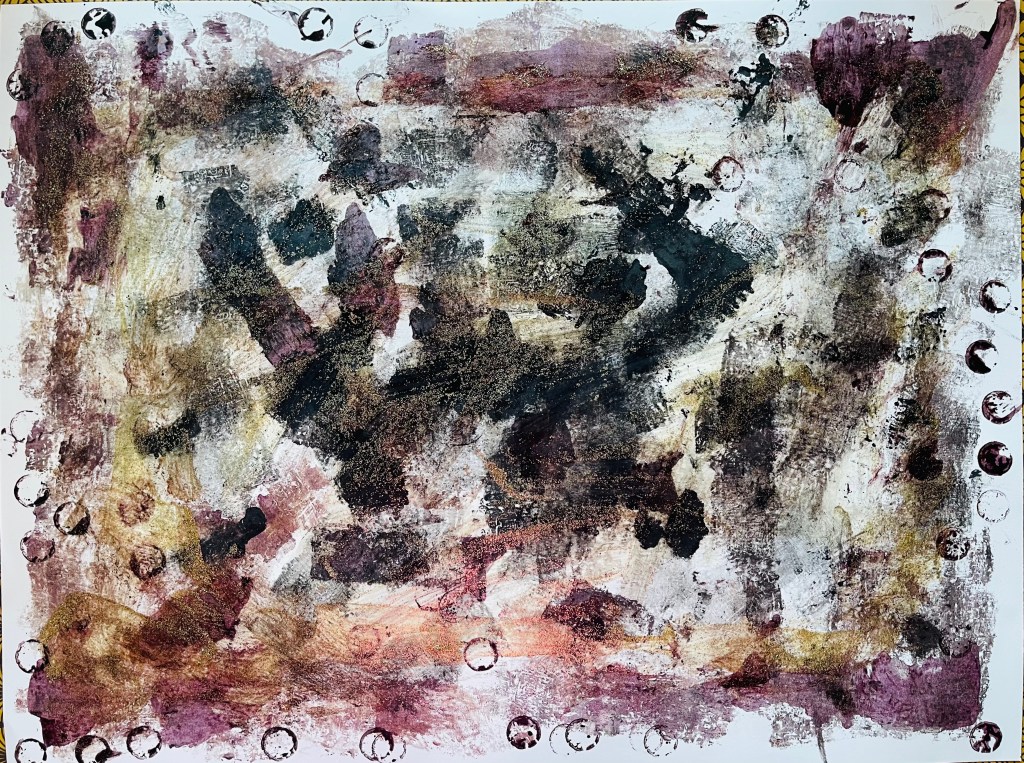
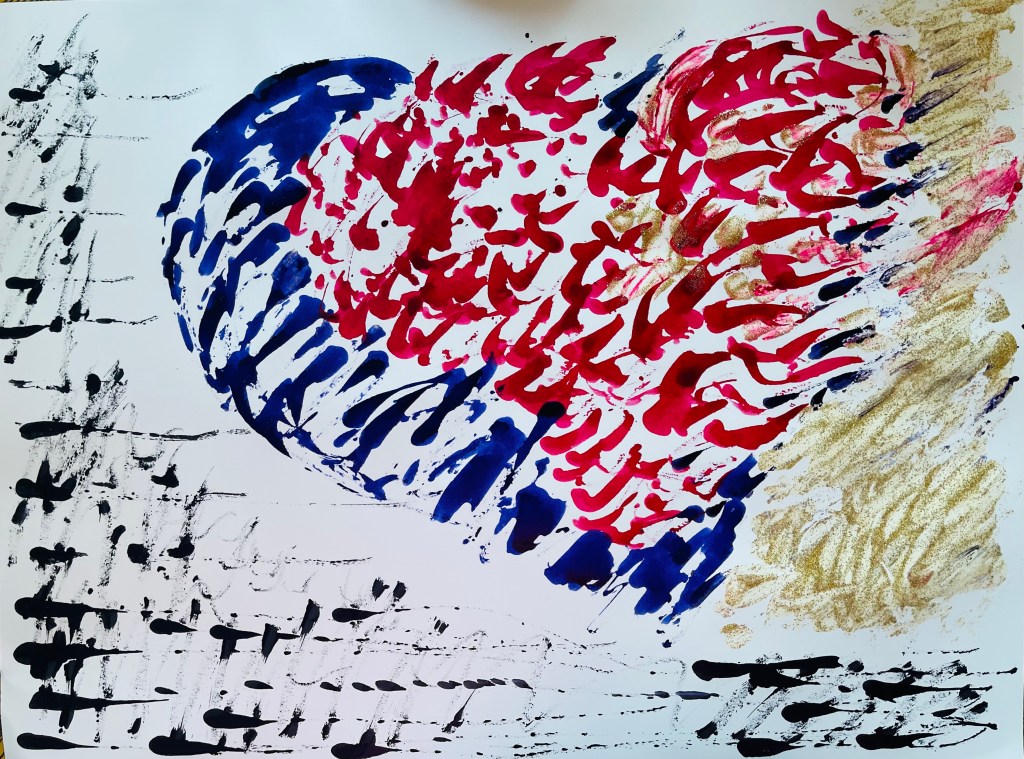
Below are videos I have made for the exercise.
Below are the outcomes of my ”no brush” painting process:
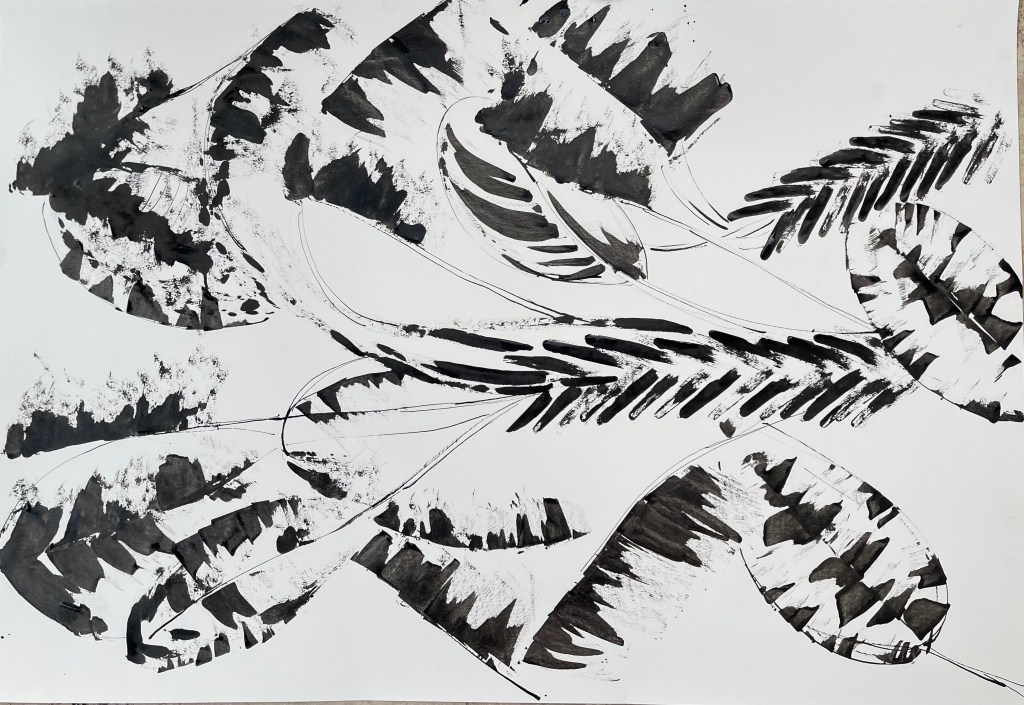
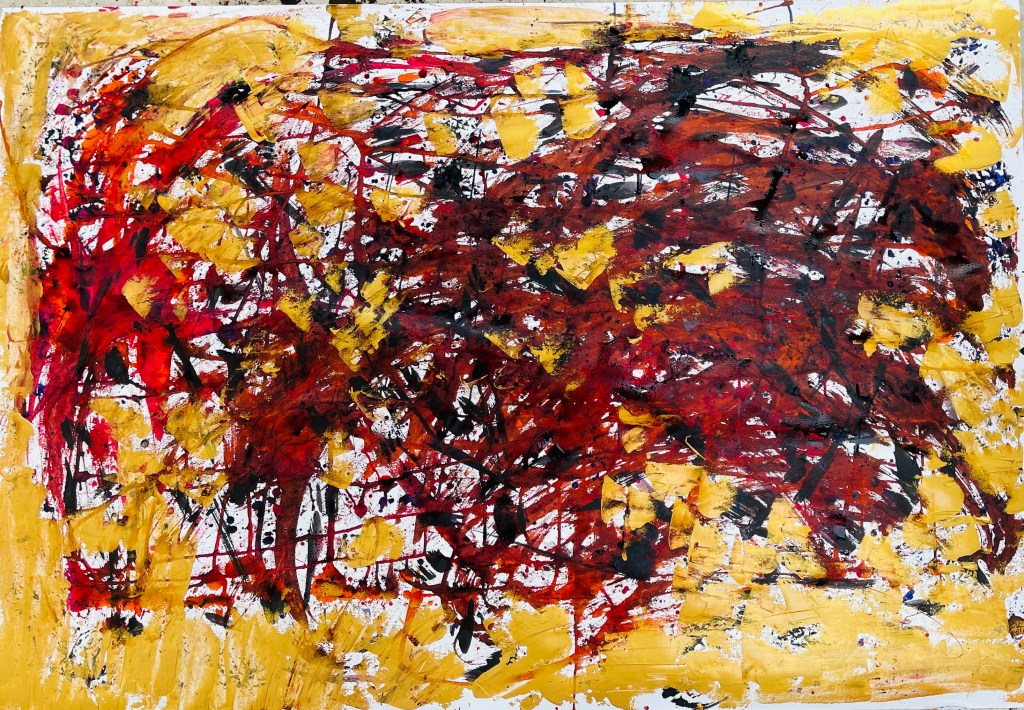
My self reflection on ‘no brush’ painting process.
Overall I have found this process very new. When you are deprived of your basic tool – a brush, changes you and literally pushes you towards new transition and exploration of your artistic capability and personal style. I also thought about how I would feel in front of a large canvas, since we were required to work on the large size. Was I intimidated or liberated? I will try to put my thoughts below.
- At this point in my artistic development, I can’t say that I enjoy all these large gestures, scattering, splashing and dripping. I don’t find all of these more artistic to me, although I would accept the idea behind this approach to painting as somewhat creative and worth trying and existing in other artists practices.
- It is crucial to outline that I fully accept the idea of total freedom to go for and get any outcome resulting from this practice. And I love it. Thus, even though my body movements were not particularly engaging for me while dripping and splashing my paints, I loved the outcome and the sense of exploration. The sense that you don’t know what is going to happen and with what you will end up. I really liked what Rebecca Fortnum said about process of painting (“Creative Accounting:Not Knowing in Talking and making,” 2013): “For virtually all artists, the search for the unknown outcome is not only welcome but provides a driving force within the creative process.‘
- Keeping this practice while working on a particular piece can be described for me as always fruitful. The more layers you do – the more options unfold in front of you, changing dramatically the overall direction of your painting. The feeling of the ongoing, never-ending process is even more prominent comparing when you use a brush.
- Size matters. Large size paper or canvas stimulate you to produce more energy for your work, which will be channelled on the surface, creating a powerful effect. After these exercises, I am very sure of it. Also, I started to understand the difference between small and large size approaches in the painting process.
- Personally, I really enjoyed working with a painting knife and extended my collection of this tool. I will do the final project for this Part 1 using the painting knife.
Bibliography:
‘The Pollockian Performative’, Jones Amelia (1998), online OCA student site; [accessed on 5.10.21]; ‘Revision of the Modernist Subject’, p.53-102, Jones Amelia, Minneapolis, online on OCA student web site, [accessed on 05.10.21];
‘Creative Accounting: Not knowing In Talking and Making’, Fortnum Rebecca, from ‘On Not Knowing: How Artists Think’, 2013, Fisher, Elizabeth & Fortnum, Rebecca, p.70-87, online on OCA student website, [accessed on October 6.10.21]
‘Theory of the Curse of the Brush’, from ed. Petra Lange-Berndt, Materiality, Documents of Contemporary Art, London, 2015, Whitechapel Gallery and MIT Press, p.65-66; online on OCA student site, [accessed on October 5th, 2021]; ‘Jackson Pollock 51’, Hans Namuth film, online on Youtube, facs 1900b, [accessed on 05.10.21]; Jackson Pollock’s drip-painting process, online on http://www.sfmoma.org, [accessed on 05.10.21];
 JeanArt