
In the final assignment of Part 5 of Understanding Visual Culture course we are required to do the following. We must reflect on in what ways video installations differ from films shown in a cinema? List the physical differences and use these evidence to explain the differences in experience and aesthetic appreciation. Think about the environment as well as the immediate space in which film is shown. Consider the types of film and elect an example for more detailed discussion. The essay must contain 1000 words.
I think it is essential at the beginning to clarify the term ‘video installation.’ Johanna Gosse describes video installations as: “video installation encompasses an expansive field of moving image practices, formats, and configurations, from multichannel film projection to video sculpture to immersive and interactive media environments” (Oxford Bibliographies). Video installations are categorized as contemporary art, performance, and conceptional art. It is also essential to understand that video installations often are complex structures, which represent intersecting media such as experimental cinema, video art, installation art, digital and new media art, music, and more.
Further below, I would like to describe video installations’ effects on viewers” perceptions, created by various artists. I researched their artworks on YouTube and read articles about them on museum and galleries websites.
Tony Oursler (1957-) is interested in sculptural video installation exploring such themes as transmission, reception, physical and social influence of the television medium. ‘Oursler has developed an ever evolving multimedia and audio visual practice utilizing projections, computers, video screens, sculptures and optical devices, which might take form as large scale installations or intimate digital effigies or bots, ethereal talking automatons or immersive and sometimes cacophonous environments. (Tony Oursler, http://www.lissongallery.com).
Fragment from” Station” installation by Tony Oursler, image via http://www.tonyoursler.com;

Ann Hamilton (1956-). Ann Hamilton is famous for her massive large-scale installations. As J. Fiona Ragheb writes in her article ( http://www.guggenheim.org) about Ann Hamilton: “Hamilton’s work foregrounds sensory experience and evokes memories that are rooted in the body, operating in a seemingly prelinguistic or entirely nonverbal realm’.
Stan Douglas (1960-). Stan Douglas is a Canadian artist, predominantly interested in photography and film making, exploring modern image-making technologies and their influence on collective psychology and memory. In his famous video installation “Doppelgänger” he “intentionally heightens the viewer’s feeling of displacement through a continual sense of reversal and mirroring, both in the form and content of his installation” (David Zwirner, http://www.galleriesnow.net).
Still from Doppelgänger, 2019, by Stan Douglas, @Stan Douglas, image via http://www.wallpaper.com;

Ryoji Ikeda (1966-) is a Japanese visual and sound artist who creates video installations and sound works to explore the aesthetics of data. His video installations are described as “sensorially immersive”, ‘spectacular sensory overload’ ( Cleo Roberts-Komireddi, the Guardian, 9.05.2021).
Fragment from a video installation by Ryoji Ikeda, image via http://www.factmag.com;
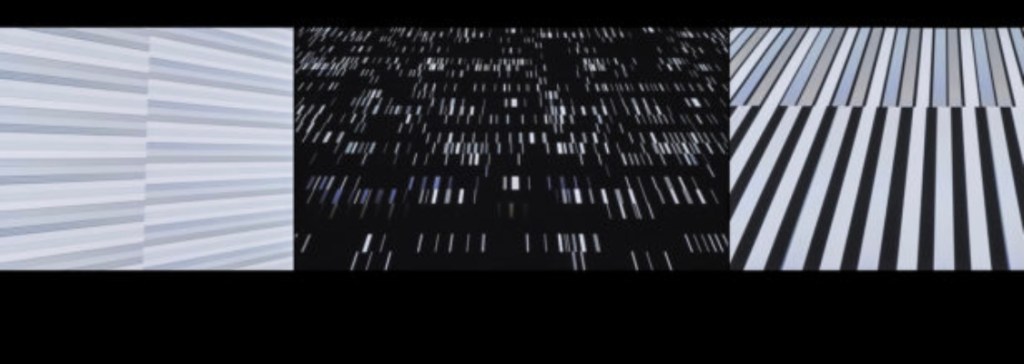
Below is the list of physical differences between video installations and films in a cinema:
Video Installation (“VI”) versus Film in a cinema:
VI can be placed, take place, and can be experienced by viewers at any place and location suitable according to the artist’s idea because the location is a part of the installation. A film can be watched, experienced only from a particular screen, location of viewer’s experience – watching the movie doesn’t matter at all for the film’s creator.
VI requires and includes various additional objects as a part of the artwork. However, the film is an artwork by itself and doesn’t require any other additional objects.
VI invites a viewer to participate in the installation, like walking in and experience different sensor stimulations, not only visual stimulation. However, the film doesn’t assume a viewer to be an active participant; the film assumes a viewer to be a distant observer.
As mentioned above by various art critics about different video installations, it is prevalent for video installations to be described as ‘immersive’ and ‘sensory-stimulating experience.’ I can say that video installations are technically more complex objects that stimulate not only our visual and audio senses, but our tactile, spatial senses. Thus viewers have a dramatically different experience when they walk in immersive video installation and watch a film in a cinema. Regarding aesthetic appreciation we receive from video installations, I can say that video installations require us to go beyond conventional boundaries of our aesthetic feeling as a type of conceptual art. The whole outcome as viewer’s perception after participation in video installation can be complex and controversial because video installation is rarely entertainment, while a film is often is.
Bibliography:
1)Station, Tony Oursler, Magasin 3, Stockholm, Sweeden, Sep.21-Dec. 15, 2002, online on http://www.tonyoursler.com [accessed on August 12, 2021];
2) Tony Oursler, Lisson Gallery, online on http://www.lissongallery.com; [accessed on August 12, 2021];
3) Video Installation, Johanna Gosse, 26.02.2020, Oxford Bibliographies, online on http://www.oxfordbibliographies.com; [accessed on August 12, 2021];
4) Ann Hamilton (linings, video), Collection online, J.Fiona Ragheb, Guggenheim, online on http://www.guggenheim.org, [accessed on August 12, 2021];
5) “Stan Douglas, Artnet,” online on http://www.artnet.com, [accessed on August 12, 2021];
6) “Stan Douglas’s riff on alternative realities us seeing double”, Jessica Klingelfuss, February 13, 2020, online on http://www.wallpaper.com, [accessed on August 12, 2021];
7)” Stan Douglas: Dopplegänger,” David Zwirner, Galleries Now, online on http://www.galleries.now.net; [accessed on August 12, 2021];
8) “Ryoji Ikeda presents: test pattern”, Henri Bruce-Jones, Fact, online on http://www.factmag.com; [accessed on August 12, 2021];
9) “To Infinity and Beyond: the spectacular sensory overload of Ryoji Ikeda’s art,” by Cleo Roberts-Komireddi, The Guardian, Sun. May 9, 2021, online on http://www.theguardian.com, [accessed on August 12, 2021];
Added after receiving my Tutor’s feedback. My self reflection and comments.
My Tutor’s report was again very professional and specific about my ability to grasp the concepts to learn in this part of the Course. All of his comments are engaging and valuable.
I want to reflect on some of his comments in detail. Below is one of his comments from the feedback:
‘Thorough demonstration in fluency with theory. There is continued evidence of a developed sense of theory with an ability to hold/grasp a number of viewpoints and positions in contemporary art. You understand Dantos descriptions of works and (not)works of art as an introduction to the post-readymade experience of contemporary art. Again I think your own coming to terms with texts is often inhibited by a reliance on lengthy passages drawn from theorists.“
Yes, I tend to include lengthy passages and lengthy quotes because of my lack of theoretical knowledge. However, I feel safer when I support my view/answer to the question if I incorporate an academic theoretical quote. I also want to sound prepared and objective, so I avoid placing my view or my understanding without referring to someone authoritative via quote. Frankly speaking, I don’t feel ready to write about art and complex philosophical concepts without those quotes. The Tutor is an astute and observing teacher. I don’t always feel confident about my ‘own coming to terms with texts’ because I am too attached to digging for theory and afraid to walk away from it further to explore the concept. I agree with his observation to the full extent. I hope to perform better in future as I do my further readings and accumulate more knowledge about the Theory and Philosophy of Art.
Below is another of my Tutor’s comments I would like to comment on in detail.
‘In Exercise 5.3 you highlight a notable high-profile example of where contemporary art is challenged around accusations of its identity/agency as art. You begin a cogent introduction and setting of the work, firstly setting out its resonance beyond the confines of the gallery. Bringing in more than one voice and reference in the assembly of your thesis would have provided better balance. I felt the questions you posed weren’t given the space to be followed up on – such as elaborating on what is context in this instance. Exercise 5.2 was omitted, although you indicate that this will be re-visited later on.‘
As he recommended, I have added to my post for Exercise 5.3 some additional two exciting views on Tracey’s Emin ‘My Bed’ artwork. I also developed my thoughts and gave more space to answer the question.
About the Exercise 5.2. I didn’t understand the question finding the wording obscure. I have asked my Tutor about this exercise during our online session, and he confirmed that he did not understand the question in the exercise either.
 JeanArt