
Exercice 4.5. Apply the Dialectic diagram to Barr`s. What would count as thesis, as antithesis and a synthesis.You will need to refer to images of art works for a persuasive answer.
Barrs chart describes the history of the evolution of visual arts movements within 1890 -1935 and is devoted mainly to the origin of Cubism and Abstract art. Barrs chart starts with Neo-Impressionism and ends with Geometrical and Non-geometrical Abstract art, stating “Cubism and Abstract Art” at the bottom line. It guides us through numerous art currents and movements from the point of very realistic and figurative art, Impressionism and Neo-Impressionism, until non-referential Abstract Art, depicting unrecognisable forms and shapes.
In general, I dare to say that we can find a dialectic dialogue on the chart between Realism and Abstract in Art. Each part in this conversation is represented by several art movements that also play as Thesis and Antithesis. Thus I see the main dialogue between Realism – central Thesis, represented by Impressionism and Neo-Impressionism and attempts of denial of the traditional way of doing and understanding art via emphasising the role of imagination and emotions- Cubism and Expressionism -as the main Anti Thesis and an Abstract Art as a newly emerged Synthesis as a result of this intense dialogue. Within shorter periods on the chart`s timeline, we can also find some “local” disputes between evolutionary stages such as Impressionism and Neo-Impressionism or Expressionism and Constructivism. In those shorter periods, we can also identify the Thesis and the AntiThesis, leading to the emergence of the Synthesis – Abstract Art.
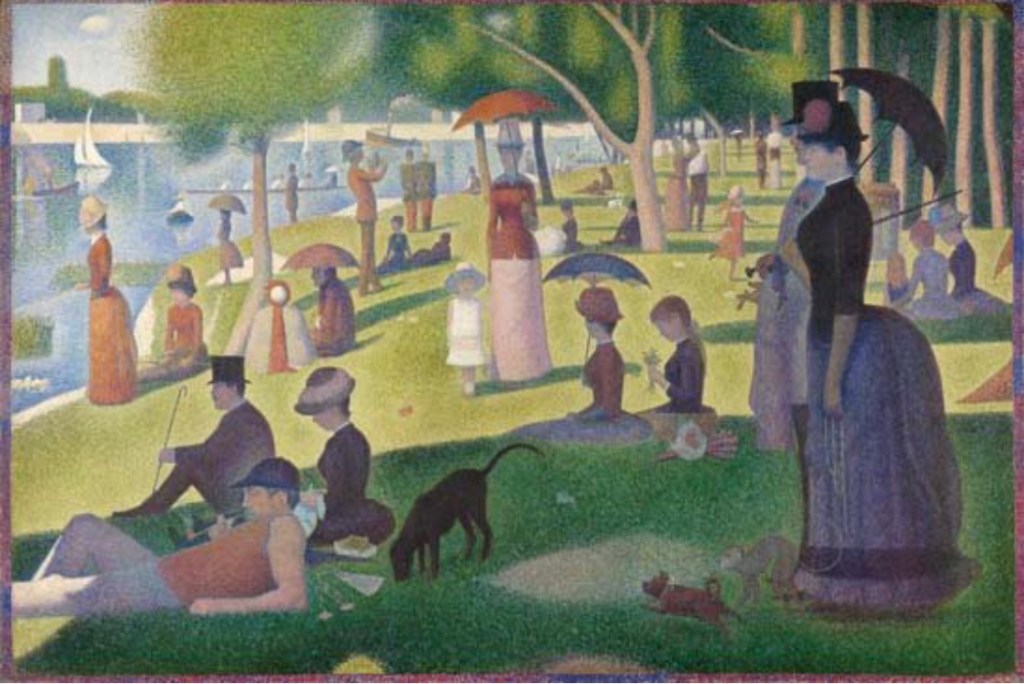
The chart starts with Neo-Impressionism, which I consider as an Antithesis to the mainstream movement of Impressionism -Thesis- of the late 19th century. Neo-Impressionism was against the empirical realism of Impressionism, trying to bring a scientific base of light and colour theory, new research in optics, achieving specific visual effects via different techniques. Impressionists were known for their spontaneous manner of catching light and colour on their canvases. At the same time, post-impressionists used to paint with a meticulous process of placing (often a calculated number) tiny uniform size dots, studying and following the scientific theories. Below I put for comparison two artworks to illustrate the above mentioned:
On the left: Dance at le Moulin de la Galette, oil on canvas by Pierre -August Renoir, 1876; Musée d`Oursay, Paris, image via http://www.britannica.com;
On the right: A Sunday on La Grande Jatte, 1884-1886, oil on canvas by Georges Seurat, in the Art Institute of Chicago; image via http://www.britannica.com;

Further on Barrs chart, we can see the emergence of Fauvism and Cubism. Notably, the 20th century is when Abstract forms of visual arts emerged as an established art movement. Most art historians do establish a link between these two art movements with Impressionism and Neo-Impressionism. Artists continued experimenting with colours and perspective, and fauvists are considered very emotional, working with pure, intense and bold colours in expressive and brisk brushstrokes. As an Antithesis, emotional and vivid Fauvism had become a new Thesis and Cubism, tried to bring some logic and structure, fragmenting the objects in a new concept of space. Cubism had become a turning point when Abstract Art announced itself as a new phenomenon at the worlds art stage, bringing on canvases unrecognisable objects.
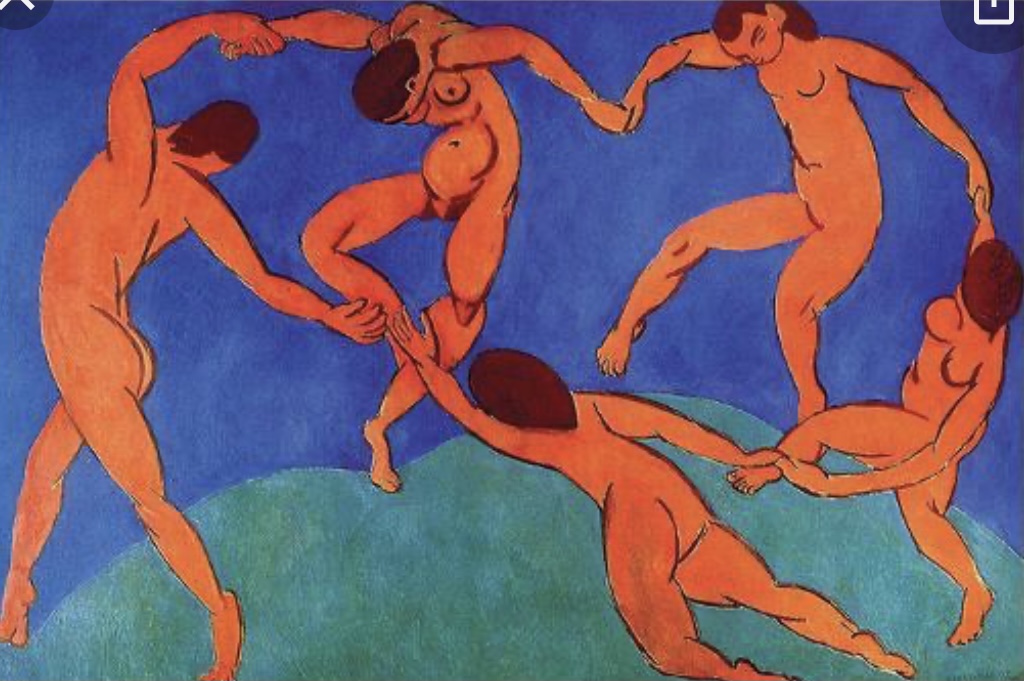
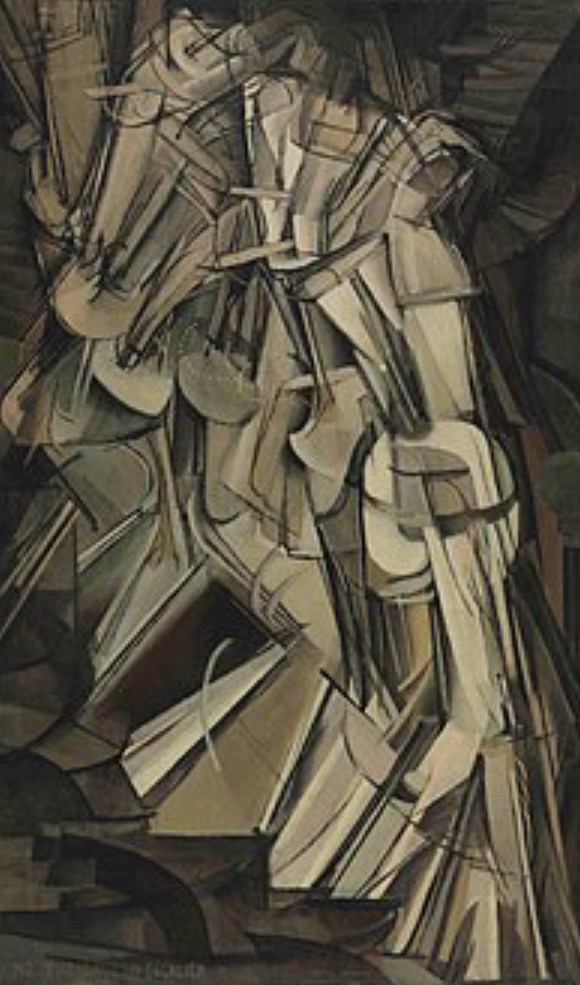
Below I put 3 artworks depicting female nude figures which illustrate very well the process of change of understanding and making art from realism to abstractionism:
On the left: Reclining Nude, 1883,August Renoir, oil on canvas, image via http://www.metmusem.org;
In the middle or on the right if you are reading my blog on computer: The Dance, Henri Matisse, 1910, oil on canvas, image via http://www.henrimatisse.org;
On the left or on the bottom if you are reading my blog from computer: Nu descendant un escalier No2, Marcel Duchamp, 1912, oil on canvas; image via http://www.khanacademy.org;

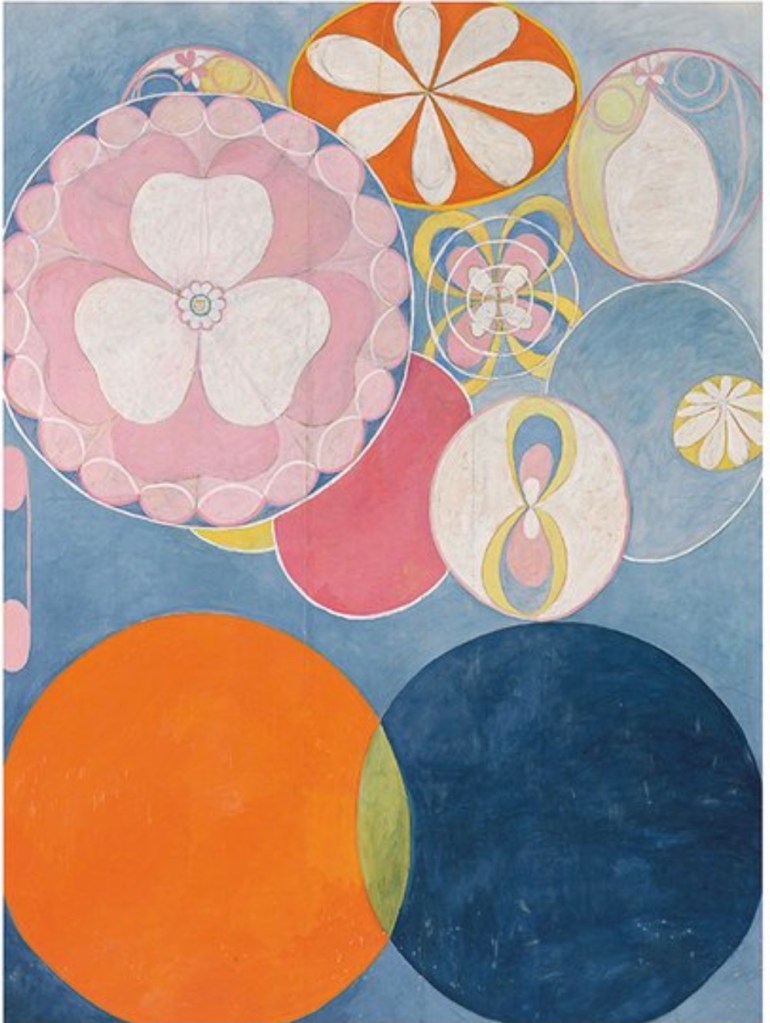
However, Swedish painter Hilma af Klint (1862-1944) and Wassili Kandinsky created their abstract works as early as 1906 and 1910. We can find Cubism and Abstract Expressionism on Barr`s chart around 1905- 1910. Below I put these artworks as examples of western earliest abstract art:
On the left: Primordial Chaos, No 16, 1906-1907, Hilma af Klint, image via http://www.tate.org.uk;
On the right: The Ten Biggest, No 2, 1907, Hilma af Klint, oil on tempera, image via http://www.tate.org.uk;

On the left below: Horses, 1909, Wassily Kandinsky, image via wassilykandisnky.net;
On the right below: Untitled, 1910, Wassily Kandinsky, watercolour; Indian ink and pencil on paper; image via http://www.wassilykandinsky.net;


It is interesting to see that Kandinsky`s paintings dated 1909 still contain some recognisable images as in the “Horses” paintings above, but in 1910 he produced totally abstract work.
Below I put two more artworks which I consider as good examples of Thesis and Antithesis struggle in visual arts history of this period of time.
On the left: Decorative Figure on an Ornamental Background, 1925-1926, Henri Matisse, oil on canvas; image via http://www.britannica.com;
On the right: Nature Morte (Violon et Compotier), 1910, Georges Brague, image via http://www.sfmoma.org;


It is interesting to see another “local” dispute on the way to a new Synthesis, between Expressionism and Constructivism emerging around 1910 and 1915 on the chart. These art movements reflected a geopolitical struggle between the Soviets and the capitalist world, mainly represented by the USA. Constructivism was a tool and a weapon for the oppressive Soviet regime to achieve its social and political goals, serving as a propaganda tool of Soviet socialistic values. While Expressionism, flourishing from the mid-forties in the USA, was a counterargument to Soviet propaganda and oppressive totalitarian political regime, emphasising an idea of freedom and individuality in society. Constructivism brought more focus on flat geometrical shapes into artworks, further pushing the evolution towards abstraction. We can say Impressionism and Expressionism were representing a line of Thesis, and Neo-Impressionism, Cubism and Constructivism were a line of Anti Thesis pulling art evolution towards Abstract. I see this because Impressionism and Expressionism were more about emotions and being spontaneous. At the same time, Neo-Impressionism wanted to bring a theory and Cubism, along with Constructivism, pursued a more logical, system-based approach in painting. Below I put two artworks representing Expressionism and Constructivism:
On the left: Davos under snow,1923, Ernst Ludwig Kirchner, oil on canvas, image via http://www.artyfactory.com;
On the right: Hit the Whites with the Red Wedge!, El Lissitzky, 1920, poster, online on http://www.artsy.net;


At the end of the chart, I see the Thesis line, which included Impressionism through Fauvism, Expressionism and Surrealism, showing us the evolution of art towards non-geometrical abstract art and the Anti Thesis Neo-Impressionism, Cubism, Constructivism, brings everything to geometrical abstract art. Abstract Art is a new Synthesis.
Bibliography:
1)Abstract Art, Editors of Encyclopaedia Britannica, July 1998, online on http://www.britannica.com; (accessed on July 10th, 2021);
2) Cubism, The Editors of Encyclopaedia Brittanica (eds), 2000, Gloria Lotha, 2007, online on http://www.brittanica. com (accessed on March 12th, 2021);
3) Fauvism, Sabine Rewald, Department of Modern and Contemporary Art , The Metropolitan Museum of Art, online on http://www.moma.com (accessed on March 12, 2021);
4) Why Kandinsky chose an abstract art? Gaby Reucher, 2016, online on http://www.dw.com (accessed on March 16, 2021); Museum of Art, October 2004, online on http://www.metmuseum.org (accessed on March 14th 2021);
6) Cubism, Editors of tate.org.com, online on http://www.tate.org.uk (accessed on 12th March 2021);
6) Modern Art, Editors of Encyclopaedia of Art (eds), online on http://www.visual-arts-cork.com (accessed on 12th of March 2021);
 JeanArt