
Exercise 4.3. In Your own words (one brief paragraph) say what you think creation and affirmation are link here
I think Hallward well describes the link between “creation” and “affirmation” as “To affirm is to create rather than to bear or endure” (P.Hallward sites as NP p.186). I have found that there is a particular concept of “affirmation” in philosophy, established by Nietzsche. He insisted that human` s existence should be free from fears to live life fully, to its maximum extent, to be not afraid to deal with the violence of external forces, to embrace the existence with all its hardship and wonder. According to Nietzsche: to think and to live what is equal to create. Deleuze very well explains this: “Something in the world forces us to think.” (DR 139). These encounters confront us with the impotence of thought itself (DR 147), and evoke the need of thought to create to cope with the violence and force of these encounters”, as well as further “life making thought active, thought making life affirmative” (Deleuze 1983, p. 101). I understand that the phenomena of thinking as our human reaction to life, as our natural reaction to our existence, is very much intertwined with making and taking decisions, revealing our willpower. This willpower is our life driving force, along with our thoughts and ideas. Thinking implies decision making and taking action, all together they are very life affirmative.
Exercise 4.4. Say to what extend Giotto`s painting can serve to illustrate the quote by Deleuze. (200 words);
The quote:
“Let us imagine something which is distinguished – and yet that from which it is distinguished is not distinguished from it. The flash of lightening for example, is distinguished from the black sky, but must carry the sky along with it….. One would say that the bottom rises to the surface, without ceasing to be the bottom. There is, on both sides, something cruel – even monstrous- in this struggle against an elusive adversary, where the distinguished is opposed to something which can not be distinguished from it, and which continues to embrace that which is divorced from it.” (Deleuze, 2014, 361);
Bondone di Giotto, the Kiss of Judas, 1305, copyright Bridgeman Images, image via OCA work book, Understanding Visual Culture;
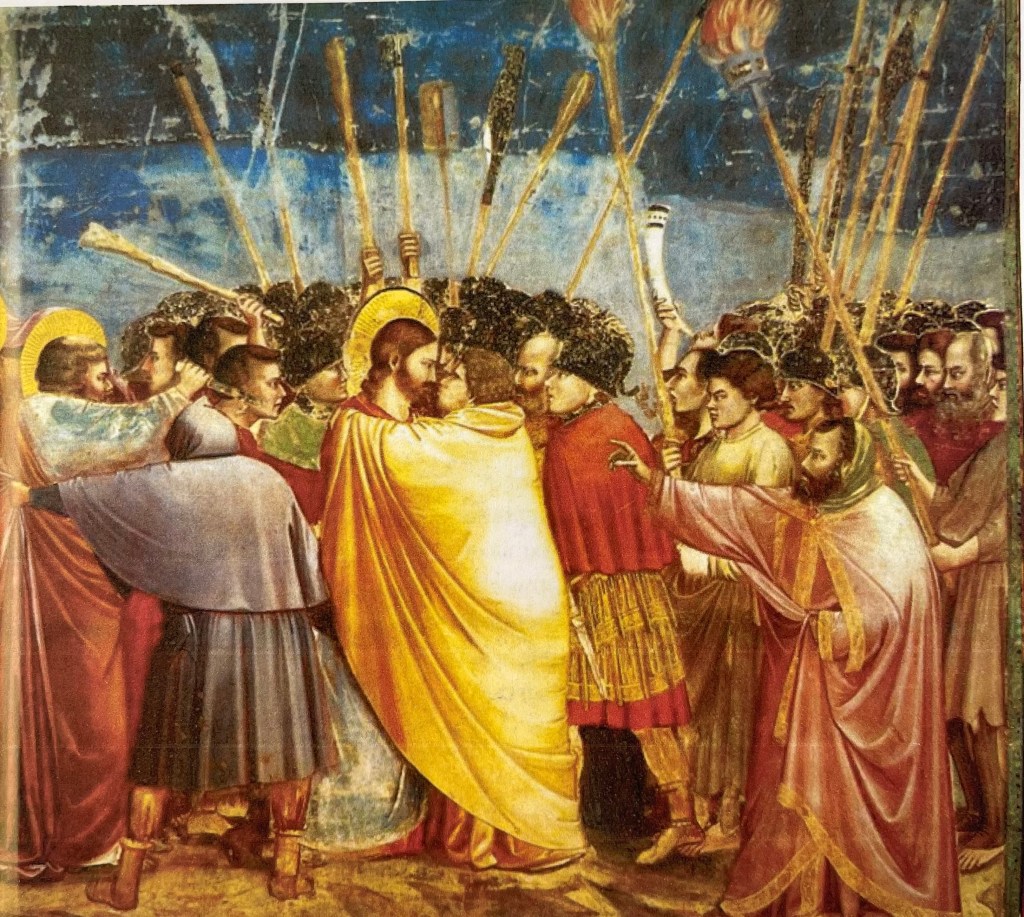
I think this particular painting of Giotto is a great example and illustration of this quote of Deleuze.
My understanding of Deleuze’s saying is that we can not understand the subject (a thing, a being, an event) without a specific background (system or context). Moreover, we should not try to detach the background; otherwise, we won’t see and won’t understand the subject, the idea. Something different can not be seen, noticed, understood and appreciated without a distinguished – another thing that exists but doesn’t distinguish itself from what is different.
Giotto’s painting illustrates a moment of betrayal and arrest of Jesus. It happens at night, and he is surrounded by a dense crowd that gives an impression of something fatal, deeply tragic, and desperate. The absence of any space around Jesus, the density of the background indeed provides a strong sense of no escape and inevitable danger for Jesus. The main subjects of the painting are Jesus and Juda. The latter is kissing Jesus. Without the surrounding background, we can not tell the story of betrayal. Through dark blues night skies and people around, standing tightly around them, the fire sticks in the night sky, Giotto aims to manifest the tragedy of the moment of betrayal. Otherwise, if we imagine different backgrounds, like no people or a serene landscape, we could interpret the moment of a man kissing another one in a very another way, as a simple life moment. The rising background with all its elements indeed can be seen as “monstrous and cruel”. The image of Jesus with his calm face is like a subject that is “divorced” from the darkness, “embracing” the subject power.
______________________________________________________________________________________
Some notes from P.Hallward:
“The idea of difference which is to say the idea of differing ideas, will allow us to think distinct creative trajectories. The production or creation of difference is what there is. It is precisely creation what is self enabling and self creating, itself enables everything it creates. The only condition for our understanding of creation, as we shall see, is thus its affirmation pure and simple” (P.Hallward, p.13).
“In an incredibly rich passage of Thus Spake Zarathustra, ‘Of the Vision and the Riddle’, Nietzsche makes it clear that the capacity to live life affirmatively involves the ability to throw off the Spirit of Gravity, which cripples us with its cowardice, its idealism and hatred of the present. Similarly, thinking affirmatively might involve that we approach our problems with a kind of playfulness, a lightness that will enable us to attack our own convictions and turn things around in a new light”
Bibliography:
- Out of This World. Deleuze and The Philosophy of Creation, Peter Hallward, Verso 2006, online on http://www.scribd.com (accessed on 05.07.2021);
- Difference and Repetition, Gilles Deleuze, Columbia University Press, 1994, online on topologicalmedialab.net, (accessed on July 1st, 2021);
- Affirming Creativity: Playing with Concepts, Dr Maria Hynes, School of Sociology, Research School of the Social Sciences, Australian National University, online on http://www.gold.ac.uk/media;(accessed on 06.07.2021);
- Gilles Deleuze, Editors of Stanford Encyclopedia of Philosophy, First published Fri May 23, 2008; substantive revision Wed Feb 14, 2018, online on http://www.plato.stanford.edu; (accessed on July 7th 2021);
- Gilles Deleuze (1925-1995), Editors of Internet Encyclopedia of Philosophy, online on http://www.iep.utm.edu, (accessed online on July 7th 2021);
- Say Yes to the World: on Nietzsche and Affirmation, Tomasz Stawizinski, 10 September 2020, online on http://www.bigthink.com (accessed on July 9th, 2021);
- Justification or Affirmation?, Peter Hallward and Christian Kerslake, RP 114, July/August 2002, online on http://www.radicalphilosophy.com; (accessed on July 9th, 2021);
______________________________________________________________________________________
Some notes of helpful explanations from Dr Maria Hynes,
- “What interests me here is the opening to an understanding of creativity that is oriented less to the kind of attributive schema that would privilege the subject and more to the mannerism of the event. Taking our cue from the kind of mannerist treatment of concepts deployed by Deleuze (1993) in The Fold, we could best translate the notion of creativity into the infinitive form, ‘to create’, where the latter would involve a kind of play with concepts, which for their part, are neither essences nor identities, but events that do the work of difference. Thus we might ask of the concept of creativity, not ‘what is its nature?’ (what is the essence of the concept?), but ‘what is its manner of acting and affecting?”
- “It is with such questions in mind that the remainder of the paper undertakes what might be called a mannerist play with a series of concepts (capacity, affirmation, event, singularity, art, time, habit), each of which speaks in some way to the overall challenge of maximising the connection of thinking to the forces that make it creative, before it is captured as an attribute of subjects.”
- ”I have been suggesting that in order to connect thinking to the forces that make it creative we need to grasp the constitutive nature of those very forces – that we are not essentially different from, nor spared of, their effects. The second task, as it were, is to engage in an active evaluation of forces as they express themselves. Of course, the forces of the world are themselves neither good nor bad, but are indifferent to these valuations. As humans who are ourselves subject to the adventures of force, we seek, through such endeavours as science, morality, culture and politics, to differentiate ourselves in the face of the indifference of nature. Human life, Nietzsche suggests, is inseparable from valuing and preferring and the human being’s essential work, its “creation of the world” is embodied in this difference‐creating gesture.”
- ”And one of the defining characters of affirmative thinking is an active evaluation and experimentation with the temporality – the duration – proper to problems. The genetic elements of such experiments, to put it in Deleuzian terms, are singularities – bifurcations or remarkable points, which can only be expressed in the infinitive form because they are not yet attributed to subjects and objects.”
______________________________________________________________________________________
Below I put some notes from “Difference and Repetition”, Gilles Deleuze, 1994.
- “The difference ‘between’ two things is only empirical, and the corresponding determinations are only extrinsic. However, instead of something distinguished from something else, imagine something which distinguishes itself – and yet that from which it distinguishes itself does not distinguish itself from it. Lightning, for example, distinguishes itself from the black sky but must also trail it behind, as though it were distinguishing itself from that which does not distinguish itself from it. It is as if the ground rose to the surface, without ceasing to be ground. There is cruelty, even monstrosity, on both sides of this struggle against an elusive adversary, in which the distinguished opposes something which cannot distinguish itself from it but continues to espouse that which divorces it.” (P. 30);
- ”In truth, all the forms are dissolved when they are reflected in this rising ground. It has ceased to be the pure indeterminate which remains below, but the forms also cease to be the coexisting or complementary determinations. The rising ground is no longer below, it acquires autonomous existence; the form reflected in this ground is no longer a form but an abstract line acting directly upon the soul. When the ground rises to the surface, the human face decomposes in this mirror in which both determinations and the indeterminate combine in a single determination which ‘makes’ the difference.” (p.30);
- ”Goya worked with aquatint and etching, the grisaille of the one and the severity of the other. Odilon Redon used chiaroscuro and the abstract line. The abstract line acquires all its force from giving up the model – that is to say, the plastic symbol of the form – and participates in the ground all the more violently in that it distinguishes itself from it without the ground distinguishing itself from the line “. (P.31);
- ”There are four principal aspects to ‘reason’ in so far as it is the medium of representation: identity, in the form of the undetermined concept; analogy, in the relation between ultimate determinable concepts; opposition, in the relation between determinations within concepts; resemblance, in the determined object of the concept itself. These forms are like the four heads or the four shackles of mediation. Difference is ‘mediated’ to the extent that it is subjected to the fourfold root of identity, opposition, analogy and resemblance.” (p.32);
 JeanArt