
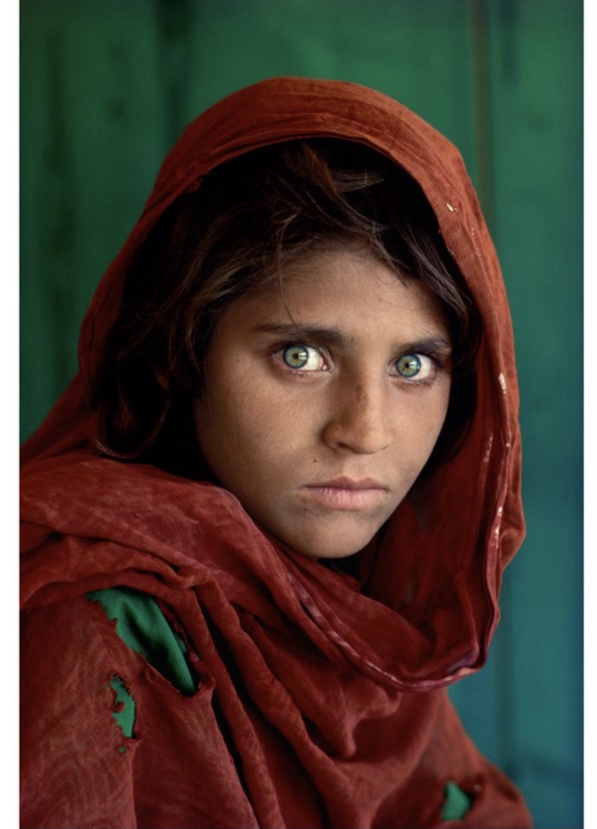
Exercise 2.4: For the picture of your own choice say how the image indicates a point of view for the spectator and say why you think the effect is rare in the cinema but common in photography. Does the painting or photograph represent eye contact between someone in the picture and ourselves. What films have you seen when characters treat the camera as another person.
Portrait paintings and photographs do represent eye contact between the object and the viewer. When we gaze at Mona Lisa’s face, we do make eye contact. It is impossible not to if we look at the painting, and when we do – it is hard to move your eyes away from her face and eyes. The portraiture and the gaze we experience looking at portraits have been studied and discussed in painting history. The way the artists capture our gaze determines the overall power of artwork. Most artists capture our gaze, placing the subject in such a way that we can not avoid direct eye contact with the subject’s eyes or have an illusion of direct eye contact. There is scientific evidence that people spend more time observing and studying portraits in which the subject looks directly at them. British art critic Philip Heshner says (2005): ‘One of the principal mechanisms of intimacy in a portrait is the direct gaze. The gaze that looks directly outward, like Raphael’s Bindo Altoviti, and engages our own has a complex force’. It is interesting to know that a study done by Bielefield University in Germany found that Mona Lisa wasn’t looking straight ahead of her as we think perceiving her gaze – but rather to the right-hand side at an angle of 15.4 degrees. As per David Niel (2019):’ Previous research on the phenomenon suggests that a gaze angle under 5 degrees is required to keep up the illusion that someone in a painting or photograph is watching us. It doesn’t matter where the viewer stands, but it does matter where the picture’s subject is looking’.
This effect is actually not ‘rare’ anymore in the cinema. However, we must admit that this genre operates in a different scopic regime: in the movie we see subjects moving and engaging with each other, which is very different from what we have in photography, where the scopic regime is static and fixed. In cinematography, there is a notion of a “fourth wall, ” an imaginary barrier between the viewer’s real world and the fictional world of the movie. It is often when directors’ break this fourth wall when the actor- characters’ acknowledge that they are in the movie and interact directly with the audience’ (Pierce Singgih, 2018). As movie directors want, actors address the camera with a direct look and words to keep the audience focused on them; One of the best examples of that technique is the House of Cards movie where the character of Kevin Spacey looks up to the camera and talks to the camera constantly. Using specific methods, such as” be extreme”, “be thoughtful”, and “be controversial”, movie directors aim to build up a deeper connection with the audience, creating an illusion of an intimate and close relationship between the subject and the viewer. These days a large number of movies do engage a “breaking the fourth wall” rule. Good examples I have watched are the House of Cards, Truman Show, Amelie, American Beauty;
Below I picked up some some famous painted and photographed portraits with such ‘gazing into eyes’ effect ( from left to right and below):
Afghan Girl, 1984, Steve McCurry, image via http://www.magnumphotos.com;
Girl with a Pearl Earring, Johannesburg Vermeer, circa 1665, image via Wikimedia Commons;
Mad Self Portrait,1954, Jean Cooke, image via http://www.artuk.org;


Below are my notes on key concepts of the notions such as ‘3 main scopic regimes’: “Cartesian Perspectivalism’, “Baconian empirism’, ‘Baroque scopic regime’:
- Martin Jay (Scopic regimes of Modernity, 1988, p.3)’…Beginning with the Renaissance and the scientific revolution, modernity has been normally considered resolutely ocularcentric’;
- Martin Jay (1988): ‘A number of implications followed from the adoption of this visual order: the abstract coldness of the perspectival gaze meant the withdrawal of the painter’s emotional entanglement with the objects depicted in geometrical space. The participatory involvement of more absorptive visual models was diminished, if not, entirely suppressed, as the gap between spectator and spectacle widened’.
- Martin Jay (Scopic Regimes of Modernity, 1988, p.6): “The three dimensional, rationalised space of perspectival vision could be rendered on a two-dimensional surface by following all of the transformational rules spelled out in Albertti’s De Pittura and later treatises by Viator, Dürer, and others.The basic device was the idea of symmetrical visual pyramids or cones with one of their apexes the receding vanishing point or centric point in the painting, the other the eye of the painter our the beholder. The transparent window that was the canvas, in Albertti’s famous metaphor, could also be understood as a flat mirror reflecting the geometricalized space radiating out from the viewing eye.
- Martin Jay (Scopic Regimes of Modernity, 1988, p.7): “Significantly that eye was singular rather than the two eyes of normal binocular vision. Such an eye was, moreover, understood to be static, unblinking, and fixated, rather than dynamic, moving with what later scientists would call “saccadic’ jumps from one focal point to another …..it followed the logic of the Gaze rather than a Glance, thus producing a visual take that as eternalised, reduced to one ‘point of view’, and disembodied’.
- Martin Jay (Scopic Regimes of Modernity,1988, p.12): ‘According to Alpers, the hegemonic role of Italian painting in art history has occluded an appreciation of the second tradition, which flourished in the seventeenth- century Low Countries…..Northern art, in contrast, suppresses narrative and textual reference in favour of favour of description and visual surface. Rejecting the privileged, constitutive role of the monocular subject, it emphasises instead the prior existence of the world of objects depicted on the flat canvas, a world indifferent to the beholder’ position in front of it. This world, moreover, is not contained entirely within the frame of the. Albertian window, but seems instead to extend beyond it. Frames do exists around Dutch paintings, but they are arbitrary and without the totalising function they serve in Southern art.’
- Martin Jay (Scopic Regime of Modernity, 1988, p.13): “If there is a philosophical correlate to Northern art, it is not Cartesianism with its faith in geometricalized, rationalised, essentially intellectual concept of space but rather the more empirical visual experience of observationally oriented Baconian empiricism…. with the indifference to hierarchy, proportion and analogical resemblances characteristic of Cartesian perspectivalism. Instead it casts its attentive eye on the fragmentary, detailed, and richly articulated surface of a world it is content to describe rather than explain.”
- Martin Jay (Scopic Regimes of Modernity, 1988, p.16): ” The third model is perhaps best indentified with the baroque…. In opposition to the lucid, linear, solid, fixed, planimetric, closed form of the Renaissance, … the classical style, the baroque was painterly, recessional, soft-focused, multiple and open. Derived, at least to one standard etymology, from the Portuguese word for an irregular, oddly shaped pearl, the baroque connoted the bizzare and peculiar, traits which were normally disdained by champions of clarity and transparency of form.’
Bibliography: 1)Vision and Visuality, Dia Art Foundation, Discussions in Contemporary Culture, Number 2, edited by Hal Foster, [online] on http://www.monoscop.org [accessed on April 2, 2021]; 2) Scopic Regimes of Modernity, Martin Jay, 1988, [online] on http://www.scribd.com [accessed on April 2nd 2021];
3) Intimate Strangers, 11.06.2005, Philip Hensher, [online] on http://www.theguardian.com [accessed on April 3d, 2021];
4) What’s The Deal With Mona Lisa’s Ever-Watchfull Eyes? Two Scientists decided ro find out’, 10/01/2019, David Nield, [online] on http://www.sciencealert.com [accessed on April 3d, 2021];
5) The Relationship Between Image and Spectator: The Case of the Advertisement’, 2.12.2020, Jean Sanders [online] on http://www.thenurj.com [accessed on April 3, 2021]; 6) The Power of the Gaze: How Artists evoke Emotion through the Eyes – Portraits, Inc, author unknown, [online] on http://www.portraitsinc.com [accessed on April 3, 2021]; 7) How the Fourth Wall Takes You Deeper, 2018, Pierce Singgih, [onlin]) on http://www.filmschoolrejects.com, [accessed on April 3d, 2021]; 8)What is the Fourth Wall? The best examples of breaking the Fourth wall, Studio Binder channel on YouTube, 2019, [viewed on April 3, 2021];
Added after receiving my Tutor’s feedback. My self reflection on the exercise.
Below is the comment of my Tutor about this exercised this Part II of the course.
‘Exercise 2.4. This was fine. Your choices worked. Again, I would move your notes into a separate section. Do this for any exercises or essays where you’ve also presented working notes. This will be most helpful when your work is formally assessed.
‘Don’t rely so much on websites: try and read some of the recommended texts. For the next section of the course I would recommend the following listed books: Borzello & Rees, Bryson, Holly & Moxey.
Make sure that you keep strictly to the point with your responses.’
My self reflection and comments:
The second part of my Tutor’s comment about the websites and recommended reading also requires some clarification from my side.
I understand the point of good research skills. I don’t browse some random websites, reading texts of questionable quality. I wish my Tutor had invested more time checking the names in my entries in the bibliography parts. They clearly show, as well as my notes ( which she suggests being removed), that I did my recommended readings, such as ‘Modernist Painting’, 1960, ‘Avant Garde and Kitsch’, 1961, by Clement Greenberg, ‘Scopic regimes of Modernity’ by Martin Jay. As additional academic reading and studying, I have read “the Story of Art’, 1950, first published in 1950, but I have read it as published in 2014 by Iskusstvo -XXI Century, Moscow). I watched lectures presented by teachers of Art such as: ‘Greenbergian Modernism. The rules Clement Greenberg set for Art’ by Angela Wescott, 2020, a Professor in the Art History ar Snow College, UVU – University of Utah, USA; Brian Reverman, an educator teaching publishing books about studying Art and writing critically about Art. I found his channel very comprehensive, and it is academic, which can be used by art students. I usually search for theoretical knowledge on such platforms as Encyclopedia Brittanica, Stanford online platform.
I read articles on established Art related platforms such as http://www.artstory.com, http://www.visual-arts-cork.com and websites of museums such as Tate, MOMA.
For this Part II course, I have read articles written by established art critics such as Matthew Israel, curator, writer, Ph.D art historian and a Co-Founder and Chief Curator of Artful, http://www.artfuljaunts.com; Donald Burton Kuspit, Professor of Art History and Philosophy, State University of New York, a contributor to Encyclopedia Britannica web site. Hal Foster, art critic and historian, member of the faculty at Princeton University since 1997, 1998 he received a Guggenheim Fellowship; Jean Sanders, an Associate Professor of Art at Penn State Colege of Arts and Architecture;
I think my Tutor has got the wrong impression that I rely ‘too heavily’ on random websites because, in 2 exercises, the Bibliography lists are lengthy. One exercise which required me to do a wide search for the information was the exercise about extending Barr’s chart, where we had to identify Art Movements after 1930 and their social causes. This exercise took a massive time because I had to find information about what was happening in the world’s history from 1930 until now- for 90 years! Naturally, I had to do a broad search, reading articles posted on different websites unrelated to Art Theory. There is no other way to do this exercise well. Another exercise that required me to read something that is not directly related to the Theory of Art – was the exercise about scopic regimes, photography and cinematography. However, I have read Martin Jay’s book as it was recommended.
It has to be outlined that my Tutor accepted most of my answers in Part II exercises, which means that I do good quality research and grasp the concepts to learn.
The last my Tutor’s comment about to be more focused and ‘stick to the question” is confusing. I answered all the questions and sticked to the point, I did recommended readings and found all the images required. If I added more than it was expected from the student or put my notes near my answers it doesn’t meant that I was ‘not focused’ on the question.
 JeanArt