
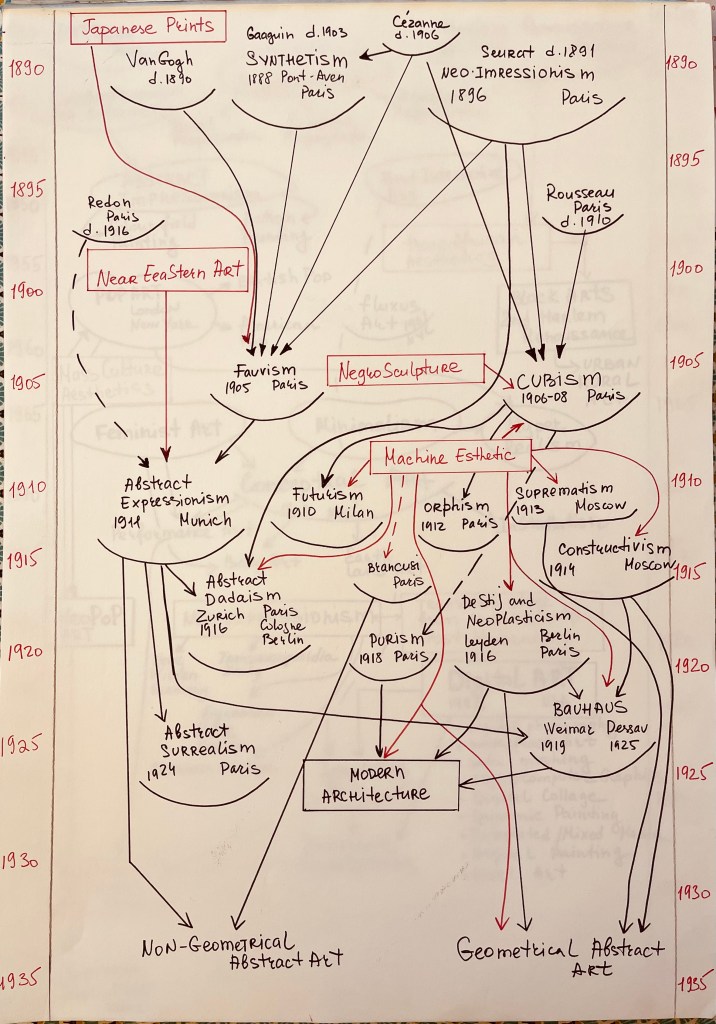
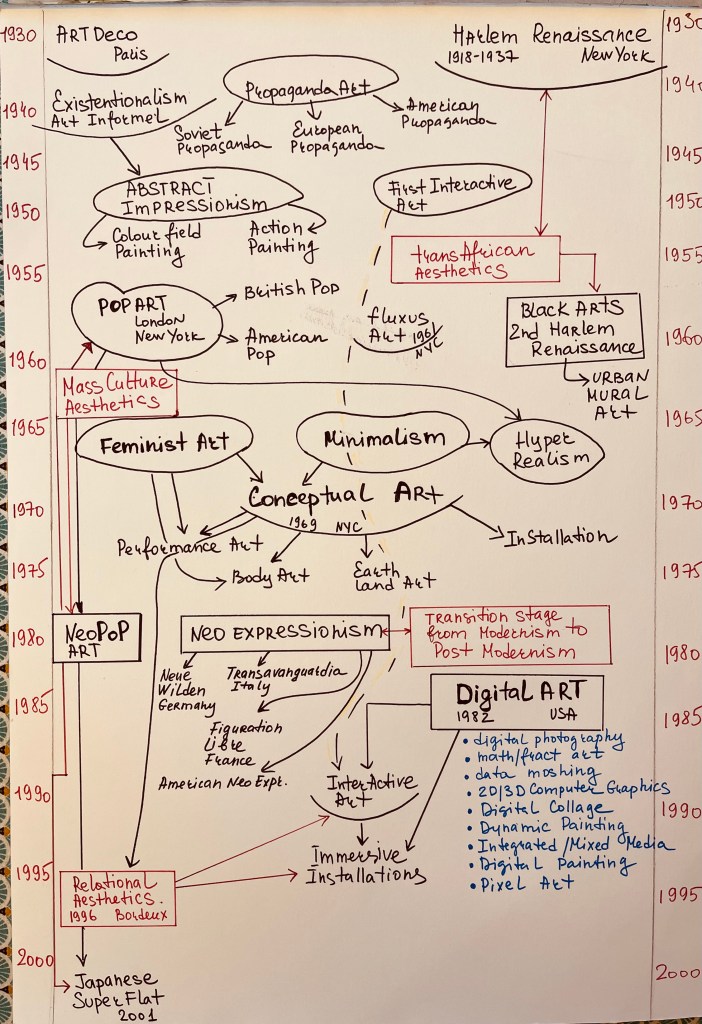
Exercise 2.1: make your own copy of Barr’s chart and extend it up to the year 2000 by including movements such as Pop Art. In a separate column list major events in politics and culture that you think had had some bearing on the kind of art practiced at the time.
This exercise required from me an extensive research. Below I put my outcomes below reflecting about social causes of different Art movements.
Avant-Garde. In the early 19th century Henri de Saint -Simon, a French political writer, stated that artists are in the first row, avant-garde ( from French’ vanguard’) of social progress, ahead of scientists and other classes. Later, at the beginning of the 20th century, the term became a well-established notion of defining the radical approach. Approach, always challenging norms and traditions, including visual culture, painting in its aesthetics, intellectual and artistic basis, its methods of production to the extreme point of being almost subversive. In this sense, Dada is the brightest example of the avant-garde movement in visual culture and painting. It is important to understand that any art movement that follows a revolution path, breaking with the conventional ways of making Art, is always considered ‘avant-garde’. In this sense, avant-garde movements of their time were: Italian Renaissance, Impressionism, Cubism and Fauvism, Abstractionism, De Stijl, Post Modernist Art, etc.
Below I put a brief description of the mainstream art movements of the 20th century. Along with the short description, I will write about underlying social events, which caused or significantly influenced the particular art movement. The extended Barr’s chart I place below my text. I preferred to indicate the underlying social cause in writing below rather than just putting the dates of a specific event in the chart because I didn’t have a space, even using the A3 format paper. Also, putting just a date and the event was not sufficient for me.
Neo-Impressionism. Neo-Impressionism emerged in the latter part of the 19th century, and it was in some sense a premonition of Modern Art. It was drifting away from spontaneity and romanticism of Impressionism to a new, methodical painting technique such as mostly pointillism, the application of tiny bits of pigments, which, most art historians believe, as a foundation for abstract Art emerging later. Neo-Impressionists followed a new technique of placing small dots of contrasting colours to enhance the image’s visual effect and sensation, trying to bring more luminosity to the canvas. They also started to address the modernity of urban life and social issues. The most famous Neo-Impressionists are Georges Seurat, Camille Pissarro, Vincent Van Gogh, Paul Signac, Henri Edmond Cross.
Fauvism: Fauvism was the first avant-garde movement that flourished in France in the early years of the twentieth century. (Sabine Rewald, 2004) and can be considered as a branch of Impressionism. Fauvists also have been very much attracted by the colour theory, particularly in complementary colours. Art critics said that Fauvists were the impressionist who first moved towards Abstractionism. The most famous fauvism artists were: Henry Matisse (1869-1954), Andre Derain (1880-1954), Maurice de Vlaminck (18760-1958). Fauvists exploited the power of colour and introduced unnaturalistic shades and highly intense colours, vivid brushstrokes, creating a vibrant, exuberant, colourful, intense effect, eventually led to the term ‘Fauves – ‘wild beasts’ done by art critic Louis Vauxelles.
An underlying social cause and events. There is a specific relationship between the rise of new, focused on tiny dots of colour, colour division- pointillism technique and the overall development of optics as a science. In the 19th century, scientists achieved much progress in the theory of optics and colour division. Some specific engineering scientific breakthroughs had happened, such as a further development of the wave theory of light and polarisation, lens invention. A three-colour theory was developed with major contributions of British physicist Young and German physicist Hermann L.F. von Helmholtz. Karl Zeiss, the founder of Carl Zeiss AG, created the first simple and compound microscope, presented in Jena, Germany in 1846 for the first time. It is a well-known fact that the works of French chemist Michel -Eugene Chevreul significantly impacted the art world and artists’ painting techniques of his time. His work inspired many artists ‘The Law of Simultaneous Color Contrast’ published in 1839: ‘In the case where the eye sees at the same time two contiguous colours, they will appear as dissimilar as possible, both in their optical composition [hue] and the height of their tone [mixture with white and black].‘
Major social events /trends of the 19th century are the following: a) first industrial revolution which led to the beginning of massive urbanization; b) higher productivity as a result of the industrial revolution led to higher growth of population in the Western World; c) rapid growth of science such as medicine, optics, engineering; d) Liberalism became a dominant political view;
Abstractionism (Nonobjective Art or Nonrepresentational Art). Modern AbstractionismAbstractionism emerged in the early 20th century, and it was entirely radical for its day: artists completely unfollowed the idea of painting as realists. They began to create images with little or no reference to the surrounding ‘real’ world’. The first artist who created the modern abstract artwork was Wassily Kandinsky in 1912, along with Kasimir Malevich with his first monochrome work “Suprematist Composition, later Piet Mondrian and others in Post Modern Art. It is recognized that AbstractionismAbstractionism, contrary to realism, was revealing and was more focused on the inner state of the artist’s consciousness, his inner life. It is worth noting that Abtrsactionism in this phase of its development – between World Wars I and II – did not flourish and received little notice from the art world and the public. However, after World War II, it has branched out into Abstract Impressionism, which was widely recognized and became one of the mainstream art movements.
An Underlying social cause/events: I like to reflect on what caused first Abstractionists to paint in a nonrepresentational, abstract way. And it is very hard to find any particular social event that can be directly related to their inspiration or scientific achievement, which was the case with Pointillists in the 19th century. However, I liked the opinion of art historian Wilhelm Worringer (1907), who noticed in his essay ‘Abstraction and Empathy’: ‘the tendency to abstraction is a consequence of people’s deep insecurity about the world’. ( Gaby Reucher, 2016). To find the underlying motives of Kandinsky’s inspiration for Abstractionism, I have searched for more information about his biography and life path. I discovered that he wrote the book “Concerning the Spiritual in Art’ which is evidence that he was very much focused on matters of human’s Soul and Spirituality. The book (Caby Reucher, 2016) ‘examines the purpose of art and how colours and forms impact the human soul’. Thus, what makes the first real Abstractionist different from everybody else is that he loudly and firmly articulated the idea that ArtArt was not about the skill of representation. It was not about creating some optical effects or illusion of space about the human’s Soul. That connects with a breakthrough in the science of Psychology brought by Sigmund Freud regarding the human’s psyche. Kandinsky painted his abstract artworks in the early 20th century and presented his first abstract watercolour in 1910. Freud published his “The Interpretation of Dreams’ in 1900. Among everything he published since 1900, the following works can be related with a growing interest to the inner state of human consciousness: 1910 ‘Five Lectures on Psycho -Analysis’, 1910 ‘Wild’ Psycho-Analysis’, 1912 ‘A Note on the Unconscious in Psycho-Analysis’, 1915 ‘The Unconscious’. We can relate Freud’s theory about Unconscious and Psycho- Analysis to ideas of Abstractionist painters of that particular time frame. I find a direct link between Abstractionist’s artistic visions and the development of Psychology and the ideas of Freudism. Kandinsky’s attractions came right before World War I. On a collective psychological level, it was a perception of upcoming catastrophic events that could reveal itself through individual artistic minds. This passage is very much related to Cubism and Surrealism as well.
Cubism. Cubism is one of the most well-known and influential art movements created to a large extent by Pablo Picasso and George Braque in Paris between 1907 and 1914. As editors of encyclopaedia Brittanica (2000) explain: the cubist style emphasized the fact, two-dimensional surface of the picture plane, rejecting the traditional techniques of perspectives, foreshortening, modelling, and chiaroscuro and refuting time-honoured theories that ArtArt should imitate nature. The term was probably derived from a comment made by the art critic Louis Vauxelles who described the paintings he saw as, cited in Cubism on http://www.tate.org.uk [accessed on March 12] when’ everything is reduced to geometric outlines and cubes”. Cubism became a platform for many art movements such as constructivism and Neoplasticism. The main feature of cubists’ paintings is their revolutionary break with the centuries-old classic European tradition of creating an illusion of natural space. Cubists broke their objects and figures down into distinct areas, fragments and planes, offering to a viewer different viewpoints at the same time. Cubism has developed in analytical and synthetic directions. Analytical Cubism is considered early Cubism and is characterized with a heavy, rugged look, different, interweaving planes and tones of black, greys and ochre. Synthetic Cubism is a latter stage of this art movement, having simpler shapes and brighter colours, collages from newspapers.
Futurism. As John James White (‘Futurism’, 1998) puts it: Futurism is an early 20th-century artistic movement centred in Italy that emphasized the dynamic, speed, energy, and the power of the machine, and the vitality, change, and restlessness of modern life. These artists are the prominent futurists: Filippo Tommaso Marinetti, Luigi Russolo, Carlo Carra, Umberto Boccioni, Gino Severini. Later this movement sprouted into Russian Avantgarde. Filippo Tommaso Marinetti founded Futurism with his manifest published on February 20, 1909, in Le Figaro, where he glorified the new technology and invention of the automobile, admiring its beauty and speed. Futurism borrowed Cubism’s fragmented and intersecting planes and added rhythmic spatial repetitions to express movement and speed. Although cubists preferred still life, Futurists concentrated on such objects as speeding automobiles, trains, athletes, animals and urban crowds. In addition, futurists exploited more vibrant colours and tried to bring, expose and reveal dynamics, agitated, aggressive, swirling notes and forms into their artworks.
An underlying social cause/event: Futurists celebrated technological progress and praised new aeroplanes and cars. The first automobile was build in 1885-1886 by Carl Benz. Since the movement was founded in Italy, we can trace the event such as the first automobile plant opening in Italy by Fiat, happening in 1900, by 1903 Fiat produced 135 cars. In 1903 the first powered aeroplane flight took place in the history of the World made by the Wright Brothers. In many sources, it is indicated that Marinetti, the founder of Futurism, from 1920 started heavily gravitate towards Nazis.
Art Deco. Marco Sanpaolo (1998) describes Art Deco (‘style moderne’) as an art movement in the decorative arts and architecture that originated in the 1920s and developed into a significant style in Western Europe and the United States during the 1930s. Art Deco is a branch of Modernism turned into fashion to create crafted luxury items with a sleek elegance with rich/wealthy look and sophisticated twist. There are certain features of Art Deco objects such as a) simple, clean shapes; b)geometric ornament; c) often had used expensive natural materials like jade, ivory, rock crystals had been used along with artificial new material as plastic, particular types of glass; d) items were individually crafted or produced with limited edition; The following artists are well known for their input into this art movement: furniture designers Jacques Ruhlman and Maurice Dufrene, the architect Eliel Saarinen, metalsmith Jean Puifocart, figural sculptor Chiparus;
Harlem Renaissance. Harlem Renaissance is an influential art movement of African American culture framed by 1918-1937, blossomed in literature, music and visual culture. It should be mentioned that Harlem Renaissance was part of a more significant social movement known as New Negro movement. It emerged in the early 20th century as a struggle of African Americans for civil rights. That time is characterized by substantial migration from rural areas to urban spaces and from South to North what eventually resulted in a rising level of literacy among the black American population and new socioeconomic opportunities, reflecting on and exploring new black identity and political empowerment. Among prominent visual artists of the Harlem Renaissance there the following: Langston Hughes, Zora Neale Hurston, Ma Rainey, James Lesesne Wells, Hale Woodruff, Richmond Barthe, Archibald John Motley Jr.
An underlying social cause/ event: The main social factor contributing to the rise of this art movement was the Great Migration which happened because of poor economic opportunities and harsh segregation laws: the black population moved from the South to the North of the country. It is interesting to know that ‘around 1916, a factory wage in the urban North was typically three times meow than what Black people could expect to make working the land in the rural South (The Great Migration, history com. editors, 2021). by the end of 1919, around 1 million Black people had left the South and established their new homes in northern cities, especially New York. The Harlem area in NYC is a prominent historical example of that time. That migration was the way how the new black urban culture evolved.
Abstract Impressionism ( 1945-1960) – a broad movement in American painting that began in the late 1940s and became a dominant trend in Western painting during the 1950s. Famous Abstract Expressionists painters were Arshile Gorky (1904-1948), Hans Hoffman (1880-1966) – early painters of this movement, Jackson Pollock , Willem de Kooning (1904-1997), Franz Kline (1910-1962), Mark Rothko (1903-1970), Barnett Newman (1905-1970), Adolph Gottlieb ( 1903-1974), Lee Krasner (1908-1984), William Baziotes (1912-1963), Ad Reinhardt (1913-1967).
Though Abstract Expressionist paintings vary significantly in terms of painting techniques, quality and the way of expression, they do share some common features such as a) they all use certain degrees of abstraction; b) they insist on free and spontaneous, ‘personal emotions; experience’; c) they follow significant freedom to choose and implement the technique and the way how they attain their artistic goals; d) the all do show an abandonment of conventional standards in composition structure via building an ‘undifferentiated field’, system, existing in ‘unstructured space’; d) the painters used the large scale canvases to increase the effect of monumentality and power.
The following art movements represent Abstract Expressionism: Colour- field painting and Action Painting (Jackson Pollock and Willem de Kooning, Morris Louis);
Underlying social event/cause: it is recognized the underlying social causes of this art movement should be rooted in the 1930s when the political instability in Europe started to be on the rise leading to World War II and massive generational trauma. Surrealism had profoundly influenced many artists, and their artworks subsequently reflected the self-expression of their inner state subconscious. Most of these artists had been matured in the 40s and had to bear a heavy impact of World War. For example, Clyford Still described one of his artworks as ‘life and death merging in fearful union’ (The Art story, http://www.theartstory.com). Barnett Newman (1969) said about that time: “We felt the moral crisis of a world in shambles, a world destroyed by a great depression and a fierce World War, and it was impossible at that time to paint the kind of paintings that we were doing—flowers, reclining nudes, and people playing the cello.”
I found an interesting opinion in the article by Alaistair Sooke (2016), who supports the idea that Abstract Impressionism, with its speedy rise in the USA, was a tool to use in Cold War with the USSR a valuable foil to Russia’s official Soviet realist style. The ideological confrontation between two Superpowers was unfolding in all planes of human existence, including the economy, science, ArtArt, and sport. American freedom and democracy versus Soviet totalitarian, suppressing individual freedom regime. Thus, the CIA could opt for Abstract Impressionism with all its liberty (as some art critics such as David Anfam, Saunders, May Kozloff insist) in their propaganda war with Russia via financing the movement through funding the galleries and exhibitions. I agree that even the potential CIA activity with these artists was not an original cause of the movement but was a supporting factor for its flourish and development.
It is also should be mentioned that later stage Abstract Impressionists were probably the first who had been influenced by the development of LSD in 1938-1943. Many ( if not countless) artists later tried psychedelic drugs to unlock their creative potential, though they may not disclose it so openly. LSD developer Swiss chemist Albert Hoffman described his LSD experience (1943) as an ‘uninterrupted stream of fantastic pictures, extraordinary shapes with the intense, kaleidoscopic play of colours’.
Pop Art. In the Pop Art movement, two branches are distinguished: British Pop Art and American Pop Art. The British Pop Art started to emerge in the mid-1950s when some young British artists ( the Independent group) noticed American rising consumerist popular culture, contrasting to their own ascetic life of post-war austerity. So they started to look for a new language and related to Dadaism, adapting its collages in a new way. British Pop art artists were: Richard Hamilton, Eduardo Paolozzi, Peter Blake, David Hockney, Allen Jones, Richard Smith, Derek Boshier.
American Pop Art emerged in New York around the late 1950s with Andy Warhol, Roy Lichtenstein, James Rosenquist, Claes Oldenburg. It was raised as a reaction to Abstract Expressionism which those artists found as too rigid, if not boring. Instead, perhaps of incorporating mass-produced, commercially popular objects, Pop Art has become one of the most recognizable styles of Modern Art. The movement blurred and eroded the boundaries between ‘high’ ArtArt and ‘low’ culture. Pop Art celebrated the mass culture of emerging consumerism and the beginning of globalization.
An underlying social cause/event: many prominent Pop Artists, including Andy Warhol, started their careers in commercial ArtArt as magazine illustrators and graphic designers, billboard painters, serving the needs of speedy rising commercialization, manufacturing, consumerism in the western society. Economic statistic data show that Americans achieved a level of prosperity they had never known before during the Eisenhower era. (Economy in the 1950s, SHMOOP University, 2017). During the 1950s, the overall economic growth was 37%, while the unemployment rate was low. Consumerism began to rise. The major shift from manufacturing to consuming society fuelled the advertising, including the TV advertising, which, according to Kori Wallace (2019) reached 128 million USD by 1951! The historical event, such as issuing the first TV licences to 10 US TV stations, happened on July 1, 1941.
Minimalism. Minimalism (known as well as ABC Art, Minimal Art, Literalist Art, Reductivism, Rejective Art) is an art movement, mostly American, emerged in the late 1960s and characterized by extreme simplicity of form and a literal, objective approach (Gloria Lotta, 2008). Minimalism is related to the reductionist approach introduced in 1913 by the Russian painter Kasimir Malevich with his composition of a black square on a white ground. It is considered that Minimalists drifted away from Action painting (part of American Abstract Expressionism), founding it as ‘too personal and insubstantial’ (Gloria Lotta, 2008). They developed a point of view that ArtArt should be nothing but itself, so they aimed to eliminate any extra visual association, which means reducing the visual elements and components on their artwork. And that was a way how these simple forms, hard edge linear style evolved. These paintings contained large, simplified, usually geometric shapes on an overall fact surface; precise contours; and broad areas of bright, unmodulated colours, stained on unprimed canvas. Jack Youngerman (1926-2020), Ellsworth Kelly (1923-2015), Frank Stella (1936-, Kenneth Noland (1924-2010), Gene Davies (1920-1985) are prominent minimalist painters.
An underlying social cause/event. As it happens with all mainstream art movements, there is always a separate movement that rejects the mainstream ideas and separates itself from the majority. Minimalism was that kind of thing, rejecting Abstract Impressionism and Pop Art and finding those too pretentious and personal. They ultimately rejected the idea that Art should reflect the inner state of mind of the artist. They thought Art should be referring to anything else but to Art itself. We can observe and compare the age gap between the Abstract Impressionists and Minimalists: most Abstract Impressionists were born right at the beginning of the 20th century, and the Minimalists were born 15-20 years later. The first group was much more heavily hit by World War I and II, considering that many of them were immigrants from Europe thorn by these two wars. Psychologically, they went through an enormous, lifelong trauma that they had to channel through their Art. While Minimalists are different generations, all Americans who actually have never seen the war, this is what can explain their less interest in the inner state of the human mind because it didn’t hurt that much!.
Conceptual Art. Minimalism greatly influenced conceptual artists; however, they rejected its fondness in sculpture as a mainstay of artistic production. For the conceptual artist, Art need not look like traditional artwork or even tale any form of Art. Notable artists of conceptual Art are Joseph Beuys, John Baldessari, Sol Lewitt, Robert Rauschenberg, Robert Smithson, Yoko Ono. The art movement emerged in the 60s. In 1968, a series of Conceptual art exhibitions promoted the movement in NYC. Conceptualism took tendencies such as happenings, performance art, installation, body art, earth/land art. It is hard to define conceptual ArtArt on stylistic grounds other than delivery that seems objective and unemotional (Conceptual Arts – History and Concepts on www. the artstrory.com)
Feminist Art. Feminist Art began in the late 1960s and was preceded by the long history of feminist activism, starting with the women’s suffrage movement in the middle of the 19th century. However, mass feminist art started to be produced only in the second decade of the 20th century. Eva Hesse and Louise Bourgeois are considered as first Proto feminist artists. The second wave of feminism in the 20th century resulted in Feminist Art rise as be well-established art movement. We must understand that it is a more social movement for social gender equality and women’s struggle to reconsider the canine of Western Art, which has been omitting women as great artists and for equal representation of women in the art world. In terms of any particular artistic approach, there is no single medium or style that would unite Feminist artists. Feminist artists channelled their creative energy through various channels such as Conceptual Art, Body art, Video art – a multi-disciplinary way and through traditional painting or sculpture. Frida Khalo, Lee Krasner, Gertrude Stein, Judy Chicago, Miriam Schapiro, Barbara Kruger, Carolee Scheuermann and many more female artists contributed significantly to Art. The good news is that a lot has been done since the 1960s. As a result of that enormous and tremendous effort, there are many contemporary female artists today who no longer need or have a responsibility to identify themselves as ‘women artists’ or directly and explicitly address the ‘women’s perspective’.
An Underlying social cause/event. Women have been struggling for their civil rights for centuries. There have been so many events: gatherings and actions, but none of them was strong enough to influence their lives to that crucial extent. It did the contraception pill invention in 1953 by biologists John Rock and Gregory Pincus. I agree with this opinion – nothing changed women’s lives as The Pill. In 1960 the first oral contraceptive, Enovid, was approved by FDA. In 1968 the FDA approved the IUD. That event led to a seismic shift in women’s lifetime paradigm and liberated women from ‘biological slavery. The pill enabled women to manage their lifetime. They even had the power to live child-free lives and do new things that were impossible to their mothers because bearing children and taking care of them would take their entire lives, which has stopped the case since 1960.
Neo Expressionism. Neo-Expressionism is an international art movement rooted in Expressionism that emerged at the beginning of the 20th century. Neo-Expressionists were inspired by intense colours and focused mainly on figurative drawing. The movement manifested itself in the late 70s and early 80s throughout the World. The following schools are distinguished: the Neue Wilden in Germany, Trasavanguardia in Italy, Figuration Libre in France, and American school. Markus Lüpertz, George Baselitz, Anslem Kiefer, Francesco Clemente, Enzo Gucci, Mimmo Paladino, Robert Combas, Hèrve Di Rosa, François Boisrond, Julian Schnabel, David Salle, Robert Longo -are notable Neo impressionists.
Digital Art. It is recognized that for the first time, the use of the term Digital art occurred in early 1980 when computer engineers developed a paint program which was used by Harold Cohen, who eventually became a pioneering digital artist. “Digital art” is something which is uniting all artworks which have been created, stored and used using digital technology; including photography, video, paintings, prints and sculptures; Thus, no particular artistic features unite all digital artworks. This is the purely technical term describing the technology artists implemented while creating their paintings.
An underlying social cause/event: Digital Art emerged due to technological progress. In 1975 Ed Roberts suggested the term ‘personal computer’ introducing his Altair 8800. The rise of commercial, personal computers (PC) as workstations started around 1977.
Relational Aesthetics. French art critic Nicolas Bourriaud has formally termed relational Aesthetics at the exhibition ‘Traffic’ held at the CAPC Musee d’Art at Bordeaux in 1996. In his book (Relational Aesthetics, 1998), he explained the term as ‘A set of artistic practises which take as their theoretical and practical point of departure the whole of human relations and their social context, rather than an independent private space’. Relational artists, such as Rirkrit Tiravanija, Liam Gillick, Pierre Huyghe, Vanessa Beecroft, rejected ArtArt in its conventional art form, aiming to engage audiences through certain situations demanding interpersonal interaction, communication among participants. This practice is rooted in earlier art movements as Conceptual Art.
Bibliography: 1) 5 Things to know about Pop Art by Laurel Bouye, April 2019, online on http://www.kazoart.com [accessed on 12 March 2021]; 2) List of art and design movements of the 20th century, written by the Editors of Encyclopaedia Britannica (eds), Naomi Bloomberg, 2014-2015, online on http://www.britannica.com, [accessed on March 10th, 2021];3) When Timothy Leary Got Artists to Take LSD, Alina Cohen, 2018, online on http://www.artsy.net [accessed on March 15th 2021]; 4) Harlem Renaissance, American Literature and Art, Hutchinson George (eds) (2008), online on http://www.brittanica.com [accessed on March 12, 2021]; 5) The Team That Invented the Birth Control Pill, Eig Johnathan, 2014, online on http://www.theatlantic.com [accessed on March 20, 2021]; 5) White John James, Futurism, online on http://www.brittanica.com [accessed on March 12, 2021]; 6) What is Abstract Art? And Why Should I Care? by Dean Nimmer, online on http://www.artistsnetwork.com [accessed on March 14, 2021]; 7) Art Deco Art Movement, the editors of Encyclopaedia Britannica (eds), Marco Sampaolo, online on http://www.brittanica.com [accessed on March 12 2021]; 8) Abstract Art, The Editors of Encyclopaedia Brittanica, 1998, Kathleen Kupier (2007) online on http://www.brittanica.com [accessed on March 16, 2021]; 9) Cubism, The Editors of Encyclopaedia Brittanica (eds), 2000, Gloria Lotha, 2007, online on http://www.brittanica. com [accessed on March 12th, 2021]; 10) The History of the Balck arts Movement , Patina Lee, 2016, online on http://www.widewalls.ch [accessed on march 16 2021]; 10) The Most Iconic Artist of the 1980s, by George Philip Lebourdais, Artsy Editorial, 2015, online on http://www.artys.net [accessed on March 16, 2021]. 11) Minimalism: Additional Information by Editors of Encyclopaedia Brittanica (eds), 1998, Gloria Lotta, 2007, online on http://www.brittanica.com [accessed on March 12, 2021]; 12)Fauvism, Sabine Rewald, Department of Modern and Contemporary Art , The Metropolitan Museum of Art, online on http://www.moma.com [accessed on March 12, 2012]; 13) Why Kandinsky chose an abstract art? Gaby Reucher, 2016, online on http://www.dw.com [accessed on March 16, 2021]; Museum of Art, October 2004, online on http://www.metmuseum.org [accessed on March 14th 2021]; 14) The 20th Century’s Abstract Art: An Expression of the Inner Life by Carol Strickland, 1996, Special to the Christian Science Monitor, online on http://www.cmonitor.co.uk [accessed on March 12, 2021]. 13) Economy in the 1950s, SHMOOP University, 2017, online on http://www.exploros.com [accessed on March 16, 2021];
14) Was modern art a weapon of the CIA?, Alaistar Sooke, 2016, online on http://www.bbc.com [accessed on March 16, 2021] ; 15) A Brief History of Dada, the irrelevant, rowdy revolution set the trajectory of 20th century by Paul Trachtman, Smithsonian magazine, 2006, online on http://www.smithsonianmag.com [accessed on March 12, 2021]; 16) Cubism, author unknown, online on http://www.tate.org.uk [accessed on 12th March 2021]; 17) Modern Art, Editors of Encyclopaedia of Art (eds), online on http://www.visual-arts-cork.com [accessed on 12th of March 2021]; 18) Avant-Garde Art, by editors of Encyclopaedia of Art Education, online on http://www.visual-arts-cork.com [accessed on March 14, 2021], 19) Neo-Impressionism, by the Editors of Art Story Foundation, online on http://www.theartstory.org [accessed March 12 2021]; 21) Movements/Pop Art , Editors of The Art Story Foundation, online on http://www.theartstory.org [accessed on March 15 2021]; 22) Feminist Art -History and Concepts, Editors of The Art Story Foundation, online on http://www.theartstory.org [accessed on March 15 2021]; 23) How LSD influenced Western culture, Holly Williams, 2018, online on http://www.bbs.com [accessed on March 16, 2021]; 24)World History: These are among the most important global events to happen annually since 1920′, author unknown, online on http://www.usatoday.com, [accessed on March 10, 2021];21]; 26) Art and Science: The Development and Impact of Optics, author unknown, online on http://www.photonics.com, [accessed on March 16th, 2021]; 27) The history and future of television advertising, Kori Wallace, 2019, Industry insights, online on blogs.oracle.com [accessed on March 20, 2021]; 28) How the inventor of the pill changed the world for women, Zoe Williams, 2010, online on http://www.theguardian.com [accessed on March 20, 2021];
Below is the copy of Barr’s chart and its extensions I did till 2000.
 JeanArt