
Art Theories
Below I put my general opinion about the first part of this course. Frankly speaking, after doing a very well structured Drawing 1 and Practice of Painting 1 courses, the first 25 pages of this course appeared to me as very confusing in terms of interrelationship between the texts and topics written on those first 25 pages and their relevance to the title of the course. No doubt that those texts are relevant. However, even though at the very beginning, on page 15 it was clearly stated: “aim to understand handful terms concerned with the arts …..- “art,” ”culture,” “theory,” and “visual.” I found the following pages – up to 25th – a very tangled wording to explain to students the subject of the course: how to understand a visual culture? I recommend that OCA reconsider these introductory pages of the course, bringing a more lucid and comprehensive way of guiding students through the very challenging theoretical course.
I suggest that on those first pages of the course, the general guidance for students could be much more clearly articulated, delivering the following sequence of topics and concepts, which I had to build up for myself after decoding and deciphering the texts on the first 25 pages.
Bibliography: 1) “ARTS 4012: Senior Studio Seminar: Art & Critical Theory” by Amy Fry on http://www.libguides.bgsu.edu; 2) “Nobody Needs A Theory of Art” by Dominic Mciver Lopes; University of British Columbia on http://www.documents.pub; 3) “Theories of Art” by Ronald W. Hepburn on http://www.users.rowan.edu; 3) “Theories of Art” by Laurie Spiegel, 1998, on http://www.retiary.org;
Exercise 1.0. Page 17 in the course work book.
In this exercise we must make a list of 10 things that “exist only because we believe them to exist” and approximately 150 words explaining “how these things differ from e.g. mountains and forests”.
Also there is a question why John Searle in his book “The Construction of Social Reality” in his writing “…. In a sense there are things that exist only because we believe them to exist …..things like money, property, governments and marriages. Yet many facts regarding these things are “objective” facts in a sense that they are not a matter of our preferences, evaluations, or moral attitudes”, puts the word “objective” in inverted commas.
My list of things which “exist only because we believe them to exist”:
Justice and injustice, evil and good, truth, illusion, freedom, right, economy, insurance, opportunity, exchange market;
My answer to the second question in the Exercise.
In his book “The Construction of Social Reality” John Searle in the chapter “Objectivity and Our Contemporary World View” explains that we should understand “2 crucial senses” which can be applied to such notions as “objectivity” and “subjectivity”: they are “epistemic” and “ontological” senses. If we apply epistemic sense, we always presume the notion of our human judgment ability, which always depends on someone’s “certain attitudes, feelings, and points of view.” Thus any “objectivity” is never “objective” enough because we all have different attitudes, thoughts, and feelings about the object/subject: one thing that is beautiful for someone is ugly to someone else.
In an ontological sense, “objective” and “subjective” are different based on their ability to “ascribe modes of existence.” In the ontological sense, I will try to give my example: let’s say ideas or feelings are subjective because “their mode of existence depends on being felt by subjects”; i.e., belong to the subject, so it is “subjective”; But cosmos for example, as opposed to subjective is “independent of any perceived or mental state.” Thus John Searle puts the word “objective” in inverted commas in his sentence above because those certain things he mentioned in that sentence, in an ontological sense they are subjective because they exist only “relative to observers and users.” That means these things such as money, property, government, marriage exist because there is a subjective agreement between us that they do exist. Thus they depend on the subject’s decision, and in this sense, they are not objective as, let say, the Universe or Cosmos, so he puts the word “objective” in inverted commas.
Exercise 1.1. The task here is to “look at the painting “The Eye of Silence” and see whether we can distinguish the intended from unintended faces and which seem most ambiguous”; We also have to look up the term “pareidolia”, find and record three examples, at least one of which should be seen in nature;
I start with the first part of the exercise, looking at the painting and identifying “intended” and “unintended” faces. Clearly, we can understand that “intended face” would be the face which the painter would want us to recognize and spot quickly and easily, indicating enough facial features. ‘Unintended faces” would be all faces we could recognize applying our imagination, in some sense joining the author in his artistic endeavor. When we become in a way his/her creative partner or co-author of this painting, finishing his ideas, going through an opened door with our imagination. As an “intended” face, I can see only one – a beautiful young woman, a siren? She is sitting on the rock, wearing a red skirt in the right lower corner. As an unintended face, I see many; I circled and numbered them on the photo below. Five of them (1,2,3,4 and 10) I see as faces in profile, and 5 of them (5,6,7,8,9) I see them as faces looking directly at me.

What I was doing as an exercise – searching for faces – was called “pareidolia.” According to Webster’s dictionary, “pareidolia” is “the tendency to perceive a specific often meaningful image in a random or ambiguous visual pattern.” This term came to English as borrowed from Greek words: “para”, meaning beside or beyond, and “eidolon,” indicating “image, reflection”;
Max Ernst is one of the most notable surrealists. He was a big master of the decalcomania technique, a method to create expressive textured surfaces and complex patterns pressing medium between the surface.
Below I put two photos with the pareidolia effect I found in my house.


Added after receiving my Tutor’s report.
My Tutor asked me to add some artistic examples. So I do it below.
Water, Giuseppe Arcimboldo, 1566, oil on wood; image via http://www.arthistoryproject.com;

Sequence 9-14, Totemic Pareidolia,Patrick Larochelle, 2017, acrylic painting on canvas, image via http://www.artfinder.com;

Bibliography: 1) “The Eye of Silence, 1943 – by Max Ernst” on http://www.max-ernst.com;
2) http://www.merriam-Webster.com;
3) “Max Ernst/How to SEE the artist with MoMa curator Anne Umland”; The Museum of Modern Art chanel in YouTube;
4) “How to: Max Ernst Texture with Plastic Wrap” on ArtistChronicle chanel in YouTube;
5) “A Visual Breakdown: Confronting the Strange in Max Ernsts “L`oeil du Silence” by Max Dunbar, Mildred Lane Kemper Art Museum, Washington University in St.Louis , Art History and Archeology” on Mildred Lane Art Museum chanel in YouTube;
Social Theories as Art Theories
Below I just put some brief notes about Social Theories since I need that to do the exercise below. I do this just for myself for future reference in my studies.
Social Conflict or Conflict Theory – power struggles of different parts of society leads to a new society;
Structural Functionalism- convergence of interlocking systems; society tends to its state of equilibrium;
Symbolic Interactionism – shared meaning;
Social Constructionism – social agreement on certain things having a certain value;
Feminist Theory – women are suppressed by men in all aspects of social life and the society is build according to the principle of men’ s superiority;
Rational Choice – people take rational choices;
Exchange Theory – people chase their rewards and minimise the punishments; costs versus benefits;
Exercise 1.2. In this exercise we were required to identify three works of art in which theory plays a decisive role, and three works of art in which theory seems absent. We must do it in 100-150 words reflect on the distinction of them;
Before doing this exercise, I tried to clarify how I should understand “theory”. Since this exercise was in the section about Social Theories as Art Theories, I decided I had to “…..identify three works of art in which social theory plays a decisive role, and three works of art in which social theory is absent”. I have included the word “social” to clarify the context of the question. Otherwise, it was not clear from what perspective we should approach the task. Since if we talk about art theories beyond the social theories, then we can bring such terms as “representative theory of art,” “creationism,” “institutional theory of art,” “objective unity,” etc. When we think about all of these theories, it isn’t easy to understand what approach we should apply to do the exercise. So I assumed the exercise meant “social theories” since it was in the section about Social Theories as Art Theories.
Since Art, and Visual Arts, in particular, is an integral part of any society and social life, many artworks can be considered where art theory “has played a decisive role.” These artworks represent a current social situation like a conflict, representing artists` inner state, social/political views, and aspirations to produce a particular impact on society, influencing viewers consciousness. Art has always been a tool in social struggle, and lots of artworks represent that. Below I allocate some of them:
“Motherland is calling You”, Iraklii Toidze, 1941; image via http://www.avroraart.ru;
Soviet artist Iraklii Toidze made this poster in June 1941. This artwork had an efficient and pragmatic goal – to stimulate people to go to war and fight against nazis. This poster had become an iconic artwork of World War II time.

”Barge Haulers on the Volga”, Ilya Repin, 1870-1873, oil on canvas; image via http://www.artefact.culture.ru;

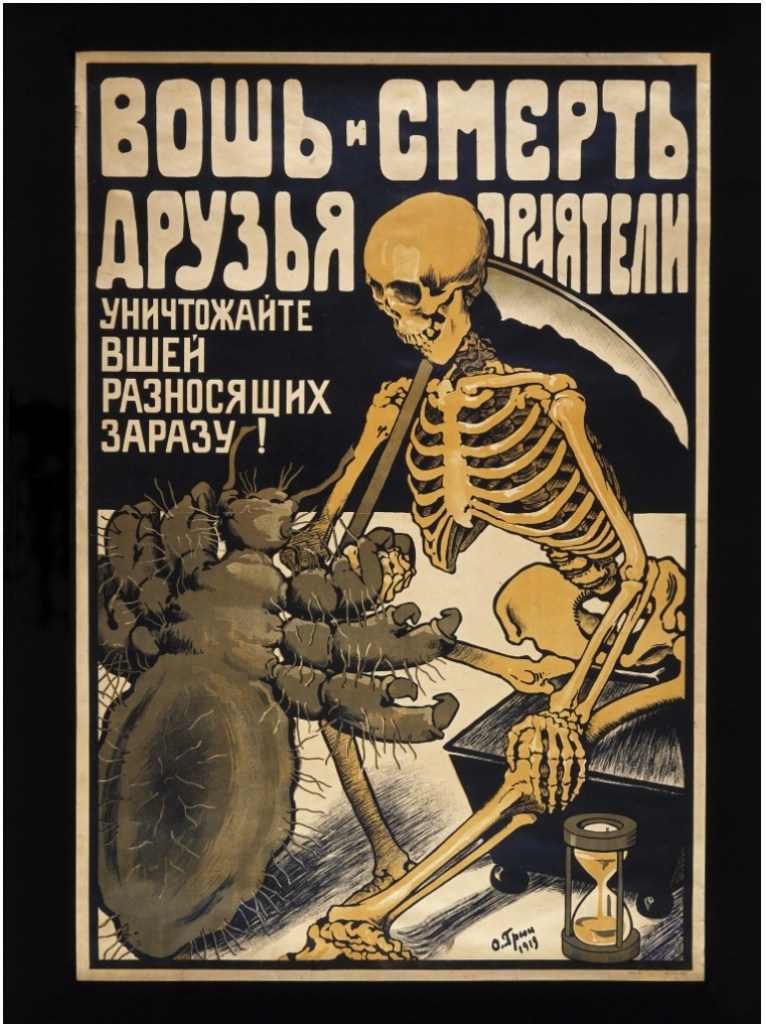
“Okna ROSTA”( below) posters series by Vladimir Mayakovskii, 1919-1920. These posters were created by Vladimir Mayakovskii and were widely used by Soviet government to educate the population about self hygiene, vaccination, as a tool to overcome the problem of hunger and decease in 1919-1920 in young Soviet Russia.


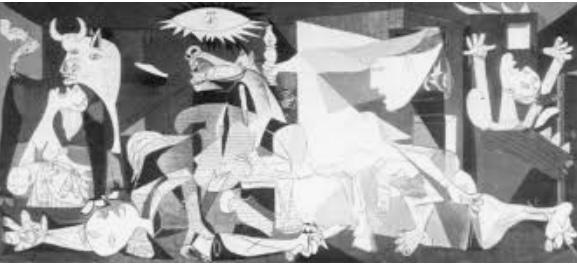
“Guernica”, Pablo Picasso, 1937, oil on canvas; image via http://www.pablopicasso.org;
“Liberty Leading the People”, Eugene Delacroix, 1830, oil on canvas; image via http://www.louvre.fr;

I was deeply impressed by the speech about Art and why we need it in our lives given by the Professor of Psychology of the University of Toronto, which can be watched on YouTube (see the reference list below). I share his view on Art as a phenomenon of human existence which is subconsciously hardwired to look for a transcendent experience. As we all know, it is tough to estimate the value of the artwork, but this way or another, we end up calling some artworks “immortal” or “genius.” We do so because we feel something special when we view/ listen to them, and that “special feeling” is quite precisely described as a “transcendental experience.” He is offering another theory of Art which can be named as a “Theological” Theory. I can put it as follows: every soul’s primordial instinct is to feel her connection with God, with the Divine, and Art is how this connection can be established. His words: “Beauty is a way to establish your connections with the Divine” is just amazingly precise for me. This theory does have common ground with Creationism. However, I think Theological Theory can be a separate, self-sufficient theory of Art because it suggests an entirely different and systematic view on how things work in our life, insisting on the subordinate nature of the artist and indicating the Creator as an ultimate source of Art. I don’t see why this theory has fewer rights to exist compared to any other theories I have read about so far. Based on this Theory, I can say that no artwork could be free from the theory. If we reject the Theory of God as a source of any Art and consider all social theories as art theories, many artworks share the political and social views of the artists.
We were required to reflect on the distinction between the artworks where we can see the theory and those where the theory “seems absent.” There are many which do not represent, in my opinion, any social art theory so obviously.
Here I put some examples.
“Bouquet”, 1599, Jan Brueghel the Elder, oil on canvas.

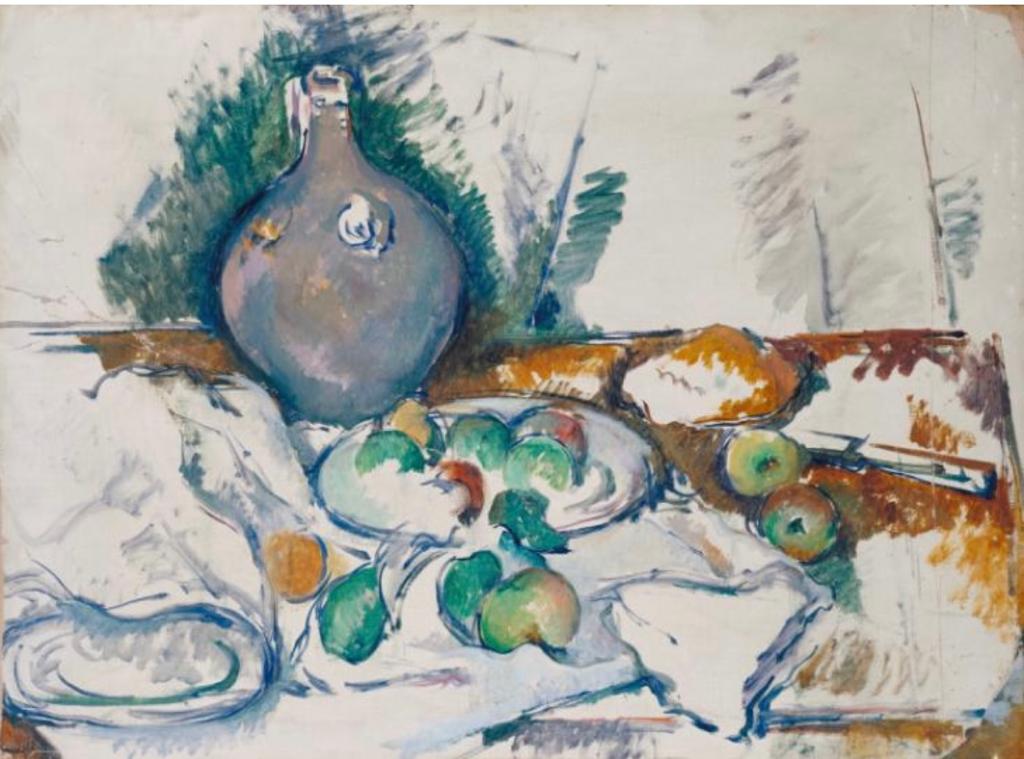
“Still Life with Water Jug”, 1892-3, Paul Cezanne, oil on canvas, image via http://www.tate.org.uk;
“Vertumne”, Giuseppe Arcimboldo; 1590; oil on panel; image via

Reflecting on the distinction between the artworks, which have been obviously created within a scope of a particular theory and those where the theory “seems absent,” took me to a specific outcome. I have concluded that no artwork would be free from the theory just because behind any artwork there is an idea in its broadest sense. If we look at the paintings above, which I put as examples of “absent theory artworks” and then we read about them, we still see that artists had expressed their ideas= theories through these works: Paul Cezanne often painted over and over again his same still life compositions because he was looking for a perfect way to create the dimension on his canvas, being unhappy with “conventional perspective, which has used a single viewpoint”; Giuseppe Arcimboldo’s famous fruits and vegetable composites heads- portraits have “several major viewpoints” and are considered as containing numerous messages from the artists, such as his life in specific historical context (devotion to his patrons), pieces of poetry which were presented along with the portraits to Rudolf II, his humor, as it was later called by art critics a “serious joke” which meant “….as one aspect of the paradox as a cultural expression in sixteenth-century Europe”.
Any artist creates within his/her historical time frame and always represents a certain culture that will be revealed consciously or subconsciously in his works. Even if they reject certain culture, they still have to talk about it. Also, since any artwork is a message, it means that this message can be studied and learned. Thus there is no artwork where we can not find a theory. We can see the difference between them in terms of what theory a particular painting is projecting: it can be any social theory, or we can study whether it is a sample of the representational theory of Art or Creationism. Some of the artworks “speak” loud, and we can see the message=theory, some of them are more abstract and complex and can contain several messages=theories, carrying a meaning which is not easy to perceive and reflect on, and we can think that there is nothing behind this, just the objects we see- but it is never the case.
Bibliography: 1)“The genesis of the Netherlandish flower piece: Jan Brueghel, Ambrosius Bosschaert and Middelburg” by Karolien De Clippel and David Van der Linden on http://www.dcvanderlinden.com; 2)“Three Founding Sociological Theories” by Daniel Davies, YouTube; 3)#106/Arcimboldo`s Metamorphoses” by Thomas DaCosta Kaufman on http://www.sciencespo.fr; 4)“Social Theories Overview, Society and Culture”, MCAT, Khan Academy, YouTube; 5) “The Folkway of Art: An Analysis of the Social Theories of Art” by John H.Mueller on http://www.journals.uchicago.edu; 6)“Jordan Peterson- The Role of Artists” #ManOfAllCreation, YouTube; 7) “Jordan Peterson: Why You Need Art in Your Life”, #philosophyinsights, YouTube; 8) “Social Theory and the Realist Impulse in Nineteenth -Century Art” by Alex Potts, Articles Issue #27; February 11, 2019 on http://www.nonsite.org; 5)“Feminist art” article on http://www.tate.org.uk;
 JeanArt