
Here we must look at range of paintings with particular attention to the way the paint has been applied. We were recommended to look at some paintings of expressionists such as Monet, Pissarro, Cezanne, Van Gogh as well as to twentieth century pastel paintings;
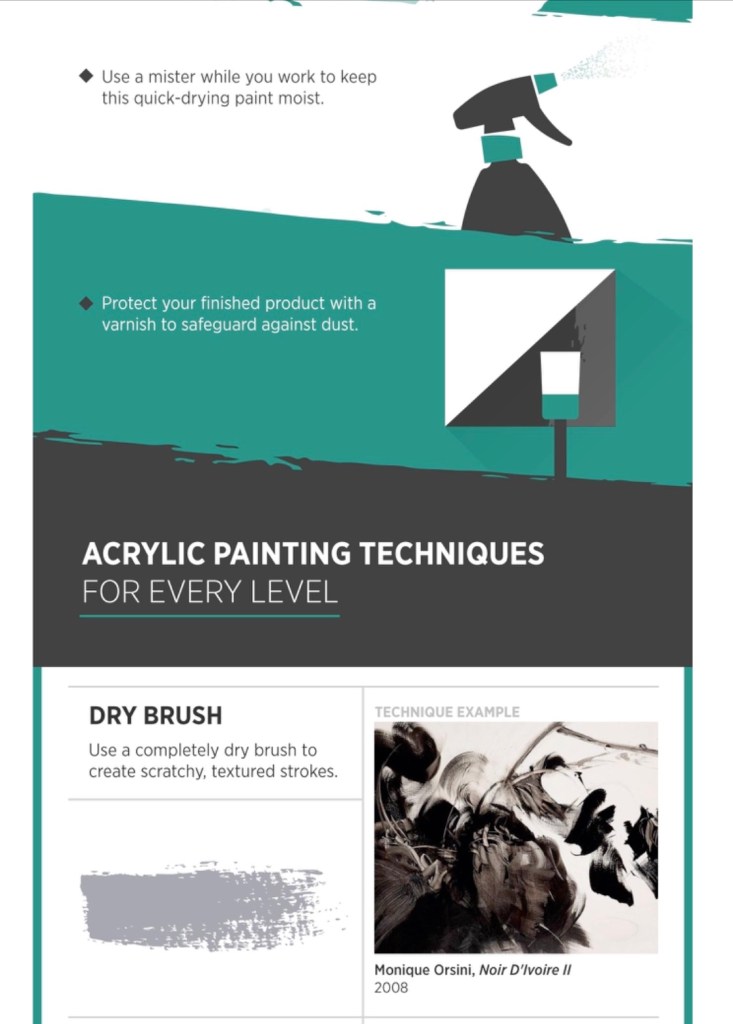
I start my research with the history of acrylic paintings and an overview of acrylic painting techniques. I have found a very good article about these topics on invaluable.com. It gives a good coverage of how acrylic painting has been developing since the first commercial acrylic paints became available in 1955, they had been first introduced as acrylic resin in 1901 by German chemist Dr. Otto Rohm. Due to acrylic pain`s versatility, a bunch of a new painting techniques emerged. Acrylics as a medium can be used on a variety of surfaces and mixed with other media. There are the following, most popular techniques which have been used by various artists:
- Dry Brush. This technique implies using a very dry brush dipped into the paint to create a scratchy, textured and uneven strokes and lines on the surface;
- Washing. Acrylic paints can modify its consistency to a great extend, so it can be applied as a thick layer and as a thin layer as well. The same as in water colours washing technique can be used with acrylics as well, diluting the paint in water;
- Stippling. This technique is closely related to Pointillism, when an artist creates an image building up a collection of tiny dots;
- Splattering. This is a lively and unpredictable technique which is totally realities to bursts of energy an artist can channel through splattering the paint on the surface.
- Dabbing. This technique is related to the same dabbing technique pastel painters use with their fingers or bristle brush, or paper: applying the paint with a pressure.
- Palette Knife. The special knife is used to create sweeping, flat, straight, angled lines, as it is said : “much like frosting a cake”;
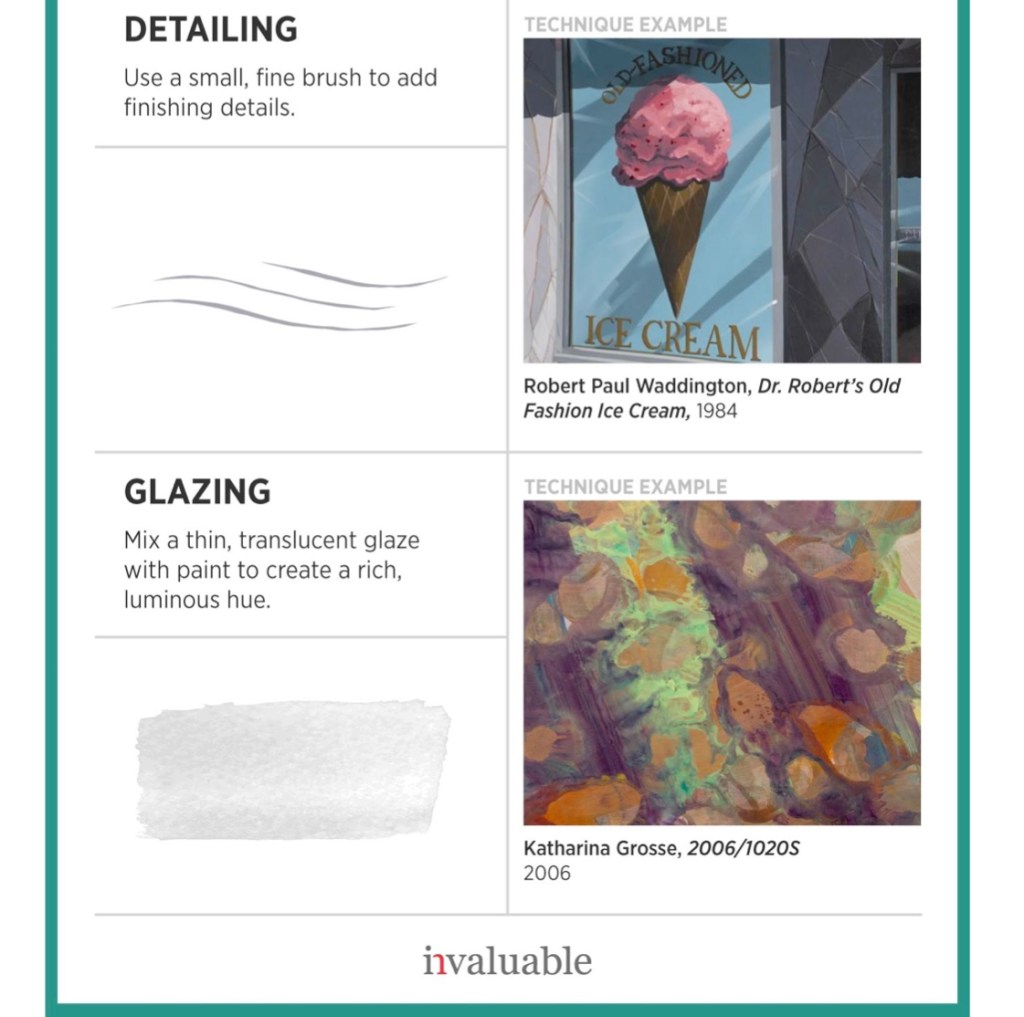
- Detailing: this technique is used when the artist needs to install more control and precision into the wort work, using a a small, fine brush, creating features which need a careful attention;
- Glazing. Many artists mix acrylic paints with a translucent film to create a rich, luminous hue and texture on the surface;
- Below I post the screenshots from http://www.invaluable.com which do give some good tips for working with acrylics:


Below is my research about painting techniques of famous artists.
Oscar Claude Monet (1840-1926)
Claude Monet is one of the most recognised artists who can be called as “master of light”. Impressionism in general put the colours and the light created to the forefront view of the painting. There are some common misconceptions about Monet`s approach to his artistic process which are interesting to read about. First is that he was spontaneous while he, actually, was not all. He worked hard studying the subjects and planning the artwork. He often painted a series of the same subject to capture the changing effects of the light. The second is that all his paintings were created on location. This is also not the case, many of his artworks had been finished in his studio.
Regarding to his technique there are some interesting facts as well. Monet used a limited palette of colours, banishing browns and earth colours, the black colour was also excluded later. He also used light coloured canvases such as white, pale grey or very light yellow and used opaque colours. He used to paint using thin, broken layers of paint which allowed the lower layers of colour to shine through. He build up his brushstrokes which varied from thick to thin; adding tiny dabs of light, contours for definition, working from dark to light. I found a good description about Monet`s painting approach and technique in the article about him on http://www.theartstory.com: a) “… Monet departed from the clear depiction of forms and linear perspective, which where prescribed by the established art of the time, and experimented with loose handling, bold colour, and strikingly unconventional compositions”; b) “In his later years, Monet became increasingly sensitive to the decorative qualities of colour and form. He began to apply paint in smaller strokes, building it up in broad fields of colour, and exploring the possibilities of a decorative paint surface harmonies and contrasts of colours” which represented “… a remarkable advance towards abstraction and towards a modern painting focused purely on surface effects”.
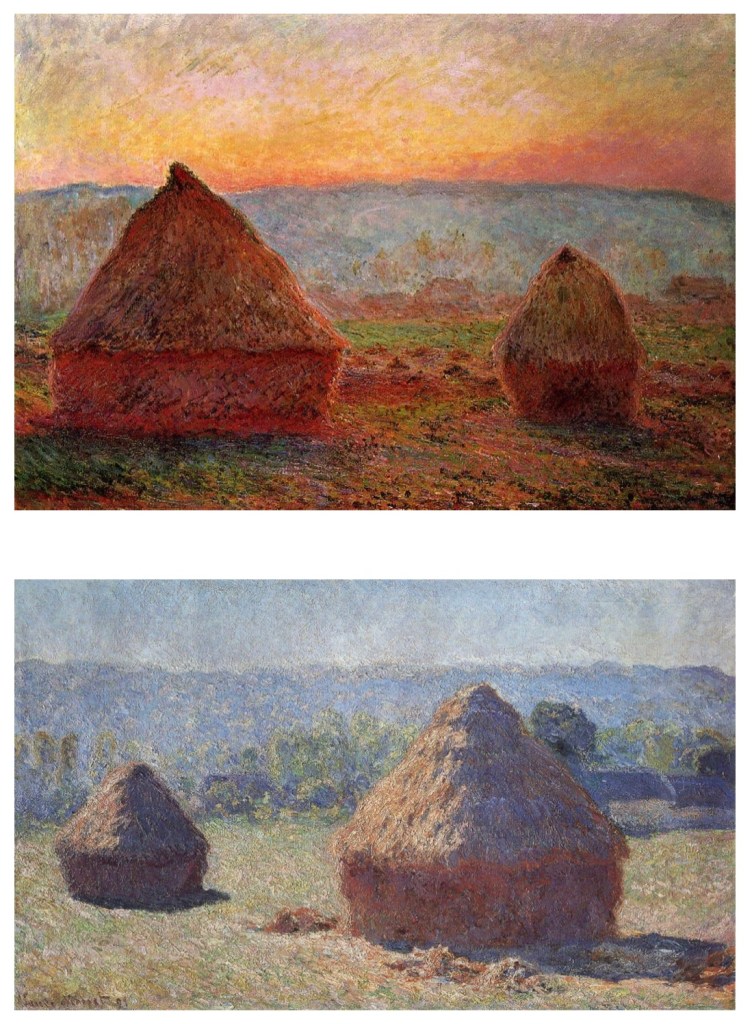
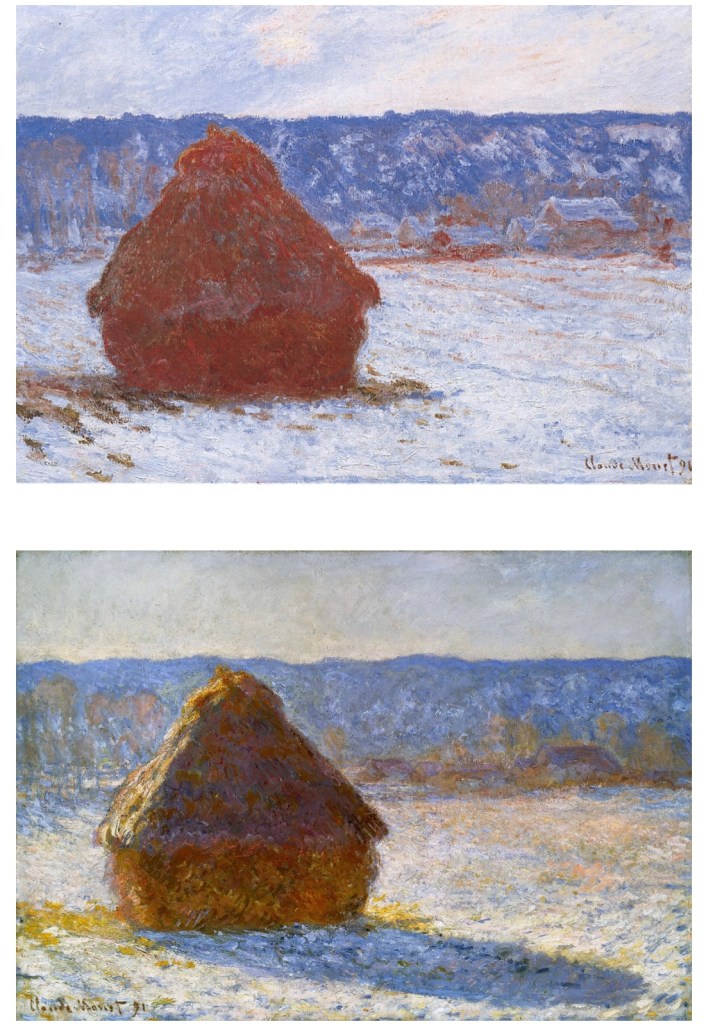
Below are 7 out of 30 paintings of his famous Haystacks which he had been painting in different time of the year for within 18 months period.
“Haystacks”, 1890-1891, oil on canvas. All images are via http://www.claude-monet.com;


Camille Pissarro (1830-1903)
There is a very good description of Pissarro`s technique which I found on http://www.home-school.com put by the user “jerryailily”: ”…Although Pissarro` S oil painting techniques looked very simple, they had a very accurate colour layers and colour control, which was resulting from his in-depth observation. When painting, his strokes were larger which could fast cover the whole painting to spread out a general tone. Then he used a small pen which was usually sable hair brush to patiently and carefully draw the thick and fine brushwork. Some of his works in his mature period were often repeatedly painted for several times. All these multiple overlapping strokes and colours staggered up and down to make very rich colours and naturally left a thick painting texture”.
In regards to his landscape technique there is his letter to one young painter and it is worth to bring here: “…. The motif should be observed more for shape and colour than for drawing. … Precise drawing is dry and hampers the impression of the whole …. it is the brushstroke of the right value and colour which should produce the drawings. … Don’t work bit by bit; but paint everything at once by placing tones everywhere, with brushstrokes of the right colour and value, while noticing what is alongside. use small brushstrokes and try to put down your perceptions immediately ….. Cover the canvas at the first go and then work until you see nothing to add. Observe the aerial perspective well, from foreground to the horizon, the reflections of sky, of foliage. Don’t be afraid of putting colour; refine the work little by little. Don’t proceed according to riels and principles, but paint what you observe and feel. Paint generously and unhesitatingly, for it is best not to loose the first impression”.
Personally, I find his advise as a best advise for a beginner in painting which I have ever read. Pissarro, obviously, had a great teaching talent.
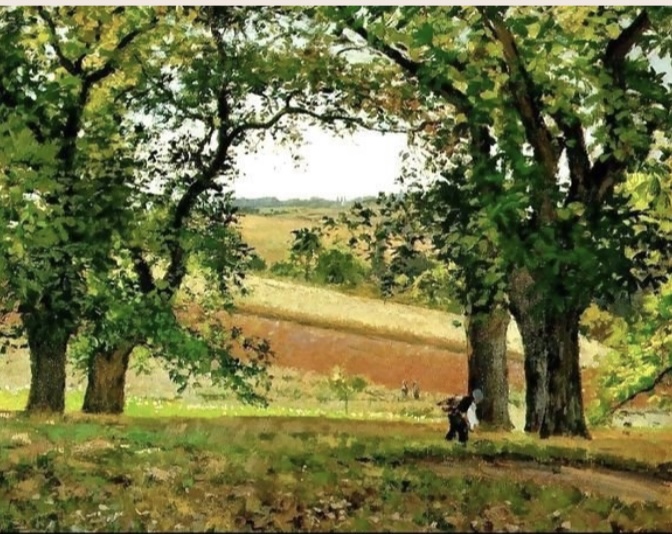
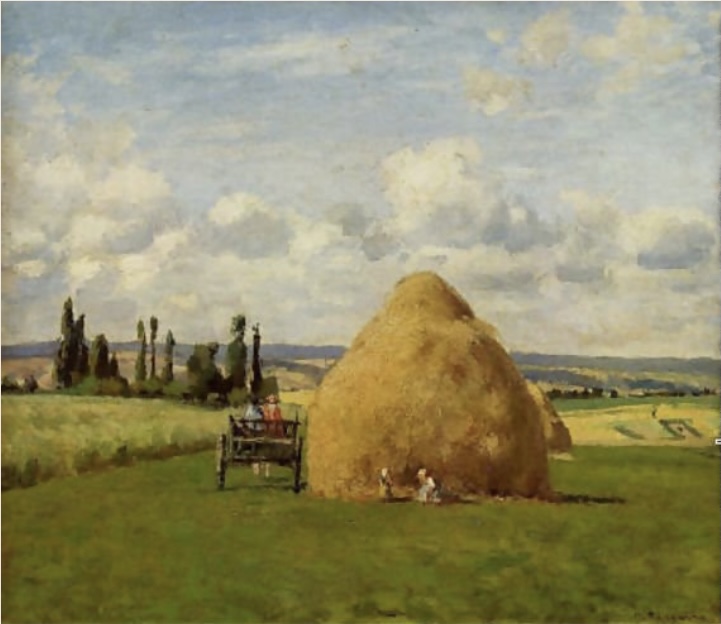
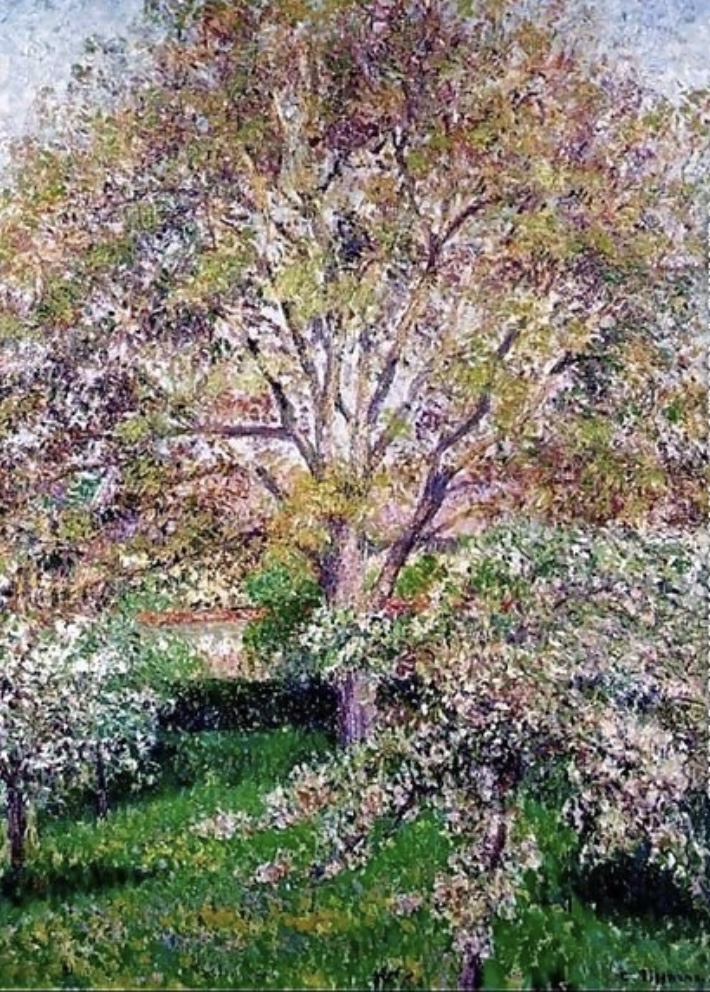
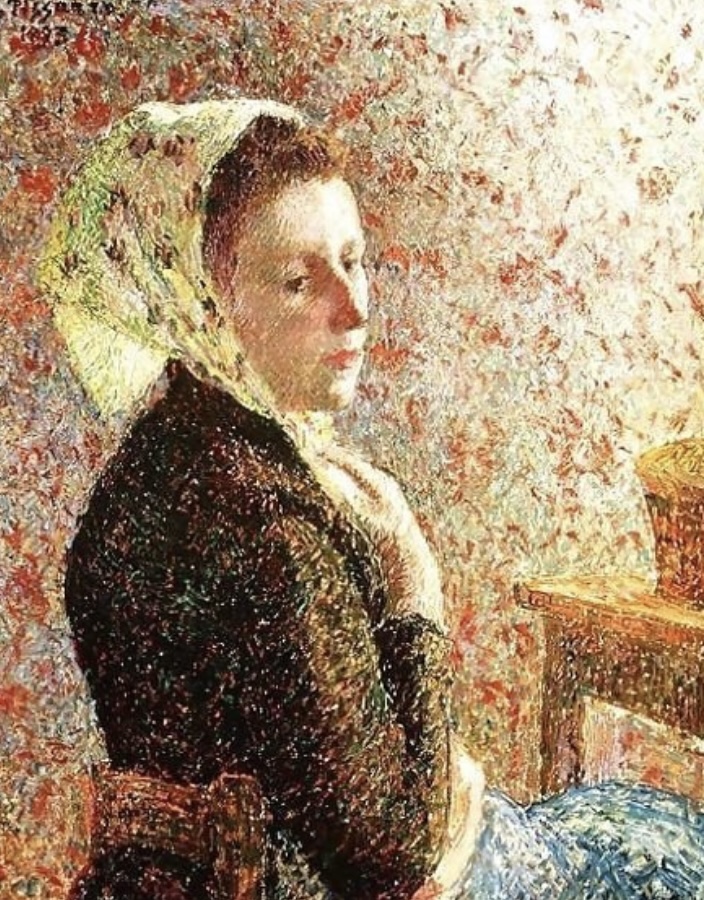
Below there are some of Pissarro` s paintings which I just adore, from left to right:
“Chestnut Trees at Osney”, 1873 ; “Haystack, Pontoise”, 1873, oil on canvas ; “Walnut and Apple Trees in Bloom, Eragny”, 1895, oil on canvas; “Woman wearing a green headscarf”, 1983, oil on canvas; (all images are via www camille -pissarro.org
Reference list:
- « 14 Acrylic Painting Techniques Used by the Masters », author not indicated, http://www.invaluable.com;
- ”Palettes and Techniques of the Impressionist Claude Monet” by Marion Boddy-Evans; updated on September 10, 2018 on http://www.liveabout.com;
- ”Claude Monet Style and Technique”, author is not indicated, an article on www. artble.com
- ”Claude Monet”, http://www.the art story.org;
- ”Camille Pissarro- A Closer Look at His Life and Art” by Dan Scott, November 30, 2019 on http://www.drawpaintacademy.com;
- ”Brief analysis of painting techniques of Pissarro and Cezanne”, discussion on http://www.home-school.com;
- ”Great Masters, Pissarro” by Patricia Seligman on http://www.my studios.com;
- ”Technical examination of works by Camille and Lucien Pissarro from the Courtauld Gallery” by Lydia Gutierrez and Aviva Burnstock in ArtMatters, International Journal for Technical Art History, on http://www.courtauld.pure.elsevier.com;
 JeanArt