I started this Assignment from my Painting 1 course at the moment of COVID-19 first quarantine and total lockdown, when a new era of social distancing just began in our world. Thus no exhibitions to visit and write a review about were available, big enough online exhibitions have not been developed yet. After searching for a good book I picked up one titled as “Landscape Painting Now. From Pop Abstraction to New Romanticism” which is an essay written by Barry Schwabsky edited by Todd Bradway.

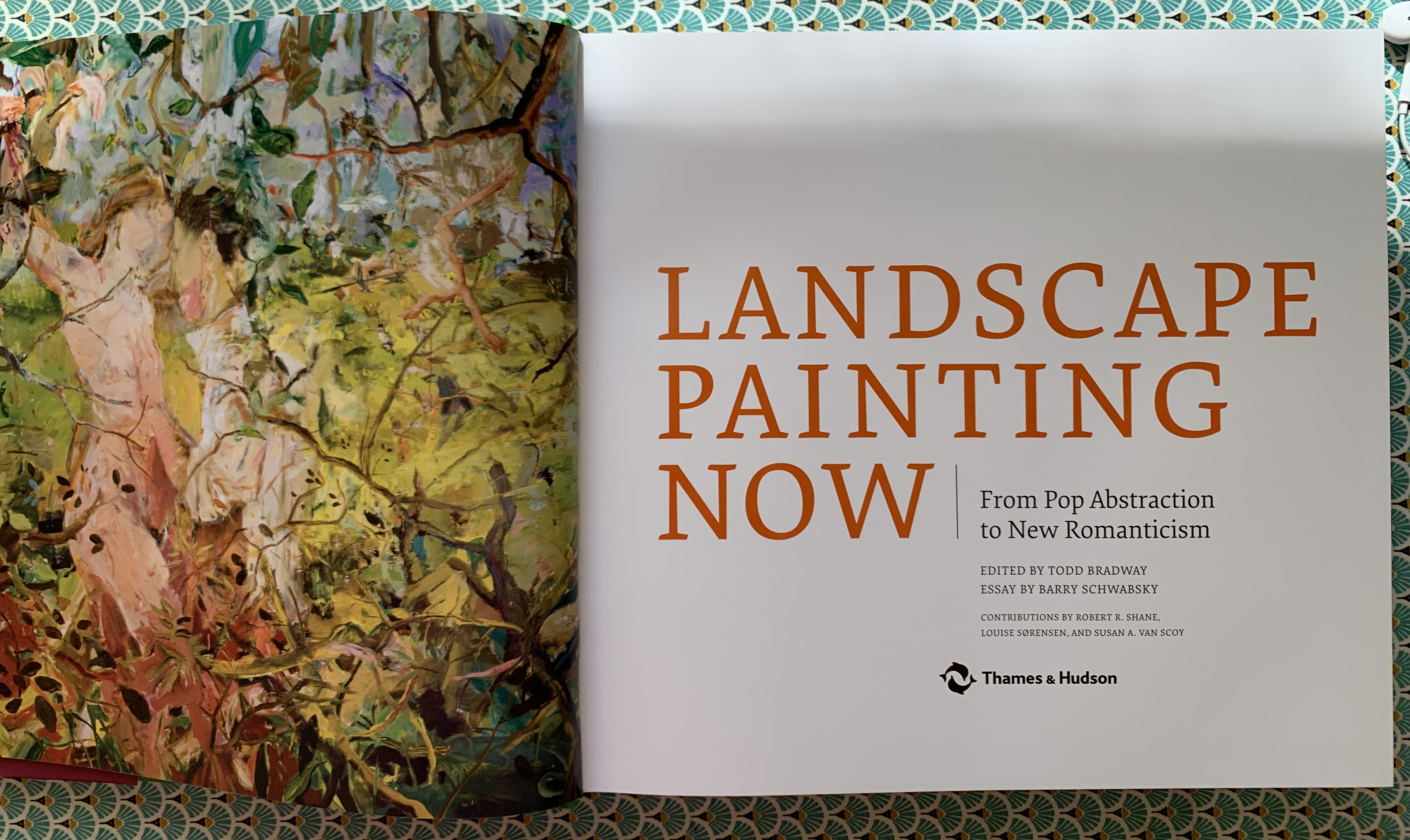
As it is said in the introduction by Todd Bradway, the “Landscape Painting Now” (368 pages) “….is a first book of its kind to take a global view of its subject, featuring more than 80 outstanding contemporary artists – both established and emerging whose ages span over seven decades and who hail from twenty five different countries”. The Book is organised through 7 thematic chapters as follows below:
- Painting with the flow of the world;
- Realism and Beyond;
- Post-Pop landscapes;
- New Romanticism;
- Constructed realities;
- Abstracted Topographies;
- Complicated Vistas;
The author of the book Barry Schwabsky aims to analyse the genre of landscape painting, its place in modern era art and, as he puts it : “ In this essay I hope to show how today’s landscape painting has been able to flourish in part thanks to the continuing interest in the theme among artists working in the 1950 through 1980s.” He observes the fact that the “…ubiquity of landscape painting has gone almost unnoticed: because we hold on to habit of mind developed during the second half of the twentieth century, when painting was dominated by abstraction… and when painting itself was sometimes sidelined by emerging genres: conceptual works, performance, installations…”.
In the first chapter « Painting the flow of the world » the author draws reader`s attention to the history of landscape painting as a genre in western and eastern parts of our world, to different paths of landscape painting in Western and Eastern art tradition due to different perception of nature and a place of human being in it. Landscape painting in European tradition for a very long time was a minor genre because « … the accent on human agency that turned land into landscape worked against the emergence of of landscape painting as an independent endeavour. Human or divine action was what counted, not the place where it occurred ». However at the same time landscape painting was fundamental to Chinese Painting tradition as well as to Japanese or Korean. As Sherman E. Lee explains (the author refers to him) this cultural difference « …The preconditions for landscape include a non-anthropocentric nature philosophy. In the Hellenistic and Roman world this was present in a philosophy for which Lucretius ` s De Rerum Natura was the prime literary expression. Christianity changed all this and landscape was this and landscape was buried ». Further the author reflects about the sources of inspiration and describes the genre as life`s vivid and unique experience of various artists.
The author insists that the « … landscape was the most abstract forum of painting before abstraction…. It shifts the accent away from the human and divine as sole agencies toward the interplay of all entities in the whole space ».
I find this statement as a good observation of why landscape painting is a complex genre which requires a very different and special perception of reality, a way to perceive yourself in certain reality in a much broader and larger view, and having a very different artistic antenna- it is very different to a perception of an object in other genres such as still life or portrait painting, but, of course, I don’t say that theses genres are simple. He further describes the experience of different landscape artists what comes as a link to his above mentioned observation. The author unfolds different artistic approaches to landscape as a subject beginning from: as the first abstract paintings continuing with other forms based on and revealing new, different and unique artistic experiences such as:
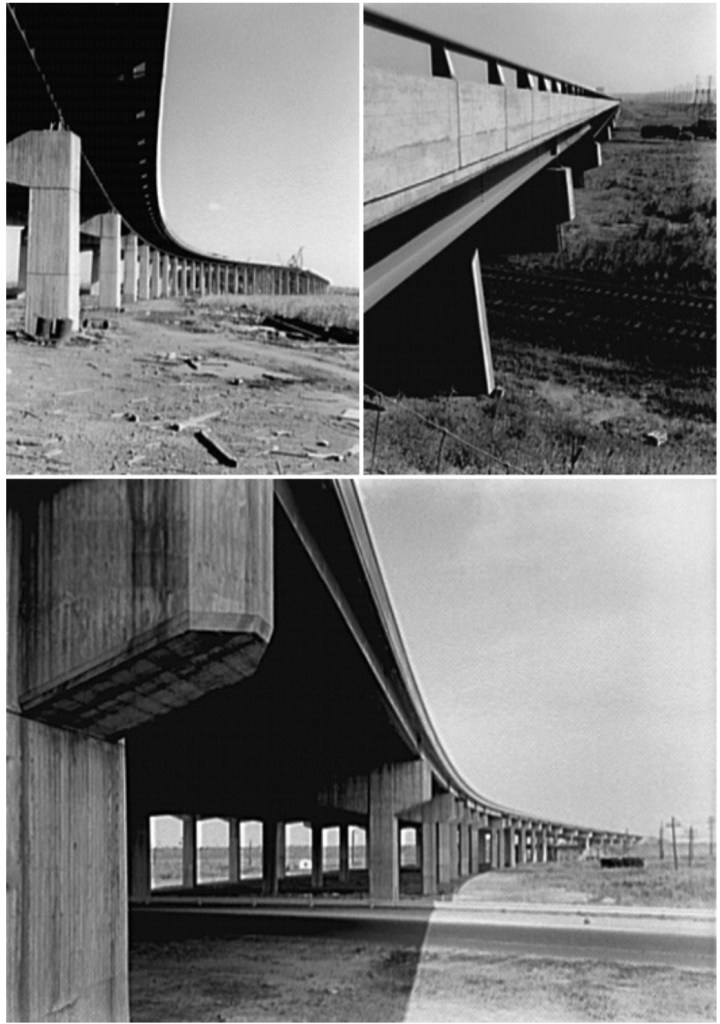
- « The experience of the road ». As Tony Smith’s well known impression he shared in 1966 in his Artforum interview : «At first I didn’t know what it was, but it’s effect was to liberate me from many of the views I had had about art. It seemed that it had been a reality which had not had any expression in art ». I have done some additional research about this artistic experience of Tony Smith who was a famous American artist and sculptor: I found the photos of that “illicit drive” mentioned by the author of the book. There is a good article about that particular experience on http://www.placejournal.org – Places. « The Highway not taken: Tony Smith and the Suburban Sublime ».
Below are the photos of the drive, New Jersey Turnpike, 1952, The Meadows, Erie Railroad Bridge and the Newark Airport viaduct; (image via placejournal.org)
- « Unframed space » as it was brought by Barnett Newman, who, as the author explains « …The experience of space conveyed by Newman ` s paintings was not supposed to be something depicted within it, but rather something delimited by the painting from the viewer, who should feel rather that see it »; It is worth to bring as well artist`s words about his paintings « … Anyone standing in front of my partings must feel the vertical. Domelike vaults encompass him to awaken an awareness of being alive in the sensation of complete space ». I checked on Barnett Newman artworks and read about the minimalism to which his artworks belong to. He is well known for his Colour Field paintings which focus on form and colour with lines and streaks. It was hard for me to distinguish in his artworks what would be a landscape neither I was able to experience the feelings he described above, what was very common as the author mentioned further. This simple fact just proves again that the artistic sensibility is very different among people and artists and a landscape as a genre is very complex because it is not just pictorial, it is very emotional and reflective.
Chapter 2: REALISM AND BEYOND
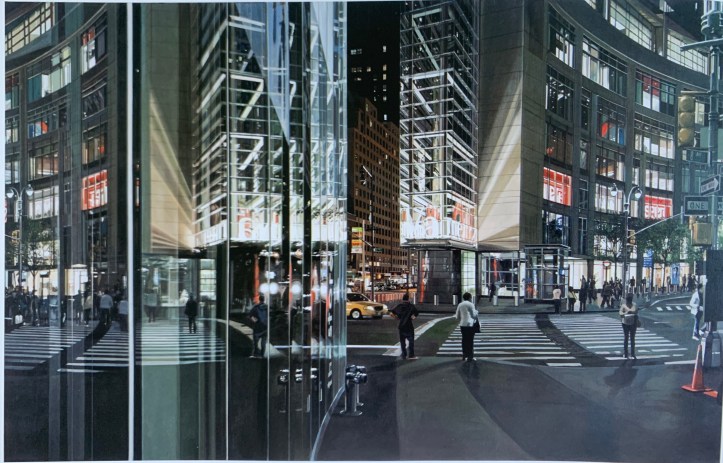
In this particular chapter the author brings 17 artists whose artworks can be considered as of realism genre, examining a main challenge of realism as a genre what is always in general can be described as a problem of any attempt to “transcribe any given portion of an unbounded three-dimensional plane on a canvas ….that can never really be resolved but only negotiated”. Any “realistic” painting/image is always a dialogue between what is “real”, how understand this term and how things appear and what they along with very subjective and individual artistic perception of this particular reality. Another factor what complicates the genre and every single artistic outcome is that any painting/picture/image is always a capture of one single moment in constantly changing environment – nothing is static, especially because an artwork is done “through a succession of marks done in the course of hours, days, weeks, perhaps even years”.
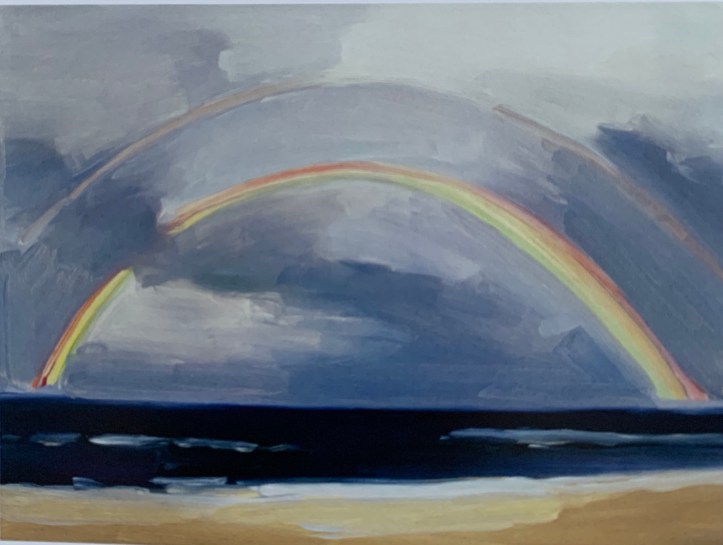
Below I put my selection of artworks from this chapter to illustrate how stretchy and versatile the realism as a genre can be: from left to right “Eminence Break” by Damian Loeb 2012; oil on linen; “Columbus Circle at Night” by Richard Estes, 2010, oil on canvas; “Mountain, New Moon” by John Beerman, 2014, oil on linen; “Summer rainbow, Cape Cod ” by Maureen Gallace, 2006, oil on panel;
All images are from the book “Lanscape Painting Now” by Barry Schwabsky


Chapter 3. POST POP LANDSCAPES
This is one of the most interesting chapter of the book because it unfolds a very special, I would say not traditional approach in landscape painting and requires additional research to understand author`s ideas about Post Pop movement. It is important to mention what he says about “post pop”artworks in general: “Post Pop does not necessarily mean “chronologically after Pop”; one might even say that the most important part of the phrase is the “post-“, designating an image that emerges after an image that already exists. May be there’s really never been such thing as Pop Art, only Post-Pop”. It is obvious that to understand this statement some art history background and knowledge is required because the author of the book doesn’t provide a clear and systematic explanations for the terms such as Pop and Post Pop, except linking the term “pop” to mass culture. He also sees some contradiction and “inimical” relationship ” between the core of landscape painting as a genre and the Pop because landscape is always something related to nature what we perceive differently, as I understand – in a very individual and unique way comparing to the things which are “mass produced and mass consumed”. Personally, I don’t find that conflict because with globalisation taken place from the moment we started to travel as tourists all over the world we do recognise many cities` images as what’s are called “iconic” and this is nothing but mass perception and mass adoration of certain places which truly became as subjects of mass consumption: everyone wants to see La Tour D` Eiffel or Statue of Liberty, or NYC Manhattan Skyline, or Venice, or Sunset Boulevard in LA, Big Ben in London and etc. I think the author missed a whole piece in modern landscape painting- all these paintings, including those which are sold daily for 8-15 dollars in Central Park in NYC or Montmartre in Paris and other places – the famous and “dreamed about to visit” images of cities. Thus to my view landscape painting has got its own numerous subjects of mass culture.
The author denies the chronological approach to this type of landscape paintings because there are artworks which have been created at the same time when the Pop Art movement began in the middle of 20th century. The author refers to Alex Katz and Wayne Thiebaud whose paintings have certain elements which are shared by Pop Art such as: “distinctly unnatural sense of colour”, distortions of the space, new innovative techniques like collages .
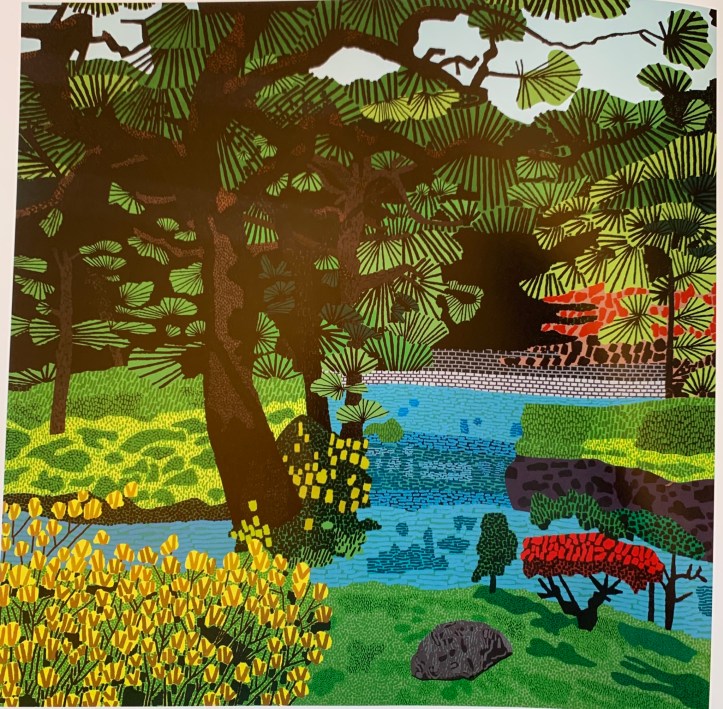
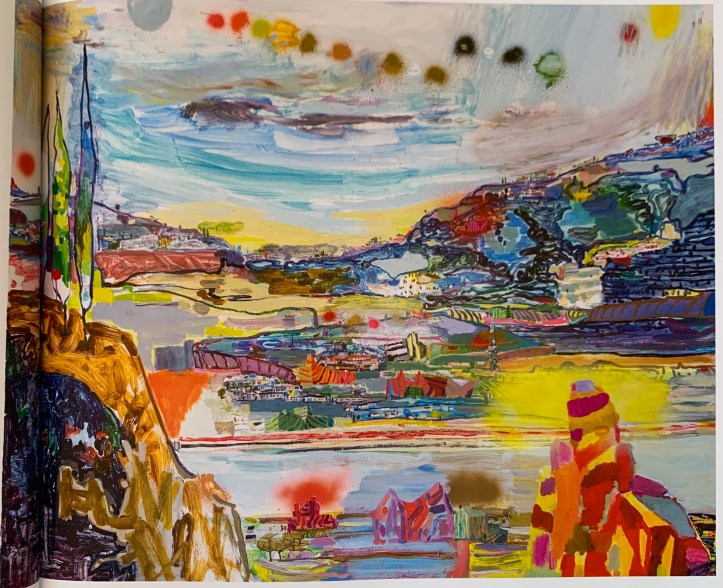
Below are some artworks I have selected from the book to illustrate the genre of Post Pop landscape painting. All images are from the book “Landscape Painting Now” by Barry Schwabsky.
From left to right : “Japanese Garden” by Jonas Wood, 2017, oil and acrylic on canvas; “Garden” by David Hockney, 2015, acrylic on canvas; “Fumigation Tents” by Lisa Sanditz, 2016, acrylic and spray paint on canvas; “Untitled” by Jonas Wood, 2008, oil on canvas;


Chapter 4. NEW ROMANTICISM
This is a very rich and large chapter in terms of the number of artworks the author brings to the pages of his essay. He features 17 different artist and all the paintings are very atmospheric and complex, each of them takes a good amount of any viewer` s time to explore, gaze and think. The paintings really swallow the viewer and this what makes them so distinct and special. In his book the author doesn’t go for explaining the classical core of the terms he reflects on, requiring in each chapter some research and reading if you are unprepared in this sense.
The author analyses an artistic approach of contemporary artists who continue the main ideas of Romanticism such as focusing on personal feelings and emotions, moods, impulses, transcendent and spiritual parts of our human existence. Many artists are attracted to mythic subjects from faith or folklore, exploring enigmatic aspects of things and mysteries.
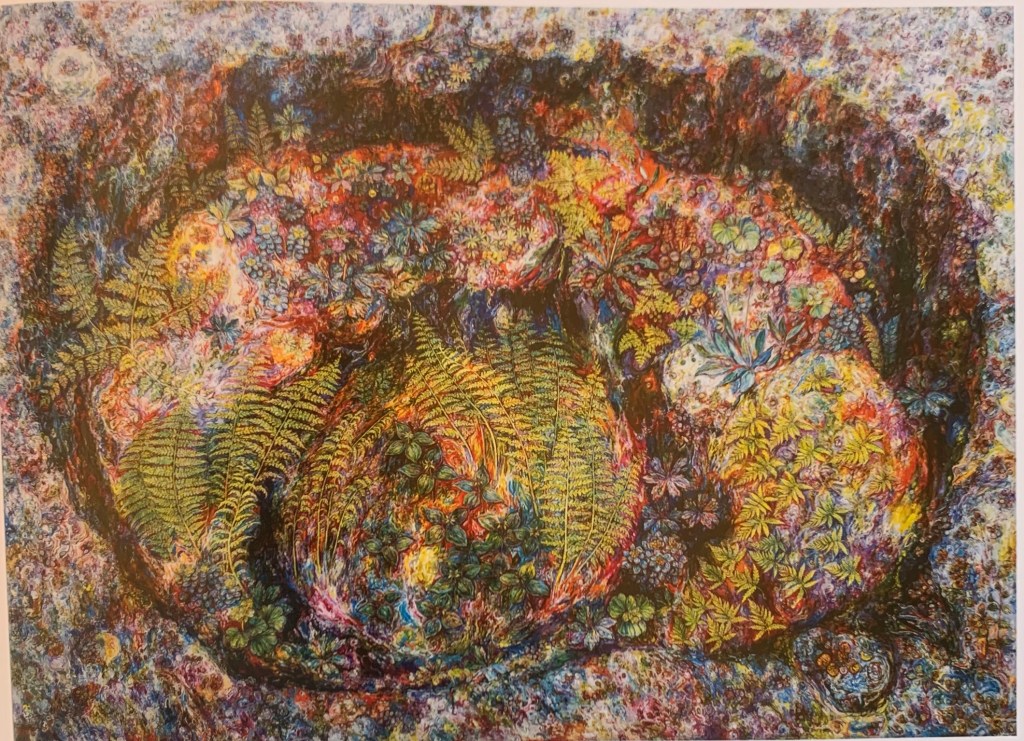
Below you can find my selection of the paintings from this chapter. All images are from the book “Landscape Painting Now” by Barry Schwabsky. From left to right:
“Looters” by Mamma Anderson, 2010, acrylic and oil on panel; “Heimat Land” by Mamma Anderson, 2004, acrylic and oil on canvas; “Untitled” by Egbert Petturson, 2015-2017, oil on canvas; “Desde la cue a del corazon” by Tomas Sanchez, 2005, acrylic on canvas; ”Gasthof Zur Muldentalsperre” by Peter Doig, 2000-02, oil on canvas; “Theme Park” by Nigel Cooke,2008, oil on canvas; “Indian Summer” by Nigel Cooke, 2015, oil on linen backed with sailcloth;




Chapter 5. CONSTRUCTED REALITIES.
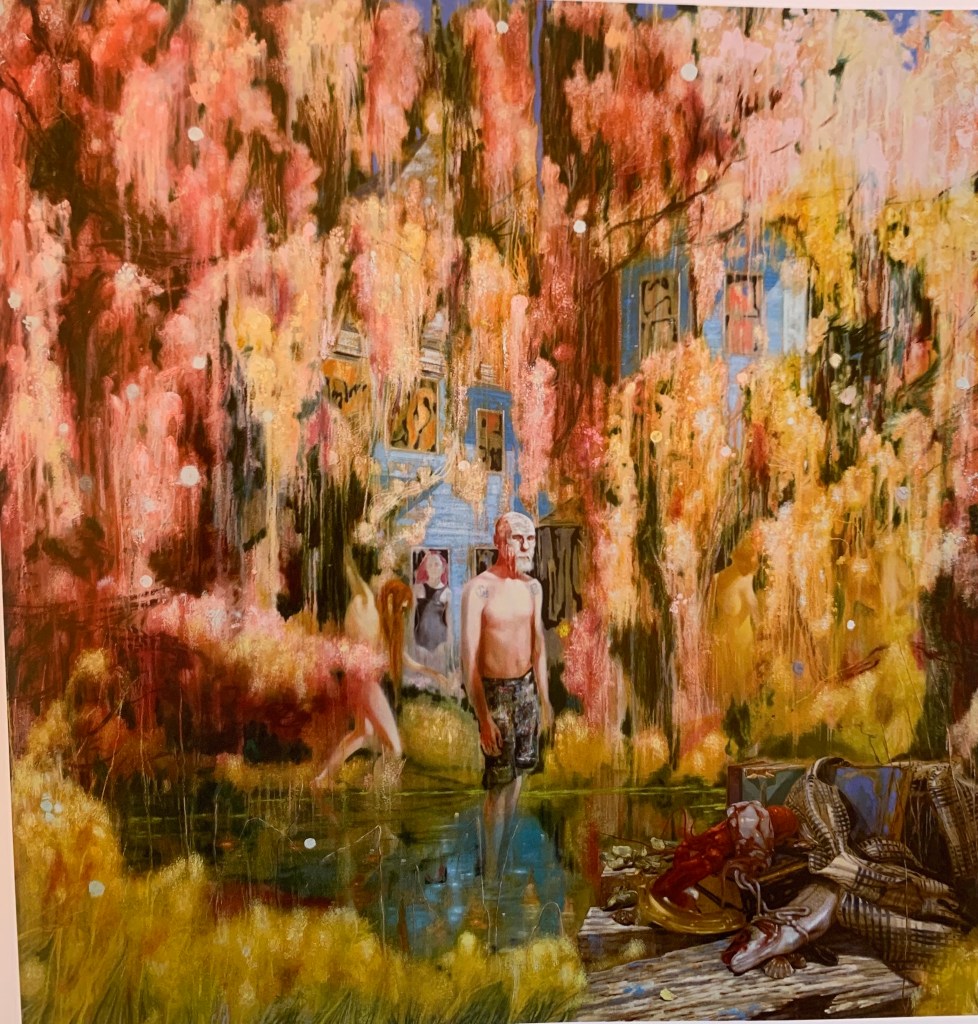
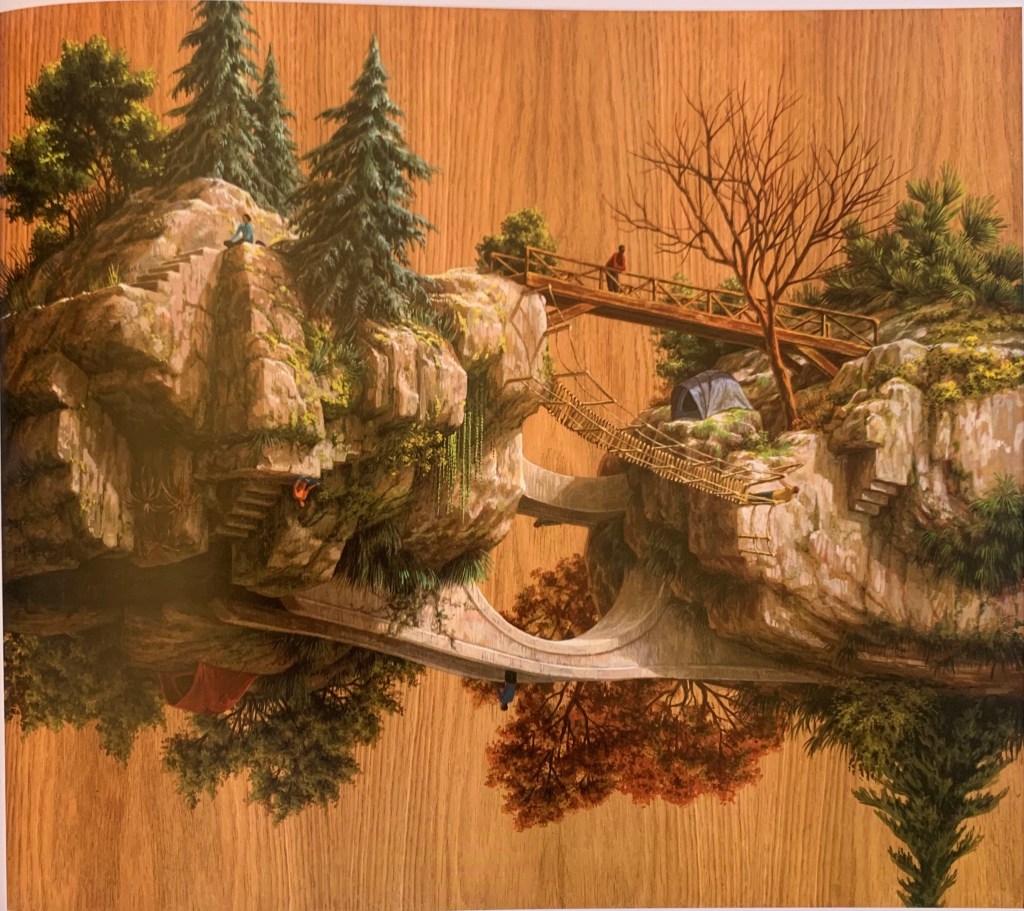
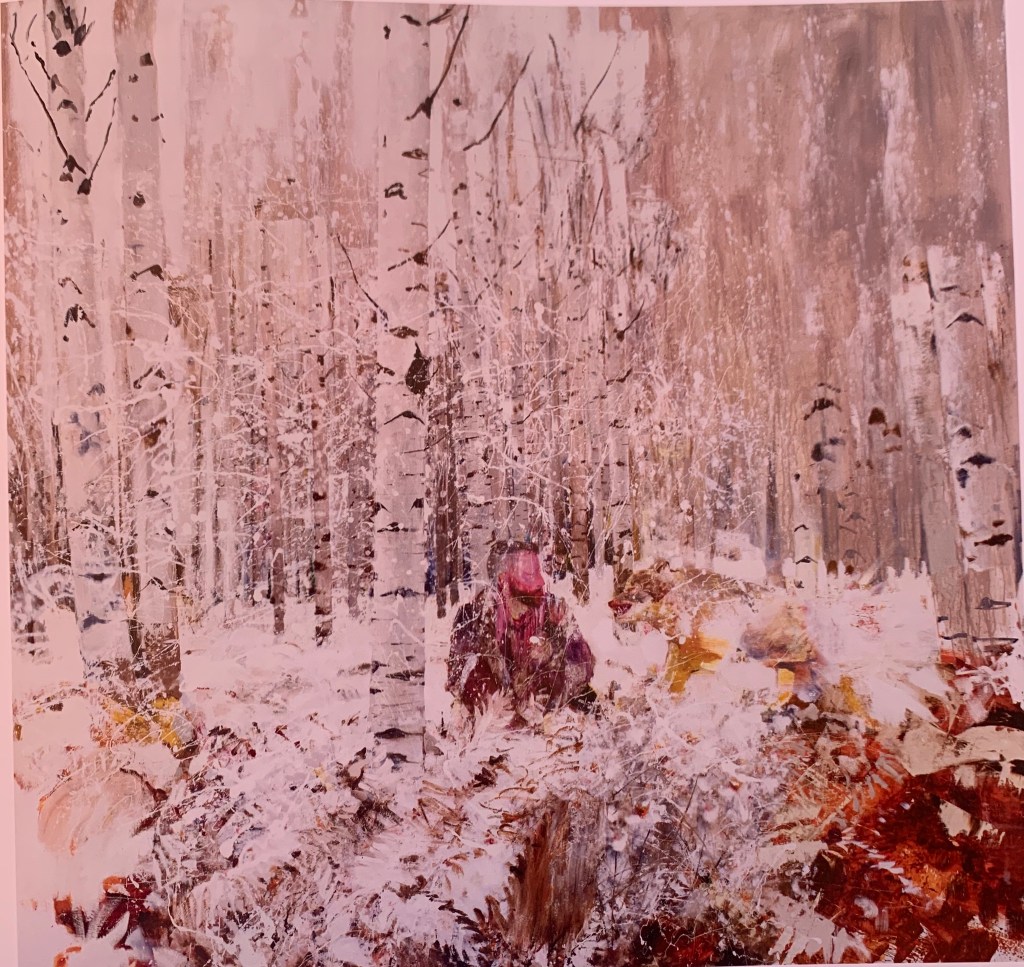
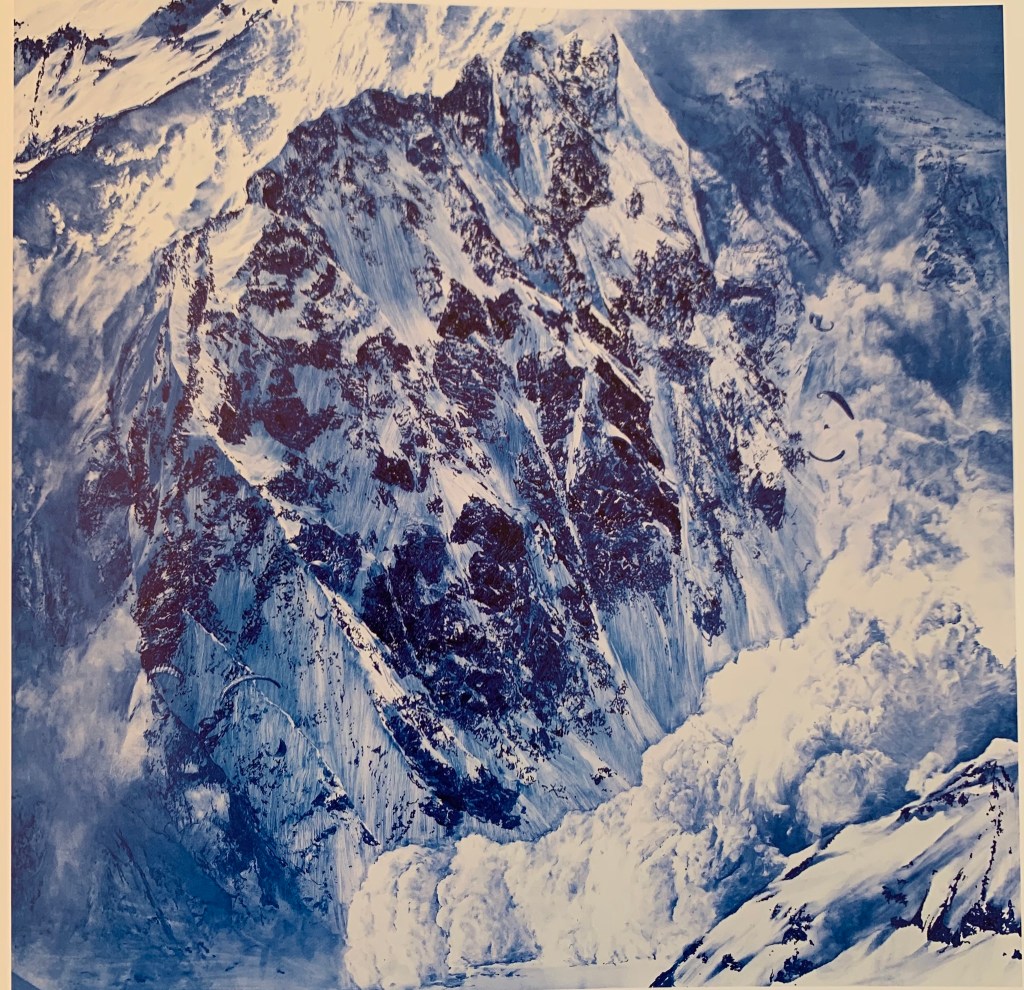
This chapter features 14 artists with a shared creative approach which the author describes as “it is not about capturing the real. It is the transition what happens between the material and the ideas”. The artists explore this interaction between the material world and their “self conscious construction of pictorial realities in contemporary paintings”. After careful reading and looking at artworks in this chapter I came to the conclusion that the classification of artworks by different movements and art directions, suggested by the author of this essay, is indeed quite conditional because many artworks travers different groups and meet different criteria of different genres simultaneously: they may contain not only the landscape but still life and human figures, the nude, the abstraction, lot of intense emotions, mood and atmosphere. Many works in this chapter can be classified as pop art or New Romanticism, or realism, or abstract painting.
Below I put my selection of the paintings from this chapter. All images are from the book “Landscape Painting Now” by Barry Schwabsky. From left to right in each row:
“Forest” by Will Cotton, 2003, oil on linen; “Pastoral” by Will Cotton, 2009, oil on linen; “Bridges” by Cinta Vidal, 2016, acrylic on wood; “The Fire Wave” by Alison Elizabeth Taylor, 2018, marquetry hybrid; “Night” by Alex Kanevsky, 2013, oil on wood; “Persian Miniature” by Adrian Ghenie, 2013, oil on canvas; “Crossing the Sea of Reeds” by Adrian Ghenie, 2016, oil on canvas; “Starry Night” by Adrian Ghenie, 2013, oil in canvas; “Hedge”by Mark Tansey, 2011, oil on canvas;






Chapter 6. ABSTRACTED TOPOGRAPHIES
In this chapter we can look at artworks and read about 12 artists. The author examines the abstract approach in landscape painting, emphasising “…. The entire field of painting was reconfigured by the arrival of abstraction ….. the still life became object, figure became presence, and landscape became space”. He explains that abstract approach in landscape painting takes the viewer to see new spatial or dimension possibilities of the reality. He says: “The artist`s work here appears to be about elaboration more than refinement or reduction….”. When Barry brings the word “elaboration” he wants the reader to understand that these artists offer their version of encoding the original content, what can be a surrounding, picked up fragment of reality in a different but related way.
Below I put my selection of the paintings from this chapter. All images are from the book “Landscape Painting Now” by Barry Schwabsky. From left to right in each row:
“HOWLeon” by Julie Mehretu, 2017, ink and acrylic on canvas; “Teenage Wildife” by Cécily Brown, 2003-04, oil on linen; “Coincidental Mapping” by Andreas Eriksson, 2013, oil on canvas; “The First Morning (Twin Eruption)” by Barnaby Furnas, 2015, Acrylic, dispersed pigment, pencil, coloured pencil on prepared linen; “Slanted” by Barnaby Furnas,2011, Dye, water-dispersed pigment and acrylic on linen;


Chapter 7. COMPLICATED VISTAS
In this chapter the author introduces 12 artists who create their artworks as a “…view (literal or metaphorical) out to far prospect, …..into the distance” where it “…. Takes a gaze or the imagination paddy a succession of planes or objects”– called as “complicated vistas”. As I understood, this art movement suggests the idea that the reality we face or immersed and placed in as human beings is very complex, and the artists aim to show it at full possible for them extend without reducing or distilling any particular fragment of their perception of it. The authors says: “What makes vistas complicated can be something internal-the complicated attitude with which one sees it”. It was interesting to discover why this chapter has been put as a last chapter in the whole structure of the book. As it’s editor Todd Bradway explains it: complicated vistas “where all other sections add up – that the other thematic sections had clear roots in the nineteenth and twentieth centuries, whereas the idea of the complication is timeless and universal”.
Below find my selection of the paintings from this chapter. All images are from the book “Landscape Painting Now” by Barry Schwabsky. From left to right in each row:
“Forces of change” by Alexis Rockman, 2017, oil and acrylic on wood; “Pioneers” by Alexis Rockman, 2015, oil and alkyd on wood panel; “Hole” by Noa Charuvi, 2011, oil on canvas; “Untitled” by Francis Alys, 2011-12, oil on canvas on wood; “Blue amorous as a cloud” by Jordan Nassar,2016, hand embroidered cotton;


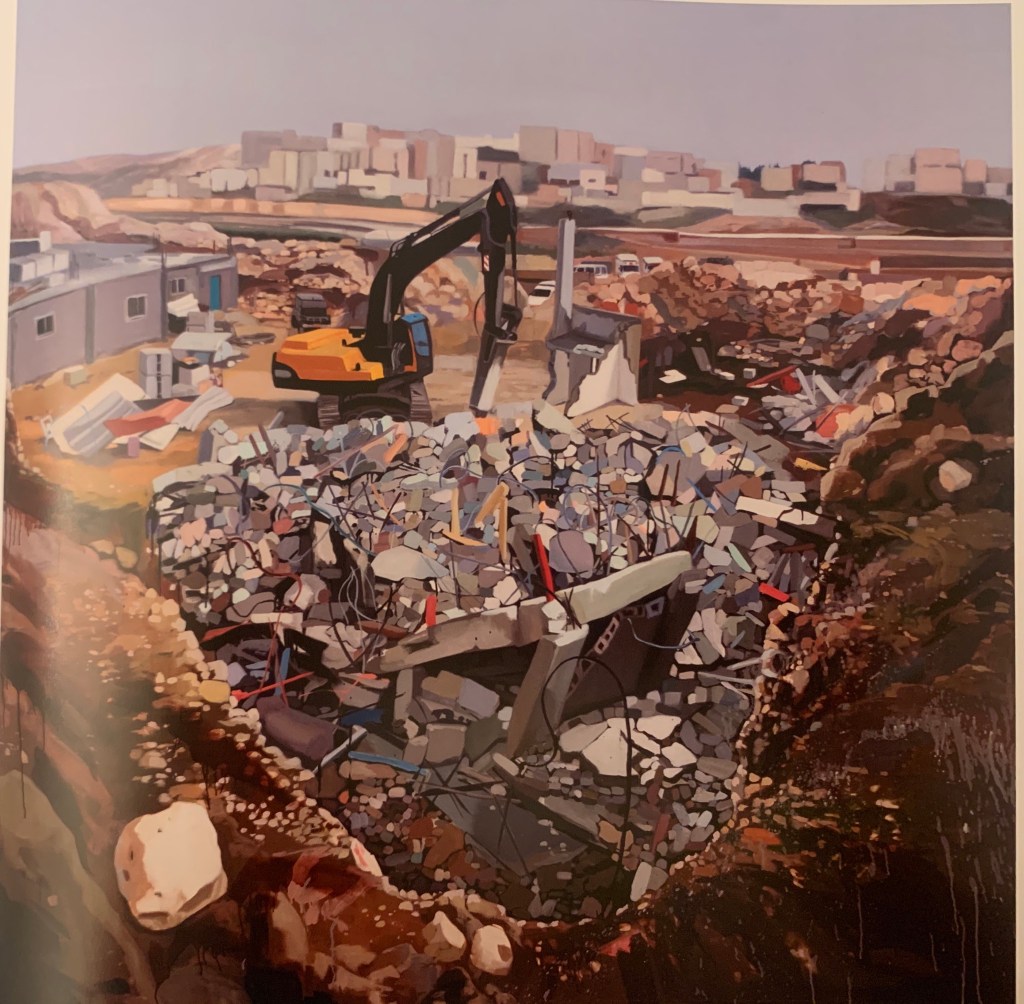
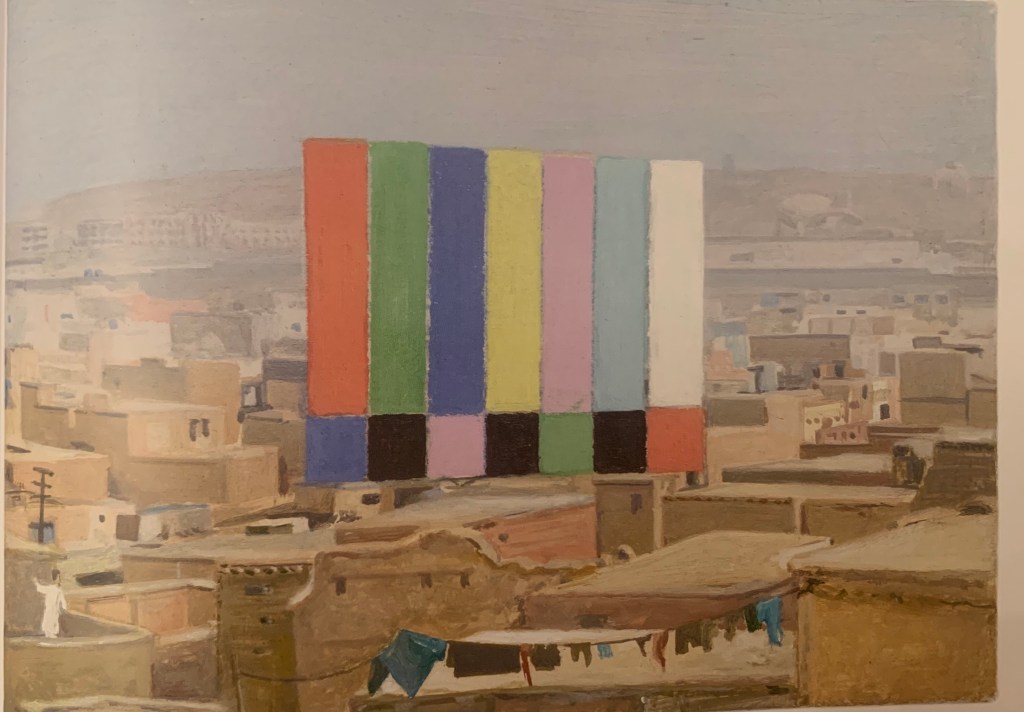

My conclusive thoughts about the book:
The book as an analysis of landscape painting genre in modern era has the following undeniable features which help to understand the genre and its evolution:
- The book is very rich and generous in terms of the number and diversity of contemporary artworks related to landscape painting. All the works have been created after 2000, though the artists age is almost 100 years of life span, beginning from Wayne Thiebaud (born in 1920), Jayne Freilicher (born in 1924, died), Alex Katz (born in 1927) till Jordan Nassau (born 1985) and Cinta Vidal (born1982). This illustrates author` s very inclusive approach in selecting the artworks including the geographic origins of the selected artists. Thus the book does indeed give a good global view on what’s going on in contemporary landscape painting. It should be said the chapter structure of the book and the primary selection of the book have been made by the book`s editor – Todd Bradway according to his interview about this project on http://www.artbook.com; The process of selection the artworks for the book was, as he puts it “ as analytical as visual” with “excellent suggestions” which came from Barry.
- The book gives a very extensive description of various artists` techniques and their artistic philosophy what helps anyone to build up a good foundation for understanding the landscape painting as one of the mainstreams in contemporary art. As its editor Todd Bradway says: “… I had also noticed, primarily via gallery visits and social media that a younger generation of painters was working extensively with landscape imagery in a multitude of ways”.
- This book is one of the first attempts to explore the contemporary landscape painting and every reader should know that it has been a bestseller at www.artbook.com which is a large resource for books on art which features thousands of new titles by independent art publishers.
- The author assumes a reader has some knowledge in art history and art theory and is prepared to understand his ideas, having an appropriate level of knowledge in painting genres and art movements. Thus if you have some gaps in these terms this book will make you to go back and do the homework, elevating your overall level in art education;
Reference list:
- « The Highway Not Taken: Tony Smith and the Suburban Sublime »; http://www.placejournal.org; Places.
- « Famous Minimalist Art that Defined the Genre » by Grace Ignacio See, June 06, 2019, www.theartling.com;
- Barnett Newman, www.artnet.com;
- “Pop in a Post Pop Art World” by Conner Williams, January 1, 2014 on www.news.artnet.com;
- “What is Pop Art? Techniques, Artists, and Examples that Shaped the Movement”, 09.17.2018 on www.invaluable.com
- “Romanticism” article on www.theartstory.org;
- “Romanticism: An Art Movement That Emphasised Emotion and Turned to the Sublime” by Kelly Richman-Abdou on July 28, 2019 on www.mymodernmet.com;
- “Neo-Romanticism: Music and Art” by Benjamin Truitt on www.study.com;
- “An Introduction to Neo-Romanticism”; author unknown, on www.thelightbox.org.uk;
- “Why Landscape Painting Is Thriving in the 21st Century” a review by art critic Peter Malone on “Landscape Painting Now” by Barry Schwabsky, March 21, 2019 on www.hyperallergic.com;
- Interview with “Landscape Painting Now” Editor, Todd Bradway on www.artbook.com;
 JeanArt