
Today I post the research I did this month about an artist – Erin Hanson (Erinhanson.com). She is a modern impressionist landscape artist, very well recognised in the world. As it is stated in her profile at Saatchi gallery’s website:
“She creates vibrant and inspiring landscapes in her signature blend of classic Impressionism and expressionism, which is becoming well known as “Open Impressionism”.
I find her works as very relevant to our 3d Assignment, since we have been busy studying trees, skies and clouds to come up with a decent landscape artwork.
She is obviously a great master of light and nature’s subtle move which are present at every single piece of her work, creating a particular uplifting mood. I have found her interview at Parka Blogs, where she revealed some of her technique. She follows as she says a “minimalist method of placing impasto paint strokes without layering”. I had to read about what “impasto technique” means.
I do like Erin’s advice she gives to beginners, for those who are thinking to become a full time professionals:
1) she recommends to draw a lot and to experiment. She has been drawing since very young age and experimented a lot with different techniques and mediums.
2) She recommends for any artist “to find a niche and stay true to it”, which is related to her “listen to feedback, but listen to what your heart tells you”.
I found these advises as very relevant to me because I sometimes struggle to find enough time for drawing. Intuitively I started to experiment with different mediums such as ink, pencils, watercolour pencils, oil pastel and dry pastel and oils. I must experiment further with different techniques. I also completely agree with her idea about your own niche. It is so true to me that every artist has got her/his particular style, even when they are drawing same things, even when you copy a master – you will end up with a different result, evolving your unique style.
In order to examine her painting technique, I have found and read a great article “25 Oil Painting Techniques You Should to Learn” OCTOBER 29, 2013 BY KIMBERLY PENDERGRASS
I try to examine her style=technique, analysing how much she applies common oil painting techniques:
1) Blocking color. I think Erin definitely uses this technique, because all her works contain many objects, at least three or four – a sky, trees, mountains and land. All objects are very well indicated and take their own space in terms of colours, which often are very contrasting. All objects are placed on the painting, edged or outlined with its prevailing colour.
2) Using layers. Even though Erin says she doesn’t use lot of layers – it is obvious that there are still many, but of course, comparing to other artists – she keep her minimalist style.
3) Intensify colours. Erin uses this method to a great extend. I can see many and different intensity shades and layers, which bring the intensity, more contrast and density of objects.
4) Contrasting colours. Erin’s works are full of contrasts and I am sure using contrasting colours is one of her favourite techniques.
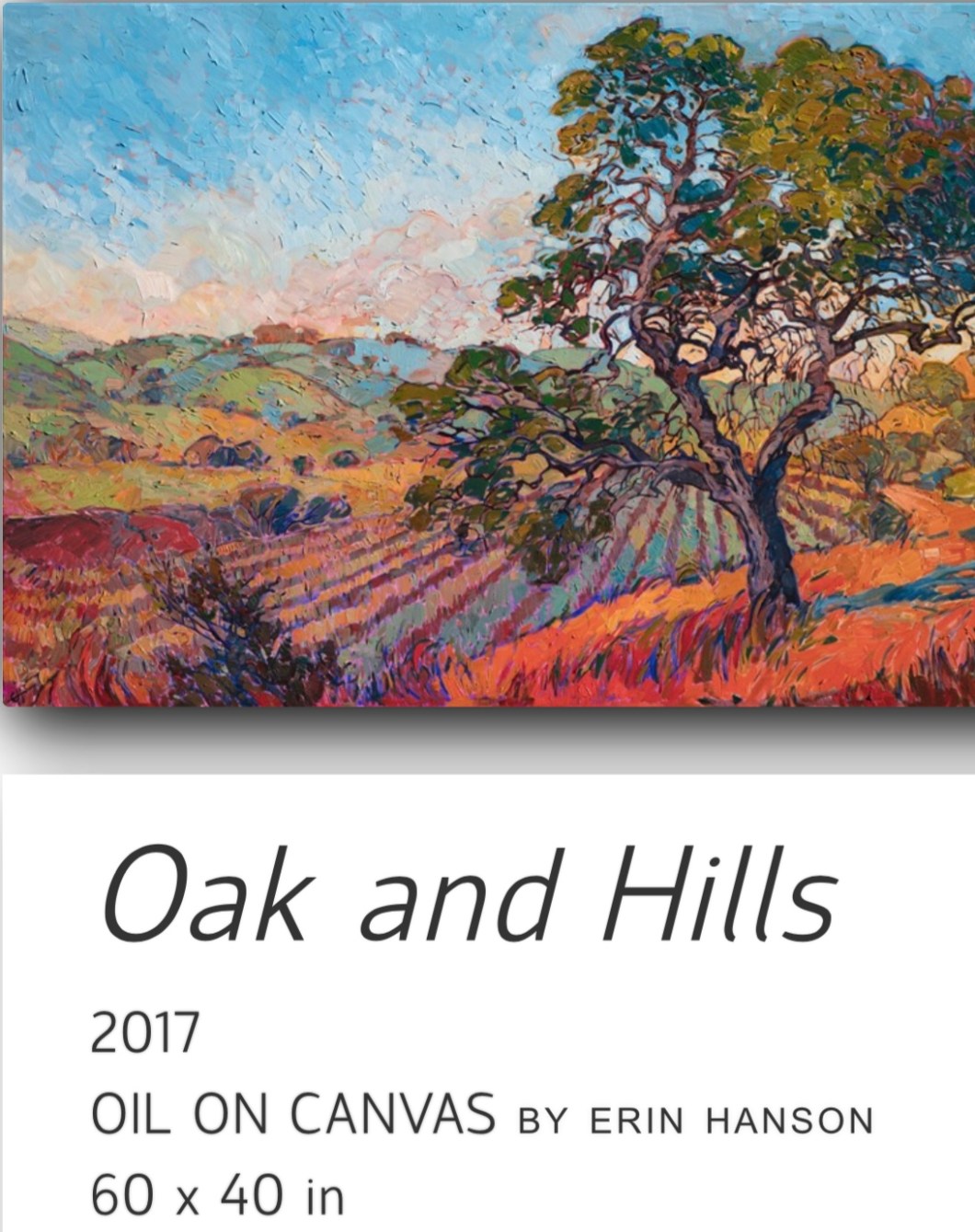
5) Brush strokes. Erin values this technique – her works are full of brushstrokes, which create a beautiful dynamic and brings nature’s powers to a viewer. She is very versatile with her brush strokes: they can be quite irregular, creating soft feeling, they are also very, as they are called “nonrepresentational” – when the brushstrokes go outside of the lines of the object, creating both color and drwaing at the same time. This is very well democtrated when she creates masses of leaves or grass on her paintings.
6) Complimentary colours. Erin uses lot of complimentary colors which are yellow and violet, blue and orange, red and green – when they are next to each other, they create a special contrast.
7) Lanscape shadows. Erin often uses cool colors like blues, violets, purples and grey which are known as best colors for creating lanscape shadows.
Below I post some of her paintings.
Erin Hanson, Erinhanson.com


Reference list:
1) Erinhanson.com
2) Kimberly Pendergast, “25 Oil Painting Techniques You Should to Learn” OCTOBER 29, 2013;
3) Saatchiart. com
 JeanArt