
Albrecht Dürer is a German artist, who was a leading printmaker, engraver and a painter during the Renaissance period. His work consisted mainly of altarpieces, portraits and religious works, he also left amazing landscape paintings. Instead of rewriting his achievements, biography and influence, I post here a quote, which describes his contribution into world art very well, as it is stated in the article about him on MutualArt.com: “His knowledge about composition, perspective and mathematics is what guided him to become of most significant Renaissance artists. his technique and understanding of proportions were composed in Four books on Meusrement and Four Books of Human Proportion, which contained explanations of geometry, architecture linear perspective and mathematics”. I checked on my Mutualart.com account how many artworks he left. It is indicated that it is more or less around 4,987 artworks. He didn’t manage to live a very long life comparing to our era standards – only 57 years ( 1471-1528). I can say that he was uniquly productive: simple math actions show that if he started to produce decent works at age of 18, then during 39 years of artistic life ( 57-18) he had to produce 2,87 artworks a day! What he certainly did. He was amazingly hardworking person, most of his artwork are engravings and printmakings, which are quite laborious and technological to produce, especially in the time. Also adding to this the books he managed to write.
I looked through his landscape paintings and picked up 2 of them which I post below.
However, all his landscapes share same mood – at least what I feel: they all quite tranquil and calm. I didn’t find weather, strong winds and shapes or movement. It is interesting because his engrave and printmaking works are quite dramatic, originating from religious stories he picked up and the way they look – strong lines, lots of details. I post below one of his engraving which is a good demonstration between the mood of his landscapes and engravings. Personally, I love the serenity which his landscape paintings bring.
Four Avenging Angels of Euphrates. (1498), mutualart.com

On this image above ( like on 100% of his engrave and prinworks) we can see a lot of details. For example how he did a sky – there is a lot of drama going on: clouds and wind, shades and lines. It is interesting that on most of his landscape works he didn’t bring so much details to sky when he did it for -ringworms and engraves. I see a very different mood approach of him to landscapes.
I found many of his landscapes where sky is almost “absent” – no shapes of clouds or shades of different sky colours, which doesn’t make the painting worse though. For example “Road in the Alps”, “ The walkway street food market in Nuremberg” – they are done in pen and ink with a color wash, which gives this softness to his paintings. Because of that technique he used I see how the mood is shared with what Chinese’s and Japanese landscape artworks bring.
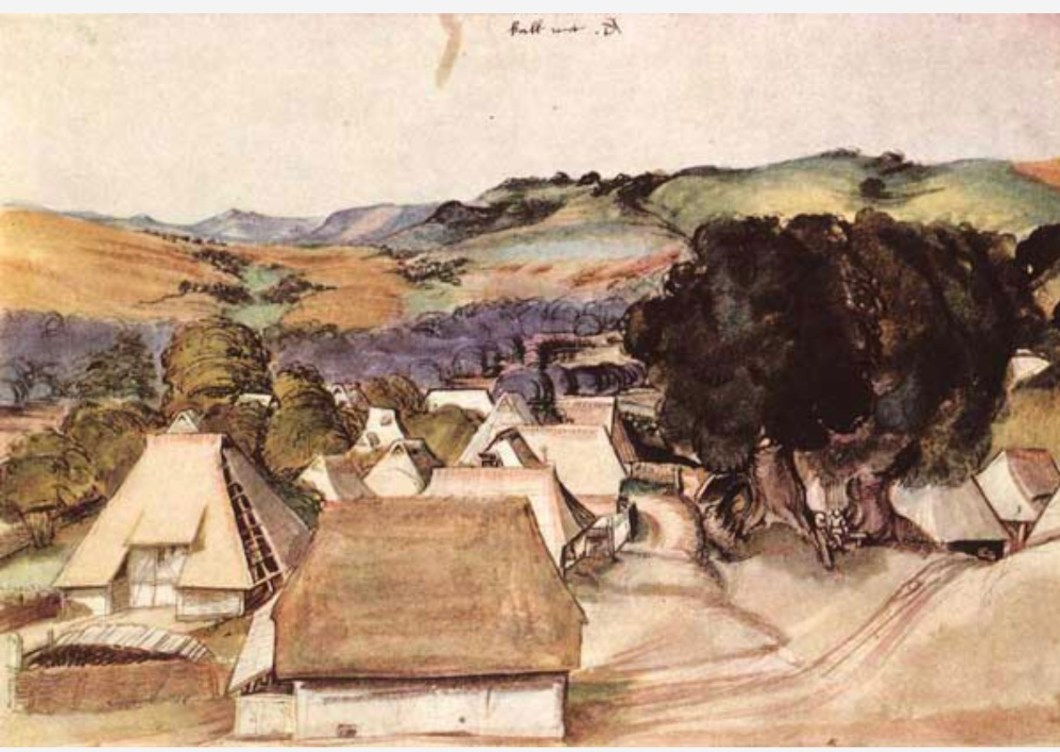
I post below his 2 works because of their good illustration of his painting technique of trees, several trees and leaves. On the “View of Kalrchreut” the Black tree is done by round strokes ( I guess) and all the trees around are also painted with some sort of round shape lines, without depicting small details like separate leaves. Objects are indicated mostly and almost only by colours and their shades. Another painting attracted my attention how he painted water. He didn’t use blue color, the water actually reflects the colours of the objects around/above it and white shades do give this “watery” feeling. That water neutrality in terms of its colours and very “passive” shapes gives that tranquil mood.
Willow Mill (1498-1496), watercolour and gouache on paper, mutualart.com

View of Kalchreut (1511), watercolour and gouache on paper, mutualart.com
Reference list:
https://www.britannica.com/contributor/Eberhard-Ruhmer/2543
https://www.mutualart.com/Artist/Albrecht-Durer/CE8BAE634C2C3838
 JeanArt